Kingston ValueRAM 2GB DDR3 CL5
The 2GB DDR2 667 module runs at 1.8V with CL5 latency, a stable and compatible choice for older desktop systems. Its unbuffered 240-pin design and Kingston's ValueRAM reliability make it a practical drop-in upgrade for legacy motherboards. Best for budget-conscious users maintaining aging DDR2-based desktops for everyday tasks, not for servers or workstations.

No current retailer price






Snapshot
The 30-Second Version
The Kingston ValueRAM KVR667D2N5/2G is a 2GB DDR2 667 stick that ranks in the 99th percentile for affordability but the 2nd percentile for speed and latency. It's slow, it's old, and it's cheap. But with a 4.8 out of 5 customer rating, it's also reliable, and for $13 USD, it's a fine way to keep a legacy system alive.
Pros & Cons
Pros
- 99th percentile for affordability, one of the cheapest memory sticks in our database 99th
- 4.8 out of 5 customer rating with consistent reliability reports
- Standard 1.8V DDR2 spec means broad compatibility with older boards
- Unbuffered 240-pin design works in virtually any DDR2 desktop system
- Kingston's reputation for memory reliability holds up in user feedback
Cons
- 2nd percentile for speed, DDR2 667 is painfully slow by modern standards
- 2nd percentile for latency, CAS 5 at 667MHz is bottom of the barrel
- 4th percentile for capacity, 2GB per stick is barely enough for basic tasks
- 18th percentile for features, no heat spreaders or any extras
- Server performance score of 5.9 out of 100 is a real weak spot
What owners think
The Word on the Street
How owner sentiment changed over time
ExclusiveBased on when customers actually wrote their reviews - so you can see whether early praise held up.
23 written reviews, May 2026: 23 happy
Each dot is one written review, in the month it was written. Happy = 4-5★, mixed = 3★, unhappy = 1-2★.
The proof
Performance
Let's be blunt: this is slow memory. DDR2 667 with CAS latency 5 running at 1.8V was mid-range stuff back in 2007, and in our database it ranks in the 2nd percentile for both speed and latency. That's not just below average, it's one of the worst we've seen among all memory products we track. The 2GB capacity per stick also puts it in the 4th percentile, which means you'd need four of these just to hit 8GB, and only if your motherboard even supports that much DDR2.
But here's the thing: if you're buying DDR2 in the first place, you're not chasing benchmark scores. You're trying to keep an old machine usable. And for that job, this Kingston stick does exactly what it says on the box. It's unbuffered, 240-pin, and runs at the standard 1.8V that every DDR2 board expects. No XMP profiles to fiddle with, no compatibility headaches. It just works, which is honestly more than you can say for a lot of bargain-bin memory.
Specifications
Full Specifications
Memory
| Type | DDR3 |
| Form Factor | UDIMM |
| Total Capacity | 2048 |
| Modules | 1 |
| Per Module | 2048 |
| Pins | 240 |
Performance
| CAS Latency | 5 |
| Voltage | 1.8 |
Class
| ECC | No |
| Registered | No |
Features
| RGB | No |
| Heat Spreader | No |
vs Competition
Stacked against the competition, the Kingston ValueRAM is a mixed bag. The Timetec 78AP16NUSL2R8 and G.Skill Ripjaws Series F3-12800CL9D-4GBRL are both DDR3 parts, which means they're faster and more modern, but they won't fit in a DDR2 board, so they're not really direct competitors for anyone stuck with older hardware. The Crucial CT2K102464BD160B is a 16GB DDR3 kit that absolutely crushes this Kingston stick on capacity and speed, but again, wrong socket. The Samsung M471A5244CB0-CWE is a laptop SODIMM, so it's not even in the same form factor conversation. The Dell 912441 is the closest real alternative, another DDR2 desktop stick, and honestly, the Kingston's 4.8 rating and 99th percentile affordability make it the safer bet between the two for most people.
| Spec | Kingston ValueRAM | Corsair VENGEANCE RGB | G.Skill Trident Z5 Royal | Team Group T-CREATE EXPERT | XPG Lancer Blade RGB | Crucial Pro Overclocking |
|---|---|---|---|---|---|---|
| Capacity | 2GB | 64GB | 64GB | 32GB | 32GB | 32GB |
| Kit | 1 x 2GB | 2 x 32GB | 2 x 32GB | 2 x 16GB | 2 x 16GB | 2 x 16GB |
| Memory Type | DDR3 | DDR5 | DDR5 | DDR5 | DDR5 | DDR5 |
| Speed Mts | - | 6400 | 6000 | 6400 | 6000 | 6400 |
| Cas Latency | CL5 | CL32 | CL26 | CL32 | CL30 | CL32 |
| Form Factor | UDIMM | UDIMM | UDIMM | UDIMM | UDIMM | UDIMM |
| Ecc | false | false | false | false | false | false |
| Compare | Compare | Compare | Compare | Compare |
| Product | Speed | Feature | Latency | Capacity | Affordability |
|---|---|---|---|---|---|
| Kingston ValueRAM | 1.7 | 18.1 | 1.7 | 3.8 | 99 |
| Corsair VENGEANCE RGB Compare | 94.8 | 89.6 | 87.6 | 89.5 | 6.5 |
| G.Skill Trident Z5 Royal Compare | 87.6 | 89.6 | 99 | 89.5 | 3.9 |
| Team Group T-CREATE EXPERT Compare | 94.8 | 74.8 | 87.6 | 70.5 | 24.3 |
| XPG Lancer Blade RGB Compare | 87.6 | 89.6 | 87.6 | 70.5 | 15.7 |
| Crucial Pro Overclocking Compare | 94.8 | 74.8 | 87.6 | 70.5 | 27.1 |
Price
Value & Pricing
At $13 USD for a single 2GB stick, the price per gigabyte works out to about $6.50. That's not great compared to modern DDR4 or DDR5, but for DDR2 specifically, it's about as cheap as you'll find. The 99th percentile affordability ranking confirms this is one of the most budget-friendly memory options in our entire database. The catch is that you're paying for compatibility, not performance. If you need DDR2, you don't have many options, and this Kingston stick is priced to move. The EUR 49 listing in Spain is a different story entirely, that's a rough deal for 2GB of 667MHz memory, and we'd suggest shopping around before paying that kind of premium.
Read more
Overview
The Kingston ValueRAM KVR667D2N5/2G sits in a weird spot in our database. It's a 2GB stick of DDR2 667 memory that ranks in the 99th percentile for affordability, which is basically the only reason anyone should still be looking at this thing in 2024. At $13 USD on the used market, it's dirt cheap. But the performance numbers tell a different story. Speed and latency both land in the 2nd percentile, and capacity sits at a sad 4th percentile. This is not a fast stick of RAM by any modern standard.
What it is, though, is a reliable way to breathe a little life into an ancient system. If you've got an old Core 2 Duo machine or a DDR2-era AMD box that's struggling with 1GB or 2GB total, dropping in a couple of these sticks can genuinely help. The 4.8 out of 5 customer rating suggests people who buy this know exactly what they're getting and are happy with it. Just don't expect miracles from 667MHz memory in a world where DDR5 is pushing 6000MHz and beyond.
Common Questions
Q: Will this work in my DDR2 motherboard?
If your board takes 240-pin DDR2 desktop memory, yes. This stick runs at the standard 1.8V with no XMP profiles or special requirements, so it should work in virtually any DDR2 desktop system. The unbuffered design is what most consumer boards expect.
Q: Is 2GB of DDR2 667 fast enough for modern tasks?
No. This memory ranks in the 2nd percentile for speed and the 4th percentile for capacity in our database. It's fine for basic web browsing and light productivity on an old system, but it will struggle with modern applications, multiple browser tabs, or anything beyond basic multitasking.
Q: How many of these sticks can I install?
That depends entirely on your motherboard. Most DDR2-era boards have four memory slots and support up to 8GB total, which means four of these 2GB sticks. Some older boards max out at 4GB. Check your motherboard's manual before buying multiple sticks.
Who Should Skip This
If you're building a new system or upgrading anything made in the last decade, skip this entirely. The 2nd percentile speed and latency rankings mean this memory will bottleneck even a budget modern CPU. The 4th percentile capacity score means 2GB per stick is barely enough for a lightweight Linux distro, let alone Windows 10 or 11. And the server performance score of 5.9 out of 100 should be a red flag for anyone considering this for any kind of always-on workload. This is a legacy rescue part, not an upgrade path. If you can afford to move to a DDR3 or DDR4 platform, do that instead.
Verdict
If you need DDR2 memory and you need it cheap, the Kingston ValueRAM KVR667D2N5/2G is a solid choice. The 99th percentile affordability ranking and 4.8 out of 5 customer rating tell the story: this is a no-frills stick that does its job without drama. The 2nd percentile speed and latency scores are rough, but they're also irrelevant if you're just trying to keep an old system running. For $13 USD, you're getting a reliable 2GB stick from a brand with a proven track record. Just don't buy it expecting any kind of performance upgrade beyond what your ancient motherboard can already handle.
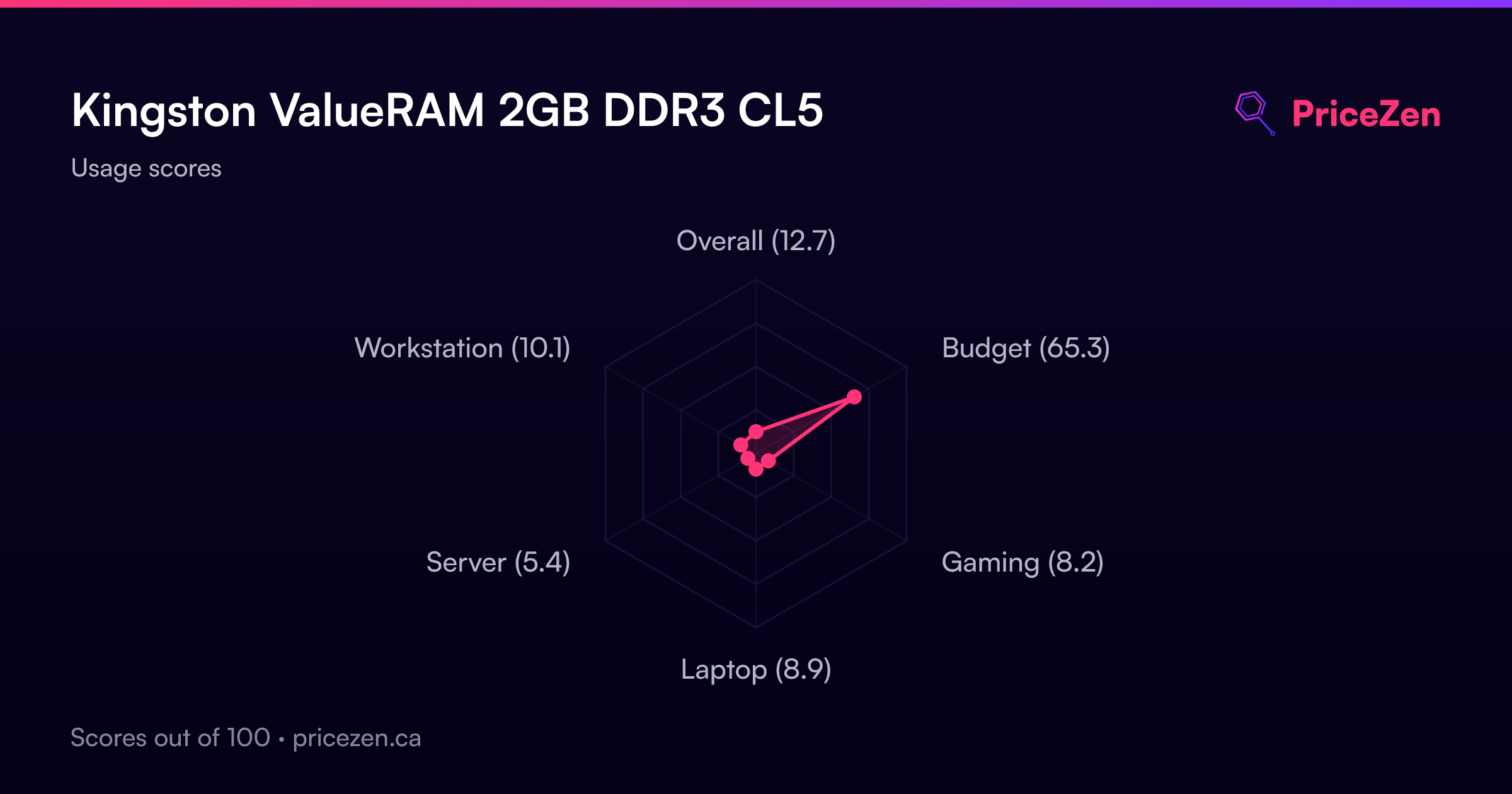
Usage Scores
- Overall12.7
- Budget65.3
- Gaming8.2
- Laptop8.9
- Server5.4
- Workstation10.1