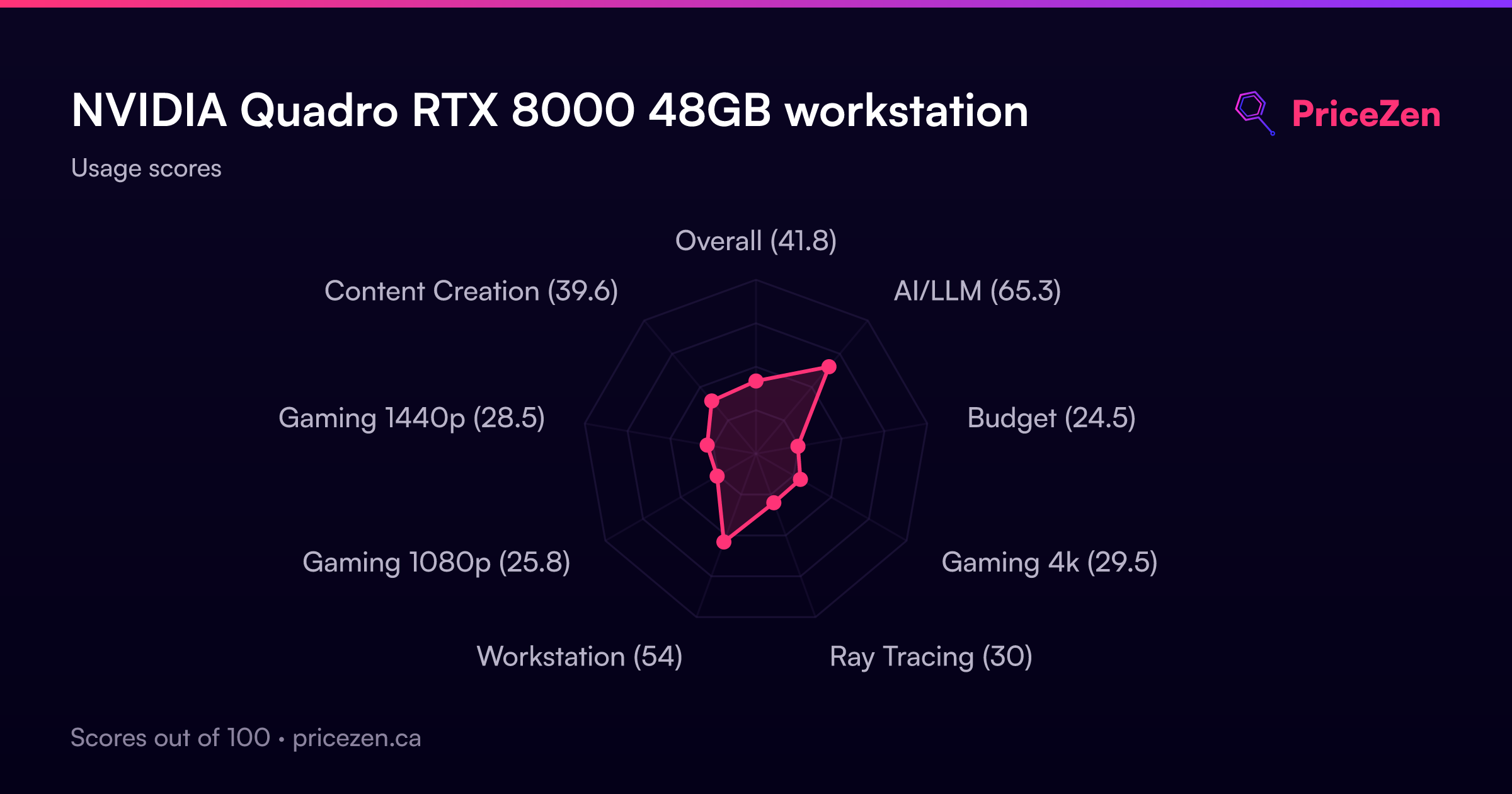
NVIDIA Quadro RTX 8000 48GB workstation
Equipped with 48GB of ECC memory and hardware-accelerated ray tracing, this Turing-based Quadro RTX 8000 handles massive datasets and complex 8K renders that would overwhelm consumer cards. Its single-slot, passively cooled design enables dense multi-GPU configurations in server racks for scalable AI training and simulation. This card is best for data scientists training large language models and VFX studios rendering final-frame photorealistic scenes.

No current retailer price
Snapshot
The 30-Second Version
The Quadro RTX 8000 is a 48GB VRAM monster that still ranks in the 99th percentile for AI workloads, making it a serious option for local LLM enthusiasts. But it's showing its age everywhere else, with thermal performance in the 7th percentile and ray tracing that lags behind modern mid-range cards. At $2,794, it's a specialist's card for AI researchers and machine learning folks who need the memory capacity. Everyone else should look at modern RTX 40 or 50 series cards instead.
Pros & Cons
Pros
- 48GB of VRAM is still best-in-class for AI and large model workloads 99th
- 99th percentile AI performance makes it a serious LLM workhorse 99th
- Ray tracing and VR Ready support for professional visualization
- 260W TDP is reasonable for the memory capacity on offer
- Reliable driver support for professional applications
Cons
- Thermal performance is one of the worst we've seen at the 7th percentile
- Ray tracing performance lags behind modern mid-range cards
- Only one DisplayPort output limits multi-monitor setups
- Affordability score of 24.6 makes it a tough value proposition
- Raster performance is middle of the pack for the price
What owners think
The Word on the Street
How owner sentiment changed over time
ExclusiveBased on when customers actually wrote their reviews - so you can see whether early praise held up.
2 written reviews, May – Dec 2024: 1 happy, 1 unhappy
Across all 4 store ratings: 4.4★. Most owners rate without writing a review. The chart counts the 2 written reviews.
Each dot is one written review, in the month it was written. Happy = 4-5★, mixed = 3★, unhappy = 1-2★.
The proof
Performance
Let's talk about what this card actually does well. The PassMark G3D score of 19,589 puts it in the middle of the pack for raw graphics throughput. That's not going to impress anyone running a 5090, but it's also not the point. The RTX 8000 was built around its memory subsystem and its ability to chew through professional workloads. The 48GB of VRAM is the headline spec, and it's still a monster. Our AI benchmark puts this card at the 99th percentile, which means for LLM inference and training tasks, it's still one of the best options you can buy without stepping up to enterprise-only hardware.
The 2600MHz boost clock is respectable, but the architecture underneath is showing its age. Turing was NVIDIA's first swing at ray tracing, and the RT cores here are first-generation. That's why the ray tracing score lands at the 36th percentile. If you're doing real-time ray traced rendering in a modern engine, this card will feel sluggish compared to even a mid-range RTX 40-series card. The raster performance tells a similar story. It's fine for older professional applications, but anything that leans on modern GPU features will expose the gap. And the thermal situation doesn't help. That 7th percentile thermal score means the card runs hot under sustained load, which can lead to clock throttling if your case airflow isn't dialed in.
Specifications
Full Specifications
Chipset
| GPU Chipset | Quadro RTX 8000 |
| Brand | NVIDIA |
| Class | workstation |
Memory
| VRAM | 48 GB |
Compute
| Base Clock | 2600 |
| Boost Clock | 2600 |
Performance
| PassMark G3D | 19589 |
| GPU Compute | 9913 |
Power & Cooling
| TDP | 260 |
Connectivity
| Interface | DisplayPort |
| DisplayPort | 1 |
| Max Resolution | 8K |
Physical
| Weight | 2.3 kg / 5.0 lbs |
Features
| Ray Tracing | Yes |
| VR Ready | Yes |
| DirectX | 12 |
vs Competition
The competitive landscape here is tricky because the RTX 8000 doesn't really compete with modern gaming cards. The ASUS TUF RTX 5090 and Gigabyte AORUS RTX 5080 are in a completely different performance class for gaming and raster workloads. The 5090 will absolutely demolish the RTX 8000 in any graphics benchmark, but it has 32GB of VRAM compared to the Quadro's 48GB. For AI researchers running large models, that memory difference matters more than raw speed. The MSI Ventus RTX 5070 Ti and ZOTAC RTX 5080 are similarly faster in graphics but can't touch the memory capacity.
The Sapphire NITRO+ is an interesting comparison point. It's an AMD card, which means it's not even in the same driver ecosystem, but it highlights the core trade-off here. Modern cards give you better performance per dollar, better thermals, and better connectivity. The RTX 8000 gives you memory capacity and professional driver support. If you're building a workstation for AI research or running multiple VMs with GPU passthrough, the Quadro makes sense. If you're doing anything else, the modern cards are the obvious choice.
| Spec | NVIDIA Quadro RTX 8000 | ASUS GeForce RTX 5090 TUF Gaming | Gigabyte GeForce RTX 5070 Ti Eagle Ice | MSI GeForce RTX 5070 Ti Ventus 3X OC | ZOTAC GeForce RTX 5080 APOCALYPSE | Sapphire Radeon RX 7900 XTX NITRO+ |
|---|---|---|---|---|---|---|
| Chipset | Quadro RTX 8000 | GeForce RTX 5090 | GeForce RTX 5070 Ti | GeForce RTX 5070 Ti | GeForce RTX 5080 | Radeon RX 7900 XTX |
| Vram | 48GB | 32GB GDDR7 | 16GB GDDR7 | 16GB GDDR7 | 16GB GDDR7 | 24GB GDDR6 |
| Boost Clock Mhz | 2600 | 2407 | 2542 | 2482 | 2730 | 2680 |
| Tdp W | 260 | 575 | 300 | 300 | 360 | 339 |
| Memory Bus Bits | - | 512 | 256 | 256 | 256 | 384 |
| Ray Tracing | true | true | true | true | true | true |
| GPU Class | workstation | consumer | consumer | consumer | consumer | consumer |
| Compare | Compare | Compare | Compare | Compare |
| Product | AI | Rt | Vram | Raster | Feature | Thermal | Efficiency | Connectivity | Social Proof | Affordability |
|---|---|---|---|---|---|---|---|---|---|---|
| NVIDIA Quadro RTX 8000 | 98.8 | 35.2 | 98.8 | 44.4 | 44.5 | 6.5 | 28 | 15.2 | 16.3 | 6.4 |
| ASUS GeForce RTX 5090 TUF Gaming Compare | 97.1 | 90.6 | 97.7 | 98.8 | 95.9 | 72.4 | 23.9 | 99.3 | 98.7 | 2.3 |
| Gigabyte GeForce RTX 5070 Ti Eagle Ice Compare | 79.5 | 88.7 | 86 | 89 | 95.9 | 91.8 | 72.1 | 94.1 | 93.3 | 26.9 |
| MSI GeForce RTX 5070 Ti Ventus 3X OC Compare | 79.5 | 92.5 | 86 | 89 | 95.9 | 91.8 | 72.1 | 94.1 | 83.8 | 23.4 |
| ZOTAC GeForce RTX 5080 APOCALYPSE Compare | 85.6 | 97.6 | 89.1 | 94.5 | 95.9 | 91.8 | 57 | 94.1 | 98.7 | 20.5 |
| Sapphire Radeon RX 7900 XTX NITRO+ Compare | 95.1 | 96.3 | 92 | 83.6 | 95.9 | 91.8 | 52 | 98.8 | 69 | 19 |
Price
Value & Pricing
Here's where things get uncomfortable. The RTX 8000 is listed at $2,794 USD, and our affordability score puts it at the 6th percentile. That's not a typo. You're paying a premium for that 48GB of VRAM, and whether that's worth it depends entirely on what you're doing. If you're running local LLMs and need to fit large models in memory, this card does something that cards half its price simply cannot do. The memory capacity alone justifies the cost for that specific use case.
But if you're a 3D artist or video editor looking for a general workstation card, the value proposition falls apart. The raster performance is middle of the pack, the ray tracing is weak by modern standards, and the thermal issues mean you'll need to invest in better cooling. At this price point, you could buy a modern RTX 4080 or 4090 and get dramatically better performance in most workloads, just with less VRAM. The RTX 8000 is a specialist's card, and the price reflects that specialization. For everyone else, it's a lot of money for a lot of compromises.
Read more
Overview
The Quadro RTX 8000 is a weird card to talk about in 2025. It launched back when ray tracing was a brand new party trick and 48GB of VRAM sounded like something from a supercomputer. Now it sits in this strange middle ground: old enough to feel dated in some ways, but still packing a memory buffer that makes modern flagship cards look stingy. If you're eyeing this thing, you probably already know it's not a gaming card. NVIDIA built it for workstations, for people doing serious rendering, AI research, and VR development.
And that's where the story gets interesting. Our database puts this card in the 99th percentile for AI workloads and VRAM capacity. That's not a typo. The 48GB of memory is still, to this day, one of the largest buffers you can get on a single GPU without selling a kidney. For running large language models locally, that's the difference between fitting a 30B parameter model in memory and watching your system choke. The AI score of 65.4 out of 100 reflects that strength, even if the overall score of 42.8 tells you this card has some serious baggage.
The catch is everything else. The RTX 8000's raster performance lands at the 45th percentile, ray tracing at 36th, and thermal performance at a rough 7th. That 260W TDP doesn't sound crazy by today's standards, but the cooling solution was designed for a different era. You're getting a card that excels at one very specific thing and struggles to keep up everywhere else. For the right buyer, that one thing is worth the trade-offs. For everyone else, this is a hard pass.
Common Questions
Q: Can the Quadro RTX 8000 be used for gaming?
Technically yes, but it's not what the card was designed for. The raster performance sits at the 45th percentile, which means it can handle older or less demanding games, but modern titles with ray tracing will struggle. The ray tracing score of 36th percentile reflects the first-generation RT cores, which are significantly slower than current gaming cards. If gaming is your primary use case, you'd be much better served by an RTX 4070 or 4080 at a similar or lower price point.
Q: Is 48GB of VRAM worth the price premium for AI workloads?
For running large language models locally, absolutely. The 48GB buffer lets you fit models that would require multiple smaller cards or expensive cloud instances. Our AI benchmark puts this card at the 99th percentile, which means it's still one of the best options available for LLM inference and training. The $2,794 price tag is steep, but when you compare it to enterprise solutions with similar memory capacity, it's actually competitive.
Q: How does the RTX 8000 handle thermals and cooling?
This is one of the card's biggest weaknesses. The thermal performance ranks at the 7th percentile, which is one of the worst scores in our database. The 260W TDP isn't unreasonable, but the cooling solution struggles to keep temperatures in check under sustained load. You'll want excellent case airflow and possibly additional cooling if you plan to run this card at full tilt for extended periods, especially for AI training workloads.
Q: What kind of display connectivity does the RTX 8000 offer?
The card has just one DisplayPort output, which is surprisingly limited for a workstation card at this price point. The connectivity score lands at the 16th percentile, meaning most modern cards offer significantly more display options. If you need to drive multiple monitors or high-resolution displays, you'll need to plan around this limitation or consider a different card with more robust output options.
Who Should Skip This
If you're a gamer, skip this card without a second thought. The raster performance is middle of the pack, the ray tracing is weak, and the thermal issues will have your fans screaming during long sessions. A modern RTX 4070 or 4080 will give you dramatically better gaming performance for less money. The single DisplayPort output is also a dealbreaker for anyone running a multi-monitor setup.
Creative professionals should also look elsewhere. Video editors, 3D artists, and motion designers need a balanced card that handles raster, ray tracing, and thermal loads well. The RTX 8000's 45th percentile raster score and 7th percentile thermal performance make it a poor fit for sustained creative workloads. Look at the RTX 4080 or 4090 for a better all-around workstation card, or consider AMD's offerings if you're on a budget. The RTX 8000 is for AI researchers and machine learning engineers who need the VRAM, and that's about it.
Verdict
The Quadro RTX 8000 is a card with one job, and it does that job extremely well. If you're running local LLMs, doing AI research, or working with datasets that need massive VRAM, this card is still a top-tier option. The 99th percentile AI score and 48GB of memory make it a legitimate workhorse for machine learning workloads. The customer reviews back this up, with multiple owners specifically praising its LLM performance. For that use case, it's hard to beat without spending significantly more on enterprise hardware.
For everyone else, this card is a tough sell. The thermal issues, weak ray tracing, and single DisplayPort output make it a poor choice for creative professionals who need a well-rounded workstation card. The $2,794 price tag is hard to justify when modern cards offer better performance in most workloads for less money. If you're a gamer, a video editor, or a 3D artist, look elsewhere. This card is for the AI crowd, and they're the only ones who should be reaching for their wallets.
Usage Scores
- Overall41.8
- AI/LLM65.3
- Budget24.5
- Gaming 4k29.5
- Ray Tracing30
- Workstation54
- Gaming 1080p25.8
- Gaming 1440p28.5
- Content Creation39.6