NVIDIA Quadro RTX 8000 48GB GDDR6 workstation
Equipped with 48GB of GDDR6 memory and 672GB/s bandwidth, this Turing-based card handles massive datasets that would choke lesser GPUs. Its single-slot, actively cooled design delivers 32.6 TFLOPS of single-precision performance while supporting five-way multi-display output and NVLink expansion. This card is best for data scientists training large AI models and film post-production teams rendering complex 3D scenes.

No current retailer price
Snapshot
The 30-Second Version
A 48GB VRAM monster trapped in a 2018 body. Buy it only if your workload demands memory capacity above all else, and even then, buy it used.
Pros & Cons
Pros
- 48GB of VRAM is still best-in-class for most workloads 99th
- 672GB/s memory bandwidth handles massive datasets without breaking a sweat 99th
- Single-slot design fits in tight workstation builds
- NVLink support for multi-GPU scaling in professional clusters
Cons
- Turing architecture is ancient by modern standards
- Compute performance is a weak 27th percentile
- 295W TDP with active cooling runs hot and loud
- Absurdly expensive for what you get in 2025
What owners think
The Word on the Street
The proof
Performance
The 48GB frame buffer is the whole story here. With 672GB/s of bandwidth and a 384-bit bus, it chews through large datasets that would choke a 16GB or even 24GB card. Our AI workload score puts it in the 99th percentile, which is genuinely impressive for a card this old. But the compute score sits at a mediocre 27th percentile, and raster performance is dead average at 45th. The 3072 CUDA cores and 32.6 TFLOPS of single-precision sound great on paper, but Turing's architecture just doesn't translate that raw spec into modern performance. Ray tracing is technically supported, but at 36th percentile, you won't be doing any real-time RT work on this thing.
Specifications
Full Specifications
Chipset
| GPU Chipset | Quadro RTX 8000 |
| Brand | NVIDIA |
| Architecture | Turing |
| Class | workstation |
Memory
| VRAM | 48 GB |
| Memory Type | GDDR6 |
| Memory Bus | 384 |
Compute
| CUDA Cores | 3072 |
| Base Clock | 1395 |
Performance
| PassMark G3D | 19589 |
| GPU Compute | 9913 |
Power & Cooling
| TDP | 295 |
| Cooler | Fan |
Connectivity
| Interface | PCI Express 3.0 x16 |
| DisplayPort | 4 |
| USB-C | 1 |
| Max Displays | 5 |
Physical
| Slot Width | 1 |
| Form Factor | Full Height |
Features
| Ray Tracing | Yes |
vs Competition
The RTX 8000 gets absolutely destroyed by modern consumer cards in raw performance. The ASUS TUF RTX 5090 with 32GB of GDDR7 will run circles around it in raster, ray tracing, and most compute workloads while costing less. Even the Gigabyte AERO RTX 5080 with 16GB beats it in everything except raw VRAM capacity. The only place the Quadro wins is memory-hungry AI inference and massive scene rendering where 48GB is the minimum requirement. If you need that much VRAM, the RTX 8000 is still one of the few options, but you're paying a massive premium for old tech.
| Spec | NVIDIA Quadro RTX 8000 | ASUS GeForce RTX 5090 TUF Gaming | Gigabyte GeForce RTX 5080 AERO OC | MSI GeForce RTX 5090 Gaming Trio | ZOTAC GeForce RTX 5080 AMP Extreme Infinity | PNY GeForce RTX 5080 OC |
|---|---|---|---|---|---|---|
| Chipset | Quadro RTX 8000 | GeForce RTX 5090 | GeForce RTX 5080 | GeForce RTX 5090 | GeForce RTX 5080 | GeForce RTX 5080 |
| Vram | 48GB GDDR6 | 32GB GDDR7 | 16GB GDDR7 | 32GB GDDR7 | 16GB GDDR7 | 16GB GDDR7 |
| Boost Clock Mhz | - | 2407 | 2730 | 2480 | 2670 | 2730 |
| Tdp W | 295 | 575 | 360 | 575 | 360 | 360 |
| Memory Bus Bits | 384 | 512 | 256 | 512 | 256 | 256 |
| Ray Tracing | true | true | true | true | true | true |
| GPU Class | workstation | consumer | consumer | consumer | consumer | consumer |
| Compare | Compare | Compare | Compare | Compare |
| Product | AI | Rt | Vram | Raster | Compute | Feature | Thermal | Efficiency | Connectivity | Affordability |
|---|---|---|---|---|---|---|---|---|---|---|
| NVIDIA Quadro RTX 8000 | 99 | 35.2 | 99 | 44.4 | 27.7 | 33.6 | 16.5 | 21.9 | 64.6 | 5 |
| ASUS GeForce RTX 5090 TUF Gaming Compare | 97.1 | 90.6 | 97.7 | 98.8 | 97.7 | 95.9 | 72.4 | 23.9 | 99.3 | 2.3 |
| Gigabyte GeForce RTX 5080 AERO OC Compare | 85.6 | 95.3 | 89.1 | 94.5 | 93.4 | 95.9 | 91.8 | 57 | 94.1 | 13.4 |
| MSI GeForce RTX 5090 Gaming Trio Compare | 97.5 | 90.9 | 97.7 | 98.8 | 98.3 | 95.9 | 91.8 | 23.9 | 94.1 | 4 |
| ZOTAC GeForce RTX 5080 AMP Extreme Infinity Compare | 85.6 | 97.6 | 89.1 | 94.5 | 93.4 | 95.9 | 91.8 | 57 | 94.1 | 8.9 |
| PNY GeForce RTX 5080 OC Compare | 85.6 | 97.6 | 89.1 | 94.5 | 93.4 | 66 | 91.8 | 57 | 81.8 | 17.9 |
Price
Value & Pricing
This is a terrible value for almost everyone. At CAD 6,300, you're paying workstation tax on a card that gets smoked by consumer GPUs costing a fraction of that. The only justification is the 48GB of VRAM, and even then, you'd be better off looking at used RTX 3090s or 4090s if you can find them. Unless your workload absolutely requires certified drivers and that specific memory capacity, this is a hard pass.
We started tracking prices for this product on Jul 18, 2026. The chart appears once we have more data.
Read more
Overview
The Quadro RTX 8000 is a weird card to talk about in 2025. It was an absolute monster when it launched, and that 48GB of GDDR6 still puts it in the 99th percentile for VRAM in our database. But time has not been kind to the rest of the silicon. The Turing architecture is showing its age, and modern consumer cards embarrass it in raw raster performance. This is a card for one very specific person: someone who needs massive VRAM for AI or rendering workloads and can't afford or justify a modern workstation card.
Common Questions
Q: Is the Quadro RTX 8000 good for gaming?
No. It'll play games, but you're paying workstation prices for performance that's roughly equivalent to a mid-range consumer card from two generations ago. Buy a gaming GPU instead.
Q: Can I use this for AI and machine learning?
Yes, and that's actually where it shines. The 48GB of VRAM lets you run larger models and bigger batch sizes than most consumer cards. Just don't expect it to be fast by modern standards.
Q: Does it support NVLink?
Yes, it supports NVLink for connecting multiple cards. That's useful for professional cluster computing and memory pooling, but it's not something most individual users will ever need.
Who Should Skip This
If you're a gamer, content creator, or anyone who doesn't specifically need 48GB of VRAM, skip this entirely. Go grab an RTX 4070 Ti or 4080 and pocket the difference. If you need certified workstation drivers but not the massive memory, look at the RTX A4000 or A5000 instead. This card is for a very narrow niche, and you'll know if you're in it.
Verdict
Don't buy this card new. The Quadro RTX 8000 was a legend in its day, but that day was 2018. The 48GB of VRAM is the only thing keeping it relevant, and that's not enough to justify the price tag. If you need this much memory for AI or rendering, hunt down a used one at a steep discount or look at modern alternatives. For everyone else, a current-gen consumer card will serve you better in every measurable way.
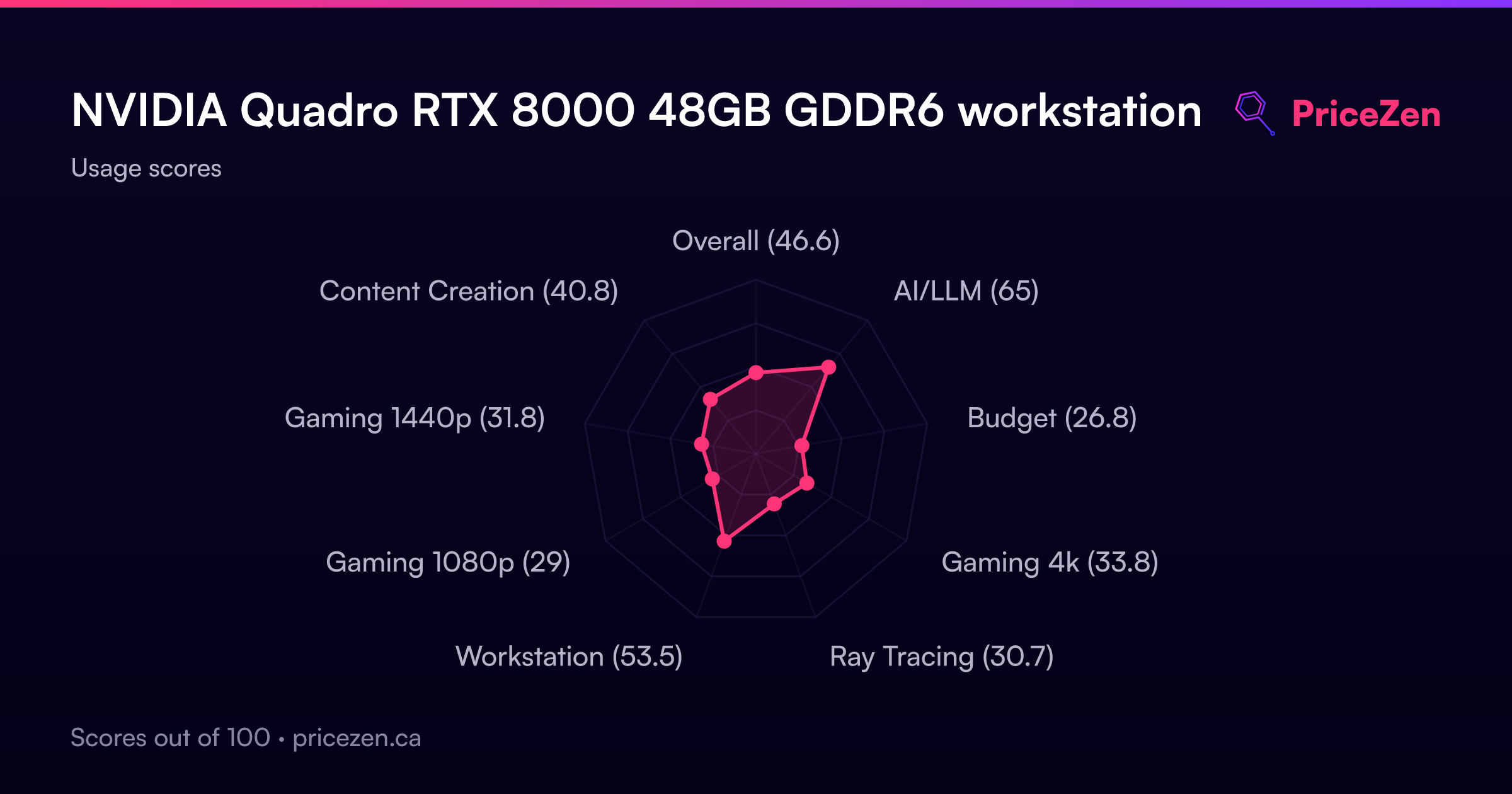
Usage Scores
- Overall46.6
- AI/LLM65
- Budget26.8
- Gaming 4k33.8
- Ray Tracing30.7
- Workstation53.5
- Gaming 1080p29
- Gaming 1440p31.8
- Content Creation40.8