NVIDIA GeForce GT 610 2GB GDDR3
Equipped with 2GB of DDR3 memory and a 40nm chip, this card provides basic multi-monitor support through its HDMI, DVI, and VGA outputs. Its single-fan cooler and PCB construction prioritize quiet operation and simple installation in legacy systems lacking integrated graphics. This is best suited for office users who only need to add display outputs to an old desktop, not for any modern gaming or content creation workloads.












Snapshot
The 30-Second Version
The GT 610 scores 338 on PassMark G3D, landing in the 6th percentile for raster performance, which means 94% of graphics cards in our database beat it. It's cheap at $52 USD and works fine for basic dual-monitor setups, especially on Linux. But with a 57/100 user sentiment score and reports of failures within months, this is a card you buy only when you have no other option.
Pros & Cons
Pros
- 97th percentile affordability at around $52 USD 97th
- 29W TDP means it runs cool and quiet
- Easy dual-monitor support with HDMI, DVI, and VGA outputs
- Works well with Linux for basic display needs
- Small form factor fits in almost any case
Cons
- PassMark G3D score of 338 lands in the 6th percentile for raster performance
- 4K gaming score of 7/100 is essentially unusable
- 64-bit memory bus severely limits the 2GB DDR3
- PCI Express 1.1 x16 interface is ancient and bandwidth-starved
- User sentiment score of 57/100 with reports of failures within months
What owners think
The Word on the Street
How owner sentiment changed over time
ExclusiveBased on when customers actually wrote their reviews - so you can see whether early praise held up.
7 written reviews, Jan 2024 – Nov 2025: 4 happy, 3 unhappy
Across all 19 store ratings: 3.9★. Most owners rate without writing a review. The chart counts the 7 written reviews.
Each dot is one written review, in the month it was written. Happy = 4-5★, mixed = 3★, unhappy = 1-2★.
The proof
Performance
Let's talk about that PassMark score of 338. For context, a modern integrated GPU like Intel's UHD 770 scores around 2,500. Even a decade-old GTX 750 Ti lands near 3,900. So the GT 610 is roughly 7-8x slower than entry-level cards from its own era. The 48 CUDA cores running at 810MHz and 600MHz memory clock are fine for pushing pixels to a second monitor, but the moment you ask it to render anything 3D, it falls flat. The 4K gaming score of 7/100 is one of the worst we've seen, and the 12.9/100 workstation score confirms this card has no business in any serious workload.
The 2GB of DDR3 sounds okay on paper, but the 64-bit memory interface cripples it. You're getting 504 GB/s of theoretical bandwidth, which sounds impressive until you realize modern cards push 10-20x that. The 29W TDP and single fan mean it runs cool and quiet, but that's because there's barely anything to cool. The PCI Express 1.1 x16 interface is another bottleneck, capping bandwidth at a fraction of what even PCIe 3.0 cards get.
Specifications
Full Specifications
Chipset
| GPU Chipset | GeForce GT 610 |
| Brand | NVIDIA |
| Class | consumer |
| Process | 40 |
Memory
| VRAM | 2 GB |
| Memory Type | GDDR3 |
| Memory Bus | 64 |
Compute
| CUDA Cores | 48 |
| Base Clock | 810 |
Performance
| PassMark G3D | 338 |
Power & Cooling
| TDP | 29 |
| Cooler | Single Fan |
| Fans | 1 |
Connectivity
| Interface | PCI Express 1.1 x 16 |
| DisplayPort | 0 |
| HDMI | 1 |
Physical
| Weight | 0.3 kg / 0.6 lbs |
vs Competition
Stacked against the competition, the GT 610 is in rough shape. The XFX Radeon RX 570 with 8GB of GDDR5 absolutely obliterates it in every performance metric, and the Sapphire PULSE 11265-05-20G offers similar value with better longevity. Even the ASUS Dual GTX 1060 6GB, which is several generations old at this point, delivers performance the GT 610 can't dream of. The Kelinx RX 580 is another budget option that makes the GT 610 look like a museum piece. The only competitor this card beats is the HP 20X24AA, which is more of a workstation adapter than a graphics card. When your main competition is a card nobody's heard of, that's not a good sign.
| Spec | NVIDIA GeForce GT 610 | XFX RX-67XLKWFDV | MSI GeForce RTX 3050 Gaming X | HP RTX A4000 | Gigabyte Radeon RX 6600 Eagle | EVGA GeForce GTX 1080 Ti |
|---|---|---|---|---|---|---|
| Chipset | GeForce GT 610 | Radeon RX 6700 | GeForce RTX 3050 | RTX A4000 | Radeon RX 6600 | GeForce GTX 1080 Ti |
| Vram | 2GB GDDR3 | 10GB GDDR6 | 6GB GDDR6 | 16GB GDDR6 | 8GB GDDR6 | 11GB GDDR5X |
| Boost Clock Mhz | - | 2425 | 1507 | - | 2491 | 1683 |
| Tdp W | 29 | 175 | 70 | 140 | 132 | 250 |
| Memory Bus Bits | 64 | 160 | 96 | - | 128 | 352 |
| Ray Tracing | - | true | true | true | true | - |
| GPU Class | consumer | consumer | consumer | workstation | consumer | consumer |
| Compare | Compare | Compare | Compare | Compare |
| Product | AI | Rt | Vram | Raster | Compute | Feature | Thermal | User Sentiment | Efficiency | Connectivity | Social Proof | Affordability |
|---|---|---|---|---|---|---|---|---|---|---|---|---|
| NVIDIA GeForce GT 610 | 5.8 | 6.8 | 4.2 | 7 | 1.4 | 10.9 | 25.6 | 7.9 | 9 | 12.7 | 19.1 | 96.9 |
| XFX RX-67XLKWFDV Compare | 44.8 | 40.8 | 44.2 | 41.6 | 28.3 | 66 | 72.3 | 0 | 73.6 | 56.1 | 83.8 | 79.9 |
| MSI GeForce RTX 3050 Gaming X Compare | 18.5 | 29.2 | 22.2 | 22 | 20.4 | 71.7 | 42.7 | 58.1 | 91 | 51.1 | 93.3 | 81 |
| HP RTX A4000 Compare | 66.8 | 35.1 | 63 | 41.8 | 36 | 33.7 | 16.5 | 0 | 92.2 | 36.3 | 0 | 19.5 |
| Gigabyte Radeon RX 6600 Eagle Compare | 29.4 | 34.9 | 29.6 | 32 | 21.3 | 52.9 | 91.7 | 1 | 77.6 | 51.1 | 93.3 | 71.4 |
| EVGA GeForce GTX 1080 Ti Compare | 49.6 | 33.4 | 43.8 | 40.8 | 31.6 | 28.5 | 72.3 | 0 | 27.2 | 44.7 | 56.7 | 72.6 |
Price
Value & Pricing
At $52 USD, the GT 610 is cheap, but cheap doesn't always mean good value. The 97th percentile affordability ranking is the only category where this card shines. For comparison, a used RX 570 or GTX 1060 can be found for not much more and delivers 10-20x the performance. The EUR 75-76 listings in Europe feel particularly rough when you consider what that money buys elsewhere. If your only goal is adding a second monitor to an old office PC, the price is tolerable. For anything else, you're paying $52 for a card that gets outperformed by the integrated graphics already sitting in your CPU.
Amazon 1 offer From CA$91
Price history
Read more
Overview
The GeForce GT 610 is a 40nm relic from 2012 that somehow still finds its way into budget builds and office PCs. The numbers tell the story: a PassMark G3D score of 338 puts it in the 6th percentile for raster performance, which means 94% of graphics cards in our database outperform it. That's not a typo. This thing gets absolutely smoked by integrated graphics on modern CPUs. But it does have one saving grace: a 97th percentile affordability ranking, with US listings around $52.
For that price, you're getting 2GB of DDR3 on a 64-bit bus, 48 CUDA cores, and a 29W TDP that won't stress your power supply. It's a display adapter first and a gaming card never. If you need extra monitor outputs for a Linux box or an office machine, it might earn its keep. If you're hoping to play anything made after 2010, keep scrolling.
Common Questions
Q: Can the GT 610 handle modern games?
No. With a PassMark G3D score of 338 and a 4K gaming score of 7/100, this card struggles with anything beyond basic 2D tasks. Even games from a decade ago will run poorly. It's best suited for desktop use, video playback, and light productivity.
Q: Will this card work with my existing power supply?
Almost certainly. The GT 610 has a 29W TDP and doesn't require any external power connectors. It draws all its power from the PCI Express slot, so even a basic 300W power supply will handle it easily. The 450W PSU recommendation in the specs is very conservative.
Q: Is 2GB of DDR3 memory enough for dual monitors?
For basic dual-monitor desktop use, yes. The 2GB of DDR3 is sufficient for running two displays at 1080p for productivity tasks. However, the 64-bit memory interface limits bandwidth significantly, so don't expect smooth performance with high-resolution video or any 3D applications across multiple screens.
Who Should Skip This
If you're planning to play any games made in the last decade, skip this card entirely. The 6th percentile raster performance and 7/100 4K gaming score mean you'll be stuck at low settings with poor frame rates, if games run at all. Content creators and workstation users should also look elsewhere, as the 12.9/100 workstation score makes this card useless for rendering, video editing, or any GPU-accelerated workload. And if you value reliability, the user sentiment score of 57/100 with multiple reports of cards dying within 5 months is a red flag. Anyone with a modern CPU should just use integrated graphics, which will outperform this card in most tasks.
Verdict
The GeForce GT 610 is a display adapter pretending to be a graphics card. The 338 PassMark score and 6th percentile raster ranking tell you everything you need to know. It's fine for adding a second monitor to a Linux box or breathing life into an old office PC, and the 29W TDP means it won't tax your power supply. But the user sentiment score of 57/100 with reports of failures within 5 months and grinding fan noises is concerning. If you can stretch your budget even slightly, a used RX 570 or GTX 1060 will serve you far better. This card is a last resort, not a first choice.
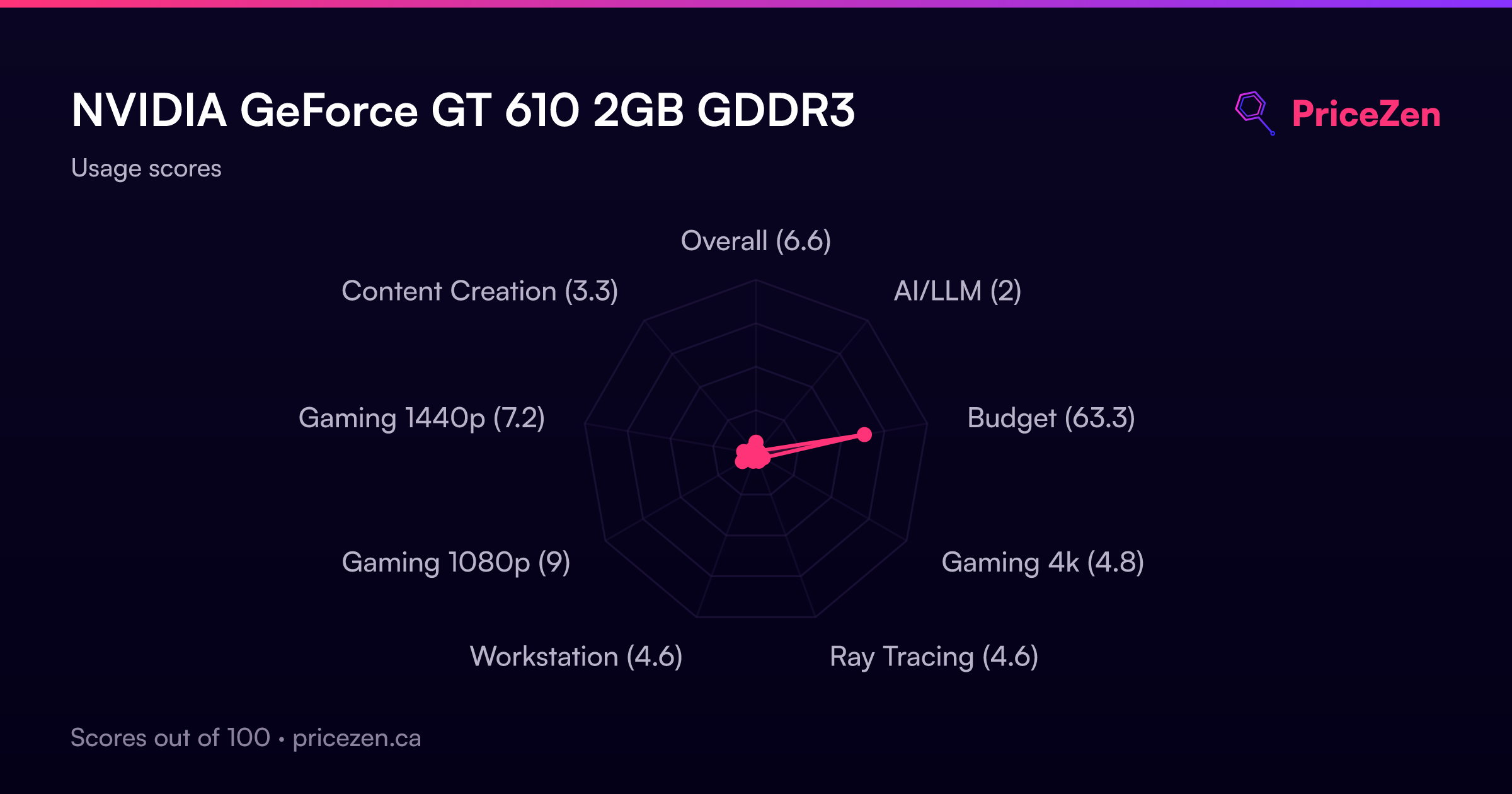
Usage Scores
- Overall6.6
- AI/LLM2
- Budget63.3
- Gaming 4k4.8
- Ray Tracing4.6
- Workstation4.6
- Gaming 1080p9
- Gaming 1440p7.2
- Content Creation3.3