ASUS GeForce RTX 3050 Dual OC 6GB GDDR6 Black
Powered by the Ampere architecture with 2304 CUDA cores and 6GB of GDDR6 memory, this card delivers reliable 1080p gaming with ray tracing and DLSS support at a 70W TDP that requires no external power connector. Its compact 201mm, 2-slot design with dual Axial-tech fans and a 0dB silent mode makes it an easy drop-in upgrade for small form factor or OEM systems. This GPU is best for budget-conscious builders seeking modern features like HDMI 2.1 in a low-power, space-constrained desktop.



Snapshot
The 30-Second Version
The ASUS Dual RTX 3050 OC is a compact, efficient budget card that fits where bigger GPUs won't. Its 201mm length and 130W TDP make it perfect for small builds and prebuilt upgrades. Performance is weak for the price, with 6GB VRAM and raster scores near the bottom of our database. At $240 it's a reasonable buy, but at $346 you should look elsewhere.
Pros & Cons
Pros
- Compact 201mm length fits small cases and prebuilts 91st
- 130W TDP and bus powered, no extra power cables needed 84th
- 91st percentile efficiency, great for low-power builds 83rd
- DLSS and ray tracing support at a budget price
- Dual Axial-tech fans keep it quiet under load
Cons
- 23rd percentile raster performance, struggles in demanding games
- 6GB VRAM on a 96-bit bus limits future-proofing
- AI and compute scores near the bottom of our database
- Only 2 display outputs, connectivity is below average
- Ray tracing is more of a checkbox than a usable feature
What owners think
The Word on the Street
How owner sentiment changed over time
ExclusiveBased on when customers actually wrote their reviews - so you can see whether early praise held up.
Happy owners: 81% lately, 73% in Jul 2022 – Sep 2024
Too few reviews to call that a change.
Across all 1,139 store ratings: 4.6★. Most owners rate without writing a review. The chart counts the 27 written reviews with stars and their own date.
13 reviews from months with approximate dates (the day we first saw a review) are left out of the trend.
9 written reviews without stars are left out of the trend.
Show the numbers
| Period | Reviews | Happy | Mixed | Unhappy | Happy share |
|---|---|---|---|---|---|
| Jul 2022 – Sep 2024 | 11 | 8 | 0 | 3 | 73% |
| Oct 2024 – Oct 2026 | 16 | 13 | 0 | 3 | 81% |
- Jan – Mar 20266 of 11 happy · 6 without stars
Buyers report serious issues: black screens, no display, and poor performance. A few mention good visuals and quiet operation but note the card often fails to work properly.
- Multiple verified buyers report black screen or no display output.
- Performance deemed low for the price; one buyer recommends Intel Arc B580 instead.
- Card praised for quietness and appearance but plagued by functionality problems.
- One buyer reports great image quality, silent operation, and good fit in mATX build.
- Oct – Dec 20252 of 2 happy · 3 without stars
Buyers praised this medium-priced graphics card for 1080p gaming, noting its low power draw and good performance for the price.
- Good value for medium price, performs better than expected.
- Works well for 1080p gaming, but not for 4K.
- Low power draw (75W), no extra power supply needed.
- Compatible with ASUS monitors; recommends latest drivers.
- Jul – Sep 20250 of 1 happy · 4 without stars
Mixed reviews: one praises the card as a compact, sharp upgrade; another reports persistent driver issues causing black screens in games.
- Compact, sharp upgrade for dual monitors; outperforms larger EVGA card.
- Frequent flashing and black screens during gaming despite driver updates.
- Good for basic use like two new builds.
- Driver issues unresolved after multiple updates causing frustration.
Each column joins calendar quarters until it holds at least 10 reviews with stars and their own date. Happy = 4-5★, mixed = 3★, unhappy = 1-2★. Period summaries are in English.
The proof
Performance
Let's talk raw numbers. The PassMark G3D score of 12,487 puts this card in the 23rd percentile for raster performance among all GPUs in our database. That's not a typo. It's a weak spot, plain and simple. For context, that's roughly where older mid-range cards from a few generations back sit. You'll play esports titles like Valorant, CS2, and Rocket League at high frame rates without breaking a sweat, but demanding AAA games at 1080p will need medium settings, sometimes low, to stay smooth.
The compute numbers tell a similar story. 4.8 TFLOPS of FP32 puts it in the 19th percentile for compute, and the AI score of 14.5 out of 100 is the weakest area of this card, landing in the 18th percentile. The 6GB of VRAM sits in the 22nd percentile, which is fine for 1080p today but already feels tight in newer titles. Ray tracing performance is in the 28th percentile, so you'll lean on DLSS heavily if you want to enable RT effects. The one bright spot is efficiency, 91st percentile. This card sips power relative to what it delivers, which is exactly what you want in a small build.
Specifications
Full Specifications
Chipset
| GPU Chipset | GeForce RTX 3050 |
| Brand | NVIDIA |
| Architecture | Ampere |
| Class | consumer |
| Process | 8 |
Memory
| VRAM | 6 GB |
| Memory Type | GDDR6 |
| Memory Bus | 96 |
| Bandwidth | 192 |
| ECC | No |
Compute
| CUDA Cores | 2304 |
| Stream Processors | 2304 |
| Tensor Cores | 64 |
| RT Cores | 16 |
| Base Clock | 1507 |
| Boost Clock | 1537 |
| FP16 TFLOPS | 4.813 |
| FP32 TFLOPS | 4.813 |
Performance
| PassMark G3D | 9498 |
| GPU Compute | 6442 |
Power & Cooling
| TDP | 70 |
| Recommended PSU | 550 |
| Power Connectors | No |
| Cooler | Dual Fan |
| Fans | 2 |
Connectivity
| Interface | PCI Express 4.0 |
| DisplayPort | 1 |
| HDMI | 1 |
| USB-C | 0 |
| Max Displays | 3 |
| Max Resolution | 7680 x 4320 |
Physical
| Length | 201 |
| Slot Width | 2 |
| Form Factor | Full Height |
| Weight | 0.8 kg / 1.7 lbs |
Features
| Ray Tracing | Yes |
| Upscaling | DLSS |
| AV1 Encode | No |
| DirectX | 12 |
| RGB | No |
vs Competition
The competitive landscape here is crowded, and the RTX 3050 sits in an awkward spot. The top of our database now includes the ASUS TUF Gaming RTX 5090, Gigabyte Eagle RTX 5070 Ti, MSI Ventus RTX 5070 Ti, ZOTAC APOCALYPSE, and Sapphire NITRO+. These cards absolutely demolish the RTX 3050 in raw performance. They're in a different league entirely, with more VRAM, higher clocks, and better compute scores. But they also cost significantly more and draw more power. If your budget stretches, those are the obvious upgrades.
The trade-off is simple: the RTX 3050 wins on size, power efficiency, and price floor. It loses on everything else. If you have a small case or a weak PSU, this card makes sense. If you have a standard ATX build and can spend more, you should.
| Spec | ASUS GeForce RTX 3050 Dual OC | Gigabyte GeForce RTX 5070 Ti Eagle Ice | MSI GeForce RTX 5070 Gaming Trio | Sapphire Radeon RX 9070 XT PULSE | XFX Radeon RX 9070 XT Mercury | PowerColor Radeon RX 9070 XT Hellhound OC |
|---|---|---|---|---|---|---|
| Chipset | GeForce RTX 3050 | GeForce RTX 5070 Ti | GeForce RTX 5070 | Radeon RX 9070 XT | Radeon RX 9070 XT | Radeon RX 9070 XT |
| Vram | 6GB GDDR6 | 16GB GDDR7 | 12GB GDDR7 | 16GB GDDR6 | 16GB GDDR6 | 16GB GDDR6 |
| Boost Clock Mhz | 1537 | 2542 | 2610 | 2970 | 3100 | 3010 |
| Tdp W | 70 | 300 | 250 | 304 | 304 | 304 |
| Memory Bus Bits | 96 | 256 | 192 | 256 | 256 | 256 |
| Ray Tracing | Yes | Yes | Yes | Yes | Yes | Yes |
| GPU Class | consumer | consumer | consumer | consumer | consumer | consumer |
| Compare | Compare | Compare | Compare | Compare |
| Product | AI | Rt | Vram | Raster | Compute | Feature | Thermal | Efficiency | Connectivity | Social Proof | Affordability |
|---|---|---|---|---|---|---|---|---|---|---|---|
| ASUS GeForce RTX 3050 Dual OC | 18.1 | 27 | 21.6 | 21.4 | 19.8 | 52.2 | 54.5 | 90.9 | 30 | 83.9 | 82.9 |
| Gigabyte GeForce RTX 5070 Ti Eagle Ice Compare | 78.9 | 88.6 | 85.9 | 88.9 | 87.8 | 95.7 | 91.9 | 71.8 | 94.2 | 93.3 | 22.8 |
| MSI GeForce RTX 5070 Gaming Trio Compare | 61 | 82.8 | 65.2 | 78.9 | 70.6 | 95.7 | 91.9 | 78.8 | 94.2 | 93.3 | 32.5 |
| Sapphire Radeon RX 9070 XT PULSE Compare | 89.4 | 84.7 | 73.5 | 74.7 | 89.8 | 95.7 | 72 | 44.9 | 89 | 93.3 | 40.3 |
| XFX Radeon RX 9070 XT Mercury Compare | 89.5 | 84.7 | 75.1 | 74.7 | 90.8 | 95.7 | 72 | 44.9 | 94.2 | 93.3 | 29.9 |
| PowerColor Radeon RX 9070 XT Hellhound OC Compare | 89.7 | 84.7 | 75.1 | 74.7 | 95.1 | 88.5 | 91.9 | 44.9 | 94.2 | 48 | 38.4 |
Price
Value & Pricing
Here's where things get interesting. US listings range from $240 to $346 across 4 vendors, and that $106 spread is worth paying attention to. At $240, this card makes a decent case for itself. At $346, you're dangerously close to cards that outperform it significantly. The CAD market is even wilder, ranging from $323 to $684 across 8 listings. That's a $361 spread, and honestly, anyone paying the high end of that range is getting a bad deal. Shop around. The budget score of 88.9 out of 100 reflects the low end of that pricing, not the high end.
The affordability percentile of 84th means this card is cheaper than most GPUs in our database, but cheap doesn't always mean good value. The 6GB VRAM and weak compute scores mean you're buying today's performance, not tomorrow's. If you can find it at the bottom of the price range, it's a reasonable entry point. If you're looking at the top of the range, save your money or look at used cards from a tier up.
Canada Computers 2 offers From CA$420
Newegg 4 offers From CA$420
B&H Photo 1 offer From CA$430
Memory Express 1 offer From CA$440
Price history
Read more
Overview
The ASUS Dual RTX 3050 OC Edition is a card that knows exactly what it is, and honestly, that's refreshing. It's not trying to be a 4K monster or an AI workstation card. It's a compact, dual-fan GPU aimed at budget builders who want a modern feature set without selling a kidney. With 6GB of GDDR6 on a 96-bit bus and a 1537MHz boost clock, it's built for 1080p gaming at sensible settings, light creative work, and systems where space and power are tight.
What makes this particular card interesting is the size. At 201mm long and 1.5 slots, it'll drop into prebuilts, small form factor cases, and older systems that can't fit the chunky triple-fan cards everyone else is shipping. The 130W TDP means you don't need a beefy power supply either, ASUS recommends 550W, and it's bus powered, so no extra PCIe power cables to fiddle with. That's a real selling point for people upgrading an office PC into a light gaming rig.
Our database puts this card's budget score at 88.9 out of 100, which is where it shines. The total score of 43.6 and 1080p gaming score of 46.2 tell the other side of the story. This is not a high-performance card. It's a value play with modern features like ray tracing and DLSS, and for the right buyer, that's enough.
Common Questions
Q: Can this card run modern games at 1080p?
Yes, but with caveats. Esports titles like Valorant, CS2, and Fortnite will run at high frame rates without issue. For demanding AAA games, you'll need to drop settings to medium or low to maintain smooth frame rates. The 6GB of VRAM is the main constraint, and you'll want to enable DLSS in supported titles to help performance.
Q: Will this fit in my small form factor case?
Probably. At 201mm long and 1.5 slots thick, this is one of the more compact dual-fan cards available. It's designed specifically for smaller cases and prebuilt systems. Just double-check your case's GPU clearance, but most ITX and mATX cases should accommodate it without issue.
Q: Do I need a new power supply for this card?
Most likely not. The card draws 130W and is bus powered, meaning it gets all its power from the PCIe slot. ASUS recommends a 550W power supply, but in practice, many systems with 450W units will run this card fine, especially if the rest of the system is modest. This is a big advantage over cards that require dedicated PCIe power cables.
Q: Is the 6GB of VRAM enough for the future?
It's already tight. Current games at 1080p can use 6GB or more at higher settings, and that trend will continue. For esports and older titles, 6GB is fine. For new AAA releases, you'll be turning textures down sooner rather than later. If you plan to keep this card for several years, the VRAM limitation will become more noticeable over time.
Who Should Skip This
If you're building a dedicated gaming PC with a standard ATX case and a decent power supply, skip this card. The performance ceiling is too low for the money, and the 6GB VRAM will frustrate you within a year or two. Look at used cards from a tier up, or stretch your budget to the RTX 5070-class options from MSI or Gigabyte. They cost more, but the performance gap is enormous.
Content creators and anyone doing AI work should also look elsewhere. The AI score of 14.5 out of 100 and compute percentile of 19th mean this card is not built for that workload. Video editing will work, but rendering times will be slow. If you need GPU compute for anything beyond light gaming, this is the wrong tool.
Verdict
For a compact budget build, a prebuilt upgrade, or a home theater PC that occasionally plays games, this card is a solid pick. The small footprint, low power draw, and quiet dual-fan cooler make it easy to live with. You'll get smooth 1080p gaming in esports titles and older games, and DLSS helps stretch performance in newer titles. Just keep your expectations in check.
For anyone building a dedicated gaming rig with a standard case and a decent power supply, this card is hard to recommend. The performance ceiling is low, the VRAM is already tight, and the price can creep into territory where better options exist. If you're spending $346 on a GPU, you should be getting more than 6GB of VRAM and 23rd percentile raster performance. Look at used cards from a tier up, or stretch your budget to the 5070-class cards from MSI or Gigabyte.
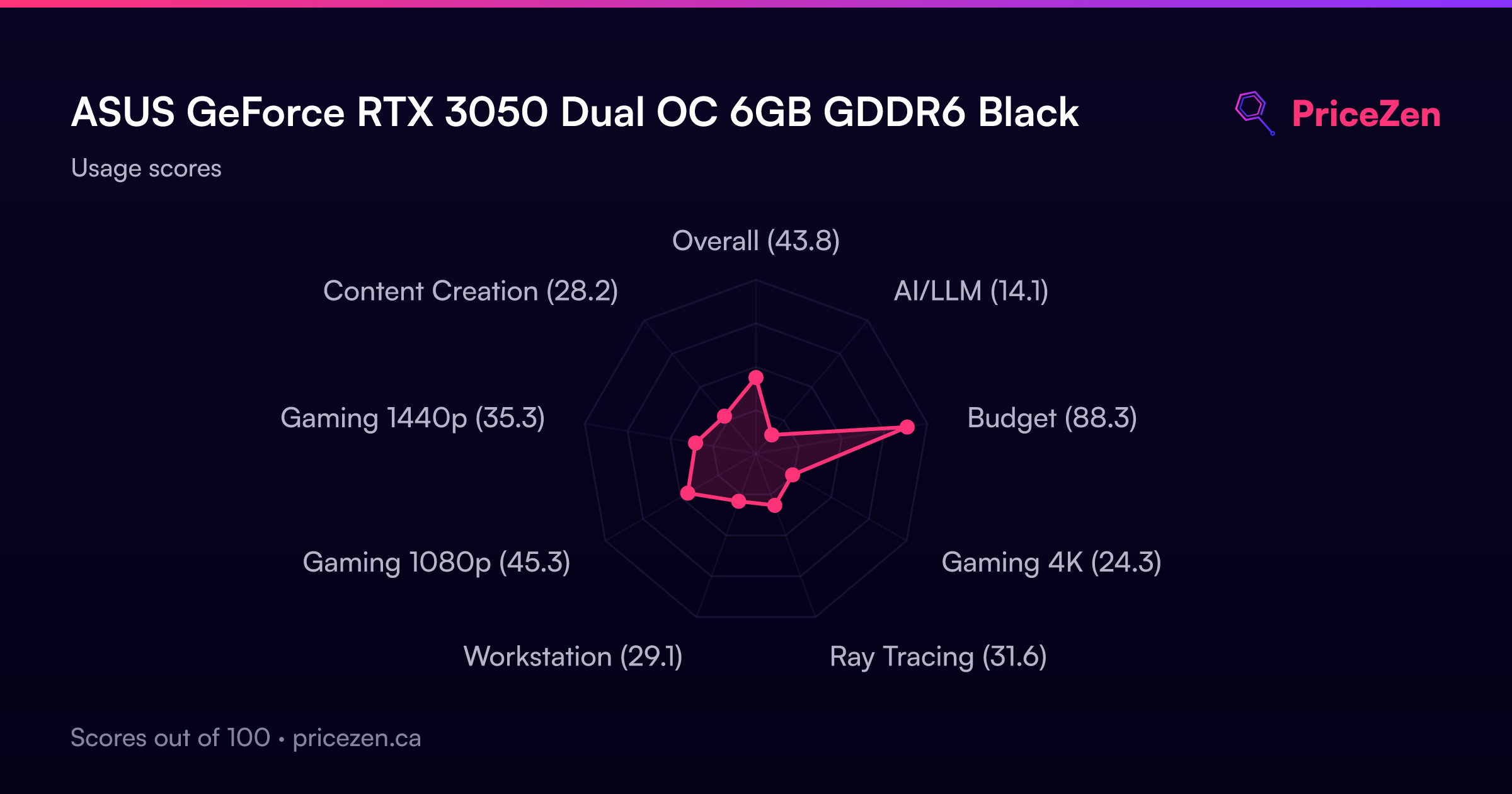
Usage Scores
- Overall43.8
- AI/LLM14.1
- Budget88.3
- Gaming 4K24.3
- Ray Tracing31.6
- Workstation29.1
- Gaming 1080p45.3
- Gaming 1440p35.3
- Content Creation28.2