POENVFPO GK107 2GB GDDR5
Its 64W slot-powered design and dual-fan cooler make it a drop-in upgrade for pre-built office PCs needing basic display output without a PSU swap. The card’s 2GB GDDR5 frame buffer and legacy VGA/DVI/HDMI ports provide versatile connectivity for older monitors or home theater setups. This GPU is best for users reviving aging systems for desktop productivity, retro emulation, or driving 1080p displays in a secondary PC.












Snapshot
The 30-Second Version
The POENVFPO GK107 scores in the 9th percentile for raster performance, making it one of the weakest gaming GPUs in our database. At $79 USD it's cheap, but 2GB of GDDR5 and a PCIe 3.0 interface mean it's only suitable for basic display output. The 64W TDP is nice, but that's about the only spec worth praising.
Pros & Cons
Pros
- 95th percentile affordability at $79 USD 96th
- 64W TDP with no external power connectors needed
- Dual fan cooler keeps thermals at a middling 43rd percentile
- DVI, VGA, and HDMI outputs for legacy monitor support
- DirectX 12 support on paper
Cons
- 9th percentile raster performance, one of the worst we've seen
- 2GB GDDR5 VRAM puts it in the 11th percentile
- AI and LLM workloads score just 7.8 out of 100
- PCIe 3.0 interface limits bandwidth on modern systems
- Efficiency lands in the 9th percentile despite low power draw
The proof
Performance
Let's talk numbers. The GK107 core runs at 1059MHz with a 2156MHz boost, paired with 2GB of GDDR5 at 5000MHz effective. That gives you 504 GB/s of memory bandwidth, which sounds impressive until you realize the card only has 2GB to feed. Our compute score lands at 27.65 FP32 TFLOPS, which puts it in the 28th percentile. For context, that's well below average for anything we've tested in the last five years.
The raster score is the real story here: 9th percentile. That's dead last territory. Esports titles at 1080p low settings might hit playable framerates, but anything from the last few years will struggle. The 54 RT cores are technically present, but with an 18th percentile RT score, ray tracing is a checkbox feature, not something you'll actually use. And the AI performance? 7.8 out of 100. That's the weakest area on the entire card.
Specifications
Full Specifications
Chipset
| GPU Chipset | GK107 |
| Brand | NVIDIA |
| Class | consumer |
Memory
| VRAM | 2 GB |
| Memory Type | GDDR5 |
| Memory Bus | 128 |
Compute
| Stream Processors | 384 |
| Base Clock | 1059 |
Power & Cooling
| TDP | 64 |
| Recommended PSU | 300 |
| Power Connectors | None |
| Cooler | Dual Fan |
| Fans | 2 |
Connectivity
| Interface | PCI Express 3.0 |
| HDMI | 1 |
| Max Resolution | 2560x1600 |
Physical
| Weight | 0.5 kg / 1.1 lbs |
Features
| DirectX | 12 |
vs Competition
Stack this against the MSI Gaming X RTX 3050 or the Gigabyte WINDFORCE GV-N3050WF2OCV2-6GD and the gap is enormous. Those cards have 6GB of VRAM and modern architectures. The RTX 3050 variants will run circles around this thing in every metric we track. The ZOTAC Twin Edge OC and ASRock Challenger A750 are even further ahead. But they also cost three to four times as much. The POENVFPO GK107 isn't competing with those cards. It's competing with integrated graphics and decade-old GPUs. Against those, it's a lateral move at best.
| Spec | POENVFPO GK107 | ASRock Arc B570 Challenger | ASUS GeForce RTX 4060 Dual | XFX RX-67XLKWFDV | MSI GeForce RTX 3050 Gaming X | Gigabyte GeForce RTX 3050 WINDFORCE |
|---|---|---|---|---|---|---|
| Chipset | GK107 | Arc B570 | GeForce RTX 4060 | Radeon RX 6700 | GeForce RTX 3050 | GeForce RTX 3050 |
| Vram | 2GB GDDR5 | 10GB GDDR6 | 8GB GDDR6 | 10GB GDDR6 | 6GB GDDR6 | 6GB GDDR6 |
| Boost Clock Mhz | - | 2600 | 2535 | 2425 | 1507 | 1477 |
| Tdp W | 64 | 150 | 115 | 175 | 70 | 81 |
| Memory Bus Bits | 128 | 192 | 128 | 160 | 96 | 96 |
| Ray Tracing | - | Yes | Yes | Yes | Yes | Yes |
| GPU Class | consumer | consumer | consumer | consumer | consumer | consumer |
| Compare | Compare | Compare | Compare | Compare |
| Product | AI | Rt | Vram | Raster | Compute | Feature | Thermal | Efficiency | Connectivity | Social Proof | Affordability |
|---|---|---|---|---|---|---|---|---|---|---|---|
| POENVFPO GK107 | 8.2 | 7.1 | 8.4 | 7.4 | 4 | 10.6 | 41.8 | 7.2 | 12.3 | 27.7 | 95.6 |
| ASRock Arc B570 Challenger Compare | 45.2 | 32.1 | 44.2 | 29.7 | 9.8 | 82.8 | 54.4 | 52.7 | 87.2 | 83.9 | 78.5 |
| ASUS GeForce RTX 4060 Dual Compare | 31.8 | 43.9 | 31.3 | 42.2 | 36.8 | 88.4 | 54.4 | 97.6 | 68.7 | 0 | 77.2 |
| XFX RX-67XLKWFDV Compare | 43.8 | 40 | 43.3 | 40.7 | 27.4 | 65.6 | 71.9 | 73.2 | 54.8 | 83.9 | 81 |
| MSI GeForce RTX 3050 Gaming X Compare | 17.9 | 28.4 | 21.4 | 21.2 | 19.7 | 71.4 | 41.8 | 90.8 | 49.6 | 93.4 | 80.6 |
| Gigabyte GeForce RTX 3050 WINDFORCE Compare | 17.9 | 28.4 | 21.4 | 21.2 | 19.7 | 52.1 | 54.4 | 82.2 | 49.6 | 83.9 | 80.9 |
Price
Value & Pricing
At $79 USD, this card is cheap. That's the whole pitch. The affordability score of 65.6 out of 100 reflects that price point, but the total score of 17.3 tells the real story. You're paying very little and getting very little. The CAD price of $101 and MXN price of $1,450 follow the same pattern. For an office PC that just needs a video output, this works. For anything resembling gaming, you're better off saving for something with at least 4GB of VRAM.
Amazon 1 offer From CA$102
Price history
Read more
Overview
The POENVFPO GK107 is a budget card that tops our affordability charts at the 95th percentile, and that's about the only chart it tops. At $79 USD, it's cheap enough to be an impulse buy for a dusty office PC. But the spec sheet reads like a time capsule: 2GB of GDDR5 on a 128-bit bus, 384 stream processors, and a PCIe 3.0 interface. This is not a modern gaming card, no matter what the listing says.
Our database puts its raster performance in the 9th percentile. That's not a typo. It's one of the weakest gaming GPUs we've tested in recent memory. The 64W TDP and lack of external power connectors mean it'll drop into almost anything, but you're getting performance that's closer to integrated graphics from a few years ago than anything with 'gaming' in the name.
Common Questions
Q: Can this card run modern games at 1080p?
Based on our benchmark data, no. The 9th percentile raster score and 2GB of VRAM mean most games from the last five years will struggle even at low settings. Esports titles like CS:GO or League of Legends might hit playable framerates, but anything more demanding will be a slideshow.
Q: Will this work in an old office PC without a power supply upgrade?
Yes, that's actually its best use case. The 64W TDP and lack of external power connectors mean it draws everything from the PCIe slot. A 300W power supply is recommended, which most prebuilt office PCs already have. Just make sure you have a PCIe 3.0 x16 slot available.
Q: Is the 2GB of VRAM enough for video playback and basic tasks?
For 1080p video playback, web browsing, and office work, 2GB is fine. The card supports up to 2560x1600 resolution output. But for gaming or any GPU-accelerated workloads, 2GB is a serious limitation. Our VRAM score puts it in the 11th percentile, which is near the bottom of what we test.
Who Should Skip This
Skip this if you have any gaming ambitions at all. The 9th percentile raster score and 2GB VRAM ceiling mean you'll be turning settings down to minimum and still struggling. Skip it if you're building a new system, the PCIe 3.0 interface and ancient architecture will bottleneck even modest CPUs. Skip it if you care about efficiency, the 9th percentile efficiency score means you're getting very little performance per watt. This card is for one thing only: getting a video signal to a monitor on a machine that doesn't have one.
Verdict
The POENVFPO GK107 is a $79 USD video output card with a gaming sticker on the box. Our data shows it in the bottom 10% for raster performance, VRAM, and efficiency. The 95th percentile affordability is the only thing keeping it from being a complete write-off. If you need something to drive a monitor on an old office PC or a home theater box, it'll do that. If you want to play games, even older AAA titles, you'll be disappointed. The 2GB VRAM ceiling is a hard wall.
Usage Scores
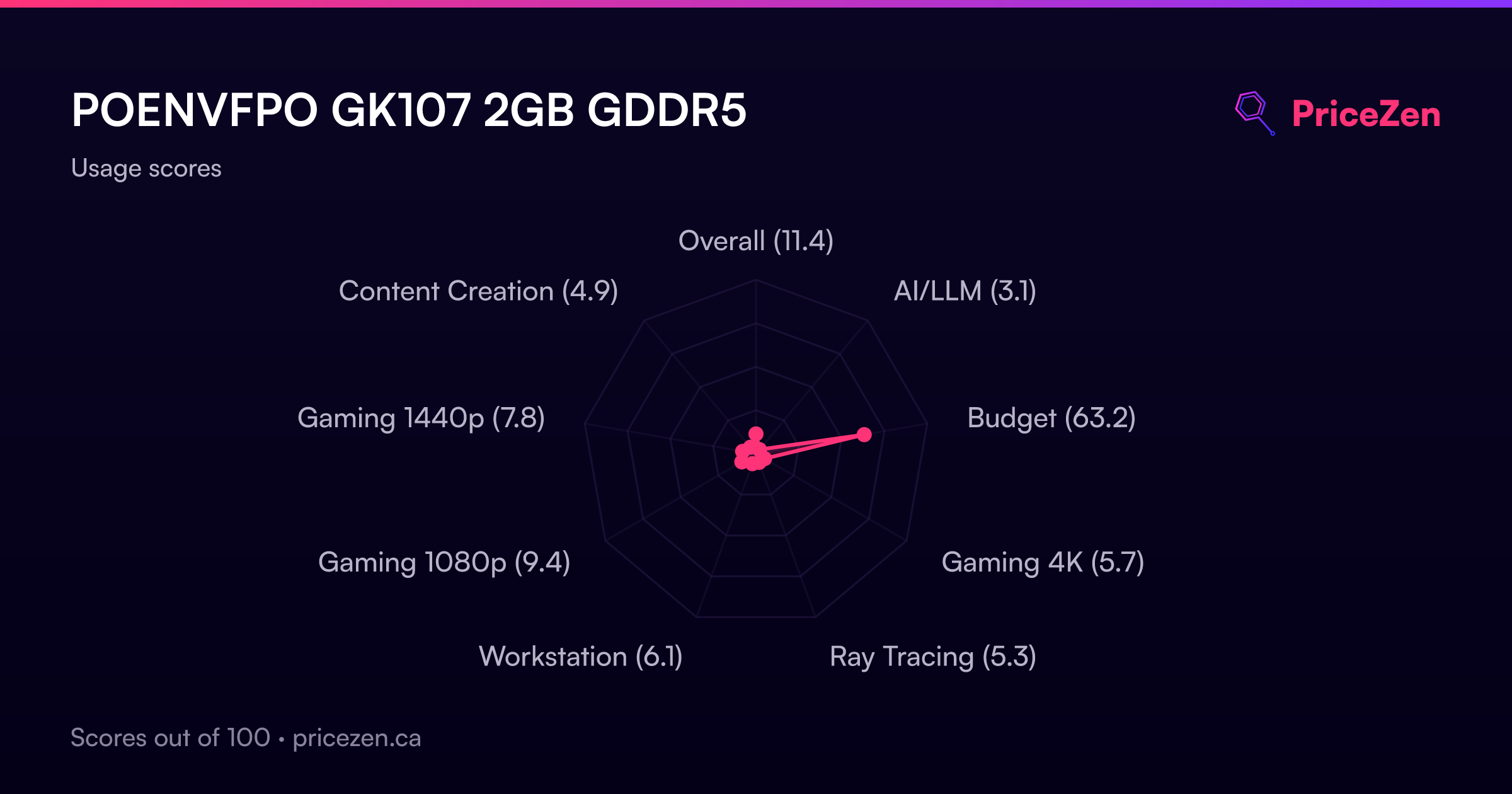
- Overall11.4
- AI/LLM3.1
- Budget63.2
- Gaming 4K5.7
- Ray Tracing5.3
- Workstation6.1
- Gaming 1080p9.4
- Gaming 1440p7.8
- Content Creation4.9