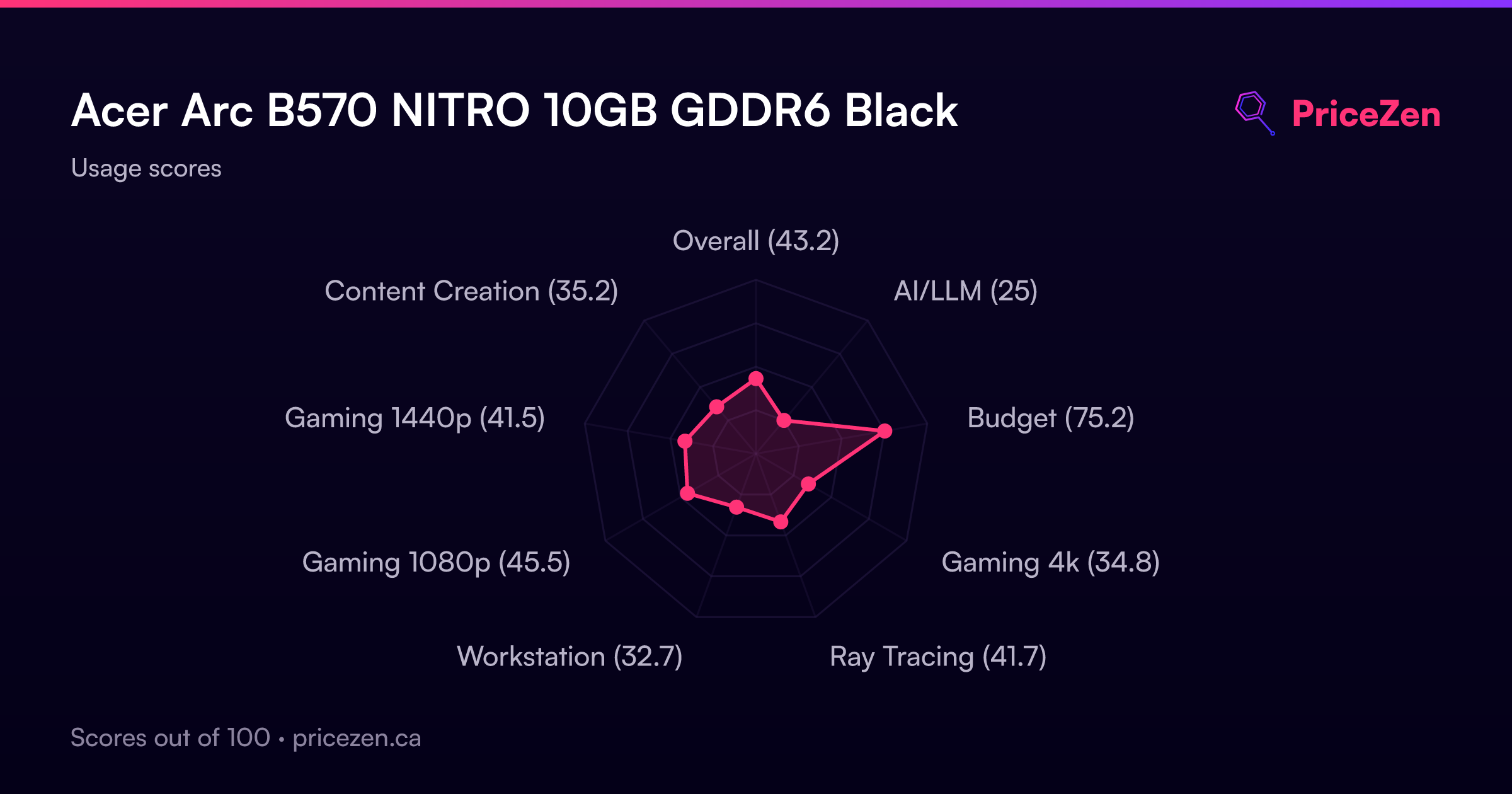
Acer Arc B570 NITRO 10GB GDDR6 Black
Equipped with Intel’s Xe2 architecture on a 3nm process and 10GB of GDDR6 memory on a 160-bit bus, this card delivers solid 1080p gaming with hardware-accelerated AV1 encoding. Its dual-fan cooler manages the 225W TDP within a compact 268mm, 2-slot design while providing modern connectivity via three DisplayPort 2.1 and one HDMI 2.1 outputs. This GPU is best for budget-conscious 1080p gamers who also need efficient video encoding for streaming.

No current retailer price











Snapshot
The 30-Second Version
The Acer NITRO Arc B570 is a $300 budget GPU with 10GB of VRAM, AV1 encoding, and XeSS upscaling. It's great for 1080p gaming and light content creation, but raster and compute performance are below average. Ray tracing is mediocre, so lean on XeSS. If you're on a tight budget and want modern features, this is a solid buy. If you need raw power or AI performance, save your pennies.
Pros & Cons
Pros
- 10GB of VRAM at a budget price 87th
- AV1 hardware encoding for streamers and creators 82nd
- XeSS upscaling and ray tracing support 72nd
- Dual-fan cooler with a compact 268mm length
- Strong connectivity with 3x DisplayPort 2.1 and HDMI 2.1
Cons
- Raster performance below average for the overall GPU market
- Compute performance is a real weak spot
- Ray tracing performance is mediocre
- PCIe 4.0 x8 limits bandwidth on older motherboards
- AI and LLM workloads are not this card's strength
What owners think
The Word on the Street
How owner sentiment changed over time
ExclusiveBased on when customers actually wrote their reviews - so you can see whether early praise held up.
5 written reviews, Mar – Jun 2026: 5 happy
Across all 3 store ratings: 5.0★. The chart counts the 5 written reviews.
Each dot is one written review, in the month it was written. Happy = 4-5★, mixed = 3★, unhappy = 1-2★.
The proof
Performance
The PassMark G3D score of 14103 puts this card in a weird spot. It's not going to scare an RTX 5070 or a Radeon RX 9070 XT, but it's also not embarrassing for a $300 card. In our database, raster performance sits at the 32nd percentile, which means it's below average compared to all GPUs we track, but that includes a lot of expensive cards. For the price, it's more interesting. The compute side is the real weak spot, landing in the 13th percentile, so if you're doing heavy 3D rendering or AI workloads, this isn't your card.
The 10GB of VRAM is a genuine selling point at this price. A lot of budget cards still ship with 8GB, and that's starting to feel tight in newer games. The 160-bit bus isn't the widest, but GDDR6 at these clocks keeps things moving. Ray tracing performance is mediocre, sitting at the 36th percentile, so you'll want to lean on XeSS upscaling to keep frame rates playable when you flip on RT effects. The dual-fan Frostblade cooler keeps the 150W TDP in check, though thermal performance is middle of the pack at the 44th percentile.
Specifications
Full Specifications
Chipset
| GPU Chipset | Arc B570 |
| Brand | Intel |
| Architecture | Xe2 |
| Class | consumer |
| Process | 3 |
Memory
| VRAM | 10 GB |
| Memory Type | GDDR6 |
| Memory Bus | 160 |
Compute
| RT Cores | 8 |
| Base Clock | 2690 |
| Boost Clock | 2690 |
| FP16 TFLOPS | 3.891 |
| FP32 TFLOPS | 1.946 |
Performance
| PassMark G3D | 14103 |
| GPU Compute | 7244 |
Power & Cooling
| TDP | 150 |
| Cooler | Dual Fan |
| Fans | 2 |
Connectivity
| Interface | PCI Express 4.0 x8 |
| DisplayPort | 3 |
| HDMI | 1 |
| Max Displays | 4 |
| Max Resolution | 7680 x 4320 |
Physical
| Length | 268 |
| Slot Width | 2 |
| Form Factor | Full Height |
| Weight | 0.6 kg / 1.4 lbs |
Features
| Ray Tracing | Yes |
| Upscaling | XeSS |
| AV1 Encode | Yes |
| DirectX | 12 Ultimate |
vs Competition
Stacked against the MSI GAMING TRIO RTX 5070 and ASUS PRIME RTX 5070, the B570 is clearly outgunned. Those cards have more VRAM, faster raster performance, and much stronger ray tracing. But they also cost a lot more. If you're building a mid-range or high-end rig, the RTX 5070 is the obvious choice. The B570 is for people who can't stretch their budget that far.
The Sapphire NITRO+ and XFX Mercury RX 9070 XT cards are in a similar boat. They're faster, more expensive, and aimed at 1440p and 4K gaming. The B570's real competition is other budget cards, and that's where the 10GB of VRAM and AV1 support help it stand out. The trade-off is clear: you give up a lot of raw performance to save money, but you keep modern features that budget cards often skimp on.
| Spec | Acer Arc B570 NITRO | MSI GeForce RTX 5070 Ti Ventus 3X OC | Gigabyte GeForce RTX 5080 AORUS Master | ASUS GeForce RTX 5070 Ti PRIME OC | PNY GeForce RTX 5070 Ti OC | Sapphire Radeon RX 9070 XT PULSE |
|---|---|---|---|---|---|---|
| Chipset | Arc B570 | GeForce RTX 5070 Ti | GeForce RTX 5080 | GeForce RTX 5070 Ti | GeForce RTX 5070 Ti | Radeon RX 9070 XT |
| Vram | 10GB GDDR6 | 16GB GDDR7 | 16GB GDDR7 | 16GB GDDR7 | 16GB GDDR7 | 16GB GDDR6 |
| Boost Clock Mhz | 2690 | 2482 | 2805 | 2527 | 2450 | 2970 |
| Tdp W | 150 | 300 | 360 | 300 | 300 | 304 |
| Memory Bus Bits | 160 | 256 | 256 | 256 | 256 | 256 |
| Ray Tracing | true | true | true | true | true | true |
| GPU Class | consumer | consumer | consumer | consumer | consumer | consumer |
| Compare | Compare | Compare | Compare | Compare |
| Product | AI | Rt | Vram | Raster | Compute | Feature | Thermal | Efficiency | Connectivity | Social Proof | Affordability |
|---|---|---|---|---|---|---|---|---|---|---|---|
| Acer Arc B570 NITRO | 46.2 | 34.9 | 44.8 | 30.5 | 14 | 71.7 | 42.7 | 53.2 | 87.2 | 38 | 81.6 |
| MSI GeForce RTX 5070 Ti Ventus 3X OC Compare | 79.6 | 92.6 | 86.1 | 89.1 | 88.1 | 95.9 | 91.7 | 72 | 94.1 | 83.8 | 23.4 |
| Gigabyte GeForce RTX 5080 AORUS Master Compare | 85.6 | 95.4 | 89.1 | 94.5 | 93.4 | 95.9 | 91.7 | 57 | 94.1 | 83.8 | 15.9 |
| ASUS GeForce RTX 5070 Ti PRIME OC Compare | 79.6 | 92.6 | 86.1 | 89.1 | 88.1 | 88.8 | 91.7 | 72 | 94.1 | 83.8 | 26.5 |
| PNY GeForce RTX 5070 Ti OC Compare | 79.6 | 92.6 | 86.1 | 89.1 | 88.1 | 66 | 91.7 | 72 | 81.8 | 93.3 | 26.5 |
| Sapphire Radeon RX 9070 XT PULSE Compare | 89.3 | 84.8 | 73.8 | 75.3 | 90.1 | 95.9 | 72.4 | 45.4 | 88.9 | 93.3 | 43.6 |
Price
Value & Pricing
At $300 USD, the B570 is one of the more affordable ways to get 10GB of VRAM and modern features like AV1 encoding and XeSS. Our affordability ranking puts it at the 81st percentile, which means it's priced better than most GPUs we track. That's the whole pitch, really. You're trading raw performance for features and memory capacity at a price that doesn't hurt.
The value story gets murkier when you look at the competition. The RTX 5070 cards from MSI and ASUS are significantly more expensive but also significantly faster. The Sapphire NITRO+ and XFX Mercury Radeon cards are also pricier. So the B570 isn't competing with those directly. It's competing with whatever else you can find around $300, and in that bracket, the 10GB of VRAM and AV1 encoder are genuine differentiators. Just don't expect it to hang with cards that cost twice as much.
Price history
Read more
Overview
The Acer NITRO Intel Arc B570 is one of those cards that makes you do a double take. It's an Intel GPU in a market that's been a two-horse race for years, and it's aimed squarely at budget builders who want modern features without selling a kidney. With 10GB of GDDR6 on a 160-bit bus, a 2690MHz boost clock, and Intel's Xe2 architecture on a 3nm process, this thing is trying to punch above its weight class. And at $300 USD, it's priced to move.
Who's this for? Someone building their first proper gaming rig, or upgrading from something ancient. The marketing talks about 1440p gaming and 8K visuals, but let's be real, this is a 1080p card with some 1440p aspirations. It's also interesting for content creators on a budget, since Intel's AV1 encoder is genuinely good and the card supports ray tracing and XeSS upscaling. You're not getting a flagship killer here, but you're getting a lot of modern tech for the money.
The catch is that Intel's driver situation has been a rollercoaster. Early Arc cards had rough launches, but things have stabilized a lot. The B570 benefits from that maturity, and the 4.9-star rating from early buyers suggests people are happy. Still, this is a card that makes sense for a specific kind of buyer, not everyone.
Common Questions
Q: Will this card fit in my case?
The Acer NITRO Arc B570 is 268mm long, 113mm tall, and 40mm wide, taking up two slots. That's fairly compact for a modern GPU, so it should fit in most mid-tower cases. Just double-check your case's GPU clearance before buying, especially if you have a smaller case or a lot of front-mounted fans.
Q: Is 10GB of VRAM enough for modern games?
For 1080p gaming, 10GB is plenty and actually gives you more headroom than the 8GB cards that are common in this price range. At 1440p, you'll start to feel the limits in some newer titles, but XeSS upscaling can help. If you're planning to game at 4K, this isn't the card for you.
Q: How does this compare to an RTX 5070?
The RTX 5070 is significantly faster in raster performance, ray tracing, and compute workloads. But it also costs a lot more. The B570 is a budget card that trades raw performance for features like 10GB of VRAM and AV1 encoding at a lower price. If you can afford the RTX 5070, it's the better card. If you can't, the B570 is a reasonable compromise.
Q: Is this card good for streaming or video editing?
Yes, actually. The AV1 hardware encoder is a standout feature for streamers and content creators, especially at this price. It lets you encode high-quality video without hammering your CPU. The compute performance is weak, so heavy 3D rendering or AI workloads will be slow, but for streaming and video editing, the B570 is a solid budget option.
Who Should Skip This
If you're doing AI work, machine learning, or heavy 3D rendering, skip this card. The compute performance is one of the weakest we've seen, landing in the 13th percentile. You'd be better off with something like an RTX 5070 or a Radeon RX 9070 XT, even if it means spending more. The B570 will frustrate you in those workloads.
Also skip it if you're building a 4K gaming rig or want ray tracing to be a core part of your experience. The ray tracing performance is mediocre, and the raster numbers won't push 4K at playable frame rates in demanding games. This is a 1080p card with some 1440p capability, not a high-end performer. If that's your goal, look at the RTX 5070 or RX 9070 XT instead.
Verdict
If you're building a budget gaming PC and want something that can handle 1080p comfortably with occasional 1440p dips, the Acer NITRO Arc B570 is a solid pick. The 10GB of VRAM gives it legs that 8GB cards don't have, and the AV1 encoder is a real bonus if you stream or edit video. The dual-fan cooler is quiet enough, and the card fits in most cases at 268mm.
But if you're doing heavy compute work, AI stuff, or want ray tracing to actually be usable without tanking your frame rate, look elsewhere. The compute performance is one of the weakest we've seen in this category, and the ray tracing numbers are underwhelming. For pure gaming on a budget, it's a good deal. For anything else, you'll want to save up for something with more muscle.
Usage Scores
- Overall43.2
- AI/LLM25
- Budget75.2
- Gaming 4k34.8
- Ray Tracing41.7
- Workstation32.7
- Gaming 1080p45.5
- Gaming 1440p41.5
- Content Creation35.2