AI muscle with 32GB for local LLMs verified Nov 20
84/100 overall score
- GPU
- GeForce RTX 5090D
- VRAM
- 32GB GDDR7
- Boost clock
- 2550 MHz
- TDP
- 575 W
- Memory bus
- 512 bit
- Ray tracing
- Yes
- Class
- consumer
Compare prices at 1 store
Cheapest first. New, refurbished and bundled offers are kept apart, so you compare like with like.
| Store | Sold by | Colour and condition | Price | vs lowest | Last checked | Link |
|---|---|---|---|---|---|---|
| New1 offerSingle unit | ||||||
| Not checked in the last 7 days, so these prices may have changed | ||||||
| Newegg | Marketplace seller | Black | CA$11,999.99 | Nov 11 | Go to store | |
 Source: PriceZen, checked Nov 11, 2026
A price counts as current when we checked it in the last 7 days. “Marketplace seller” means a third-party seller on that store, not the store itself.
Snapshot
The 30-Second Version
A 38,958 PassMark G3D score and 32GB of GDDR7 at 1,792 GB/s put this Gigabyte at the top of our compute and raster rankings. It's also CAD 12,000 with a 575W appetite and a 1000W PSU requirement. Brilliant card, punishing price.
Pros & Cons
Pros
- Top-of-the-charts compute and raster rankings, backed by a 38,958 PassMark G3D score 99th
- 32GB GDDR7 on a 512-bit bus at 1,792 GB/s, one of the best memory setups available 99th
- AI/LLM suitability of 92.8/100, among the strongest cards for local model work 98th
- Factory overclock to 2,550 MHz versus 2,407 MHz on the standard GAMING model 98th
- Triple-fan cooling ranks as a standout even with a 575W TDP to dissipate
Cons
- CAD 12,000 puts affordability in the bottom few percent of every GPU we track
- 575W TDP and a 1000W PSU requirement make efficiency a weak spot
- 342mm long and 3.5 slots thick, so small cases need not apply
- Only 4 reviews behind the 4.2/5 rating, leaving social proof thin
- Connectivity is just above average: 3x DP 2.1b and 1x HDMI 2.1b, nothing exotic
The proof
Performance
Let's start with the memory subsystem, because it's the part that makes this card interesting beyond gaming. 32GB of GDDR7 at 28 Gbps across a 512-bit bus gives you 1,792 GB/s, and our VRAM ranking puts it among the best you can buy. Pair that with 21,760 CUDA cores over PCIe 5.0 x16 and the AI/LLM suitability score of 92.8 out of 100 makes sense: big models want capacity and bandwidth, and this thing has both in spades. Compute sits at the 99th percentile in our scoring, essentially the ceiling.
Gaming follows the same script. Raster ranks at the very top of the field, ray tracing scores 88.3/100 for suitability and lands as one of the best on the market, and 4K gaming comes in at 88.2/100. DLSS 4 and VR readiness are on the feature list, though the overall feature ranking is merely strong rather than class-leading. The triple-fan cooler earns a leading thermal ranking despite that 575W TDP, which is genuinely impressive engineering. Efficiency, though? 24th percentile territory. A 1000W PSU recommendation and a single 16-pin connector aren't suggestions, they're the entry fee.
Specifications
Full Specifications
Chipset
| GPU Chipset | GeForce RTX 5090D |
| Brand | NVIDIA |
| Architecture | Blackwell |
| Class | consumer |
Memory
| VRAM | 32 GB |
| Memory Type | GDDR7 |
| Memory Bus | 512 |
Compute
| CUDA Cores | 21760 |
| Tensor Cores | 5 |
| RT Cores | 4 |
| Base Clock | 2550 |
| Boost Clock | 2550 |
Performance
| PassMark G3D | 38958 |
| GPU Compute | 24458 |
Power & Cooling
| TDP | 575 |
| Recommended PSU | 1000 |
| Power Connectors | 1 x 16-Pin |
| Cooler | Triple Fan |
| Fans | 3 |
Connectivity
| Interface | PCI Express 5.0 x16 |
| DisplayPort | 3 |
| HDMI | 1 |
| Max Displays | 4 |
| Max Resolution | 7680 x 4320 |
Physical
| Length | 342 |
| Slot Width | 3.5 |
| Form Factor | ATX |
Features
| Ray Tracing | Yes |
| Upscaling | DLSS 4 |
| VR Ready | Yes |
| DirectX | 12 Ultimate |
| RGB | Yes |
vs Competition
Against the ASUS GeForce RTX 5090 TUF Gaming and the ZOTAC GeForce RTX 5090 AMP Extreme INFINITY, you're cross-shopping the same tier of silicon, so let this card's own numbers argue for it: a 2,550 MHz factory boost, a leading thermal ranking from the triple-fan design, and 32GB at 1,792 GB/s. If those two come in cheaper when you check, the calculus changes fast at this price. The PNY GeForce RTX 5080 ARGB OC is the sensible step-down for someone who wants high-end 4K without the 575W power bill, and the MSI GeForce RTX 5070 Ti Ventus 3X OC or Sapphire Radeon RX 9070 XT PULSE make far more sense if your games run at 1440p and your wallet has feelings. This Gigabyte wins on raw capability, sitting at the top for compute and raster and near it for AI. It loses on affordability against literally all of them.
| Spec | Gigabyte GeForce RTX 5090D Gaming OC | ASUS GeForce RTX 5090 TUF Gaming | MSI GeForce RTX 5090 SUPRIM | ZOTAC GeForce RTX 5090 SOLID OC White Edition | PNY NVIDIA RTX PRO 6000 Blackwell Max-Q Workstation Edition | NVIDIA GeForce RTX 5090 Founder Edition |
|---|---|---|---|---|---|---|
| Chipset | GeForce RTX 5090D | GeForce RTX 5090 | GeForce RTX 5090 | GeForce RTX 5090 | NVIDIA RTX PRO 6000 Blackwell Max-Q Workstation Edition | GeForce RTX 5090 |
| Vram | 32GB GDDR7 | 32GB GDDR7 | 32GB GDDR7 | 32GB GDDR7 | 96GB GDDR7 | 32GB GDDR7 |
| Boost Clock Mhz | 2550 | 2407 | 2565 | 2422 | 2280 | 2407 |
| Tdp W | 575 | 575 | 600 | 575 | 300 | 575 |
| Memory Bus Bits | 512 | 512 | 512 | 512 | 512 | 512 |
| Ray Tracing | Yes | Yes | Yes | Yes | Yes | Yes |
| GPU Class | consumer | consumer | consumer | consumer | workstation | consumer |
| Compare | Compare | Compare | Compare | Compare |
| Product | AI | Rt | Vram | Raster | Compute | Feature | Thermal | Efficiency | Connectivity | Affordability |
|---|---|---|---|---|---|---|---|---|---|---|
| Gigabyte GeForce RTX 5090D Gaming OC | 97.8 | 90.8 | 97.8 | 98.8 | 98.7 | 77.7 | 91.8 | 23.1 | 81.3 | 2.6 |
| ASUS GeForce RTX 5090 TUF Gaming Compare | 97.2 | 90.5 | 97.8 | 98.8 | 97.7 | 95.7 | 71.9 | 23.1 | 99.3 | 2.2 |
| MSI GeForce RTX 5090 SUPRIM Compare | 97.9 | 90.5 | 97.8 | 98.8 | 98.8 | 95.7 | 71.9 | 20.1 | 94.2 | 2.9 |
| ZOTAC GeForce RTX 5090 SOLID OC White Edition Compare | 97.4 | 90.8 | 97.8 | 98.8 | 97.9 | 95.7 | 91.8 | 23.1 | 94.2 | 2 |
| PNY NVIDIA RTX PRO 6000 Blackwell Max-Q Workstation Edition Compare | 99.8 | 99.6 | 99.8 | 87.2 | 99.4 | 99.8 | 24.8 | 69.1 | 87.2 | 0.4 |
| NVIDIA GeForce RTX 5090 Founder Edition Compare | 97.1 | 90.8 | 96.8 | 98.8 | 97.7 | 52.1 | 31 | 23.1 | 81.3 | 4.8 |
Price
Value & Pricing
CAD 12,000 at Newegg is the only listing we're tracking right now, so there's no store-to-store shopping to be done here. What that money buys is real: 32GB of GDDR7, 1,792 GB/s of bandwidth, 21,760 CUDA cores and a 38,958 G3D benchmark score, all near the top of our rankings. Our budget suitability score of 56.6/100 is the polite version; the affordability ranking is brutal. You're paying flagship money for flagship numbers, and if your workload doesn't actually need 32GB of VRAM or top-percentile raster throughput, a chunk of that price is going to waste. We track prices over time through our community extension, and this is a card worth watching rather than impulse-buying.
We started tracking prices for this product on Nov 11, 2026. The chart appears once we have more data.
Read more
Overview
38,958 in PassMark G3D. That's the number that tells you what this card is about: our ranking puts its compute and raster performance at the very top of the charts, with AI workloads right behind. The Gigabyte RTX 5090D Gaming OC packs 21,760 CUDA cores on Blackwell's GB202 silicon, a 2,550 MHz boost clock (the standard GAMING model sits at 2,407 MHz), and 32GB of GDDR7 on a 512-bit bus pushing 1,792 GB/s of bandwidth. If you're feeding a local LLM or chasing 4K frames, this is spec-sheet catnip.
And then there's the bill. CAD 12,000 at Newegg, which lands it in the bottom few percent for affordability in our data. It also drinks 575W and wants a 1000W PSU, stretches 342mm long and eats 3.5 slots. So: monster performance, monster everything else. We compared it against every other GPU we track, and the story is consistently "top-tier speed, bottom-tier value."
Common Questions
Q: Is 32GB of VRAM actually useful, or just a spec-sheet flex?
For AI work, it's the whole point. The 32GB GDDR7 buffer runs on a 512-bit bus at 1,792 GB/s, and our VRAM ranking puts it among the best available. That's why the AI/LLM suitability score hits 92.8/100. For pure gaming it's overkill today, but it's the reason this card ranks near the top for compute rather than just raster.
Q: What power supply do I need?
Gigabyte specifies a 1000W PSU, and the card itself has a 575W TDP fed through a single 16-pin connector. Our efficiency ranking puts it well behind most GPUs, so budget for the PSU upgrade alongside the CAD 12,000 card price. The triple-fan cooler does handle the heat well, with a leading thermal ranking.
Q: Will it fit in my case?
Measure first. It's 342mm long and occupies 3.5 slots, so mid-towers and anything compact are likely out. You'll also want clearance for the 16-pin power cable. On the display side you get 3x DisplayPort 2.1b and 1x HDMI 2.1b over PCIe 5.0 x16, which is solid but middle-of-the-pack for connectivity in our rankings.
Who Should Skip This
Anyone gaming at 1440p or below should walk away, full stop. You'd be paying CAD 12,000 for headroom you'll never touch, and the affordability ranking sits in the bottom few percent for a reason. Skip it too if your PSU is under 1000W and you don't fancy replacing it, if your case can't swallow 342mm and 3.5 slots, or if you pay your own electricity bill and care about it: efficiency lands at the 24th percentile, a genuine weak spot. And if you just want great 4K gaming rather than the best, the PNY RTX 5080 ARGB OC or Sapphire RX 9070 XT PULSE deserve a look before you commit this kind of money.
Verdict
If you're running local LLMs, heavy ray-traced workloads, or 4K at silly refresh rates, this card earns its keep: 92.8/100 for AI, 88.3 for ray tracing, 88.2 for 4K gaming, and compute and raster rankings at the absolute top of our data. The 32GB buffer is the real differentiator and it's not something you can software-update your way into later. But go in with eyes open: CAD 12,000, a 1000W PSU, 3.5 slots of case space, and an efficiency ranking that lags behind most of the field. Buy it for the workload, not the bragging rights.
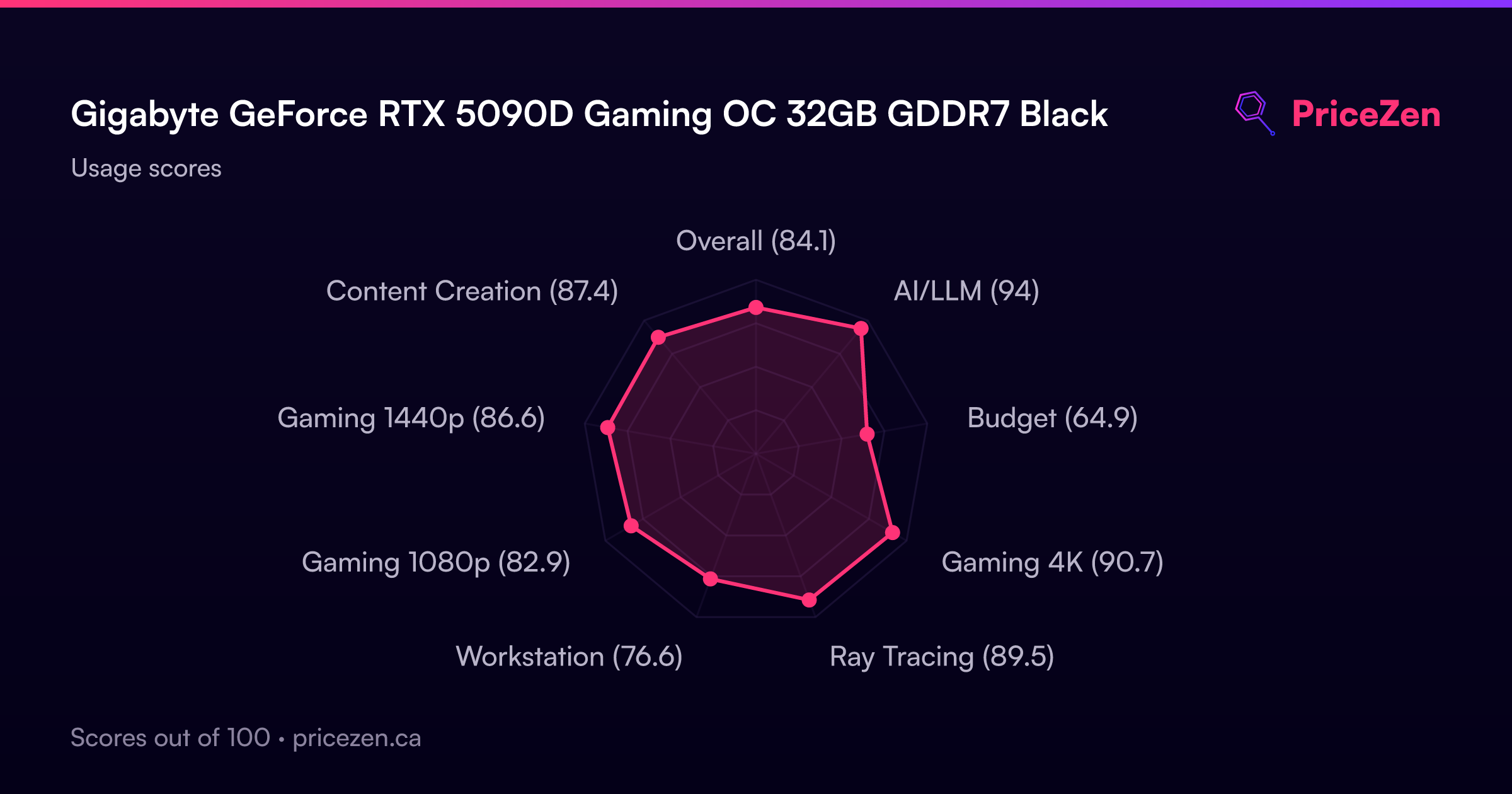
Usage Scores
- Overall84.1
- AI/LLM94
- Budget64.9
- Gaming 4K90.7
- Ray Tracing89.5
- Workstation76.6
- Gaming 1080p82.9
- Gaming 1440p86.6
- Content Creation87.4