PowerColor Radeon RX 6900 XT Red Devil OC 16GB GDDR6

Runs cool where other cards run hot verified Nov 23
71/100 overall score 4.3 average from 352 owner ratings
- GPU
- Radeon RX 6900 XT
- VRAM
- 16GB GDDR6
- Boost clock
- 2340 MHz
- TDP
- 300 W
- Memory bus
- 256 bit
- Ray tracing
- Yes
- Class
- consumer
Compare prices at 1 store
Cheapest first. New, refurbished and bundled offers are kept apart, so you compare like with like.
| Store | Sold by | Colour and condition | Price | vs lowest | Last checked | Link |
|---|---|---|---|---|---|---|
| New1 offerSingle unit | ||||||
| Out of stock when last checked | ||||||
| Amazon | Not known | Not listed | No price | Out of stock | 6 days ago | Go to store |
 Source: PriceZen, checked Nov 22, 2026
A price counts as current when we checked it in the last 7 days. “Marketplace seller” means a third-party seller on that store, not the store itself.
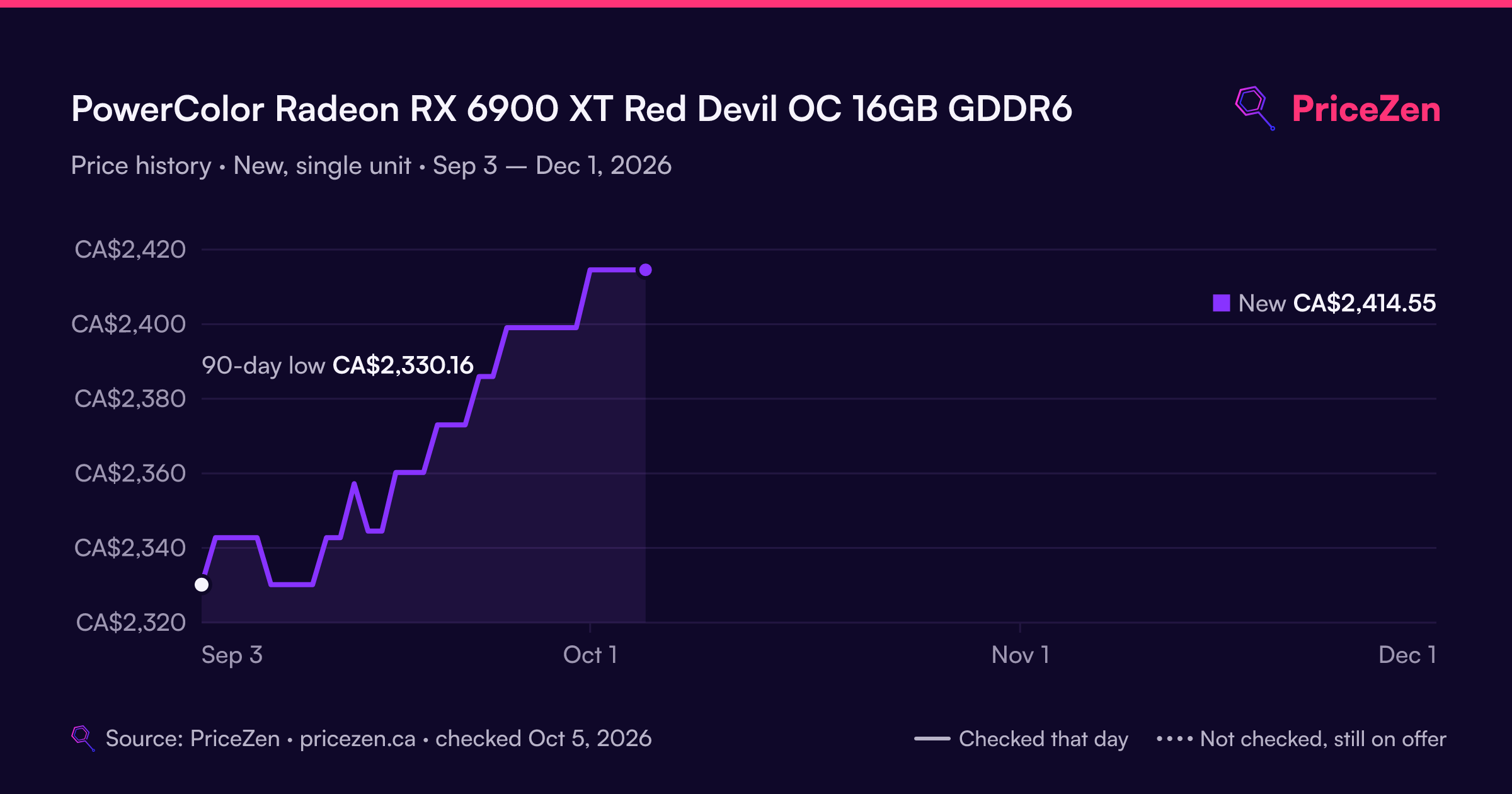
Price history
Checked that dayNot checked that day, still on offer
Source: PriceZen, checked Oct 5, 2026







Snapshot
The 30-Second Version
The PowerColor Red Devil RX 6900 XT is a 4K gaming graphics card that still punches above its weight in rasterized performance. It runs cool and quiet, has 16GB of VRAM, and offers great value against Nvidia's 3080 series. Just don't expect much from ray tracing, and make sure your case and power supply can handle this triple-slot beast.
Pros & Cons
Pros
- Excellent 4K gaming performance for the price 92nd
- 16GB VRAM gives real headroom at high resolutions 80th
- Premium build quality with a solid support bracket 74th
- Quiet operation under normal gaming loads 70th
- Strong thermal performance, one of the best coolers we've seen
Cons
- Coil whine under heavy load is a common complaint
- Ray tracing performance lags behind Nvidia
- Triple-slot design won't fit in smaller cases
- Requires three 8-pin power connectors and a beefy PSU
- Driver crashes and black screen issues reported by some owners
What owners think
The Word on the Street
- Buyers consistently praise the 4K gaming performance, with many noting it delivers roughly double the frame rates of a GTX 1080 Ti.
- The build quality gets a lot of love, with owners highlighting the premium feel, included support bracket, and quiet operation during normal use.
- A recurring complaint is coil whine under load, along with occasional driver crashes and black screen issues that frustrate some owners.
How owner sentiment changed over time
ExclusiveBased on when customers actually wrote their reviews - so you can see whether early praise held up.
9 written reviews, Apr 2021 – Jan 2025: 8 happy, 1 mixed
Across all 352 store ratings: 4.3★. Most owners rate without writing a review. The chart counts the 9 written reviews.
Each dot is one written review, in the month it was written. Happy = 4-5★, mixed = 3★, unhappy = 1-2★.
The proof
Performance
In our database, this card scores a PassMark G3D of 26,652, which lands it in the 71st percentile for raster performance. That's a strong showing, especially for a card that's now two generations old. In practice, you're looking at roughly double the performance of a GTX 1080 Ti, which multiple owners have confirmed. 4K gaming at 60+ FPS is very achievable in most titles, and 1440p is basically a walk in the park.
The 16GB of VRAM is a real advantage here. At 4K with high-res textures, that buffer gives you headroom that 8GB and even 10GB cards simply don't have. Memory bandwidth sits at 512 GB/s, which is solid but not class-leading. Thermal performance is where this card really shines though. The triple-fan cooler keeps things surprisingly cool, landing in the 92nd percentile for thermals. Under normal gaming loads, it stays quiet. Push it hard with a sustained 4K session and you'll hear the fans spin up, but it's not obnoxious.
Ray tracing is the weak spot. The 80 RT cores put it in the 71st percentile for RT, but that's a generous ranking when you compare it to Nvidia's RTX 30 and 40 series. In games with heavy ray tracing, expect a significant performance hit. If RT is a priority for you, this isn't the card to buy.
Specifications
Full Specifications
Chipset
| GPU Chipset | Radeon RX 6900 XT |
| Brand | AMD |
| Architecture | RDNA 2 |
| Class | consumer |
| Process | 7 |
Memory
| VRAM | 16 GB |
| Memory Type | GDDR6 |
| Memory Bus | 256 |
| Bandwidth | 512 |
Compute
| Stream Processors | 5120 |
| RT Cores | 80 |
| Base Clock | 2105 |
| Boost Clock | 2340 |
| FP16 TFLOPS | 46.08 |
| FP32 TFLOPS | 23.04 |
Performance
| PassMark G3D | 26652 |
| GPU Compute | 14391 |
Power & Cooling
| TDP | 300 |
| Recommended PSU | 900 |
| Power Connectors | 3 x 8-Pin |
| Cooler | Triple Fan |
| Fans | 3 |
Connectivity
| Interface | PCI Express 4.0 |
| DisplayPort | 3 |
| HDMI | 1 |
| Max Displays | 4 |
| Max Resolution | 7680 x 4320 |
Physical
| Length | 320 |
| Slot Width | 3 |
| Form Factor | ATX |
| Weight | 2.4 kg / 5.3 lbs |
Features
| Ray Tracing | Yes |
| Upscaling | AMD FidelityFX |
| AV1 Encode | No |
| VR Ready | Yes |
| DirectX | 12 |
| RGB | No |
vs Competition
Against the RTX 3080, the Red Devil 6900 XT wins on raw rasterization and VRAM capacity. The 3080's 10GB feels cramped at 4K in newer titles, while the 6900 XT's 16GB gives you breathing room. But the 3080 pulls ahead in ray tracing and has DLSS, which is a big deal if you play RT-heavy games. The 3080 Ti is a closer match in raster, but it typically costs more on the used market.
Compared to newer cards like the RTX 4070 Ti or RX 7900 XT, the 6900 XT shows its age. The 7900 XT beats it across the board, including ray tracing, and draws less power doing it. The 4070 Ti offers similar raster performance with vastly better RT and DLSS 3 frame generation. If you can stretch your budget, those are better long-term buys. But if you find a 6900 XT at a good price and you mostly play non-RT games at 4K, it's still a capable card.
| Spec | PowerColor Radeon RX 6900 XT Red Devil OC | ASUS GeForce RTX 5090 TUF Gaming | Gigabyte GeForce RTX 5070 Ti Eagle Ice | MSI GeForce RTX 5070 Ti Ventus 3X OC | ZOTAC GeForce RTX 5080 APOCALYPSE | PNY GeForce RTX 5080 ARGB OC |
|---|---|---|---|---|---|---|
| Chipset | Radeon RX 6900 XT | GeForce RTX 5090 | GeForce RTX 5070 Ti | GeForce RTX 5070 Ti | GeForce RTX 5080 | GeForce RTX 5080 |
| Vram | 16GB GDDR6 | 32GB GDDR7 | 16GB GDDR7 | 16GB GDDR7 | 16GB GDDR7 | 16GB GDDR7 |
| Boost Clock Mhz | 2340 | 2407 | 2542 | 2482 | 2730 | 2620 |
| Tdp W | 300 | 575 | 300 | 300 | 360 | 360 |
| Memory Bus Bits | 256 | 512 | 256 | 256 | 256 | 256 |
| Ray Tracing | Yes | Yes | Yes | Yes | Yes | Yes |
| GPU Class | consumer | consumer | consumer | consumer | consumer | consumer |
| Compare | Compare | Compare | Compare | Compare |
| Product | AI | Rt | Vram | Raster | Compute | Feature | Thermal | User Sentiment | Efficiency | Connectivity | Social Proof | Affordability |
|---|---|---|---|---|---|---|---|---|---|---|---|---|
| PowerColor Radeon RX 6900 XT Red Devil OC | 73.7 | 80.4 | 70.1 | 69.8 | 66 | 65.6 | 91.8 | 57.6 | 46.4 | 54.7 | 65.1 | 55.6 |
| ASUS GeForce RTX 5090 TUF Gaming Compare | 97.2 | 90.5 | 97.8 | 98.8 | 97.7 | 95.7 | 71.9 | 85 | 23.1 | 99.3 | 98.7 | 2.2 |
| Gigabyte GeForce RTX 5070 Ti Eagle Ice Compare | 78.9 | 88.6 | 86 | 88.9 | 87.9 | 95.7 | 91.8 | 85 | 71.7 | 94.2 | 93.4 | 22.8 |
| MSI GeForce RTX 5070 Ti Ventus 3X OC Compare | 78.9 | 92.4 | 86 | 88.9 | 87.9 | 95.7 | 91.8 | 85 | 71.7 | 94.2 | 83.9 | 21 |
| ZOTAC GeForce RTX 5080 APOCALYPSE Compare | 85.5 | 97.7 | 89.1 | 94.5 | 93.3 | 95.7 | 91.8 | 99.5 | 56.6 | 94.2 | 98.7 | 23.1 |
| PNY GeForce RTX 5080 ARGB OC Compare | 85.5 | 97.7 | 89.1 | 94.5 | 93.3 | 95.7 | 91.8 | 71.1 | 56.6 | 94.2 | 74.9 | 15.8 |
Price
Value & Pricing
Value is tricky here because pricing has been all over the map. At its original MSRP, this card was a tough sell. But at current used market prices, it's a different story. The sentiment summary from buyers consistently mentions value versus Nvidia's 3080 series as a positive. You're getting 3080 Ti-level raster performance with more VRAM, often for less money. That said, if you're coming from a 2080 Ti, the upgrade isn't dramatic enough to justify the cost. And if you're building new, you should at least glance at the RX 7900 XT or RTX 4070 Ti before committing to a used 6900 XT.
Read more
Overview
The PowerColor Red Devil RX 6900 XT is a big, beefy flagship card from AMD's RDNA 2 lineup. It's aimed squarely at 4K gaming and high-refresh 1440p, with 16GB of GDDR6 memory and a 2340MHz boost clock. PowerColor's Red Devil series has always been their premium tier, and this one comes with a massive triple-fan cooler, a support bracket, and a triple-slot design that demands a roomy case. Pricing is all over the place these days, but we've seen it listed around 11,384 MXN in Mexico, and used market prices vary wildly depending on when you're shopping.
If you're searching for a 4K gaming GPU that doesn't require selling a kidney for an RTX 4080 or 4090, this card keeps popping up in conversations. It's not the newest thing on the shelf anymore, but raw rasterization performance still holds up surprisingly well. The 5121 stream processors and 23 TFLOPS of FP32 compute put it in a class that was absolute top-tier just a couple years ago.
Is the RX 6900 XT good for 4K gaming? For most titles, yes. It'll push 60+ FPS at 4K in the vast majority of games without breaking a sweat. Just don't expect much from ray tracing, and keep your expectations realistic for AI workloads. This is a gaming card first and foremost.
Common Questions
Q: Is the RX 6900 XT good for 4K gaming?
Yes, the RX 6900 XT handles 4K gaming at 60+ FPS in most titles, especially with its 16GB of VRAM. It's one of the better budget options for 4K if you skip ray tracing.
Q: How does the RX 6900 XT compare to the RTX 3080?
The 6900 XT beats the RTX 3080 in raw rasterization and has more VRAM, but the 3080 wins on ray tracing and has DLSS support. For non-RT 4K gaming, the 6900 XT is often the better value.
Q: What power supply do I need for the RX 6900 XT?
PowerColor recommends a 700W PSU minimum, but many owners suggest 850W to 900W for headroom, especially since the card uses three 8-pin power connectors.
Q: Does the RX 6900 XT support ray tracing?
Yes, it has 80 ray tracing cores, but performance is noticeably weaker than Nvidia's RTX 30 and 40 series cards. Expect significant frame rate drops in RT-heavy games.
Who Should Skip This
Skip this card if you care about ray tracing or want DLSS. Nvidia's RTX 3080, 3080 Ti, or newer 4070 Ti will serve you much better in RT-heavy titles. Also skip it if you have a smaller case, since the triple-slot design and 332mm length won't fit in compact builds. If you're already on a 2080 Ti, the performance jump isn't worth the cost. And if you're sensitive to coil whine or want a plug-and-play experience without driver headaches, you might want to look at Nvidia alternatives or wait for a deal on the RX 7900 XT.
Verdict
Should you buy the PowerColor Red Devil RX 6900 XT? If you're on a budget and want strong 4K gaming without ray tracing, yes. It's a beast of a card for rasterized workloads, and the 16GB of VRAM future-proofs you better than most cards from its generation. The cooler is excellent, the build quality is top-notch, and it runs quiet when you're not pushing it to the limit.
But there are real caveats. Coil whine is a recurring complaint, and some owners have dealt with driver crashes and black screens. The triple-slot design means you need a big case, and the three 8-pin connectors mean you need a serious power supply. If ray tracing matters to you, or if you want DLSS, look elsewhere. For pure rasterized 4K gaming on a budget, this card still delivers.
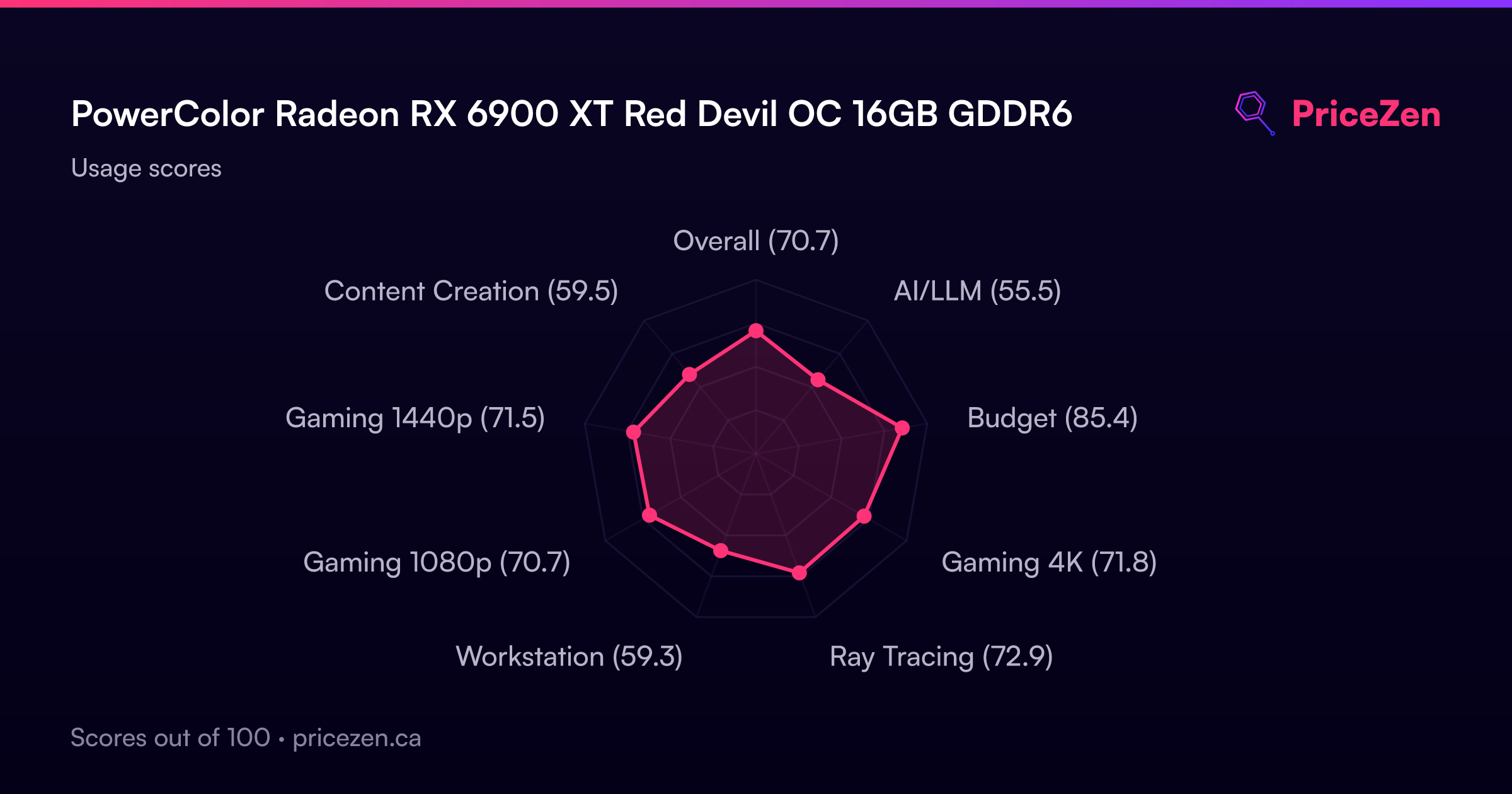
Usage Scores
- Overall70.7
- AI/LLM55.5
- Budget85.4
- Gaming 4K71.8
- Ray Tracing72.9
- Workstation59.3
- Gaming 1080p70.7
- Gaming 1440p71.5
- Content Creation59.5