ASUS GeForce GTX 1650 Phoenix OC 4GB GDDR6
The 4GB of GDDR6 memory on a 128-bit bus delivers 50% more bandwidth than standard GDDR5, making this a capable entry-level card for 1080p gaming at a 50W TDP. Its compact 174mm length and Axial-tech dual-fan cooler with Auto-Extreme manufacturing ensure reliable, quiet operation in small form factor builds. This card is best for budget-conscious gamers upgrading older office PCs that lack external PCIe power connectors.

No current retailer price











Snapshot
The 30-Second Version
The ASUS GeForce GTX 1650 Phoenix OC Edition is a compact, slot-powered graphics card that's perfect for upgrading older prebuilt PCs without touching the power supply. It delivers solid 1080p gaming in esports and older titles, runs quiet, and installs in minutes. But with only 4GB of VRAM and a $395 price tag, it's a poor value for anyone building a standard gaming PC.
Pros & Cons
Pros
- No external power connector needed, just slot it in 84th
- Compact 174mm length fits small cases and prebuilts 73rd
- Quiet operation at idle and light loads 72nd
- Solid 1080p performance in esports and older games 66th
- Easy drop-in upgrade for office PCs with weak PSUs
Cons
- 4GB VRAM limits modern AAA gaming hard
- Thermals are mediocre, heat exhausts into the case
- Fan can get noisy under sustained load
- Pricing is inflated due to market conditions
- Connectivity is sparse with just DP, HDMI, and DVI-D
What owners think
The Word on the Street
How owner sentiment changed over time
ExclusiveBased on when customers actually wrote their reviews - so you can see whether early praise held up.
13 written reviews, Oct 2020 – Aug 2025: 13 happy
Across all 448 store ratings: 4.6★. Most owners rate without writing a review. The chart counts the 13 written reviews.
Each dot is one written review, in the month it was written. Happy = 4-5★, mixed = 3★, unhappy = 1-2★.
The proof
Performance
The GTX 1650 Phoenix OC puts up a PassMark G3D score of 7873 in our database. That lands it in the 19th percentile for raster performance, which sounds rough until you remember what this card is for. It's not competing with RTX 5070s. It's competing with integrated graphics and whatever ancient GPU is currently sitting in someone's office PC. Against those, it's a massive leap.
In practice, you're looking at solid 1080p gaming at medium to high settings in lighter titles. Esports stuff like Valorant, CS2, Fortnite, and League run great. Older AAA games from a few years back are playable too. But 4GB of VRAM is the hard limit here. Modern titles like Cyberpunk or Alan Wake 2 will choke, and you'll be dropping settings to low or relying on upscaling tricks. The 128 GB/s memory bandwidth doesn't help either. FP32 compute sits at 2.98 TFLOPS, which is fine for what it is, but AI workloads are basically a non-starter at 8.3/100. Don't buy this for anything except gaming and basic display output.
Specifications
Full Specifications
Chipset
| GPU Chipset | GeForce GTX 1650 |
| Brand | NVIDIA |
| Architecture | Turing |
| Class | consumer |
| Process | 12 |
Memory
| VRAM | 4 GB |
| Memory Type | GDDR6 |
| Memory Bus | 128 |
| Bandwidth | 128.1 |
Compute
| CUDA Cores | 1024 |
| Base Clock | 1635 |
| Boost Clock | 1665 |
| FP16 TFLOPS | 5.967 |
| FP32 TFLOPS | 2.984 |
Performance
| PassMark G3D | 7873 |
| GPU Compute | 3038 |
Power & Cooling
| TDP | 75 |
| Recommended PSU | 250 |
| Cooler | Single Fan |
| Fans | 1 |
Connectivity
| Interface | PCI Express 3.0 x16 |
| DisplayPort | 1 |
| HDMI | 1 |
| Max Resolution | 7680 x 4320 |
Physical
| Length | 174 |
| Slot Width | 2 |
| Form Factor | Full Height |
| Weight | 0.5 kg / 1.1 lbs |
vs Competition
Compared to the Gigabyte AORUS RTX 5080 or MSI Shadow RTX 5070 Ti, the GTX 1650 Phoenix OC is in a completely different universe. Those cards are 4K gaming monsters with 16GB of VRAM and massive power requirements. The GTX 1650 isn't trying to compete with them, and it shouldn't be judged on that scale. The real comparison is against other low-power, slot-powered cards like the GTX 1050 Ti or RX 6400. Against the 1050 Ti, the 1650 is a clear step up in performance and efficiency. Against the RX 6400, it's a mixed bag. The RX 6400 is newer and sometimes cheaper, but it's limited to PCIe 4.0 x4, which cripples it on older PCIe 3.0 systems. The GTX 1650 runs at full PCIe 3.0 x16, so it's actually the better choice for older prebuilts.
If you have a standard ATX case and a decent PSU, skip this entirely. A used RTX 2060 or RX 6600 will give you dramatically better performance for similar or less money. The GTX 1650 Phoenix OC only makes sense when power and space constraints leave you with no other options.
| Spec | ASUS GeForce GTX 1650 Phoenix OC | Gigabyte GeForce RTX 5070 Ti Eagle Ice | MSI GeForce RTX 5070 Ti Ventus 3X OC | ZOTAC GeForce RTX 5080 APOCALYPSE | PNY GeForce RTX 5080 ARGB OC | Sapphire Radeon RX 9070 XT PULSE |
|---|---|---|---|---|---|---|
| Chipset | GeForce GTX 1650 | GeForce RTX 5070 Ti | GeForce RTX 5070 Ti | GeForce RTX 5080 | GeForce RTX 5080 | Radeon RX 9070 XT |
| Vram | 4GB GDDR6 | 16GB GDDR7 | 16GB GDDR7 | 16GB GDDR7 | 16GB GDDR7 | 16GB GDDR6 |
| Boost Clock Mhz | 1665 | 2542 | 2482 | 2730 | 2620 | 2970 |
| Tdp W | 75 | 300 | 300 | 360 | 360 | 304 |
| Memory Bus Bits | 128 | 256 | 256 | 256 | 256 | 256 |
| Ray Tracing | - | true | true | true | true | true |
| GPU Class | consumer | consumer | consumer | consumer | consumer | consumer |
| Compare | Compare | Compare | Compare | Compare |
| Product | AI | Rt | Vram | Raster | Compute | Feature | Thermal | User Sentiment | Efficiency | Connectivity | Social Proof | Affordability |
|---|---|---|---|---|---|---|---|---|---|---|---|---|
| ASUS GeForce GTX 1650 Phoenix OC | 15.4 | 17.9 | 16.8 | 18.4 | 12.5 | 10.9 | 25.6 | 71.5 | 66.2 | 20.8 | 83.8 | 73.3 |
| Gigabyte GeForce RTX 5070 Ti Eagle Ice Compare | 79.6 | 88.7 | 86 | 89 | 88.2 | 95.9 | 91.7 | 85.4 | 72.1 | 94.1 | 93.3 | 26.7 |
| MSI GeForce RTX 5070 Ti Ventus 3X OC Compare | 79.6 | 92.5 | 86 | 89 | 88.2 | 95.9 | 91.7 | 85.4 | 72.1 | 94.1 | 83.8 | 23.1 |
| ZOTAC GeForce RTX 5080 APOCALYPSE Compare | 85.7 | 97.6 | 89 | 94.5 | 93.5 | 95.9 | 91.7 | 99.5 | 57 | 94.1 | 98.7 | 20.3 |
| PNY GeForce RTX 5080 ARGB OC Compare | 85.7 | 97.6 | 89 | 94.5 | 93.5 | 95.9 | 91.7 | 45.5 | 57 | 94.1 | 74.7 | 14.5 |
| Sapphire Radeon RX 9070 XT PULSE Compare | 89.3 | 84.7 | 73.8 | 75.2 | 90.2 | 95.9 | 72.3 | 96 | 45.5 | 88.8 | 93.3 | 43.3 |
Price
Value & Pricing
Here's where things get tricky. The GTX 1650 launched years ago as a budget card, but current pricing sits around $395 USD on Amazon, which is frankly absurd for this level of performance. That's the market being weird, not ASUS being greedy. For that money, you could get a used RTX 3060 or RX 6600 that absolutely destroys this card in every metric. But those cards need external power and more space. If you're locked into a small form factor prebuilt with a 250W PSU, your options are limited, and the GTX 1650 Phoenix OC is one of the few cards that actually works. So the value proposition depends entirely on your situation. For a standard gaming PC build, this is a terrible deal. For a constrained prebuilt upgrade, it's one of the only games in town.
Read more
Overview
The ASUS GeForce GTX 1650 Phoenix OC Edition is a budget graphics card that's carved out a weirdly specific niche for itself. It's not chasing 4K, ray tracing, or any of that stuff. What it does is solve a very real problem: getting decent 1080p gaming into older or smaller PCs that can't handle a beefier card. With a 75W TDP and no external power connector needed, it just pulls everything from the PCIe slot. That's the whole pitch, and for a lot of people, it's exactly what they need.
We're looking at the Turing-based GTX 1650 with 4GB of GDDR6 on a 128-bit bus, 1024 CUDA cores, and a boost clock up to 1665MHz in OC mode. The Phoenix design keeps things compact at 174mm long, so it fits in small chassis and prebuilt office towers without drama. ASUS also threw in their Axial-tech fan, which is supposed to push more air with less noise.
Is the GTX 1650 good for gaming in 2025? For esports titles and older AAA games at 1080p, yes. For anything demanding, you'll feel the 4GB VRAM ceiling pretty fast. But if you're upgrading a Dell or HP prebuilt with a weak power supply, this might be the best drop-in option you can actually buy without swapping the PSU too.
Common Questions
Q: Is the ASUS GTX 1650 Phoenix OC good for gaming?
Yes, for 1080p gaming in esports titles and older AAA games, the GTX 1650 Phoenix OC performs well at medium to high settings. But the 4GB VRAM limits modern demanding games, so don't expect to run Cyberpunk or Alan Wake 2 smoothly.
Q: Does the GTX 1650 Phoenix OC need external power?
No, this card draws all its power from the PCIe slot with a 75W TDP. That makes it ideal for prebuilt PCs with weak power supplies that lack PCIe power cables.
Q: Will the GTX 1650 Phoenix OC fit in a small case?
Yes, at 174mm long and 2 slots wide, it fits in most small form factor cases and compact prebuilt towers. Just make sure your case has clearance for the cooler and bracket.
Q: How does the GTX 1650 compare to the GTX 1050 Ti?
The GTX 1650 is a clear upgrade over the GTX 1050 Ti, offering better performance and efficiency with the same slot-powered design. It's the better choice for upgrading older systems without changing the power supply.
Who Should Skip This
Skip this card if you're building a new gaming PC or have a standard ATX case with a decent power supply. For the same $395, you can find used RTX 3060 or RX 6600 cards that deliver dramatically better performance and more VRAM. Also skip it if you want to play modern AAA games at high settings, since 4GB of VRAM will bottleneck you hard. If you need ray tracing or AI workloads, this card is essentially useless for those tasks. And if you're sensitive to fan noise under load, the single Axial-tech fan can get audible when pushed hard. For those users, a dual-fan card or something with better thermals would be a smarter buy.
Verdict
Should you buy the ASUS GTX 1650 Phoenix OC? If you have an older prebuilt PC with a weak power supply and no PCIe power cables, and you want to play games at 1080p without rebuilding your whole system, then yes, this is one of the best options available. It's quiet, easy to install, and delivers a genuinely transformative upgrade over integrated graphics or ancient discrete cards. The 75W slot-powered design is the killer feature here, and nothing else in this price bracket does it as well.
But if you're building a new PC or have a standard case with a real PSU, don't buy this. The 4GB VRAM and aging Turing architecture are real limitations, and the current $395 price tag is hard to justify when much faster used cards are available for less. This is a specialist product for a specific problem. If you have that problem, it's great. If you don't, look elsewhere.
Usage Scores
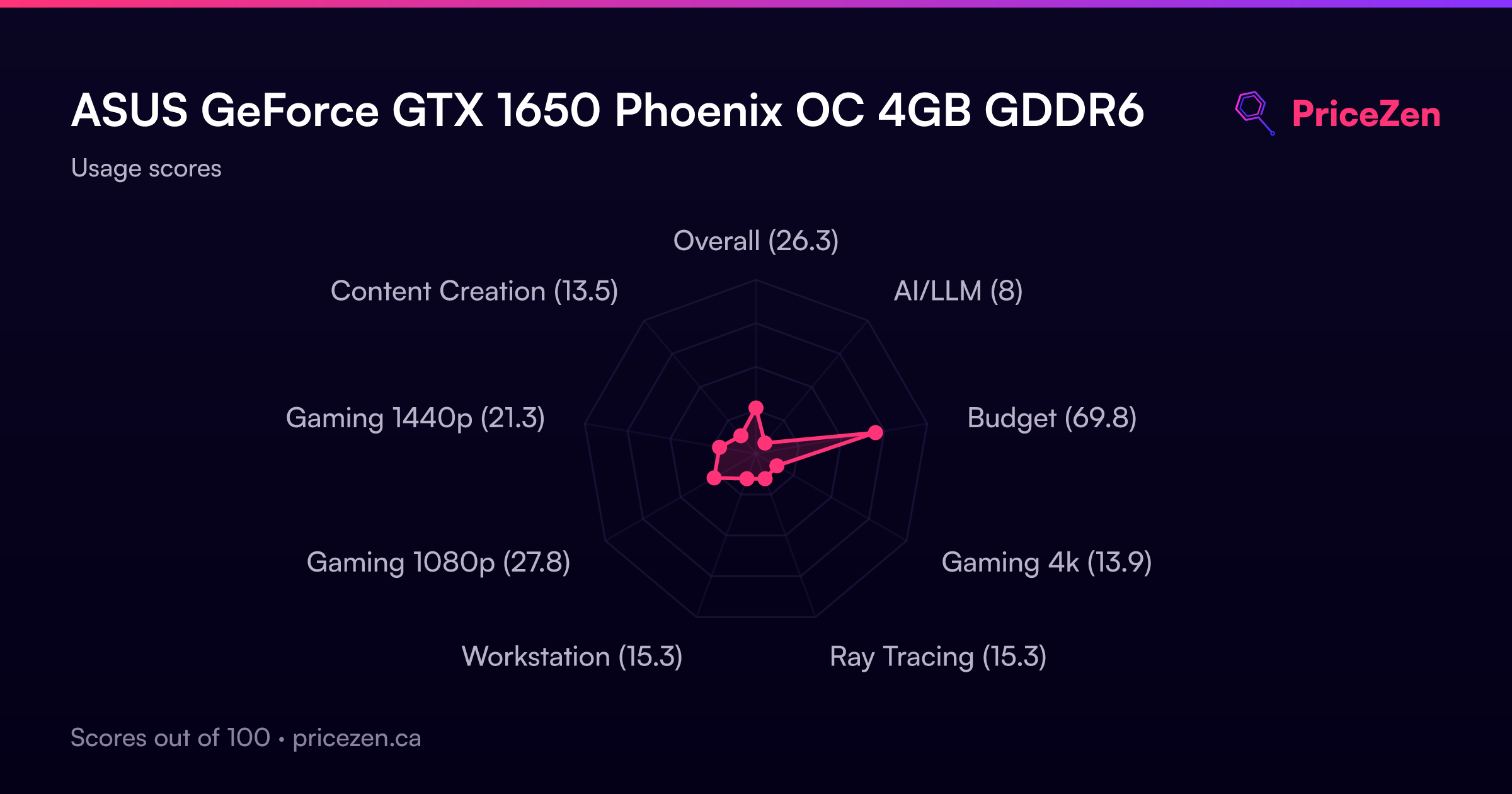
- Overall26.3
- AI/LLM8
- Budget69.8
- Gaming 4k13.9
- Ray Tracing15.3
- Workstation15.3
- Gaming 1080p27.8
- Gaming 1440p21.3
- Content Creation13.5