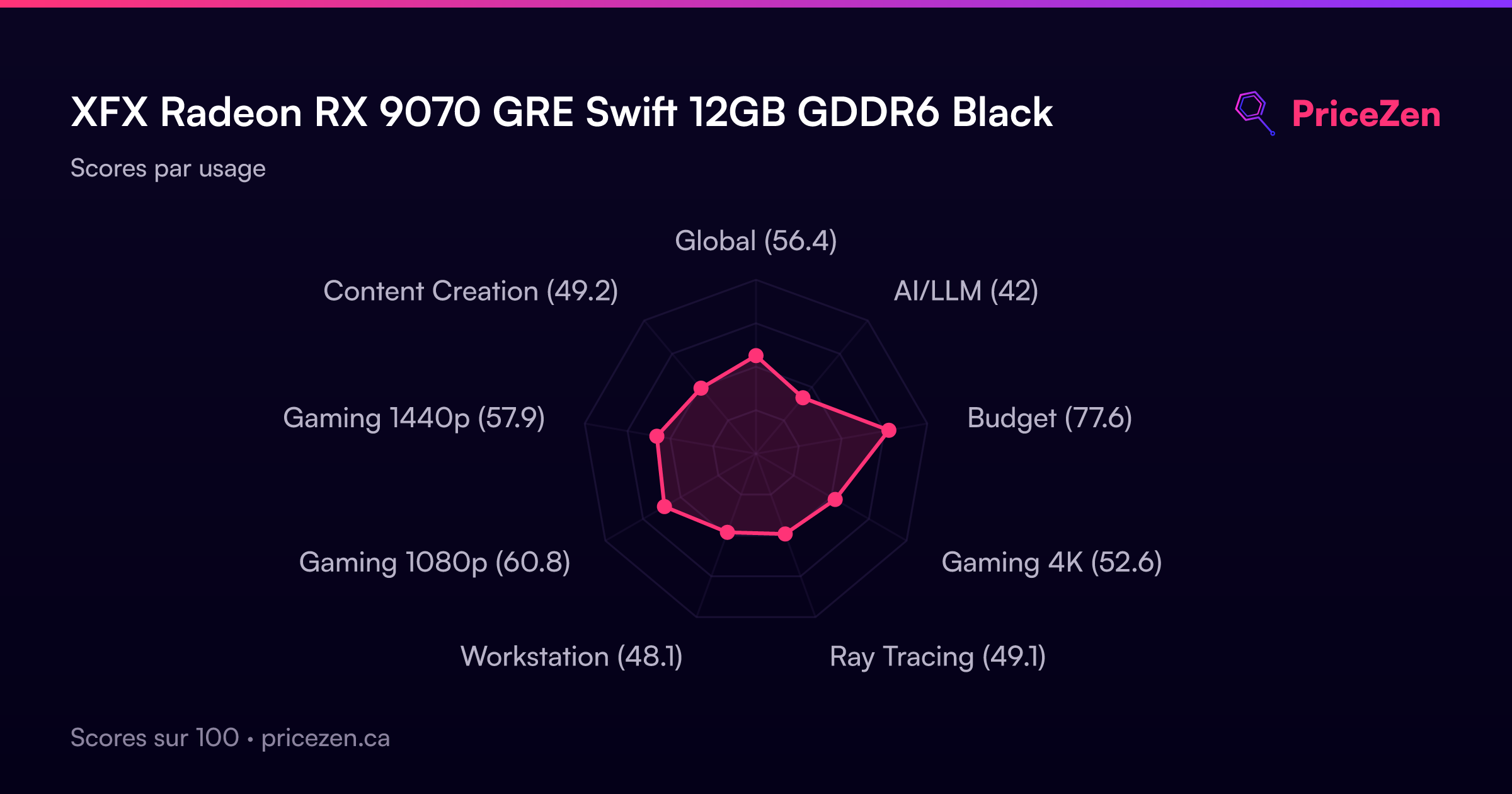
XFX Radeon RX 9070 GRE Swift 12GB GDDR6 Black

Interface PCIe 5.0 pour les cartes mères actuelles vérifié le 28 nov.
56/100 note globale
- GPU
- Radeon RX 9070 GRE
- VRAM
- 12GB GDDR6
- Boost clock
- 2790 MHz
- TDP
- 220 W
- Memory bus
- 192 bit
- Ray tracing
- Oui
- Class
- consumer
Aperçu
The 30-Second Version
A no-frills rasterization card at a fair price. Great if you hate paying for features you'll never use, disappointing if you actually want those features.
Pros & Cons
Points forts
- Strong budget value at $550, our model scores it 77.8/100 for affordability 81st
- Triple-fan cooler in a 2-slot, 301mm package fits most cases without drama 72nd
- DisplayPort 2.1 and PCIe 5.0 give you connectivity that punches above its price 69th
- Modest 220W TDP means a 650W PSU is all you need
Points faibles
- Ray tracing performance falls behind most competitors in this tier
- 12GB on a 192-bit bus is just adequate, not comfortable for future titles
- Feature set is sparse compared to Nvidia's RTX 5070 Ti alternatives
- AI and compute workloads are a weak spot, scoring only 42/100 for LLM tasks
Les preuves
Performance
The PassMark G3D benchmark score of 23571 lands this card squarely in the middle of the pack for raw rasterization, which tracks with its 1080p gaming score of 60.8 and 1440p score of 57.9 in our model. That's competent, not exciting. What caught our attention is the efficiency picture: 220W TDP with a triple-fan design and only a 2-slot footprint at 301mm long means this thing won't cook your case or demand a monster PSU. A 650W unit is the recommended minimum, and two 8-pin connectors keep cable management simple. The connectivity is actually a bright spot, ranking well above average thanks to three DisplayPort 2.1 outputs and one HDMI 2.1. PCI Express 5.0 support is future-proofing you won't need today but won't regret having tomorrow.
Specifications
Full Specifications
Chipset
| GPU Chipset | Radeon RX 9070 GRE |
| Brand | AMD |
| Architecture | RDNA 4 |
| Class | consumer |
Memory
| VRAM | 12 GB |
| Memory Type | GDDR6 |
| Memory Bus | 192 |
Compute
| Stream Processors | 3072 |
| Base Clock | 2220 |
| Boost Clock | 2790 |
Performance
| PassMark G3D | 23571 |
| GPU Compute | 13823 |
Power & Cooling
| TDP | 220 |
| Recommended PSU | 650 |
| Power Connectors | 2 x 8-Pin |
| Cooler | Triple Fan |
| Fans | 3 |
Connectivity
| Interface | PCI Express 5.0 |
| DisplayPort | 3 |
| HDMI | 1 |
| Max Displays | 4 |
Physical
| Length | 301 |
| Slot Width | 2 |
| Form Factor | ATX |
Features
| Ray Tracing | Yes |
| DirectX | 12 Ultimate |
vs Competition
The competition here is fierce. The Gigabyte RTX 5070 Ti Eagle Ice, MSI RTX 5070 Ti Ventus 3X OC, and PNY RTX 5070 Ti OC all sit in the same general neighborhood, and every one of them brings Nvidia's feature advantage to the fight. The ASUS RTX 5070 Ti ROG Strix OC is the premium option if you want top-tier build quality. And the ZOTAC RTX 5080 APOCALYPSE is a different weight class entirely. Against all of these, the XFX 9070 GRE's argument is simple: it costs less and draws less power. But its ray tracing ranks below average while its feature score sits in the bottom third. If you care about ray tracing or AI upscaling features, cross-shop the 5070 Ti options seriously. If you just want frames per dollar in traditional rendering, this XFX card makes a reasonable case.
| Spec | XFX Radeon RX 9070 GRE Swift | ASUS GeForce RTX 5090 TUF Gaming | Gigabyte GeForce RTX 5070 Ti Eagle Ice | MSI GeForce RTX 5070 Ti Ventus 3X OC | ZOTAC GeForce RTX 5080 APOCALYPSE | PNY GeForce RTX 5080 ARGB OC |
|---|---|---|---|---|---|---|
| Chipset | Radeon RX 9070 GRE | GeForce RTX 5090 | GeForce RTX 5070 Ti | GeForce RTX 5070 Ti | GeForce RTX 5080 | GeForce RTX 5080 |
| Vram | 12GB GDDR6 | 32GB GDDR7 | 16GB GDDR7 | 16GB GDDR7 | 16GB GDDR7 | 16GB GDDR7 |
| Boost Clock Mhz | 2790 | 2407 | 2542 | 2482 | 2730 | 2620 |
| Tdp W | 220 | 575 | 300 | 300 | 360 | 360 |
| Memory Bus Bits | 192 | 512 | 256 | 256 | 256 | 256 |
| Ray Tracing | Yes | Yes | Yes | Yes | Yes | Yes |
| GPU Class | consumer | consumer | consumer | consumer | consumer | consumer |
| Compare | Compare | Compare | Compare | Compare |
| Produit | AI | Rt | Vram | Raster | Compute | Feature | Thermal | Efficiency | Connectivity | Affordability |
|---|---|---|---|---|---|---|---|---|---|---|
| XFX Radeon RX 9070 GRE Swift | 63.3 | 42.8 | 52.5 | 62 | 58.6 | 32.4 | 71.8 | 68.6 | 81.3 | 54.4 |
| ASUS GeForce RTX 5090 TUF Gaming Compare | 97.2 | 90.5 | 97.8 | 98.8 | 97.7 | 95.7 | 71.8 | 23.1 | 99.3 | 2.2 |
| Gigabyte GeForce RTX 5070 Ti Eagle Ice Compare | 78.9 | 88.6 | 86 | 88.9 | 87.9 | 95.7 | 91.8 | 71.6 | 94.2 | 22.9 |
| MSI GeForce RTX 5070 Ti Ventus 3X OC Compare | 78.9 | 92.4 | 86 | 88.9 | 87.9 | 95.7 | 91.8 | 71.6 | 94.2 | 21 |
| ZOTAC GeForce RTX 5080 APOCALYPSE Compare | 85.5 | 97.7 | 89.1 | 94.4 | 93.3 | 95.7 | 91.8 | 56.6 | 94.2 | 23 |
| PNY GeForce RTX 5080 ARGB OC Compare | 85.5 | 97.7 | 89.1 | 94.4 | 93.3 | 95.7 | 91.8 | 56.6 | 94.2 | 15.8 |
Prix
Value & Pricing
At $550, this is a fair deal if pure rasterization gaming on a budget is your priority. Our affordability ranking puts it slightly above the midpoint, meaning you're not getting a steal but you're not overpaying either. The budget score of 77.8 is the strongest number on this card's report card. If that's what matters most to you, the price-to-performance math works. Just don't expect it to compete with cards that cost significantly more in features or ray tracing.
En savoir plus
Overview
The XFX Radeon RX 9070 GRE Swift is a solid mid-range card that knows exactly what it is: a budget-friendly rasterization workhorse. At $550 from Newegg, you're getting RDNA 4 architecture with 3072 stream processors and a 2790 MHz boost clock, wrapped in a triple-fan cooler that keeps things reasonable at 220W. Our scoring model puts its budget value at 77.8 out of 100, which tells you the real story here. This card isn't trying to win any beauty contests or AI benchmarks. It's trying to give you playable framerates without emptying your wallet.
But let's be honest about the trade-offs. The 12GB of GDDR6 on a 192-bit bus is adequate, not generous. Ray tracing performance sits below average in our rankings, and the feature set is thin compared to what Nvidia's competing cards bring to the table. If you want DLSS, frame generation tricks, or strong ray tracing, you're shopping in the wrong aisle.
Common Questions
Q: What are the actual clock speeds on this card?
The game clock runs at 2220 MHz and the boost clock hits 2790 MHz. That boost number is healthy for RDNA 4, though real-world sustained clocks will depend on your case airflow and thermal headroom.
Q: Will 12GB of VRAM be enough for modern games?
For 1080p, absolutely. For 1440p, you're fine in most current titles but some demanding games with high-res textures will push against that ceiling. The 192-bit bus also limits bandwidth compared to wider configurations, so don't expect miracles at 4K.
Q: Do I need a beefy power supply for this card?
Nope. XFX recommends a 650W PSU minimum, and with a 220W TDP plus two standard 8-pin connectors, you're not asking much of your system. Most decent mid-range builds already have enough headroom.
Who Should Skip This
If you want strong ray tracing, AI upscaling, or plan to run local LLMs, this isn't your card. The RT performance is below average and the AI score is a dismal 42/100. Go look at the Gigabyte RTX 5070 Ti Eagle Ice or the MSI RTX 5070 Ti Ventus 3X OC instead. You'll pay more, but you'll get a fundamentally more capable feature set.
Verdict
Buy the XFX RX 9070 GRE Swift if you're building a budget-conscious gaming rig focused on rasterized titles at 1080p or 1440p and you don't care about ray tracing or Nvidia's software features. Skip it if you want a card that'll handle ray-traced games well or double as an AI workstation. At $550, it does one job competently. Just make sure that one job is the job you actually need done.
Usage Scores
- Global56.4
- AI/LLM42
- Budget77.6
- Gaming 4K52.6
- Ray Tracing49.1
- Workstation48.1
- Gaming 1080p60.8
- Gaming 1440p57.9
- Content Creation49.2