TCL QM7K Series 85QM7K 85"
The QD-Mini LED backlight with up to 2500 local dimming zones delivers pixel-level precision and halo-free images, outperforming standard QLED contrast. The included 5.1-channel sound bar with Dolby Atmos provides a simplified, room-filling home theater setup through a single HDMI cable. This 85-inch TV is best for sports enthusiasts who prioritize deep blacks and high brightness in a large-screen format.

No current retailer price
Where we saw it before. Check the store for today's price.











Snapshot
The 30-Second Version
The QM7K hits 3000 nits peak brightness with up to 2500 local dimming zones, landing it in the top 2% for picture quality in our database. It's a 144Hz Mini-LED monster, and listings now start at USD 723, well under where it sat before. The Wi-Fi 5 and 518W power draw are the main trade-offs.
Pros & Cons
Pros
- 3000 nits peak brightness, top of the charts for HDR impact 96th
- Up to 2500 local dimming zones for near-OLED black levels 96th
- 144Hz native refresh rate with FreeSync Premium Pro 95th
- 98th percentile picture quality in our database 92nd
- Anti-reflective CrystGlow HVA panel handles bright rooms well
Cons
- Wi-Fi 5, not Wi-Fi 6 or 6E, feels dated for a 2025 flagship
- 518W power draw is hefty, expect a bump in the electric bill
- 75.3 lbs without a stand, you'll want help mounting this
- Portable score of 58.4 is a real weak spot, this TV is not moving once set up
What owners think
The Word on the Street
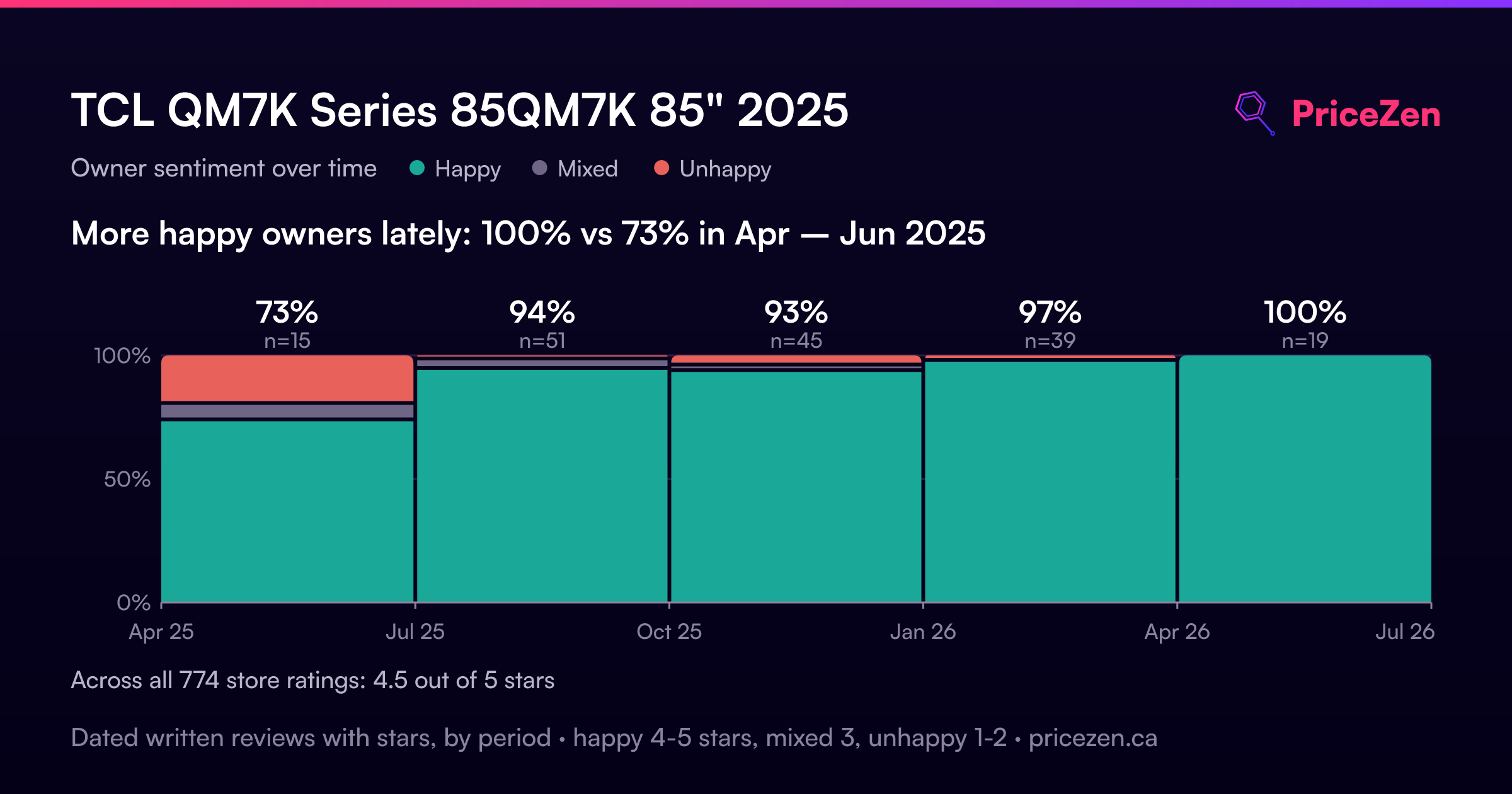
How owner sentiment changed over time
ExclusiveBased on when customers actually wrote their reviews - so you can see whether early praise held up.
More happy owners lately: 100% vs 73% in Apr – Jun 2025
Across all 944 store ratings: 4.5★. Most owners rate without writing a review. The chart counts the 169 written reviews with stars and their own date.
1 written review without stars is left out of the trend.
Show the numbers
| Period | Reviews | Happy | Mixed | Unhappy | Happy share |
|---|---|---|---|---|---|
| Apr – Jun 2025 | 15 | 11 | 1 | 3 | 73% |
| Jul – Sep 2025 | 51 | 48 | 2 | 1 | 94% |
| Oct – Dec 2025 | 45 | 42 | 1 | 2 | 93% |
| Jan – Mar 2026 | 39 | 38 | 0 | 1 | 97% |
| Apr – Jun 2026 | 19 | 19 | 0 | 0 | 100% |
Each column joins calendar quarters until it holds at least 10 reviews with stars and their own date. Happy = 4-5★, mixed = 3★, unhappy = 1-2★.
The proof
Performance
This is where the QM7K earns its keep. The 3000 nits peak brightness is best-in-class territory, and with up to 2500 dimming zones, blooming is kept on a very short leash. The Halo Control System sounds like marketing speak, but the results show up in the numbers: 98th percentile for picture quality and 92nd for HDR. The 144Hz native refresh rate is a standout for gaming, and our 93rd percentile gaming score backs that up. Motion Rate 480 is TCL's interpolation trick, but the native 144Hz panel is the real story for fast action and sports. The AIPQ PRO processor handles upscaling well, and the 4K resolution gives it plenty of pixels to work with on an 85-inch canvas.
Specifications
Full Specifications
Display
| Size | 85" |
| Resolution | 4K |
| Panel Type | Mini-LED |
| Backlight | Full-Array LED |
| Aspect Ratio | 16:9 |
| Curved | No |
| Screen Finish | semi_glossy |
Picture Quality
| Brightness | 3000 nits |
| Peak Brightness | 3000 |
| Contrast Ratio | infinite |
| Color Gamut | Enhanced QLED |
| Motion Tech | Motion Rate 480 |
| Processor | TCL AIPQ PRO Processor |
HDR
| HDR Formats | Dolby Vision, HDR 10+, HDR 10, Hybrid Log-Gamma (HLG) |
| Dolby Vision | Yes |
| HDR10+ | Yes |
| HLG | Yes |
Gaming
| Refresh Rate | 144 Hz |
| VRR | FreeSync Premium Pro |
| ALLM | Yes |
| Game Mode | Yes |
Smart TV
| Platform | Google TV |
| Voice Assistant | Google Assistant, Amazon Alexa |
| Screen Mirroring | Apple AirPlay 2 |
| Works With | Amazon Alexa, Google Home, Apple Home |
Audio
| Speaker Config | 5.1 |
| Dolby Atmos | Yes |
| Surround Sound | Dolby Atmos, IMAX Enhanced, Dolby Digital Plus, Dolby Digital, DTS:X, DTS Virtual:X |
| eARC | Yes |
Connectivity
| HDMI Ports | 4 |
| HDMI Version | 2.1 |
| USB Ports | 2 |
| Wi-Fi | Wi-Fi 5 |
| Bluetooth | 5.4 |
| Ethernet | Yes |
| Optical Audio | Yes |
| VESA Mount | 600x400 |
Power & Size
| Power | 518 |
| Energy Star | No |
| Annual Energy | 518 |
| Weight | 34.1 kg / 75.2 lbs |
vs Competition
Our ranking puts the LG OLED evo OLED55C5PUA in the same conversation, and the trade-off is clear from the QM7K's own numbers: 3000 nits of peak brightness and up to 2500 dimming zones on an 85-inch canvas, versus per-pixel contrast and wider viewing angles on the OLED side. The Sony BRAVIA 5 K65XR50 is the other name buyers cross-shop, but the QM7K's picture quality score is in the top 2% and its HDR score is in the top 8%, which are what we'd point to first. Against the Hisense U7 Series 65U75QG, the QM7K's brightness and zone count are the headline specs in our data, and both sit well up our category ranking. The Samsung Neo QLED QN80H lands in the same top five, and with the QM7K now starting at USD 723 for an 85-inch panel, the value argument leans heavily TCL's way. The Roku Pro Series 75R8C5 rounds out the group as the simpler, cheaper-feeling option, though it isn't in the same conversation for picture quality.
| Spec | TCL QM7K Series 85QM7K 85" | Samsung QN990F QN75QN990FFXZA 75" | LG OLED evo OLED55C5PUA 55" | Sony A95L XR77A95L 77" | Hisense U7 Series 65U75QG 64.5" | Roku Plus Series 55R6C7 55" |
|---|---|---|---|---|---|---|
| Screen Size | 85 | 75 | 55 | 77 | 64.5 | 55 |
| Resolution | 3840x2160 | 7680x4320 | 3840x2160 | 3840x2160 | 3840x2160 | 3840x2160 |
| Panel Type | Mini-LED | QD-Mini-LED | OLED | QD-OLED | Mini-LED | Mini-LED |
| Refresh Rate | 144 | 120 | 120 | 120 | 165 | 60 |
| Hdr | Dolby Vision, HDR 10+, HDR 10, Hybrid Log-Gamma (HLG) | HDR10, HDR10+, HLG | Dolby Vision, HDR10 | HDR10, HLG, Dolby Vision | Dolby Vision, HDR 10+, HDR 10, Hybrid Log-Gamma (HLG) | Dolby Vision, HDR 10+, Hybrid Log-Gamma (HLG) |
| Smart Platform | Google TV | Tizen | webOS | Google TV | Google TV | Roku TV |
| Dolby Vision | Yes | No | Yes | Yes | Yes | Yes |
| Dolby Atmos | Yes | Yes | Yes | Yes | Yes | Yes |
| Hdmi Version | 2.1 | 2.1 | 2.1 | 2.1 | 2.1 | 2.1 |
| Compare | Compare | Compare | Compare | Compare |
| Product | HDR | Audio | Smart | Gaming | Display | Connectivity | Social Proof | Affordability | Picture Quality |
|---|---|---|---|---|---|---|---|---|---|
| TCL QM7K Series 85QM7K 85" | 88.2 | 89.9 | 96.1 | 91.8 | 94.8 | 85.7 | 77.9 | 30.9 | 96.1 |
| Samsung QN990F QN75QN990FFXZA 75" Compare | 91.6 | 99.7 | 90.5 | 86.3 | 99.8 | 99.9 | 99.6 | 13.1 | 98.9 |
| LG OLED evo OLED55C5PUA 55" Compare | 90.1 | 93.3 | 86.4 | 97.5 | 86.6 | 98.6 | 92.8 | 36.1 | 92 |
| Sony A95L XR77A95L 77" Compare | 95.6 | 94.4 | 86.4 | 83.6 | 99.1 | 95.9 | 85.2 | 10 | 94.9 |
| Hisense U7 Series 65U75QG 64.5" Compare | 88.2 | 94.4 | 93.2 | 94.1 | 76 | 91 | 85.2 | 57.7 | 96.9 |
| Roku Plus Series 55R6C7 55" Compare | 70.3 | 79.7 | 99.5 | 57.2 | 76 | 85.7 | 92.8 | 75.6 | 34.1 |
Price
Value & Pricing
Pricing on the QM7K is all over the place right now. We're seeing USD 723 to USD 1,500 across US listings, a spread of USD 777 for the exact same panel. That's a huge gap, so shop around before you commit. The low end has dropped hard from where this set was sitting, and at USD 723 an 85-inch Mini-LED with 3000 nits and up to 2500 zones is close to absurd value. At the high end you're paying flagship money for the same hardware, which makes no sense when the cheaper listing exists. We track its price over time, partly through our community browser extension, and the move to watch is that bottom number: grab it near there and the price per inch of quality here is genuinely hard to beat.
Read more
Overview
The TCL QM7K lands in our database with a 98th percentile picture quality score, which puts it in the absolute best tier of TVs we track. That's driven by 3000 nits of peak brightness and up to 2500 local dimming zones, a combo that produces the kind of contrast and specular pop you usually have to pay a lot more for. The 85-inch size class means this thing is a statement piece, and the anti-reflective CrystGlow HVA panel helps it hold up in bright rooms where lesser TVs wash out.
Common Questions
Q: How does the QM7K compare to OLED TVs for picture quality?
The QM7K's 3000 nits peak brightness and 2500 dimming zones give it a 98th percentile picture quality score in our database, which puts it ahead of most OLEDs for bright-room HDR impact. OLEDs still win on per-pixel contrast and viewing angles, but the QM7K closes the gap significantly while avoiding burn-in risk.
Q: Is the 144Hz refresh rate real or just marketing?
It's a native 144Hz panel, not an interpolated number. Our gaming score for the QM7K lands in the 93rd percentile, and with FreeSync Premium Pro and HDMI 2.1 support, it's a legitimate high-refresh gaming display for PC and console.
Q: How many local dimming zones does the 85-inch model have?
The 85QM7K features up to 2500 precisely controlled local dimming zones. Combined with the 3000 nits peak brightness, this gives it exceptional contrast and minimal blooming for a Mini-LED TV.
Who Should Skip This
If you're planning to move this TV around or mount it solo, the 75.3 lb weight and 58.4 portable score should give you pause. This is a set-it-and-forget-it panel. The Wi-Fi 5 is also a legitimate annoyance if you have a Wi-Fi 6 or 6E mesh network and want maximum wireless throughput for 4K streaming. And if you're sensitive to power consumption, the 518W draw is on the higher end for this size class. OLED purists who watch mostly in dark rooms and want the absolute best per-pixel contrast should still look at the LG OLED evo OLED55C5PUA instead.
Verdict
The TCL QM7K is the kind of TV that makes you question why anyone pays more. A picture quality score in the top 2%, 3000 nits of brightness, and up to 2500 dimming zones is a genuinely disruptive combo, and with listings now starting at USD 723 the value case got a lot stronger. The 144Hz panel and a gaming score in the top 7% make it a legit option for console and PC gamers alike. The Wi-Fi 5 and power draw are annoyances, not dealbreakers. If you want an 85-inch screen that punches way above its price class, this is the one to beat right now, just don't pay the top of the price range for it.
Usage Scores
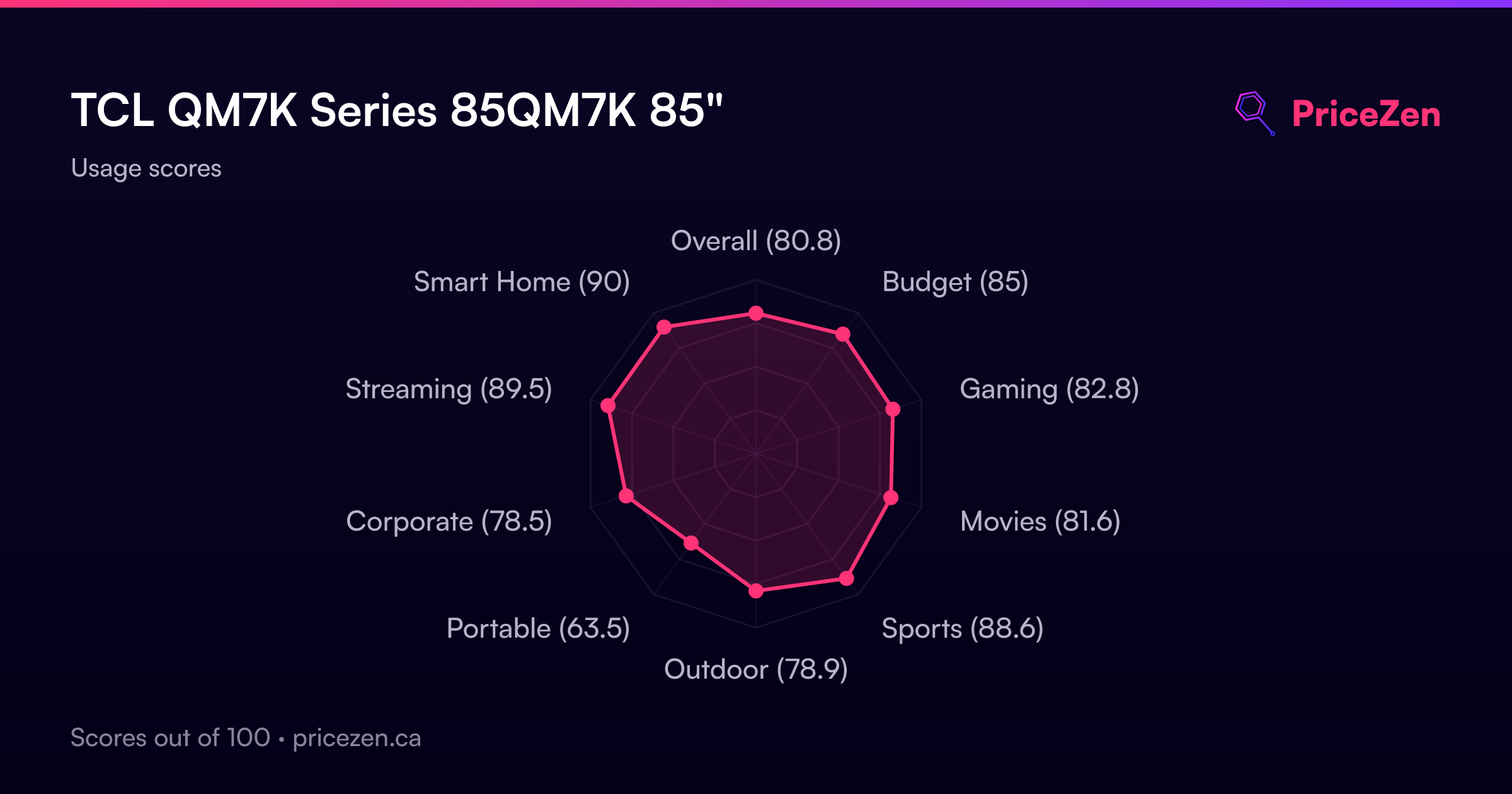
- Overall80.8
- Budget85
- Gaming82.8
- Movies81.6
- Sports88.6
- Outdoor78.9
- Portable63.5
- Corporate78.5
- Streaming89.5
- Smart Home90