TCL QM8L Series 98QM8L 97.5"

6,000 nits on a 97.5-inch screen verified Nov 19
81/100 overall score 4.6 average from 55 owner ratings
- Screen
- 97.5"
- Resolution
- 3840x2160
- Panel
- Mini-LED
- Refresh
- 144 Hz
- HDR
- Dolby Vision, Hybrid Log-Gamma (HLG), HDR 10+, HDR 10
- Smart platform
- Google TV
- Dolby vision
- Yes
- Dolby atmos
- Yes
Compare prices at 2 stores
Cheapest first. New, refurbished and bundled offers are kept apart, so you compare like with like.
| Store | Sold by | Colour and condition | Price | vs lowest | Last checked | Link |
|---|---|---|---|---|---|---|
| New2 offersSingle unit | ||||||
| Out of stock when last checked | ||||||
| Visions Electronics | Visions Electronics | Not listed | No price | Out of stock | Nov 22 | Go to store |
| Amazon | Not known | Not listed | No price | Out of stock | Sep 30 | Go to store |
 Source: PriceZen, checked Nov 22, 2026
A price counts as current when we checked it in the last 7 days. “Marketplace seller” means a third-party seller on that store, not the store itself.











Snapshot
The 30-Second Version
The TCL QM8L is a 98-inch Mini-LED beast with a ridiculous 6000 nits peak brightness and 100% BT.2020 color. It's got 144Hz gaming support and picture quality in the 99th percentile of our database. Pricing has come down and now runs from USD 2,670 to USD 3,000 depending on vendor, so the spread is narrow and there's no bad listing to fall into. If you want the biggest, brightest screen possible and don't need OLED's perfect blacks, this is a top pick.
Pros & Cons
Pros
- 6000 nits peak brightness is the highest we've seen in this category 99th
- 100% BT.2020 color coverage with the new Super QLED layer 95th
- 144Hz native refresh with FreeSync Premium Pro for serious gaming 94th
- All four HDMI ports support HDMI 2.1 93rd
- WHVA 2.0 Ultra Panel with anti-reflective coating and wide viewing angles
- Picture quality in the 99th percentile of our database
- Pricing has dropped to USD 2,670 to USD 3,000, with a much narrower gap between vendors
Cons
- 575W power draw is a lot, even for a 98-inch TV
- 7000:1 contrast ratio can't match OLED black levels
- 55kg weight means you'll need a serious wall mount and probably two people
- Display score is only 57th percentile, which is odd for a flagship
- Built-in audio is a starting point at this size, so budget for a soundbar or surround system
What owners think
How owner sentiment changed over time
ExclusiveBased on when customers actually wrote their reviews - so you can see whether early praise held up.
8 written reviews, May – Nov 2026: 8 happy
Across all 55 store ratings: 4.6★. Most owners rate without writing a review. The chart counts the 8 written reviews.
Each dot is one written review, in the month it was written. Happy = 4-5★, mixed = 3★, unhappy = 1-2★.
The proof
Performance
Let's talk about that 6000 nits number, because it's the whole story here. Most HDR content is mastered at 1000 to 4000 nits, so this TV can display essentially everything without tone mapping. Highlights will punch hard. Sunlight, explosions, neon signs, they'll all have a physical intensity that most TVs simply can't produce. The picture quality ranking puts this in the 99th percentile, which means it's competing with the absolute best panels on the market. The 7000:1 contrast ratio is strong for a Mini-LED, though it's not OLED-level. That's the trade-off. You get insane brightness, but blacks won't be quite as perfect as an OLED in a dark room.
The gaming side is equally serious. 144Hz native refresh with FreeSync Premium Pro means this thing can keep up with a high-end PC or a next-gen console. The gaming score lands in the 93rd percentile, which is excellent. HDMI 2.1 across all four ports is a nice touch, no hunting for the one good input. The Motion Rate 480 is TCL's marketing number, not a true 480Hz refresh, but the actual 144Hz panel is more than enough for anything you'll throw at it. Input lag should be low with ALLM and Game Mode, though we don't have a specific number in our data. The TSR AI Processor Pro handles upscaling, and it does a solid job with lower-res content, which matters on a screen this big. A 1080p stream stretched to 98 inches can look rough if the processor isn't up to it. This one mostly is.
The audio setup is a 2.1.2 channel arrangement with Dolby Atmos support. That's better than most built-in TV audio, with actual up-firing drivers for height effects. The audio score is in the 89th percentile, which is well above average for a TV. But let's be real. At this size and price, you're not buying this for the built-in speakers. You're pairing it with a soundbar or a full surround system. The eARC port makes that easy. The 575W power draw is worth mentioning again. That's roughly three times what a 65-inch OLED pulls. If you watch a lot of TV, you'll see it on your bill.
Specifications
Full Specifications
Display
| Size | 97.5" |
| Resolution | 4K |
| Panel Type | Mini-LED |
| Backlight | Full-Array LED |
| Aspect Ratio | 16:9 |
| Curved | No |
| Screen Finish | glossy |
Picture Quality
| Brightness | 6000 nits |
| Peak Brightness | 6000 |
| Contrast Ratio | 7000:1 |
| Color Gamut | 100% of BT.2020 Color |
| Color Depth | 10-bit |
| Motion Tech | Motion Rate 480 |
| Processor | TSR AI Pro Processor |
HDR
| HDR Formats | Dolby Vision, Hybrid Log-Gamma (HLG), HDR 10+, HDR 10 |
| Dolby Vision | Yes |
| HDR10+ | Yes |
| HLG | Yes |
Gaming
| Refresh Rate | 144 Hz |
| VRR | FreeSync Premium Pro |
| ALLM | Yes |
| Game Mode | Yes |
Smart TV
| Platform | Google TV |
| Voice Assistant | Google Assistant, Gemini |
| Screen Mirroring | Chromecast, Apple AirPlay 2 |
| Works With | Google Home, Apple Home |
Audio
| Speaker Config | 2.2 |
| Dolby Atmos | Yes |
| Surround Sound | Dolby Atmos, IMAX Enhanced, Dolby Digital Plus, Dolby Digital, DTS:X |
| eARC | Yes |
Connectivity
| HDMI Ports | 4 |
| HDMI Version | 2.1 |
| USB Ports | 3 |
| Wi-Fi | Wi-Fi 6 |
| Bluetooth | 5.4 |
| Ethernet | Yes |
| Optical Audio | Yes |
| VESA Mount | 600x500 |
Power & Size
| Power | 575 |
| Energy Star | No |
| Annual Energy | 575 |
| Weight | 55.0 kg / 121.3 lbs |
vs Competition
The closest rival on size and intent is the Sony BRAVIA 9 K85XR90. It's an 85-inch Mini-LED flagship aimed at exactly the buyer who wants a wall-filling picture, and Sony's processing reputation is well earned. But you're giving up screen area going from 97.5 inches down to 85, and on a screen this large that difference is something you feel from the couch. The TCL counters with 6000 nits of peak brightness and a picture quality ranking in the 99th percentile of our database, which is about as high as that number goes. If sheer scale and HDR punch are what you're chasing, the TCL makes the stronger case.
The Hisense U7 Series 85U7SG is the other big-screen Mini-LED in the mix, also at 85 inches. Hisense has been pushing hard on value in this space, and the U7 is a sensible pick if 85 inches already fills your wall. The TCL's advantages are the ones you can put numbers on: 6000 nits peak, 100% BT.2020 color coverage from the Super QLED layer, and a 144Hz native panel with FreeSync Premium Pro that lands gaming in the 93rd percentile. If you game on a big screen, that refresh rate matters.
Against OLED, the trade-off hasn't changed. The LG OLED evo OLED55C5PUA delivers perfect blacks and effectively infinite contrast, which the TCL's 7000:1 native contrast ratio can't touch. In a pitch-black room watching dark, moody films, OLED still wins on shadow detail. But that LG is a 55-inch panel. You'd be trading roughly half your screen area for deeper blacks, and at that point you're buying a completely different experience rather than a better version of the same one.
The Samsung Neo QLED QN80H at 65 inches and the Roku Pro Series 75R8C5 at 75 inches are both smaller propositions. They're fine TVs for normal-sized rooms, and the Roku in particular is the kind of set you buy when you want a good picture without building a media room around it. Neither is really competing for the same buyer. If you've already decided you want 98 inches, the shortlist is basically the TCL and the two 85-inch Mini-LEDs, and the TCL is the one with the brightness crown and the biggest canvas.
| Spec | TCL QM8L Series 98QM8L 97.5" | Samsung QN990F QN75QN990FFXZA 75" | LG OLED evo C6 55" | Sony A95L XR77A95L 77" | Hisense U7 85U7SG 85" | SYLVOX Cinema 55" |
|---|---|---|---|---|---|---|
| Screen Size | 97.5 | 75 | 55 | 77 | 85 | 55 |
| Resolution | 3840x2160 | 7680x4320 | 3840x2160 | 3840x2160 | 3840x2160 | 3840x2160 |
| Panel Type | Mini-LED | QD-Mini-LED | OLED | QD-OLED | Mini-LED | Mini-LED |
| Refresh Rate | 144 | 120 | 120 | 120 | 165 | 120 |
| Hdr | Dolby Vision, Hybrid Log-Gamma (HLG), HDR 10+, HDR 10 | HDR10, HDR10+, HLG | Dolby Vision, HDR10, HLG | HDR10, HLG, Dolby Vision | Dolby Vision, HDR 10+, HDR 10, Hybrid Log-Gamma (HLG) | Dolby Vision |
| Smart Platform | Google TV | Tizen | webOS | Google TV | Google TV | Google TV |
| Dolby Vision | Yes | No | Yes | Yes | Yes | Yes |
| Dolby Atmos | Yes | Yes | Yes | Yes | Yes | Yes |
| Hdmi Version | 2.1 | 2.1 | 2.1 | 2.1 | 2.1 | 2.1 |
| Compare | Compare | Compare | Compare | Compare |
| Product | HDR | Audio | Smart | Gaming | Display | Connectivity | Social Proof | Affordability | Picture Quality |
|---|---|---|---|---|---|---|---|---|---|
| TCL QM8L Series 98QM8L 97.5" | 88.2 | 83.7 | 93.2 | 91.8 | 94.8 | 93.6 | 56.5 | 9.2 | 99.3 |
| Samsung QN990F QN75QN990FFXZA 75" Compare | 91.5 | 99.7 | 90.5 | 86.2 | 99.8 | 99.9 | 99.6 | 13.3 | 98.9 |
| LG OLED evo C6 55" Compare | 95.6 | 89.9 | 86.4 | 99 | 86.5 | 85.7 | 97.8 | 37.8 | 89.1 |
| Sony A95L XR77A95L 77" Compare | 95.6 | 94.4 | 86.4 | 83.6 | 99.1 | 95.9 | 85 | 10.1 | 94.9 |
| Hisense U7 85U7SG 85" Compare | 88.2 | 93.2 | 93.2 | 94.1 | 94.8 | 95.9 | 97.8 | 28.9 | 96.9 |
| SYLVOX Cinema 55" Compare | 60 | 89.9 | 60.9 | 86.2 | 75.9 | 74 | 52.6 | 13.3 | 95.3 |
Price
Value & Pricing
Here's where things get a lot easier to like. The QM8L Series pricing across vendors in our database now runs from USD 2,670 to USD 3,000, and that top end has come down hard. We track prices over time, partly through our community browser extension, and this is one of the bigger drops we've seen on a flagship this size. The spread between vendors used to be wide enough to make shopping around feel mandatory. Now it's narrow, which means even the worst listing in our data isn't a bad deal for what you're getting.
At USD 2,670, a 98-inch Mini-LED with 6000 nits peak brightness and a 144Hz panel is aggressive pricing, full stop. And at USD 3,000 you're still getting the same screen, the same Super QLED color layer, the same four HDMI 2.1 ports. There's no longer a version of this purchase where you accidentally overpay by thousands because you clicked the wrong vendor. That was the real risk before, and it's mostly gone.
The other thing worth saying: the value argument here isn't just about the sticker. Our scoring model puts picture quality in the 99th percentile and gaming in the 93rd, so you're paying entry-flagship money for a panel that ranks near the very top of its category. If you're shopping on price-per-inch, this TCL is hard to beat right now. Just budget for sound separately, because at this size the built-in speakers are a starting point, not the destination.
We started tracking prices for this product on Nov 22, 2026. The chart appears once we have more data.
Read more
Overview
TCL has been on a tear in the TV world, and the QM8L Series is their swing at the absolute top of the Mini-LED food chain. This 98-inch monster is not for casual viewers. It's for someone who wants a theater wall, a centerpiece, a screen so big it makes your couch feel like a front-row seat. The headline number here is 6000 nits of peak brightness, which is frankly absurd. Most flagship TVs top out around 2000 to 3000 nits. TCL is doubling that and daring everyone else to keep up.
What makes this interesting is the combination of that brightness with the new Super QLED layer and the WHVA 2.0 Ultra Panel. TCL claims 100% of BT.2020 color, which is a wild spec if it holds up in real content. The ZeroBorder design means the bezels are basically gone, so all you see is picture. And the Halo Control System is their new backlight management tech, which should help tame blooming, the classic Mini-LED weakness. At 97.5 inches, this is a statement piece. You'll need a big wall and a bigger budget.
This is a 2026 model running Google TV with the new TSR AI Processor Pro. It's got HDMI 2.1, 144Hz support, FreeSync Premium Pro, and all the gaming bells and whistles. The 2.1.2 channel audio setup with Dolby Atmos and DTS:X is decent for built-in sound, though at this size you should really pair it with a proper sound system. The power draw is 575W, which is hefty. Your electric bill will notice this TV. But if you're buying a 98-inch flagship, you probably already know that.
Who is this for? Someone with a dedicated media room or a very large living room. Someone who wants the brightest, most vivid picture possible and doesn't care about OLED's perfect blacks. Someone who watches a lot of HDR content, sports, or plays games on a big screen. If that's you, this is one of the most interesting TVs of the year.
Common Questions
Q: How does the 6000 nits brightness actually affect real-world viewing?
In practice, 6000 nits means HDR highlights will have serious punch. Most HDR content is mastered at 1000 to 4000 nits, so this TV can display nearly all of it without tone mapping or clipping. Bright scenes will look more realistic, and specular highlights like sunlight glinting off water or neon signs will have a physical intensity that dimmer TVs can't reproduce. It also helps a lot in bright rooms where ambient light washes out the picture on lesser panels.
Q: Is this TV good for gaming?
Yes, it's excellent for gaming. The 144Hz native refresh rate with FreeSync Premium Pro support means smooth, tear-free gameplay with a high-end PC or console. All four HDMI ports support HDMI 2.1, so you can connect multiple next-gen devices without worrying about which input to use. ALLM and Game Mode keep input lag low, and the gaming score in our database puts this in the 93rd percentile. The only real downside is the size. You'll want to sit far enough back that you can actually see the whole screen.
Q: How does the picture quality compare to OLED?
It's a trade-off. An OLED like the LG OLED evo OLED55C5PUA has perfect blacks and effectively infinite contrast because each pixel turns off completely. The TCL QM8L has a 7000:1 contrast ratio, which is good for Mini-LED but not OLED-level. In a dark room, OLED will show more shadow detail and deeper blacks. But the TCL is dramatically brighter at 6000 nits peak, and it's a 97.5-inch panel versus 55 inches on that LG. In a bright room, or with HDR content that emphasizes highlights, or if you simply want the biggest picture in the house, the TCL has a clear advantage.
Q: Do I need a special wall mount for a 98-inch TV?
Yes, absolutely. This TV weighs 55kg, which is about 121 pounds. You'll need a heavy-duty wall mount rated for at least that weight, and the VESA pattern is 600x500, which is larger than the standard 400x400 found on smaller TVs. Make sure your mount supports that pattern. You'll also want to mount it into studs, not drywall anchors. Two people minimum for the install. This is not a solo weekend project.
Who Should Skip This
If you watch most of your content in a dark room and care deeply about black levels and shadow detail, skip this and get an OLED. The LG OLED evo OLED55C5PUA will give you perfect blacks that this Mini-LED can't match, even with its fancy local dimming. The 7000:1 contrast ratio is fine, but it's not the same experience. You'll notice it in dark scenes with bright elements, like starfields or city night shots. Just know you'd be dropping to a 55-inch panel to get there.
Also skip this if you don't have the space or the power budget. A 98-inch TV needs a big wall and a viewing distance of at least 10 to 12 feet to be comfortable. And the 575W power draw is significant. If you're in an apartment with limited wall space or you're trying to keep your energy bill down, something like the Samsung Neo QLED QN80H at 65 inches or the Roku Pro Series 75R8C5 at 75 inches will fit your room and your habits far better. The Roku in particular is the sensible pick if you just want a good TV without building a theater around it.
Verdict
If you want the biggest, brightest TV you can get without selling a kidney, the TCL QM8L is the one to beat, and the latest pricing only strengthens that. The 6000 nits peak brightness is genuinely best-in-class, and the 100% BT.2020 color coverage means HDR content will look spectacular. The gaming features are top-tier, with 144Hz and FreeSync Premium Pro making this a legit option for a giant gaming display. Our ranking puts picture quality in the 99th percentile of its category, which is about as strong a signal as our scoring model gives.
But it's not for everyone. If you're a cinephile who watches in a pitch-black room and obsesses over shadow detail, an OLED like the LG OLED evo OLED55C5PUA will serve you better on blacks, though you'll be looking at a much smaller picture. The TCL's contrast ratio is good for Mini-LED but not OLED-good. And the 575W power draw is a real consideration if you watch a lot of TV. For bright rooms, big rooms, sports fans, and gamers who want a massive screen, this is a fantastic choice. With vendor pricing now sitting between USD 2,670 and USD 3,000, the old advice to hunt around for the good listing matters a lot less. Even the high end of that range is a fair ask for this much television.
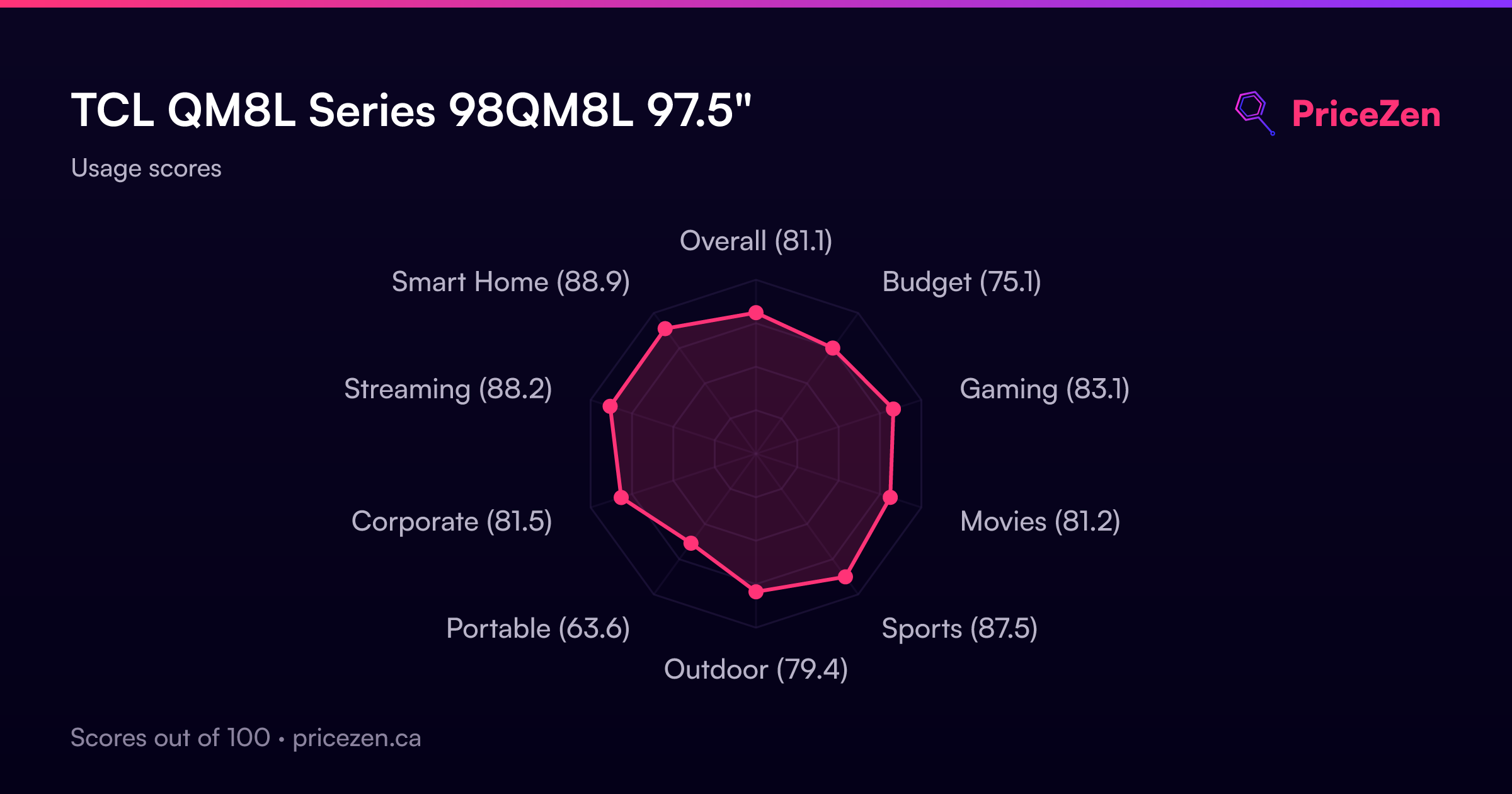
Usage Scores
- Overall81.1
- Budget75.1
- Gaming83.1
- Movies81.2
- Sports87.5
- Outdoor79.4
- Portable63.6
- Corporate81.5
- Streaming88.2
- Smart Home88.9