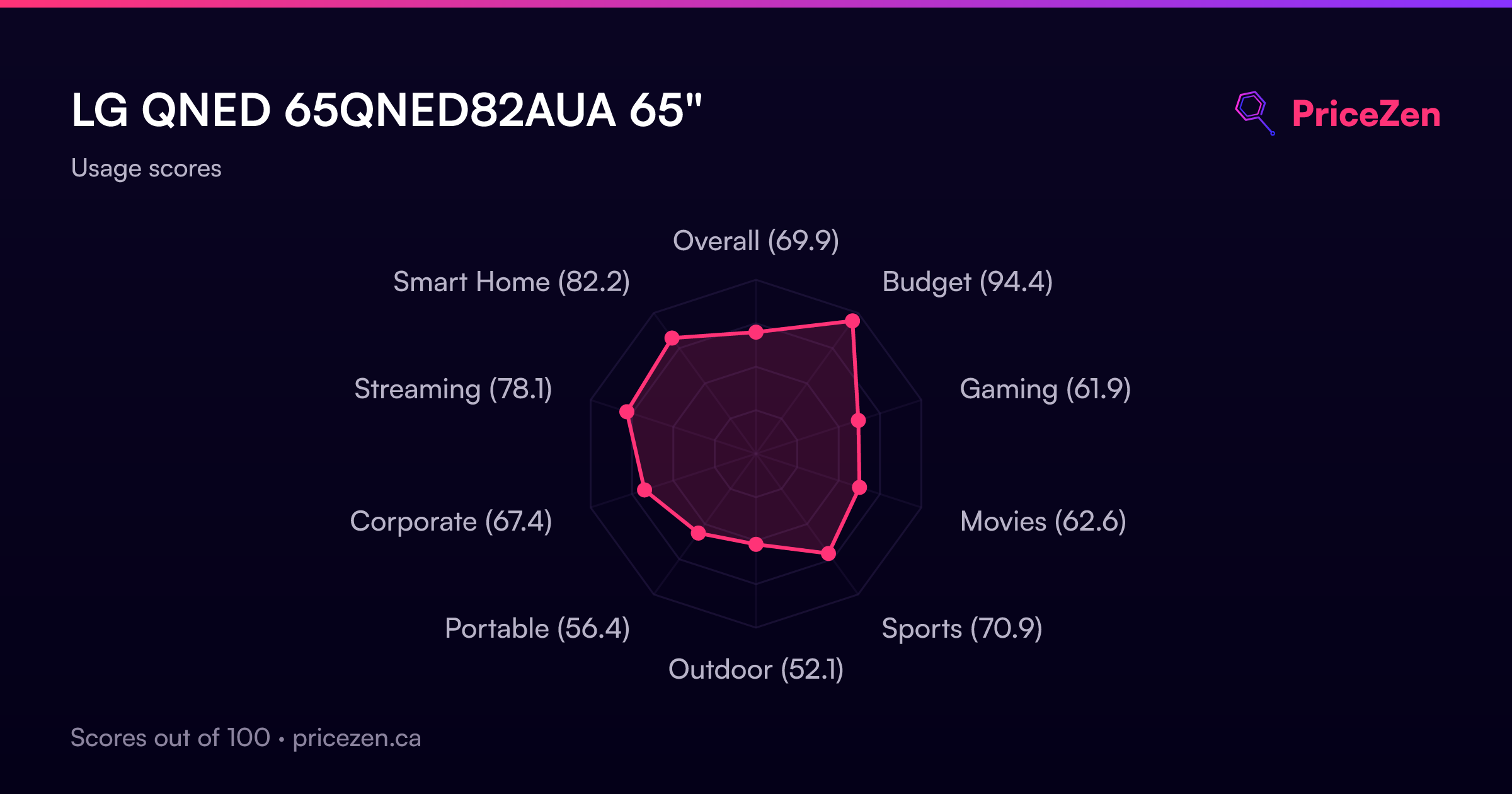
LG QNED 65QNED82AUA 65"
The 65-inch 4K QNED panel with 400 nits brightness and the α7 AI Processor Gen8 deliver accurate colors and near-4K upscaling, while 60Hz VRR and ALLM cover console gaming basics. Its 2.2-channel Dolby Atmos audio with Virtual 9.1.2 surround and webOS with Alexa, AirPlay 2, and Google Cast make it a practical smart hub. Best for budget-conscious buyers who want a large, well-rounded TV for mixed streaming, casual gaming, and smart home control without premium OLED pricing.

No current retailer price











Snapshot
The 30-Second Version
The LG QNED82A delivers vibrant QNED color and solid 4K upscaling from the α7 AI Processor Gen8 at a price that's hard to argue with. The 60Hz panel and 400 nits brightness hold it back for serious gamers and bright-room viewing, but for everyday streaming it's a strong performer. Prices swing wildly from USD 117 to USD 597, so shop around. If you can snag it at the low end, it's one of the best value TVs we've seen.
Pros & Cons
Pros
- QNED color tech produces genuinely vibrant, accurate colors 87th
- α7 AI Processor Gen8 does excellent 4K upscaling 80th
- Fast webOS interface with minimal lag 79th
- HDMI 2.1 with VRR and ALLM for smooth gaming 71st
- Dolby Atmos and virtual 9.1.2 surround sound from built-in speakers
- Great value, with prices ranging from USD 117 to USD 597 across vendors
Cons
- 60Hz panel limits high-refresh gaming
- Magic Remote frustrates many users
- 400 nits brightness struggles in very bright rooms
- Glare from reflections is a common complaint
- HDR support limited to HDR10 and HLG, no Dolby Vision
What owners think
The Word on the Street
How owner sentiment changed over time
ExclusiveBased on when customers actually wrote their reviews - so you can see whether early praise held up.
Owners are as happy as early on: 97% lately, 96% in Apr – Sep 2025
Across all 664 store ratings: 4.5★. Most owners rate without writing a review. The chart counts the 209 written reviews with stars and their own date.
9 written reviews without stars are left out of the trend.
Show the numbers
| Period | Reviews | Happy | Mixed | Unhappy | Happy share |
|---|---|---|---|---|---|
| Apr – Sep 2025 | 45 | 43 | 0 | 2 | 96% |
| Oct – Dec 2025 | 83 | 73 | 3 | 7 | 88% |
| Jan – Mar 2026 | 52 | 47 | 1 | 4 | 90% |
| Apr – Jul 2026 | 29 | 28 | 0 | 1 | 97% |
- Apr – Jun 202624 of 25 happy
Buyers in Q2 2026 praised the TV's bright, sharp picture, especially in daylight, and fast webOS. The Magic Remote drew mixed reactions: some loved it, one found it unintuitive. Minor glare noted.
- Picture quality exceeds price, with excellent brightness and contrast in bright rooms; HDR and dark scenes handled well.
- Magic Remote: most enjoy point-and-click and voice control, but one buyer finds it unintuitive and poorly documented.
- webOS is fast and responsive; app switching and setup are smooth, enhancing overall user experience.
- Screen glare from reflections is noticeable, though not a major complaint for most.
- Jan – Mar 202647 of 52 happy
Reviewers praise the picture quality, size upgrade to 75 inches, and built-in free channels. Some note physical handling challenges and consider a soundbar.
- Great picture and 4K quality, bright and crisp.
- Large 75-inch size is a dramatic upgrade from 55-inch.
- Includes nearly 1000 free channels and streaming apps.
- Physical installation is difficult without help; warranty service concerns.
- Oct – Dec 202573 of 83 happy · 9 without stars
Buyers praised picture quality, value, and sound, with several calling it a great purchase. One criticized the Google OS as confusing, and another noted slower response than a higher-end model.
- Picture quality is consistently praised as clear, vibrant, and better than previous TVs.
- Value for money is highlighted, especially for the screen size and features offered.
- Sound quality is described as very good or best, exceeding expectations.
- Google operating system is criticized as confusing and clunky, prompting one user to add a Roku.
Each column joins calendar quarters until it holds at least 10 reviews with stars and their own date. Happy = 4-5★, mixed = 3★, unhappy = 1-2★. Period summaries are in English.
The proof
Performance
The α7 AI Processor Gen8 is the star here. It handles 4K upscaling better than most TVs in this price bracket, and you'll notice it most when watching older content or cable broadcasts. The processor analyzes what's on screen in real time and sharpens things up without making everything look artificially crunchy. It's a subtle effect, but once you see it working on a grainy old sitcom, you get why LG keeps pushing this chip.
Gaming is a mixed bag. You get HDMI 2.1, VRR, ALLM, and a dedicated game mode with low input lag, which is great. But the panel is capped at 60Hz. That's fine for PS5 and Xbox Series X games running at 4K/60, but if you're hoping to push 120fps in competitive shooters, this isn't the panel for you. The HGIG mode is a nice touch for accurate HDR tone mapping in games, and it works well with the 400 nits of brightness. Just don't expect the eye-searing highlights you'd get from a mini-LED or OLED set.
Specifications
Full Specifications
Display
| Size | 65" |
| Resolution | 4K |
| Panel Type | LED |
| Backlight | Edge LED |
| Aspect Ratio | 16:9 |
| Curved | No |
Picture Quality
| Brightness | 400 nits |
| Contrast Ratio | Local Dimming |
| Color Gamut | 100% Color Volume |
| Color Depth | 10-bit |
| Motion Tech | HGIG Mode |
| Processor | Alpha 7 AI Processor Gen8 |
HDR
| HDR Formats | HDR10, HLG |
| Dolby Vision | No |
| HDR10+ | No |
| HLG | Yes |
Gaming
| Refresh Rate | 60 Hz |
| VRR | FreeSync, VRR |
| ALLM | Yes |
| Game Mode | Yes |
Smart TV
| Platform | webOS |
| Voice Assistant | Amazon Alexa |
| Screen Mirroring | Apple AirPlay 2, Google Cast |
| Works With | Alexa, Google, Apple HomeKit |
Audio
| Speaker Config | 2 |
| Dolby Atmos | Yes |
| Surround Sound | Dolby Digital, Virtual Surround Sound |
| eARC | Yes |
Connectivity
| HDMI Ports | 3 |
| HDMI Version | 2.1 |
| USB Ports | 1 |
| Wi-Fi | Wi-Fi 5 |
| Bluetooth | 5 |
| Ethernet | Yes |
| Optical Audio | Yes |
| VESA Mount | 300x200 |
Power & Size
| Power | 119 |
| Energy Star | Yes |
| Annual Energy | 220 |
| Weight | 22.8 kg / 50.3 lbs |
vs Competition
Stacked against the TCL QM7L Series, the LG has better brand recognition and a more polished smart TV experience, but the TCL brings mini-LED backlighting and likely higher peak brightness for similar money. If you're in a bright room, the TCL might be the better call. The Roku Plus Series is simpler and cheaper, but you're giving up the processing power and color accuracy that make the LG stand out.
The Samsung M70H is the closest direct competitor in terms of positioning. Both are mid-range 4K sets from major brands with solid processing. Samsung's Tizen OS is arguably more intuitive than LG's webOS for some users, but the LG counters with better gaming features and that QNED color tech. The Sony BRAVIA 2 II is worth a look if you care about motion handling and upscaling, since Sony's processing is still the gold standard. But you'll typically pay more for it. The Hisense QD7 is the budget alternative, and while it's cheaper, the picture quality and build don't quite match what LG is doing here.
| Spec | LG QNED 65QNED82AUA 65" | Sony BRAVIA 9 K85XR90 85" | Hisense U7 Series 65U75QG 64.5" | TCL QM8K Series 75QM8K 75" | Samsung The Frame Pro LS03HW 55" | Roku Pro Series 75R8C5 75" |
|---|---|---|---|---|---|---|
| Screen Size | 65 | 85 | 64.5 | 75 | 55 | 75 |
| Resolution | 3840x2160 | 3840x2160 | 3840x2160 | 3840x2160 | 3840x2160 | 3840x2160 |
| Panel Type | LED | Mini-LED | Mini-LED | Mini-LED | QD-Mini-LED | QLED |
| Refresh Rate | 60 | 120 | 165 | 144 | 144 | 120 |
| Hdr | HDR10, HLG | HDR10, HLG, Dolby Vision | Dolby Vision, HDR 10+, HDR 10, Hybrid Log-Gamma (HLG) | Dolby Vision, HDR 10, HDR 10+, Hybrid Log-Gamma (HLG) | HDR10+, HLG | Dolby Vision, HDR 10+, Hybrid Log-Gamma (HLG) |
| Smart Platform | webOS | Google TV | Google TV | Google TV | Tizen | Roku TV |
| Dolby Vision | false | true | true | true | false | true |
| Dolby Atmos | true | true | true | true | true | true |
| Hdmi Version | 2.1 | 2.1 | 2.1 | 2.1 | 2.1 | 2.1 |
| Compare | Compare | Compare | Compare | Compare |
| Product | HDR | Audio | Smart | Gaming | Display | User Sentiment | Connectivity | Social Proof | Affordability | Picture Quality |
|---|---|---|---|---|---|---|---|---|---|---|
| LG QNED 65QNED82AUA 65" | 55.9 | 71 | 86.6 | 58.2 | 67.6 | 30.5 | 68.8 | 78.8 | 67.9 | 79.9 |
| Sony BRAVIA 9 K85XR90 85" Compare | 83.7 | 96.9 | 89 | 76.3 | 95 | 73.6 | 91.4 | 86.1 | 12.5 | 75.2 |
| Hisense U7 Series 65U75QG 64.5" Compare | 88.8 | 94.5 | 93.5 | 94.2 | 76.6 | 94.8 | 96 | 86.1 | 57.6 | 97 |
| TCL QM8K Series 75QM8K 75" Compare | 88.8 | 94.5 | 98.4 | 91.9 | 89.1 | 84.1 | 91.4 | 86.1 | 33.3 | 99.3 |
| Samsung The Frame Pro LS03HW 55" Compare | 79.2 | 90.1 | 78.1 | 91.9 | 81.9 | 0 | 99.8 | 93.4 | 37.4 | 75.2 |
| Roku Pro Series 75R8C5 75" Compare | 71.4 | 84 | 80.7 | 86.7 | 85.1 | 84.1 | 91.4 | 86.1 | 40.9 | 34.6 |
Price
Value & Pricing
Here's where things get interesting. The price spread on this TV is wild. We're seeing listings from USD 117 all the way up to USD 597 across seven US vendors. That's a USD 480 gap for what should be the same TV. If you're shopping for this, do yourself a favor and check multiple stores before pulling the trigger. The lowest price we're tracking makes this an absolute steal, while the high end starts to creep into territory where better options exist.
At the lower end of that range, this TV is hard to beat. You're getting a 65-inch 4K panel with solid processing, good color, and decent gaming features for less than what some brands charge for a 43-inch set. At the higher end, the value proposition gets shakier. Once you're pushing USD 600, you're within striking distance of mini-LED TVs with better brightness and higher refresh rates. The affordability score sits at the 69th percentile, which feels about right. It's a good deal, not a legendary one.
Gibbys Electronic Supermarket 1 offer From CA$1,098
We started tracking prices for this product on Nov 18, 2026. The chart appears once we have more data.
Read more
Overview
The LG QNED82A is one of those TVs that makes you question why you'd spend twice as much on a flagship. It's a 65-inch 4K set built around LG's QNED color tech, which is their answer to traditional quantum dot panels. The pitch is simple: more accurate, more vivid color without the premium price tag. And for the most part, it delivers.
This is a TV aimed squarely at people who want a big, bright screen for everyday viewing. Streaming shows, sports, the occasional movie night. It's not trying to be a reference monitor for cinephiles or a 144Hz esports battlestation. It's a living room TV that does the basics really well and throws in some nice extras like Dolby Atmos and HDMI 2.1 support.
What makes it interesting is the α7 AI Processor Gen8 doing the heavy lifting. LG's been refining this chip for years, and it shows in how the TV handles upscaling and picture processing. You're getting a lot of that flagship processing trickle-down at a mid-range price. The 400 nits brightness won't blow you away on paper, but in a normal room it's plenty, and the local dimming helps keep dark scenes from looking washed out.
Common Questions
Q: Does this TV support 120Hz for gaming?
No, the QNED82A has a 60Hz panel. It does support HDMI 2.1, VRR, and ALLM, which help reduce screen tearing and input lag, but you won't get 120fps output. If high refresh rate gaming is a priority, you'll want to look at LG's higher-end QNED or OLED models, or competitors like the TCL QM7L Series.
Q: How does the picture quality compare to OLED?
It's not a fair fight. OLED panels have per-pixel lighting and essentially infinite contrast, while this QNED uses a Direct LED backlight with local dimming. The QNED82A gets brighter in some scenarios and has excellent color volume, but blacks won't be as deep and you may notice some blooming around bright objects on dark backgrounds. For most casual viewing, the difference is less dramatic than spec sheets suggest.
Q: Is the Magic Remote really that bad?
It's polarizing. The pointer-based navigation works well once you get used to it, but plenty of users find it finicky and prefer traditional button navigation. The good news is the TV also works with standard remotes and voice controls via Alexa or Google Assistant, so you're not stuck with the Magic Remote if it's not your thing.
Q: Does this TV support Dolby Vision?
No, the QNED82A supports HDR10 and HLG only. If you watch a lot of Dolby Vision content on Netflix or Disney+, you won't get the dynamic metadata benefits. The HDR performance is still solid for an edge-lit LED, but it's something to keep in mind if HDR format support matters to you.
Who Should Skip This
Competitive gamers should look elsewhere. The 60Hz panel is a hard ceiling, and while VRR and ALLM help, they don't make up for the lack of high refresh rate support. If you're playing fast-paced shooters or racing games, a 120Hz or 144Hz panel will make a bigger difference than any picture processing trick. The TCL QM7L Series or LG's own higher-tier QNED models are better fits.
Home theater enthusiasts chasing the best possible HDR experience should also pass. The 400 nits peak brightness and lack of Dolby Vision mean HDR content won't have the punch you'd get from a mini-LED or OLED set. Dark room viewing reveals the limitations of the local dimming, with blacks that lean more dark gray than true black. If you're building a dedicated theater space, save up for an OLED or a high-end mini-LED instead.
Verdict
For most people, the LG QNED82A is a safe, smart buy. It nails the fundamentals: good picture quality, fast interface, solid sound, and enough gaming features to keep casual players happy. The QNED color tech genuinely makes a difference, especially with animated content and nature documentaries where vibrant colors pop. If you're coming from an older 1080p set or a budget 4K TV, this will feel like a meaningful upgrade.
But it's not for everyone. If you're a serious gamer who wants 120Hz, look elsewhere. If you watch a lot of HDR content and want the best possible contrast, a mini-LED or OLED set will serve you better. And if you're sensitive to reflections, the glare on this panel might drive you nuts in a bright room. The sweet spot is the casual viewer who wants a big, colorful screen for streaming and doesn't want to overthink it. At the right price, this TV is an easy recommendation.
Usage Scores
- Overall69.9
- Budget94.4
- Gaming61.9
- Movies62.6
- Sports70.9
- Outdoor52.1
- Portable56.4
- Corporate67.4
- Streaming78.1
- Smart Home82.2