Lenovo Legion Tab 8.1" ZAEF0068US 2025, Snapdragon 8 Gen 3, 12GB, 256GB
Powered by the Snapdragon 8 Gen 3 with hardware-accelerated ray tracing, this 8.8-inch tablet pushes mobile gaming at a fluid 165Hz refresh rate on its sharp 2.5K display. Its compact 1310g build and 12GB of LPDDR5X memory make it a genuinely portable powerhouse that fits in one hand. This device is best for mobile gamers who want high frame-rate, console-quality visuals in a pocketable form factor.

No current retailer price











Snapshot
The 30-Second Version
The Lenovo Legion Tab Gen 3 is a gaming tablet through and through. The 165Hz 2.5K display and Snapdragon 8 Gen 3 make it a pocket-sized powerhouse for mobile games, and the main listing we track sits at BRL 4,984. Skip it if you need productivity features or video output, but for pure gaming it's one of the best Android tablets around.
Pros & Cons
Pros
- 165Hz 2.5K display is one of the best screens on any tablet 100th
- Snapdragon 8 Gen 3 with 12GB RAM handles demanding games with ease 84th
- UFS 4.0 storage means fast load times 84th
- Compact 8.8-inch size is perfect for handheld gaming 84th
- Android 14 with three promised OS upgrades
Cons
- No video output, which kills any docked or TV gaming dreams
- Productivity score of 35/100 makes it a poor laptop replacement
- Battery life is just average for the category
- Social proof is weak, only 18 reviews so far
- Camera setup is basic, 13MP rear and 8MP front
What owners think
The Word on the Street
How owner sentiment changed over time
ExclusiveBased on when customers actually wrote their reviews - so you can see whether early praise held up.
8 written reviews, Oct 2025 – Feb 2026: 7 happy, 1 unhappy
Across all 18 store ratings: 4.3★. Most owners rate without writing a review. The chart counts the 8 written reviews.
Each dot is one written review, in the month it was written. Happy = 4-5★, mixed = 3★, unhappy = 1-2★.
The proof
Performance
The Snapdragon 8 Gen 3 is a beast of a mobile chip, and in this form factor it has room to stretch. The 3.30 GHz clock speed is the headline number, but what matters more is how it handles sustained loads. Gaming tablets have better thermal headroom than phones, so the chip can hold higher clocks for longer before throttling. That means games like Genshin Impact, Call of Duty Mobile, and emulators run smoother here than they would on a phone with the same silicon. The 12GB of LPDDR5X RAM is also a big deal for multitasking and keeping games in memory when you switch apps.
The 165Hz display is the real star of the performance story. Most tablets top out at 120Hz, and plenty of gaming phones don't even hit 165. For fast-paced games, that refresh rate means lower input lag and smoother motion. The 500 nits brightness is solid for indoor use, though you'll squint a bit in direct sunlight. The screen sits in the 86th percentile for tablets, which tracks. It's a standout panel. The GPU and CPU rankings are more middle-of-the-pack at 37th and 36th percentile respectively, but that's against all tablets, including laptops-in-disguise like the Surface Pro. For an Android gaming tablet, this is about as good as it gets right now.
Specifications
Full Specifications
Processor
| CPU | QTI SM8650 |
| Cores | 8 |
Memory & Storage
| RAM | 12 GB |
| RAM Generation | LPDDR5X |
| Storage | 256 GB |
| Storage Type | UFS |
Display
| Size | 8.06" |
| Resolution | 2560x1600 (QHD) |
| Panel | LCD |
| Refresh Rate | 165 Hz |
| Brightness | 500 nits |
Connectivity
| Wi-Fi | Wi-Fi 6 |
| USB-C | 1 |
Features
| Stylus Support | No |
| Fingerprint Reader | No |
| Face Unlock | No |
Physical
| Weight | 1.3 kg / 2.9 lbs |
| OS | Android 14 |
vs Competition
Our ranking compares every tablet against the others in its category, and the current top five around the Legion Tab is an odd mix: the Apple iPad Pro 13" M5, the Microsoft Surface Pro 13" 11, the Samsung Galaxy Tab 12.4" S10+, the TABWEE T60 Pro 13.4" and the URAO 14.1" G140L. Notice the sizes. Every one of them is a big-screen tablet, and the Legion Tab is an 8.8-inch device you can hold in two hands like a controller. That difference matters more than any spec on paper.
The iPad Pro 13" M5 sits at the top of our productivity rankings, and it's the obvious pick if your tablet needs to earn its keep with documents, notes and creative apps. The Legion Tab scores 35 out of 100 for productivity, so it isn't playing that game. What it does instead is entertainment, where it hits 58.3, backed by a 165Hz panel that sits in the 86th percentile for screens. Android also leaves you free to sideload and run emulators, which is a big part of why people buy a gaming tablet in the first place.
The Surface Pro 13" 11 is a computer in tablet clothing, and that's exactly why it ranks well for work. It's also the reason the Legion Tab's GPU and CPU percentiles look middling at 37th and 36th: those rankings include machines like this one. For handheld play, a 13-inch Windows slab isn't the shape you want. The Galaxy Tab 12.4" S10+ is the closest thing here to a traditional all-rounder, a large Android tablet aimed at media and everyday use. Same platform as the Legion Tab, very different intent, and again a screen you rest on a table rather than hold up for a long session.
The TABWEE T60 Pro 13.4" and the URAO 14.1" G140L round out the group, and both go even bigger on screen size. If your priority is a large panel for reading, browsing or watching something propped up on a stand, they're worth a look. Neither is trying to be a pocketable gaming device, which is the entire point of the Legion Tab. Our advice: decide first whether you want a big general-purpose tablet or a small one built for games, because these five and the Legion Tab are answering different questions.
| Spec | Lenovo Legion Tab 8.1" ZAEF0068US | Apple iPad Pro 13" M5 | Microsoft Surface Pro 11 13" | Samsung Galaxy Tab 12.4" S10+ | Xiaomi Pad 7 11.2" 2AFZZCRP4CG | TABWEE T60 Pro 13.4" |
|---|---|---|---|---|---|---|
| CPU | QTI SM8650 | Apple M5 | Qualcomm Snapdragon X Elite X1E-84-100 | MediaTek Dimensity 9300+ | Snapdragon 7+ Gen 3 | Unisoc |
| RAM (GB) | 12 | 16 | 16 | 12 | 8 | 8 |
| Storage (GB) | 256 | 1024 | 1024 | 512 | 256 | 256 |
| Screen | 8.1" 2560x1600 | 13" 2752x2064 | 13" 2880x1920 | 12.4" 2800x1752 | 11.2" 3200x2136 | 13.4" 1920x1200 |
| OS | Android 14 | iPadOS | Windows 11 Home | Android 14 | Android 14 | Android 15 |
| Stylus | false | true | true | true | true | true |
| Cellular | false | true | false | false | false | false |
| Battery (Wh) | - | 39 | 53 | - | - | - |
| Compare | Compare | Compare | Compare | Compare |
| Product | CPU | GPU | RAM | Screen | Battery | Feature | Storage | Sharpness | Portability | Connectivity | Social Proof | Affordability | Water Resistance |
|---|---|---|---|---|---|---|---|---|---|---|---|---|---|
| Lenovo Legion Tab 8.1" ZAEF0068US | 84 | 82.1 | 83.9 | 84.3 | 32 | 28.1 | 83.7 | 99.6 | 7.5 | 62.2 | 22.5 | 12.8 | 46.5 |
| Apple iPad Pro 13" M5 Compare | 99.1 | 99.4 | 92.4 | 99.7 | 97.5 | 96.5 | 97.7 | 73.6 | 48.6 | 99.2 | 99.2 | 1.7 | 46.5 |
| Microsoft Surface Pro 11 13" Compare | 98.5 | 96.6 | 92.4 | 99.1 | 99.6 | 74.3 | 97.7 | 82.4 | 21.8 | 92.7 | 91 | 5.4 | 97.3 |
| Samsung Galaxy Tab 12.4" S10+ Compare | 82.1 | 79 | 80.9 | 95.3 | 87.9 | 96.5 | 92.9 | 82.4 | 50.1 | 76.9 | 91 | 8.5 | 97.3 |
| Xiaomi Pad 7 11.2" 2AFZZCRP4CG Compare | 86.3 | 84 | 65.8 | 98 | 85.2 | 60.8 | 83.7 | 99.3 | 60.1 | 76.9 | 91 | 33.8 | 46.5 |
| TABWEE T60 Pro 13.4" Compare | 95.3 | 88.9 | 65.8 | 55.1 | 86.7 | 88.5 | 74.9 | 27.6 | 32.6 | 76.9 | 87.1 | 36.5 | 46.5 |
Price
Value & Pricing
The main listing we track right now is BRL 4,984. That's the number to weigh against what this tablet actually is: a compact gaming machine with flagship silicon and one of the best screens you'll find at this size. We follow its price over time across stores, partly through our community browser extension, so if you're not in a hurry it's worth watching rather than buying on impulse.
The value question really comes down to what you want it for. If you're buying a dedicated gaming tablet, the Legion Tab delivers Snapdragon 8 Gen 3 performance, 12GB of LPDDR5X RAM and UFS 4.0 storage in a body small enough to hold for hours. But if you need a tablet that can also do work, take notes, or replace a laptop, the productivity score of 35 out of 100 should give you pause. You'd be paying for a device that's mediocre at half the things tablets are supposed to do.
Read more
Overview
The Lenovo Legion Tab Gen 3 is one of those devices that knows exactly what it wants to be. It's an 8.8-inch Android tablet built around the Snapdragon 8 Gen 3, 12GB of LPDDR5X RAM, and a 165Hz display. That's a spec sheet aimed squarely at people who want a handheld gaming machine that can also handle media and casual browsing. It's not trying to replace your laptop, and honestly, it's not even trying that hard to replace your iPad. It's a gaming tablet first, and everything else is a bonus.
Lenovo has been doing the Legion line for a while now, mostly on the laptop side, and this tablet carries that DNA. The 2.5K LTPS panel at 165Hz is the kind of screen you'd expect on a gaming laptop, not a sub-$500 tablet. And the Snapdragon 8 Gen 3 is Qualcomm's current flagship mobile chip, the same one you'll find in top-tier Android phones. Pair that with UFS 4.0 storage and you've got a device that loads games fast and keeps frame rates high.
But here's the thing. The tablet market is weird right now. Apple's iPad Pro M5 exists, Samsung has the Galaxy Tab S11, and Microsoft keeps pushing the Surface Pro line. The Legion Tab isn't competing with those on productivity. Our scoring puts it at 35 out of 100 for productivity, which is rough. But for entertainment it hits 58.3, and that's where this thing shines. If you want a pocketable gaming tablet with a killer screen, this is a very specific and very good answer to that question.
Common Questions
Q: Can I connect this tablet to a TV or external monitor?
No, and this is one of the biggest complaints from owners. The Legion Tab Gen 3 does not support video output over USB-C, so you can't mirror your screen to a TV or monitor. Everything happens on the 8.8-inch panel, which is excellent for handheld play but limiting if you were hoping to throw games onto a bigger screen.
Q: How does the Snapdragon 8 Gen 3 handle demanding games?
Very well. The Snapdragon 8 Gen 3 is Qualcomm's flagship mobile chip, and in a tablet form factor it has better thermal headroom than a phone, so it can sustain high performance for longer gaming sessions. Combined with 12GB of LPDDR5X RAM and UFS 4.0 storage, you'll get smooth frame rates and fast load times in games like Genshin Impact, Call of Duty Mobile, and most emulators.
Q: Is this tablet good for work or school?
Not really. Our scoring puts productivity at 35 out of 100, which is well below average for tablets. If you need a tablet for note-taking, document editing, or multitasking, the Apple iPad Pro 13" M5 and the Microsoft Surface Pro 13" 11 sit at the top of our productivity rankings and are the safer picks.
Q: How long does the battery last?
The 6550mAh battery is about average for this category, sitting in the 69th percentile. For gaming, expect a few hours of intensive play before needing a charge. For video streaming and casual browsing, you should get through most of a day. It's not class-leading, but it's not a dealbreaker either.
Who Should Skip This
If you need a tablet for work, school, or creative tasks, skip this one. The productivity score of 35 out of 100 tells the story. There's no stylus support worth mentioning, the camera setup is basic, and Android's tablet apps still lag behind for serious work. The Apple iPad Pro 13" M5 and the Microsoft Surface Pro 13" 11 lead our productivity rankings, and either is a better fit if you need to get things done.
Also skip it if you want to connect your tablet to a TV or monitor. The lack of video output is a real limitation, and it's the top complaint from actual owners. And if what you really want is a big screen for reading, browsing and watching video propped up on a stand, the larger tablets in our top five, including the Samsung Galaxy Tab 12.4" S10+, the TABWEE T60 Pro 13.4" and the URAO 14.1" G140L, are aimed at that job. The Legion Tab is 8.8 inches of handheld gaming, and it's only the right buy if that's what you're after.
Verdict
If you're a mobile gamer who wants the best possible Android gaming experience in a compact form factor, the Legion Tab Gen 3 is an easy recommendation. The 165Hz display, Snapdragon 8 Gen 3, and 12GB of RAM make it a legitimate gaming machine. The 8.8-inch size is perfect for holding in landscape mode for long sessions, and the UFS 4.0 storage means you're not waiting around for games to load.
But if you need a tablet that can do more than game and watch videos, look elsewhere. The productivity score is genuinely bad, and the lack of video output is a baffling omission for a device with this much gaming horsepower. You can't dock it to a TV or monitor, which feels like a missed opportunity. For students, professionals, or anyone who wants a do-everything tablet, the Apple iPad Pro 13" M5 or the Microsoft Surface Pro 13" 11 rank far higher for that kind of work in our data. For pure gaming in a size you can actually hold, though, this thing is hard to beat.
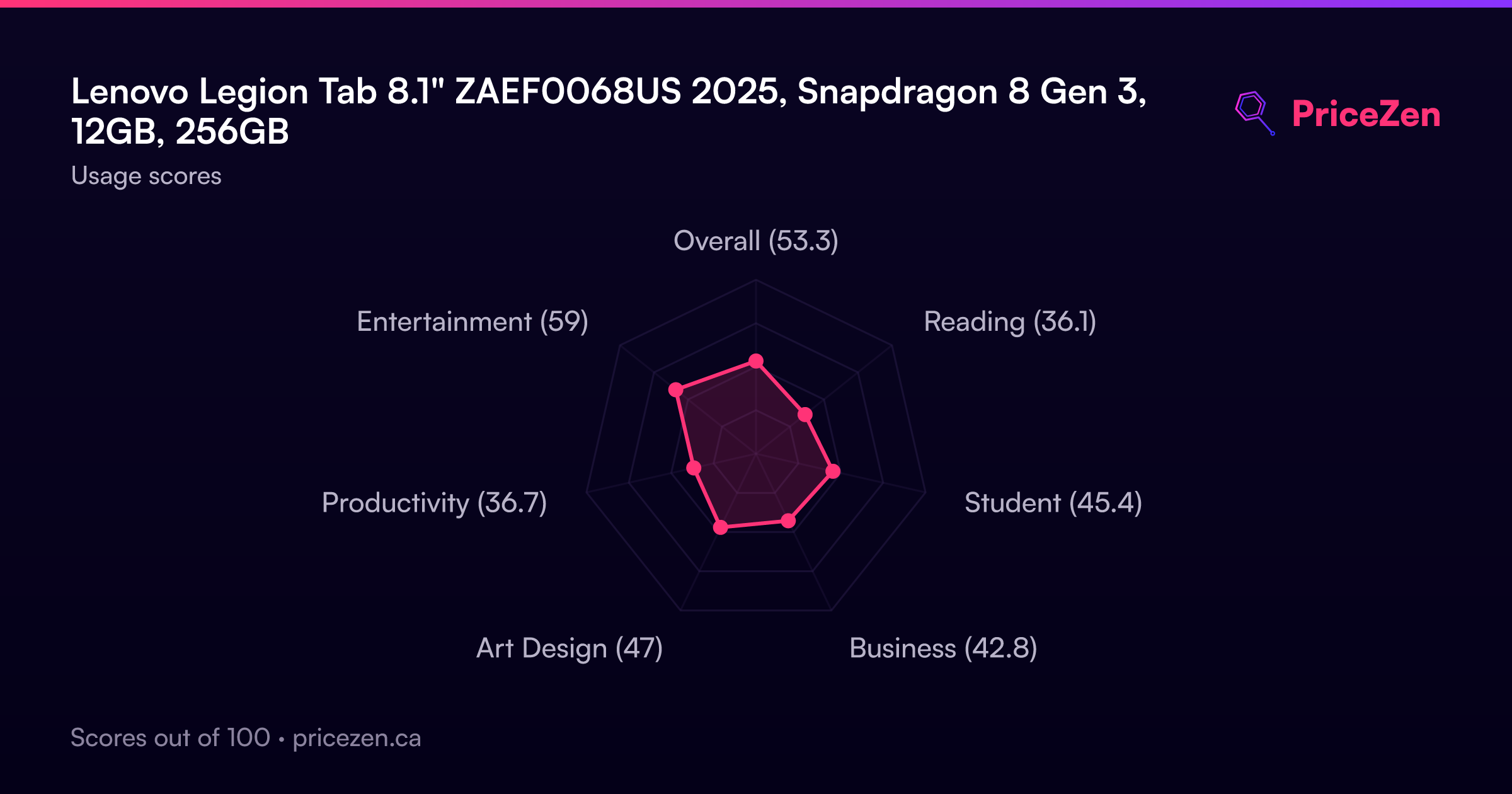
Usage Scores
- Overall53.3
- Reading36.1
- Student45.4
- Business42.8
- Art Design47
- Productivity36.7
- Entertainment59