Xiaomi Pad 7 Ai 11.2" 2410CRP4CG, Snapdragon 7+ Gen 3, 8GB, 256GB, Blue
Powered by a Snapdragon 7+ Gen 3 chip, the 11.2-inch 3.2K display stands out with a 144Hz refresh rate and 800 nits peak brightness for fluid, vivid visuals. Its hardware-level low blue light certification and stylus support with a 240Hz touch sampling rate make it a strong choice for extended reading and precise digital art. This tablet is best for entertainment consumers and digital artists who prioritize a high-quality screen and pen input over cellular connectivity.

No current retailer price
Snapshot
The 30-Second Version
The Xiaomi Pad 7 Ai delivers an 85th percentile screen and 84th percentile battery at USD 355, which is absurd value for a media tablet. The Snapdragon 7+ Gen 3 handles games and video without breaking a sweat. Just don't expect cellular connectivity or expandable storage, this is a WiFi-only entertainment machine.
Pros & Cons
Pros
- 85th percentile screen with 144Hz refresh and 800 nits brightness 86th
- 84th percentile 8850mAh battery keeps it running all day 85th
- Snapdragon 7+ Gen 3 hits 83rd percentile for CPU performance 75th
- 256GB storage at USD 355 is a strong value 72nd
- Stylus support with 240Hz pen sampling
Cons
- No SIM or SD slot, storage is capped at 256GB
- 47th percentile feature score, missing extras competitors include
- 25th percentile connectivity, WiFi-only with no cellular option
- 38.7/100 business score, weak for productivity tasks
- 29th percentile social proof, limited real-world feedback
The proof
Performance
The Snapdragon 7+ Gen 3 is doing serious work here. An 83rd percentile CPU score puts it ahead of most tablets in our database, and the 80th percentile GPU means games and video editing won't make it sweat too hard. The 8GB of RAM is more middle of the pack at the 66th percentile, but for an entertainment-focused tablet, that's plenty. You're not running virtual machines on this thing.
The display is the real star. 3200 x 2136 resolution at 345 ppi with a 144Hz refresh rate and 800 nits peak brightness. That's a standout panel, one of the best on the market for this price. The 68 billion colors and DCI-P3 coverage mean content looks rich without being oversaturated. And the 8850mAh battery at the 84th percentile means you can actually enjoy that screen for hours without hunting for a charger.
Specifications
Full Specifications
Processor
| CPU | Snapdragon 7+ Gen 3 |
| Cores | 8 |
Memory & Storage
| RAM | 8 GB |
| Storage | 256 GB |
| Expandable | No |
Display
| Size | 11.2" |
| Resolution | 2560x1440 (QHD) |
| Refresh Rate | 144 Hz |
| Brightness | 800 nits |
Connectivity
| Bluetooth | Bluetooth 5.4 |
| Cellular | No |
Features
| Stylus Support | Yes |
Physical
| OS | HyperOS 2 |
vs Competition
Against the Apple iPad Pro M5 and Samsung Galaxy Tab S11 Ultra, the Pad 7 Ai loses on raw power and features, but it costs a fraction of the price. The iPad Pro and Galaxy Tab S11 Ultra are in a different league for productivity and creative work, but you're paying flagship money for that. The Lenovo Yoga Tab Plus and Microsoft Surface Pro 11 both offer better business credentials, which explains the Pad 7 Ai's weak 38.7/100 business score. Where the Xiaomi wins is pure entertainment value. That 85th percentile screen and 84th percentile battery at USD 355 make it the budget king for streaming and gaming. The Vekfulpc T60 Pro is the only competitor in a similar price range, and it can't match the Xiaomi's display quality.
| Spec | Xiaomi Pad 7 Ai 11.2" 2410CRP4CG | Apple iPad Pro 13" M5 | Microsoft Surface Pro 13" 11 | Samsung Galaxy Tab 12.4" S10+ | Lenovo Yoga Tab Plus 12.7" ZAEG0096US | TABWEE T60 Pro 13.4" |
|---|---|---|---|---|---|---|
| CPU | Snapdragon 7+ Gen 3 | Apple M5 | Qualcomm Snapdragon X Elite X1E-84-100 | MediaTek Dimensity 9300+ | QTI SM8650 | Unisoc |
| RAM (GB) | 8 | 16 | 16 | 12 | 16 | 8 |
| Storage (GB) | 256 | 1024 | 1024 | 512 | 256 | 256 |
| Screen | 11.2" 2560x1440 | 13" 2752x2064 | 13" 2880x1920 | 12.4" 2800x1752 | 12.7" 2944x1840 | 13.4" 1920x1200 |
| OS | HyperOS 2 | iPadOS | Windows 11 Home | Android 14 | Android 14 | Android 15 |
| Stylus | true | true | true | true | true | true |
| Cellular | false | true | false | false | false | false |
| Battery (Wh) | - | 39 | 53 | - | - | - |
| Compare | Compare | Compare | Compare | Compare |
| Product | CPU | GPU | RAM | Screen | Battery | Feature | Storage | Sharpness | Connectivity | Affordability | Reading Battery | Water Resistance |
|---|---|---|---|---|---|---|---|---|---|---|---|---|
| Xiaomi Pad 7 Ai 11.2" 2410CRP4CG | 71.8 | 69.9 | 65.7 | 86.1 | 85.3 | 48.6 | 74.9 | 52.4 | 24.3 | 37.5 | 71.6 | 46.5 |
| Apple iPad Pro 13" M5 Compare | 99.1 | 99.4 | 92.3 | 99.7 | 97.6 | 96.6 | 97.7 | 67.4 | 99.2 | 1.6 | 41.3 | 46.5 |
| Microsoft Surface Pro 13" 11 Compare | 98.5 | 96.6 | 92.3 | 99.1 | 99.6 | 74.5 | 97.7 | 78.2 | 92.9 | 4.7 | 87.2 | 97.4 |
| Samsung Galaxy Tab 12.4" S10+ Compare | 82.2 | 79.1 | 80.7 | 95.6 | 88 | 96.6 | 92.9 | 78.2 | 77.3 | 7.7 | 57 | 97.4 |
| Lenovo Yoga Tab Plus 12.7" ZAEG0096US Compare | 84.1 | 82.2 | 92.3 | 96.8 | 88.8 | 96.6 | 83.7 | 87.7 | 92.9 | 21.2 | 52.3 | 46.5 |
| TABWEE T60 Pro 13.4" Compare | 95.3 | 88.8 | 65.7 | 46.4 | 86.8 | 88.6 | 74.9 | 18.4 | 77.3 | 34.5 | 17.9 | 46.5 |
Price
Value & Pricing
At USD 355, this tablet is punching well above its weight class. You're getting an 85th percentile display and an 84th percentile battery for less than half the price of most flagship tablets. The 256GB of storage at the 74th percentile is solid, and the Snapdragon 7+ Gen 3 keeps things snappy. The value proposition is simple: you're paying mid-range money for a screen and battery that compete with tablets costing twice as much. The trade-offs are connectivity and features, not core performance.
Read more
Overview
The Xiaomi Pad 7 Ai lands with an 85th percentile screen and an 84th percentile battery, which is a fancy way of saying the two things you stare at and worry about most are both genuinely excellent. You get an 11.2-inch 3.2K panel running at 144Hz with 800 nits peak brightness, paired with an 8850mAh cell. That's a combo that makes this tablet feel more expensive than its USD 355 price tag suggests. The Snapdragon 7+ Gen 3 sits at the 83rd percentile for CPU and 80th for GPU, so it's not just a pretty face either.
But this is a WiFi-only global version with no SIM slot, no SD slot, and no calling or texting. That's the trade-off. You're getting flagship-adjacent display and battery performance at a mid-range price, but you're locked into whatever 256GB of storage you get out of the box. For a media and entertainment tablet, that's a deal most people can live with. For anyone hoping to use this as a workhorse, the 38.7/100 business score tells a different story.
Common Questions
Q: Can I use this tablet for work or productivity?
The 38.7/100 business score suggests this isn't the best choice for productivity. The 8GB of RAM at the 66th percentile and 47th percentile feature score mean it lacks the multitasking muscle and extras that tablets like the Surface Pro 11 or iPad Pro M5 offer. It's fine for light email and document editing, but heavy productivity users should look elsewhere.
Q: How good is the display for watching movies?
The display is one of the best on the market at this price. It's an 11.2-inch 3.2K panel at 345 ppi with a 144Hz refresh rate and 800 nits peak brightness. The 85th percentile screen score puts it ahead of most tablets in our database. DCI-P3 coverage and 68 billion colors mean HDR content looks fantastic.
Q: Does this tablet support cellular data or phone calls?
No. This is the WiFi-only global version. There's no SIM card slot, no cellular connectivity, and no calling or texting. The 25th percentile connectivity score reflects this limitation. You'll need to rely on WiFi for all internet access.
Who Should Skip This
Skip this if you need a tablet for work. The 38.7/100 business score is a real weak spot, and the 47th percentile feature score means you're missing productivity extras that competitors include. The 25th percentile connectivity is also a dealbreaker if you need cellular data on the go. And if you're the type who fills up storage fast, the lack of an SD slot means you're stuck with 256GB forever. The 29th percentile social proof also means there's not much real-world feedback to lean on if something goes wrong.
Verdict
If you want a tablet for watching videos, playing games, and reading, the Xiaomi Pad 7 Ai is an easy recommendation at USD 355. The 85th percentile screen and 84th percentile battery are the two metrics that matter most for entertainment, and both are excellent. The Snapdragon 7+ Gen 3 keeps everything responsive. Just know what you're getting into: no SIM, no SD slot, and a feature set that's below average. For a pure media machine, it's a steal. For anything work-related, look elsewhere.
Usage Scores
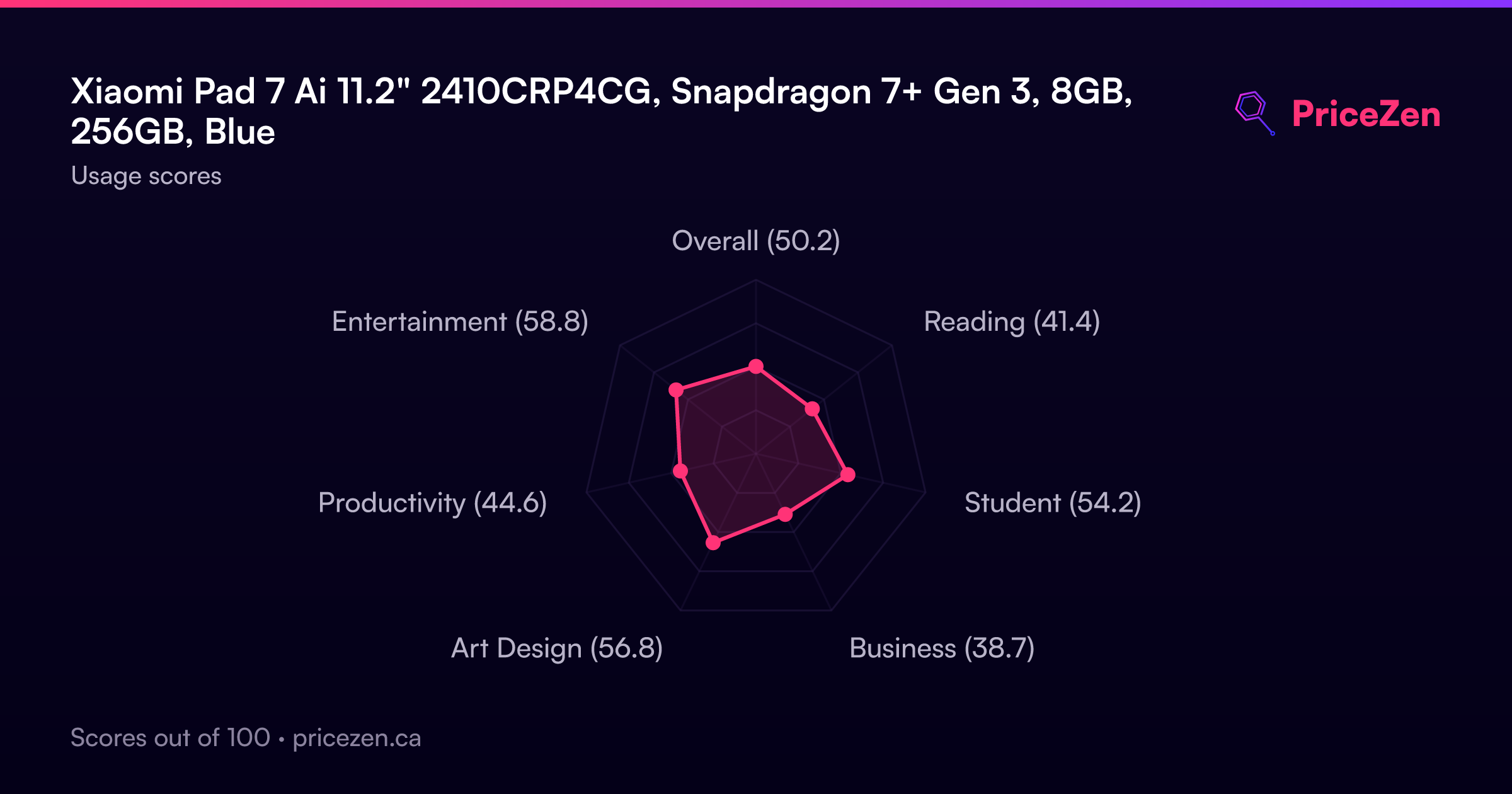
- Overall50.2
- Reading41.4
- Student54.2
- Business38.7
- Art Design56.8
- Productivity44.6
- Entertainment58.8