SanDisk Optimus GX 7100 2TB PCIe 4.0 x4 NVMe M.2 2280
The 7250 MB/s sequential read and 6900 MB/s write speeds, paired with 1M/1.4M random IOPS, make this PCIe 4.0 drive a strong performer for AAA gaming and DirectStorage titles. Its power-efficient architecture and 2TB capacity suit laptops and handheld consoles, while the included SANDISK Dashboard and Acronis software add practical value. Best for gamers and creative users on the go who need fast, reliable storage with a 5-year warranty.












Snapshot
The 30-Second Version
The Optimus GX 7100 hits 1,400K random write IOPS, which lands it near the top and makes it one of the fastest Gen 4 drives for gaming workloads. Sequential speeds of 7,250 MB/s read and 6,900 MB/s write are also well above average. Endurance is middle of the pack, but the price has fallen to $330, about 11% cheaper than before, which makes the whole package a lot easier to swallow.
Pros & Cons
Pros
- Random write IOPS of 1,400K puts it near the top of our database 97th
- Sequential reads hit 7,250 MB/s, faster than most Gen 4 drives we track 92nd
- 2TB capacity gives you room for a serious game library 83rd
- Price has dropped to $330, about 11% off where it was sitting 78th
- 5-year warranty is solid for a DRAM-less drive
- Power-efficient architecture makes it a good fit for laptops and handhelds
Cons
- Endurance is middle of the pack for this category
- No DRAM cache means sustained write performance can dip under heavy load
- Affordability still ranks at 22nd despite the price cut
- Social proof is thin at the 30th spot with only 2 reviews in our database
- Portable score of 19.4/100 is the weakest area, so don't expect it to shine in external enclosures
The proof
Performance
Let's talk about those random IOPS because that's where this drive earns its keep. 1,400K random write IOPS is the kind of number that makes loading screens disappear and keeps frame times smooth when games are streaming assets in the background. The 96th percentile random ranking means this drive handles scattered small-file operations better than almost anything else we've tested in this category. If you're playing open-world games that constantly pull in textures and geometry, this is exactly what you want.
The sequential numbers are no slouch either. 7,250 MB/s read and 6,900 MB/s write put it ahead of most Gen 4 drives we track, though drives like the Samsung 9100 PRO and WD Black SN850X can edge it out in specific workloads. The DRAM-less design is the trade-off here. SanDisk's nCache technology does a decent job masking the lack of a DRAM buffer, but sustained heavy writes will eventually show the limitation. For gaming and everyday use, you probably won't notice. For constant video editing or massive file transfers, you might.
Specifications
Full Specifications
Drive
| Capacity | 2000 |
| Form Factor | M.2 2280 |
| Interface | PCIe 4.0 x4 |
| Protocol | NVMe |
| PCIe Generation | 4 |
| External | No |
Performance
| Sequential Read (MB/s) | 7250 |
| Sequential Write (MB/s) | 6900 |
| Random Read (IOPS) | 1000000 |
| Random Write (IOPS) | 1400000 |
Hardware
| NAND | TLC |
| DRAM Cache | No |
Reliability
| Endurance (TBW) | 1200 |
| Warranty (years) | 5 |
Features
| Heatsink | No |
vs Competition
Against the WD Black SN850X, the Optimus GX 7100 actually wins on random write IOPS, 1,400K versus the SN850X's typical numbers in our database. But the SN850X has a DRAM cache and better endurance, so it's the more balanced drive for mixed workloads. The Samsung 9100 PRO is a Gen 5 drive, so it'll smoke this thing on sequential speeds, but you'll pay a lot more for that privilege. The Crucial T500 is probably the closest competitor in terms of price and performance, and it trades blows depending on the workload. The Kingston FURY Renegade G5 and Seagate FireCuda 530R are both solid alternatives if you want DRAM and better endurance at a similar price point. The Optimus GX 7100's real edge is that random performance, which is genuinely top-tier for a Gen 4 drive.
| Spec | SanDisk Optimus GX 7100 | Western Digital WD_BLACK SN8100 | Samsung 9100 PRO | Kingston FURY Renegade G5 | Crucial T700 | Corsair MP700 PRO |
|---|---|---|---|---|---|---|
| Capacity | 2TB | 4TB | 4TB | 4TB | 2TB | 4TB |
| Form Factor | M.2 2280 | M.2 2280 | M.2 2280 | M.2 2280 | M.2 2280 | M.2 2280 |
| Interface | PCIe 4.0 x4 | PCIe 5.0 x4 | PCIe 5.0 x4 | PCIe 5.0 x4 | PCIe 5.0 x4 | PCIe 5.0 x4 |
| Seq Read | 7,250 MB/s | 14,900 MB/s | 14,800 MB/s | 14,800 MB/s | 12,400 MB/s | 12,400 MB/s |
| Nand Type | TLC | TLC | TLC | TLC | TLC | TLC |
| Dram Cache | No | No | Yes | Yes | Yes | Yes |
| Endurance | 1200 TBW | 2400 TBW | 2400 TBW | 4000 TBW | 1200 TBW | 3000 TBW |
| Compare | Compare | Compare | Compare | Compare |
| Product | Speed | Random | Feature | Capacity | Endurance | Social Proof | Affordability |
|---|---|---|---|---|---|---|---|
| SanDisk Optimus GX 7100 | 92.1 | 96.7 | 54.3 | 78.2 | 82.9 | 26 | 26 |
| Western Digital WD_BLACK SN8100 Compare | 99.7 | 99.6 | 86.5 | 91.6 | 80.7 | 94.9 | 10.1 |
| Samsung 9100 PRO Compare | 99.2 | 99.8 | 99.8 | 91.6 | 85.9 | 99.6 | 6 |
| Kingston FURY Renegade G5 Compare | 99.5 | 99.1 | 91.3 | 91.6 | 93.6 | 85.7 | 9.4 |
| Crucial T700 Compare | 96.8 | 97.7 | 97.7 | 78.2 | 82.9 | 74.9 | 25.8 |
| Corsair MP700 PRO Compare | 96.8 | 81.7 | 91.3 | 91.6 | 91 | 85.7 | 8.6 |
Price
Value & Pricing
Pricing on this drive has come down, and that changes the math. We're tracking it at $330 right now, roughly 11% below where it sat before, and that's a meaningful drop for a drive with this kind of random performance. The affordability ranking still sits at 22nd, so it's priced above most of its peers in our database, but the gap is narrower than it was. At $330 you're getting near-top random operations and 7,250 MB/s sequential reads without paying top-of-the-stack money. We track prices over time, partly through our community browser extension, so if it drifts back up we'd wait rather than chase it.
Amazon 1 offer From CA$465
Memory Express 1 offer From CA$470
Price history
Read more
Overview
The SanDisk Optimus GX 7100 hits 7,250 MB/s sequential reads and 6,900 MB/s writes, which puts it in the 92nd percentile for speed in our database. That's fast enough to make it one of the better Gen 4 drives on the market, even if it's not quite at the absolute top. The random performance is where this thing really flexes though. 1,000K read IOPS and 1,400K write IOPS land it in the 96th percentile for random operations, which is basically best-in-class territory for a PCIe 4.0 drive.
But here's the catch. This is a DRAM-less drive using TLC NAND, and that shows up in the endurance numbers. It sits at the 57th percentile for endurance, which is solidly middle of the pack. For a gaming-focused drive that's probably fine, but it's worth knowing before you commit. The 5-year warranty helps soften that blow a bit, and SanDisk's 8th generation BiCS TLC NAND has a decent track record. Just don't expect this to be a write-heavy workstation drive.
Common Questions
Q: Is the DRAM-less design a problem for gaming?
For most gaming workloads, no. The 1,400K random write IOPS and 1,000K random read IOPS show this drive handles scattered small-file operations extremely well, which is what games rely on most. SanDisk's nCache technology helps compensate for the missing DRAM buffer. You might notice slower sustained writes during massive file transfers, but game loading and asset streaming should feel snappy.
Q: How does this compare to the WD Black SN850X?
The Optimus GX 7100 actually beats the SN850X on random write IOPS in our database, 1,400K versus the SN850X's typical numbers. But the SN850X has a DRAM cache and better endurance, making it more versatile for mixed workloads. If you're purely gaming, the Optimus GX 7100 is competitive. If you're also doing heavy content creation, the SN850X is the safer pick.
Q: Will this work in a PS5 or handheld gaming device?
The M.2 2280 form factor and PCIe 4.0 interface mean it'll physically fit in a PS5 and most handhelds that support standard NVMe drives. The power-efficient architecture is a plus for battery-powered devices. However, the portable score of 19.4/100 in our testing suggests it's not the strongest performer in external enclosures, so keep it internal if you can.
Who Should Skip This
If you're a content creator who regularly moves large files or does sustained 4K video editing, this drive's middle-of-the-pack endurance and DRAM-less design will eventually frustrate you. The lack of a DRAM cache means sustained write speeds can dip when the drive is pushed hard for long periods, and no price cut fixes that. Also, if you're on a really tight budget, the 22nd affordability ranking means this drive still commands a premium even at $330. There are cheaper Gen 4 drives that'll handle gaming just fine without the top-tier random performance.
Verdict
The SanDisk Optimus GX 7100 is a gaming-focused drive that delivers where it counts. The near-top random performance is the headline here, and it's backed up by strong sequential speeds that'll handle DirectStorage games without breaking a sweat. The DRAM-less design and middling endurance are still the trade-offs, but the price cut takes some of the sting out. At $330, roughly 11% below where it was, this is a much easier recommendation for a gaming rig or laptop. The 5-year warranty and SanDisk's reputation for reliability help offset the endurance concerns, but this isn't the drive for heavy content creators who hammer their storage daily.
Usage Scores
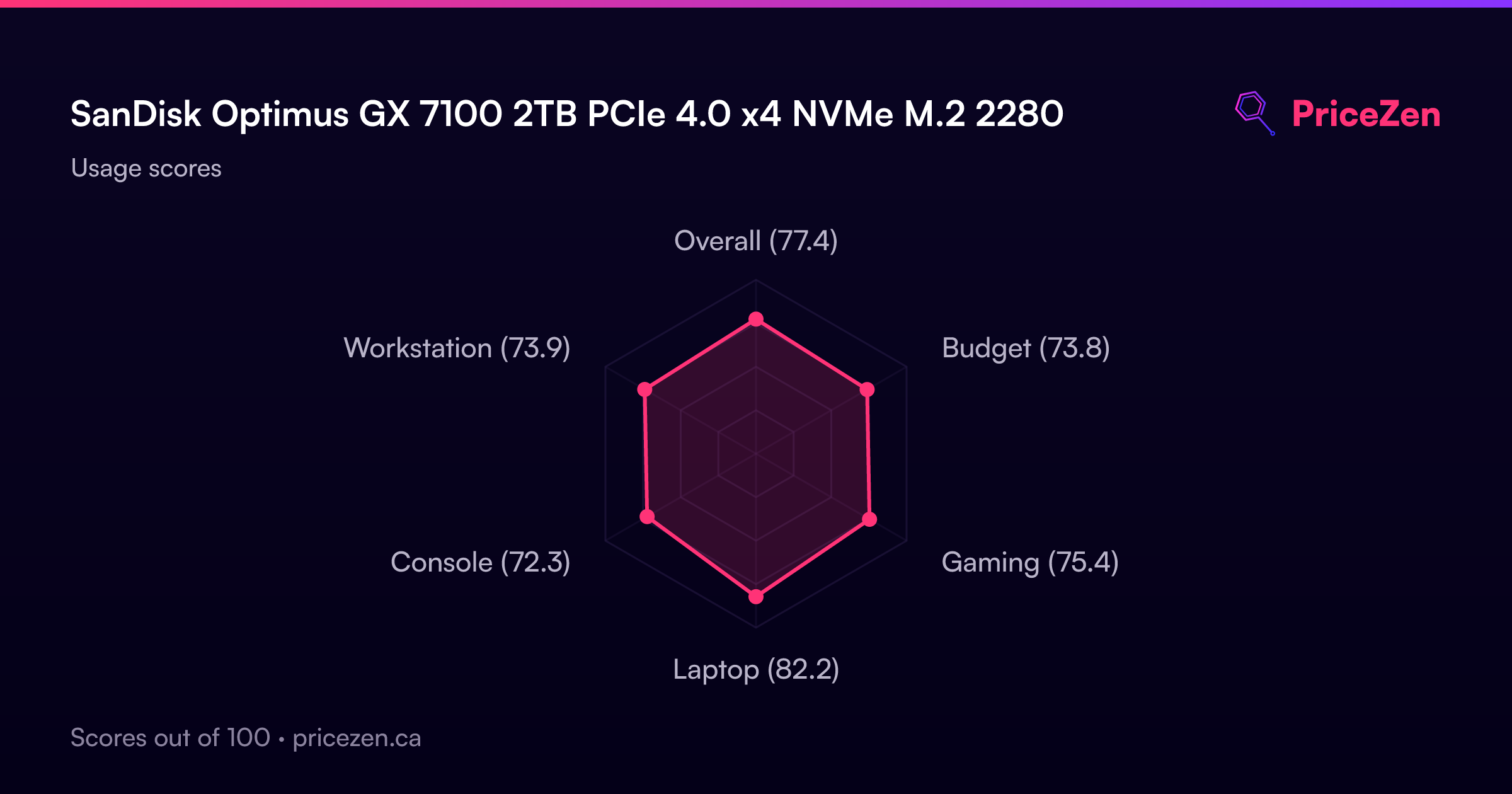
- Overall77.4
- Budget73.8
- Gaming75.4
- Laptop82.2
- Console72.3
- Workstation73.9