Samsung 860 PRO 256GB SATA III 2.5"
The 256GB Samsung 860 PRO delivers 560 MB/s reads and 530 MB/s writes with MLC V-NAND and a DRAM cache, ensuring consistent performance for everyday tasks. Its hardware encryption and SATA compatibility with older interfaces make it a reliable drop-in upgrade for legacy systems. Best for mainstream PC and laptop users who prioritize endurance and data security over raw capacity.

No current retailer price











Snapshot
The 30-Second Version
The 860 PRO maxes out SATA III at 560 MB/s read and 530 MB/s write, but that only lands it in the 39th percentile for speed. Feature set is top-tier at the 98th percentile, and owners love it with a 4.8-star rating. It's a fantastic upgrade for old SATA-only systems, but a poor value if you have an M.2 slot available.
Pros & Cons
Pros
- Feature set ranks in the 98th percentile, with MLC NAND, DRAM cache, and hardware encryption 98th
- Maxes out the SATA III interface at 560 MB/s read and 530 MB/s write 95th
- Strong QD1 random write performance at 43,000 IOPS 95th
- 4.8 out of 5 stars across 3,345 customer reviews
- Social proof in the 95th percentile, owners genuinely love this drive
Cons
- Speed sits at the 39th percentile, well behind any modern NVMe drive
- 256GB capacity lands in the 18th percentile, cramped by today's standards
- Endurance ranks in the 15th percentile, MLC or not
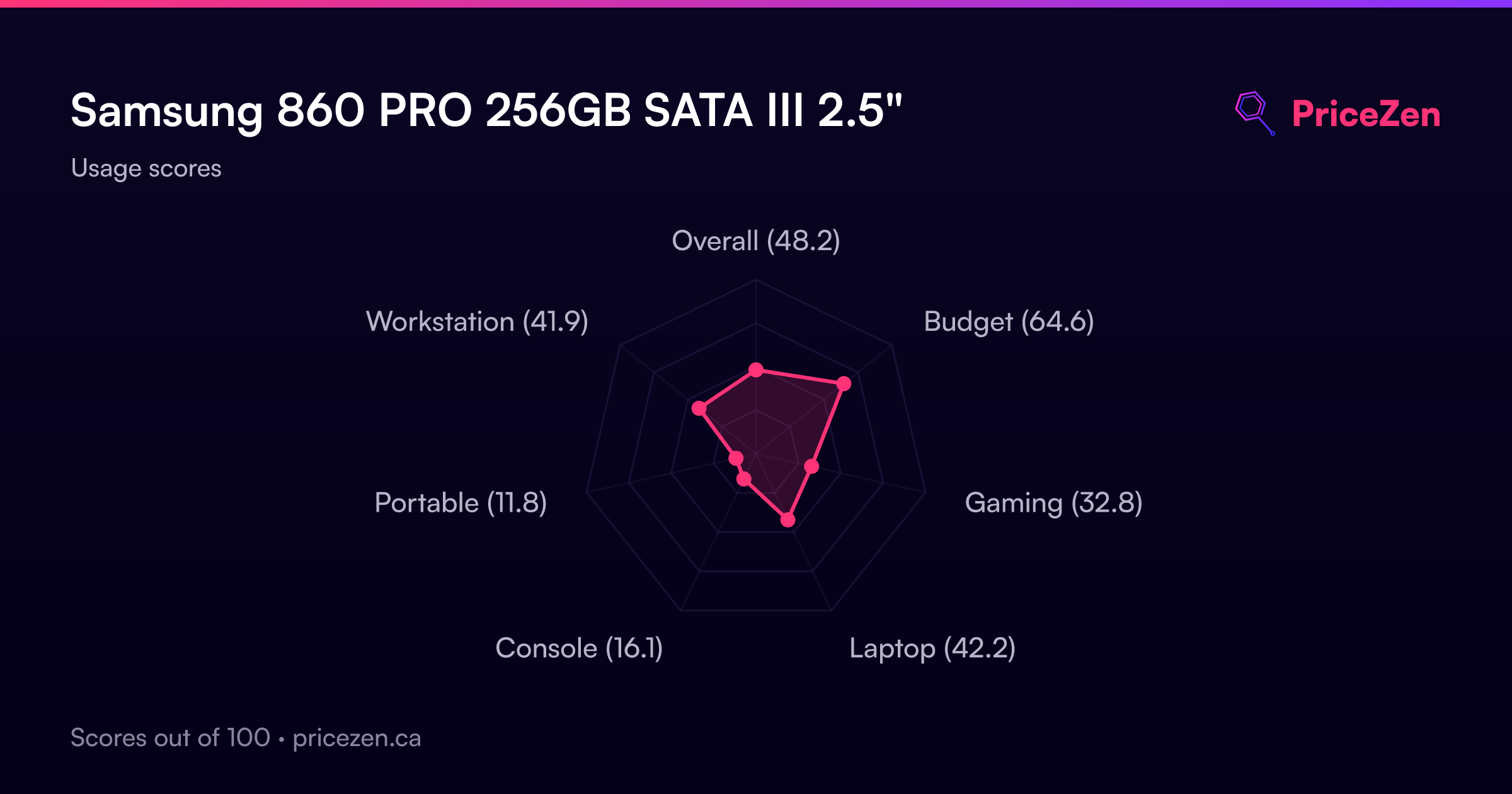
- Portable use case scores just 11.8 out of 100
- USD 206 for 256GB is a rough price per gigabyte
What owners think
The Word on the Street
How owner sentiment changed over time
ExclusiveBased on when customers actually wrote their reviews - so you can see whether early praise held up.
7 written reviews, Jul 2018 – May 2021: 7 happy
Across all 3,345 store ratings: 4.8★. Most owners rate without writing a review. The chart counts the 7 written reviews.
Each dot is one written review, in the month it was written. Happy = 4-5★, mixed = 3★, unhappy = 1-2★.
The proof
Performance
Sequential reads hit 560 MB/s and writes hit 530 MB/s, which is basically maxing out the SATA III bus. Random performance is more interesting: 100,000 IOPS read and 90,000 IOPS write at QD32. At QD1, which matters more for everyday responsiveness, you're looking at 11,000 IOPS read and 43,000 IOPS write. That QD1 write number is actually pretty solid for a SATA drive.
But let's be honest about where this lands. Against our full database, speed is at the 39th percentile. That's below average, and it's not close to the NVMe drives that dominate the top of the charts. The MJX controller and MLC NAND are doing their job, but they're working within the limits of a 6 Gb/s interface that was finalized in 2009. For a SATA drive, this is about as good as it gets. For a modern drive, it's a different story.
Specifications
Full Specifications
Drive
| Capacity | 256 |
| Form Factor | 2.5" |
| Interface | SATA III |
| Protocol | SATA |
| External | No |
Performance
| Sequential Read (MB/s) | 560 |
| Sequential Write (MB/s) | 530 |
| Random Read (IOPS) | 100000 |
| Random Write (IOPS) | 90000 |
Hardware
| NAND | MLC |
| DRAM Cache | Yes |
| Controller | MJX controller |
Features
| Hardware Encryption | Yes |
vs Competition
Stack this against the Western Digital WD_BLACK SN850P or the Crucial T710 and the gap is stark. Those NVMe drives push 7,000 MB/s or more, over twelve times the sequential throughput of the 860 PRO. The Kingston Fury Renegade and Team Group MP44 also leave it in the dust on raw speed. But here's the catch: all of those are NVMe drives that need an M.2 slot. The 860 PRO is a 2.5-inch SATA drive, and if your system only has SATA ports, none of those competitors are even an option. In that context, the 860 PRO is competing against other SATA drives, and it's one of the best of a dying breed.
| Spec | Samsung 860 PRO | Western Digital WD_BLACK SN8100 | Kingston FURY Renegade | Crucial T700 | SanDisk WD_BLACK | Seagate FireCuda 530R |
|---|---|---|---|---|---|---|
| Capacity | 256GB | 4TB | 4TB | 2TB | 8TB | 4TB |
| Form Factor | 2.5" | M.2 2280 | M.2 2280 | M.2 2280 | M.2 2280 | M.2 2280 |
| Interface | SATA III | PCIe 5.0 x4 | PCIe 4.0 x4 | PCIe 5.0 x4 | PCIe 5.0 x4 | PCIe 4.0 x4 |
| Seq Read | 560 MB/s | 14,900 MB/s | 7,300 MB/s | 12,400 MB/s | 14,900 MB/s | 7,400 MB/s |
| Nand Type | MLC | TLC | TLC | TLC | TLC | TLC |
| Dram Cache | true | false | true | true | true | false |
| Endurance | - | 2400 TBW | 4000 TBW | 1200 TBW | 4800 TBW | 5050 TBW |
| Compare | Compare | Compare | Compare | Compare |
| Product | Speed | Random | Feature | Capacity | User Sentiment | Endurance | Social Proof | Affordability |
|---|---|---|---|---|---|---|---|---|
| Samsung 860 PRO | 38.6 | 45.5 | 97.7 | 18.4 | 95.2 | 14.9 | 94.9 | 43.8 |
| Western Digital WD_BLACK SN8100 Compare | 99.7 | 99.6 | 86 | 92.6 | 95.2 | 80.4 | 94.9 | 8.5 |
| Kingston FURY Renegade Compare | 93.5 | 94.4 | 94.1 | 92.6 | 79.6 | 94 | 94.9 | 10.9 |
| Crucial T700 Compare | 96.7 | 97.7 | 97.7 | 78.8 | 79.6 | 82.6 | 75 | 21.9 |
| SanDisk WD_BLACK Compare | 99.1 | 99.3 | 97.7 | 98.1 | 95.2 | 80.4 | 39.9 | 3.2 |
| Seagate FireCuda 530R Compare | 93 | 96.8 | 53.3 | 92.6 | 66.4 | 95.6 | 85.7 | 7.5 |
Price
Value & Pricing
At USD 206 for 256GB, you're paying about 80 cents per gigabyte. That's a tough pill when 1TB NVMe drives routinely sell for less. The MLC NAND and DRAM cache add cost, and Samsung's PRO branding carries a premium, but the value proposition only makes sense if you specifically need a SATA drive with this level of reliability. The affordability score sits at the 45th percentile, which is about average, but average doesn't feel great when you're getting a quarter of the capacity of similarly priced competitors.
Read more
Overview
The Samsung 860 PRO 256GB is a SATA III drive that tops out at 560 MB/s sequential read and 530 MB/s write. Those numbers won't impress anyone who's seen a modern NVMe drive, but they're the ceiling for the SATA interface, and this drive hits it. The feature set is where it shines, landing in the 98th percentile of our database, with MLC V-NAND, a DRAM cache, and hardware encryption all packed in.
Here's the thing though. This drive is a relic from a different era of computing, and the data shows it. Speed sits at the 39th percentile, capacity at 18th, and endurance at 15th. It's a 256GB drive in a world where 1TB is the starting point. But for the right use case, like breathing life into an older laptop or desktop that's still spinning a mechanical hard drive, it's a massive upgrade.
Common Questions
Q: Is this drive worth buying in 2024?
Only if your system is limited to SATA. The 560 MB/s read speed is the SATA III ceiling, but it's in the 39th percentile of our database. If you have an M.2 slot, an NVMe drive will give you dramatically better performance for less money per gigabyte.
Q: How does the 860 PRO compare to the 860 EVO?
The PRO uses MLC NAND while the EVO uses TLC, which gives the PRO better endurance and sustained write performance. But the endurance score here is still only in the 15th percentile of our database, and the price premium over the EVO is hard to justify for most users.
Q: Will this work in my old laptop?
If your laptop has a 2.5-inch SATA bay, yes. The drive is compatible with SATA 3 Gb/s and 1.5 Gb/s interfaces, so even older systems will work, just at reduced speeds. Owners report excellent results upgrading older laptops, with the main caveat being occasional AHCI mode issues on some models.
Who Should Skip This
Anyone with an M.2 slot should skip this drive entirely. The speed percentile of 39 and capacity percentile of 18 mean you're paying a premium for technology that's been superseded. The portable use case score of 11.8 out of 100 is a red flag if you're planning to use this in a laptop that moves around a lot. And at USD 206 for 256GB, the price per gigabyte is hard to defend when 1TB NVMe drives cost less. If you need bulk storage, endurance, or raw speed, this isn't your drive.
Verdict
The 860 PRO 256GB is a great SATA SSD and a mediocre modern SSD. If you've got an older laptop or desktop that's still running a mechanical hard drive, this drive will transform it. Boot times drop, apps launch instantly, and the whole system feels new. The 4.8-star rating across 3,345 reviews backs that up. But if you have an M.2 slot available, buy an NVMe drive instead. You'll get dramatically more speed and capacity for the same money. The 860 PRO is a specialist tool for a specific job, and it does that job well.
Usage Scores
- Overall48.2
- Budget64.6
- Gaming32.8
- Laptop42.2
- Console16.1
- Portable11.8
- Workstation41.9