CN CL1 128GB PCIe 3.0 x4 NVMe M.2 2230
The 128GB PCIe Gen3 x4 NVMe interface delivers faster boot times and app loading on laptops and desktops. Its compact M.2 2230 form factor fits ultra-thin notebooks, though the 128GB capacity limits storage-heavy use. Best for budget-conscious users upgrading an older laptop for everyday tasks like web browsing and document editing.












Snapshot
The 30-Second Version
The SSSTC CL1 128GB is cheap at $58 USD, landing in the 87th percentile for affordability, but that's about where the good news ends. User sentiment sits at the 16th percentile with reports of DOA units and overheating, and 128GB of capacity puts it in the 7th percentile. It's a budget boot drive for low-stakes projects, nothing more.
Pros & Cons
Pros
- 87th percentile for affordability, $58 USD on Amazon 86th
- 62nd percentile random performance, decent for small file operations
- M.2 2230 form factor fits compact laptops and handhelds
- 4.3/5 customer rating across 212 reviews
- PCIe 3.0 x4 interface, real NVMe not SATA
Cons
- 7th percentile for capacity, 128GB fills up fast
- 15th percentile endurance, longevity is a real question mark
- 16th percentile user sentiment, owners report DOA units and heat issues
- 53rd percentile speed, closer to SATA in real-world use
- OEM packaging, no retail box or accessories
What owners think
The Word on the Street
How owner sentiment changed over time
ExclusiveBased on when customers actually wrote their reviews - so you can see whether early praise held up.
8 written reviews, Jun 2021 – Jun 2025: 6 happy, 1 mixed, 1 unhappy
Across all 212 store ratings: 4.3★. Most owners rate without writing a review. The chart counts the 8 written reviews.
Each dot is one written review, in the month it was written. Happy = 4-5★, mixed = 3★, unhappy = 1-2★.
The proof
Performance
Speed lands at the 53rd percentile, which is about average for NVMe drives in our database. That sounds fine until you remember this is a PCIe 3.0 x4 drive competing against a field that includes plenty of Gen4 and Gen5 hardware. Random performance sits at the 62nd percentile, so small file operations are actually a bit better than the overall speed number suggests. One owner noted it performs closer to SATA speeds in real-world use, which tracks with the middling benchmark position.
For basic tasks like OS boots, app launches, and media transfers, this drive will feel like a massive upgrade over any spinning disk. But don't expect it to impress anyone who's used a modern Gen4 drive. The 128GB capacity also means you'll hit the performance cliff that comes with filling an SSD to the brim faster than you'd think.
Specifications
Full Specifications
Drive
| Capacity | 128 |
| Form Factor | M.2 2230 |
| Interface | PCIe 3.0 x4 |
| Protocol | NVMe |
| PCIe Generation | 3 |
| External | No |
vs Competition
Stacked against the Crucial T500, Samsung 990 EVO, or SK Hynix Platinum P41, this drive loses on every metric except price. Those competitors are all Gen4 drives with capacities starting at 500GB or 1TB, and they dominate the speed and endurance rankings. The SanDisk WD Blue WDS100T5B0E is probably the closest philosophical match, a budget-oriented drive, but even that comes in at 1TB and outperforms the CL1 across the board. The only reason to pick the SSSTC over any of these is if you're building something where the M.2 2230 form factor is a hard requirement and you genuinely cannot spend more than $60.
| Spec | CN CL1 | Western Digital WD_BLACK SN8100 | Samsung 9100 PRO | Crucial T500 | XPG GAMMIX S70 Blade | Corsair MP600 PRO XT |
|---|---|---|---|---|---|---|
| Capacity | 128GB | 1TB | 1TB | 1TB | 2TB | 2TB |
| Form Factor | M.2 2230 | M.2 2280 | M.2 2280 | M.2 2280 | M.2 2280 | M.2 2280 |
| Interface | PCIe 3.0 x4 | PCIe 5.0 x4 | PCIe 5.0 x4 | PCIe 4.0 x4 | PCIe 4.0 x4 | PCIe 4.0 x4 |
| Seq Read | - | 14,900 MB/s | 14,700 MB/s | 7,300 MB/s | 7,400 MB/s | 7,100 MB/s |
| Nand Type | - | TLC | TLC | TLC | TLC | TLC |
| Dram Cache | - | true | true | true | true | false |
| Endurance | - | 600 TBW | 600 TBW | 600 TBW | 1480 TBW | 1400 TBW |
| Compare | Compare | Compare | Compare | Compare |
| Product | Speed | Random | Feature | Capacity | User Sentiment | Endurance | Social Proof | Affordability |
|---|---|---|---|---|---|---|---|---|
| CN CL1 | 53 | 61.8 | 14.5 | 7.2 | 15 | 14.6 | 58.3 | 86.3 |
| Western Digital WD_BLACK SN8100 Compare | 97.8 | 98.7 | 99.7 | 55.3 | 95 | 80.6 | 95.4 | 38.8 |
| Samsung 9100 PRO Compare | 98.9 | 99.8 | 99.7 | 55.3 | 64.4 | 85.7 | 99.6 | 41.9 |
| Crucial T500 Compare | 91.4 | 96.7 | 98.8 | 55.3 | 95 | 82.6 | 95.4 | 52.1 |
| XPG GAMMIX S70 Blade Compare | 92.9 | 90.6 | 93.8 | 78.6 | 79 | 77.4 | 77.7 | 30.7 |
| Corsair MP600 PRO XT Compare | 88.1 | 95.2 | 87 | 78.6 | 95 | 91.3 | 51 | 22.8 |
Price
Value & Pricing
At $58 USD, the price per gigabyte works out to about 45 cents, which is not actually that great by modern SSD standards. You can find 1TB drives from reputable brands for around $60-70 these days, which puts this drive's value proposition in a weird spot. The 87th percentile affordability ranking is more about the low absolute price than the price per GB. If you absolutely need the cheapest possible NVMe drive and 128GB is genuinely enough, this works. But the CAD 111 and EUR 137 listings are frankly absurd for this capacity, and anyone paying those prices is getting taken for a ride.
Amazon 1 offer From CA$112
Price history
Read more
Overview
The SSSTC CL1 128GB is a budget NVMe drive that lands in the 87th percentile for affordability, which is really the whole pitch here. At $58 USD on Amazon, you're getting a PCIe 3.0 x4 M.2 2230 drive for less than most 256GB SATA drives. But the numbers tell a messy story: user sentiment sits at the 16th percentile and endurance at the 15th, which means people are not exactly thrilled with how these hold up over time.
Capacity is the other elephant in the room. 128GB puts this drive in the 7th percentile for storage space, which is rough in 2025 when a single modern game can eat 100GB. This is not a drive for your main rig. It's a boot drive for a lightweight Linux box, a cache drive, or a cheap upgrade to breathe life into an old laptop that's still spinning a hard disk.
Common Questions
Q: Will this drive work in a Raspberry Pi 5?
It might, but we'd be cautious. One owner reported random failures when using this drive on a Raspberry Pi 5. The M.2 2230 form factor does fit many Pi 5 NVMe hats, but the 15th percentile endurance ranking and reported reliability issues make it a risky choice for a system that's often left running 24/7.
Q: Is 128GB enough for Windows 11?
Technically yes, Windows 11 needs about 64GB minimum, but you'll be left with roughly half the drive for everything else. With capacity in the 7th percentile, you'll constantly be managing space. This drive is better suited for lightweight Linux distros, ChromeOS Flex, or as a secondary cache drive.
Q: Does this drive need a heatsink?
Given that one owner reported the drive getting extremely hot, a heatsink is probably a good idea if your system has room for one. The M.2 2230 form factor means many laptops won't have space for a full heatsink, but a thin thermal pad or copper shim could help. The heat reports combined with the 15th percentile endurance score suggest thermals are a real concern here.
Who Should Skip This
Skip this drive if you value your data or your time. The 16th percentile user sentiment score is not a fluke, it's a pattern of DOA units, overheating, and random failures. If you need more than 128GB, which is almost everyone, the 7th percentile capacity ranking means you'll be shopping again within months. And if you're outside the US, the CAD 111 and EUR 137 prices are genuinely terrible for what you get. Anyone building a system they actually depend on should look at the Crucial T500 or Samsung 990 EVO instead, even if it means spending a bit more.
Verdict
The SSSTC CL1 128GB is a drive that makes sense in exactly one scenario: you need the cheapest possible NVMe boot drive for a lightweight system and you're willing to roll the dice on reliability. The 16th percentile user sentiment score is the number that worries us most. Multiple owners report dead-on-arrival units, extreme heat, and random failures on Raspberry Pi 5 boards. That's not a drive we'd trust with anything important. If you can stretch your budget even $20-30, you'll find dramatically better options with more capacity and far better reliability track records.
Usage Scores
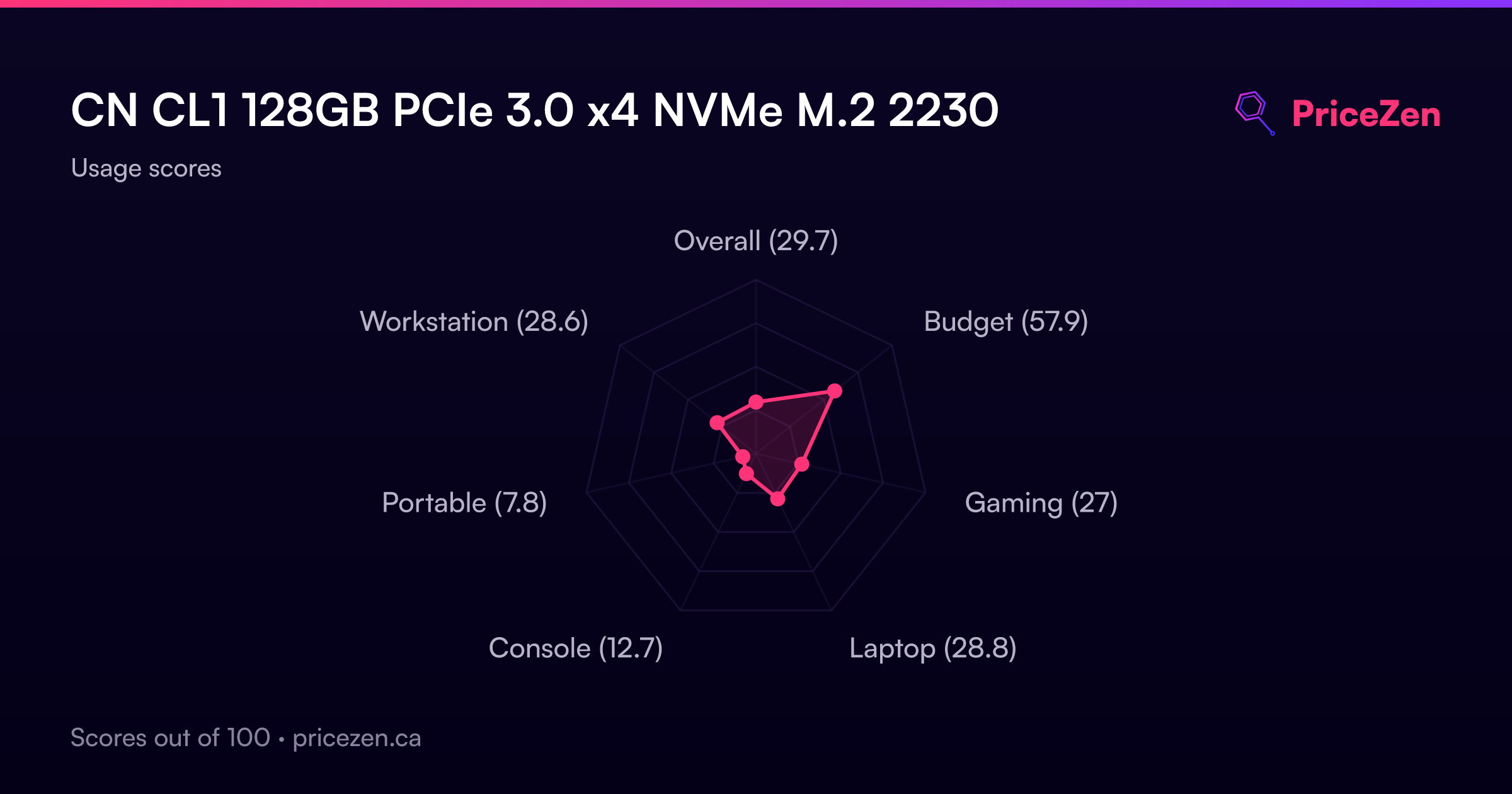
- Overall30.3
- Budget59.1
- Gaming27.2
- Laptop29.2
- Console13
- Portable7.9
- Workstation28.7