Samsung 250GB SSD SATA III 2.5"
The 250GB SATA III interface delivers sequential read speeds of 540 MB/s and write speeds of 520 MB/s, with 256MB of low-power DDR3 SDRAM cache and Samsung's TurboWrite technology for faster file transfers. Its 2.5-inch form factor and compatibility with SATA 3Gb/s and 1.5Gb/s interfaces make installation easy in most laptops and desktops, while the efficient controller draws only 2mW to extend battery life. This drive suits budget-conscious users upgrading an older laptop or desktop for everyday tasks, though its portability score is low.

No current retailer price










Snapshot
The 30-Second Version
Speed scores 8 out of 100 in our rankings, which is about as low as this category goes. The 540 MB/s reads and 520 MB/s writes are respectable for SATA, but 250GB, endurance at 15/100 and random performance at 23 make this a niche rescue drive rather than an upgrade.
Pros & Cons
Pros
- 540 MB/s sequential reads and 520 MB/s writes, close to the SATA ceiling
- SATA 6Gb/s with fallback to 3Gb/s and 1.5Gb/s, so it drops into older machines
- 256MB of low-power DDR3 cache plus Rapid Mode for extra processing headroom
- 2.5-inch form factor fits both laptops and desktops
- Affordability ranks 53, solidly middle of the pack
Cons
- Speed score of 8/100 is one of the worst in the category
- Random performance at 23 falls behind most rivals
- 250GB capacity ranks 13/100, tight for anything beyond an OS install
- Endurance at 15/100 lags behind most of the field
- Portable use scores 2.7/100, our weakest reading for this drive
The proof
Performance
Let's start with the spec sheet, because it's genuinely tidy for what it is. Sequential reads of 540 MB/s and writes of 520 MB/s, a SATA 6Gb/s interface that also drops back to 3Gb/s and 1.5Gb/s, 256MB of DDR3 SDRAM doing cache duty, and Rapid Mode leaning on that DRAM to speed up processing. Samsung's 3D V-NAND stacks 32 cell layers vertically instead of laying them flat, which is how a 250GB drive fits in a 2.5-inch shell. There's also a 2 mW idle figure thanks to the revised controller, which is the sort of thing that quietly helps a laptop's battery.
But raw sequential numbers only tell half the story, and our rankings tell the other half. Random performance sits at 23, a weak spot, and that's the metric that actually decides how snappy a boot drive feels day to day. Speed overall is 8/100, one of the lowest we've seen in this category. Endurance at 15/100 lags behind most of the field too. So: fine sequential throughput, middling-to-poor everywhere else. It's a competent SATA drive being graded on a curve that includes much faster things.
Specifications
Full Specifications
Drive
| Capacity | 250 |
| Form Factor | 2.5" |
| Interface | SATA III |
| Protocol | SATA |
| External | No |
vs Competition
Here's where it gets uncomfortable. Our comparison set includes the Kingston FURY Renegade, Western Digital WD_BLACK SN850X, Crucial T700, SanDisk Optimus GX PRO 8100 and Lexar NM1090 PRO, and against that crowd this Samsung's 540 MB/s read ceiling and 8/100 speed ranking simply don't compete. Capacity at 13/100 and endurance at 15/100 mean the SN850X and FURY Renegade are worth cross-shopping if you care about space or write longevity, and the Crucial T700 and Lexar NM1090 PRO are the ones to look at if outright speed is the whole point. The only scenario where this drive wins is the one where your motherboard has a SATA port and nothing else, in which case the competitors aren't really options at all.
| Spec | Samsung 250GB SSD | Western Digital WD_BLACK SN8100 | Kingston FURY Renegade | Crucial T700 | SanDisk WD_BLACK | Seagate FireCuda 530R |
|---|---|---|---|---|---|---|
| Capacity | 250GB | 4TB | 4TB | 2TB | 8TB | 4TB |
| Form Factor | 2.5" | M.2 2280 | M.2 2280 | M.2 2280 | M.2 2280 | M.2 2280 |
| Interface | SATA III | PCIe 5.0 x4 | PCIe 4.0 x4 | PCIe 5.0 x4 | PCIe 5.0 x4 | PCIe 4.0 x4 |
| Seq Read | - | 14,900 MB/s | 7,300 MB/s | 12,400 MB/s | 14,900 MB/s | 7,400 MB/s |
| Nand Type | - | TLC | TLC | TLC | TLC | TLC |
| Dram Cache | - | false | true | true | true | false |
| Endurance | - | 2400 TBW | 4000 TBW | 1200 TBW | 4800 TBW | 5050 TBW |
| Compare | Compare | Compare | Compare | Compare |
| Product | Speed | Random | Feature | Capacity | Endurance | Affordability |
|---|---|---|---|---|---|---|
| Samsung 250GB SSD | 8.2 | 23.2 | 14.8 | 13.5 | 14.9 | 51.9 |
| Western Digital WD_BLACK SN8100 Compare | 99.7 | 99.6 | 86 | 92.6 | 80.4 | 8.5 |
| Kingston FURY Renegade Compare | 93.5 | 94.4 | 94.1 | 92.6 | 94 | 11 |
| Crucial T700 Compare | 96.7 | 97.7 | 97.7 | 78.8 | 82.6 | 21.9 |
| SanDisk WD_BLACK Compare | 99.1 | 99.3 | 97.7 | 98.1 | 80.4 | 3.1 |
| Seagate FireCuda 530R Compare | 93 | 96.8 | 53.3 | 92.6 | 95.6 | 7.4 |
Price
Value & Pricing
We track one live listing right now: JPY 40,749 at Amazon JP, new and in stock. That's the only price in our data, so there's no store-to-store spread to shop around for. Affordability ranks 53 against the category, which sounds reassuring until you remember what you're buying: 250GB, a SATA interface, and a total score of 13.6/100. If your machine physically cannot take anything faster, that's a reasonable trade. If it can, this is the wrong place to spend the money.
Read more
Overview
540 MB/s reads and 520 MB/s writes on a SATA 6Gb/s link. Those are the numbers Samsung leads with for this 250GB 850 EVO, and they're about as far as SATA goes before the cable itself becomes the bottleneck. The catch is what our scoring model does with them: speed lands at 8 out of 100 against everything else in its category, which puts it near the bottom of the pile. Capacity scores 13/100, endurance 15/100, features 15/100.
The one bright spot is affordability at 53, basically middle of the pack, and that's the entire pitch here. This is a 2.5-inch drive with 256MB of low-power DDR3 cache, Samsung's 32-layer 3D V-NAND and TurboWrite, aimed at older laptops and desktops that only have a SATA port. Our laptop score of 12.5/100 says even that job is a stretch when you stack it against the current field.
Common Questions
Q: Is 250GB enough for a main drive?
For an OS and a handful of apps, yes. Beyond that it gets tight fast, and our capacity ranking of 13/100 backs that up. If you're storing games, video or large project files, treat this as a boot drive and keep bulk storage elsewhere.
Q: Will it work in an older laptop with a slower SATA port?
Yes. The interface is SATA 6Gb/s but it's explicitly compatible with SATA 3Gb/s and SATA 1.5Gb/s, and the 2.5-inch form factor is the standard laptop size. You won't see the full 540 MB/s read figure on an older link, but it'll run.
Q: How does it compare to a modern NVMe SSD?
Poorly on speed. Our model puts it at 8/100 for speed and 23 for random performance against the wider category, which includes drives like the WD_BLACK SN850X and Crucial T700. Its 540 MB/s sequential read is a SATA-limited number. Only choose it if your system has no other option.
Who Should Skip This
Skip this if your machine has an M.2 slot, full stop. A speed ranking of 8/100 and random performance at 23 mean you'd be leaving a lot on the table. Skip it if you need space, since 250GB ranks 13/100 for capacity. Skip it if you write heavily, because endurance at 15/100 lags behind most of the field. And skip it for portable duty entirely: 2.7/100 is the weakest score this drive posts anywhere in our data.
Verdict
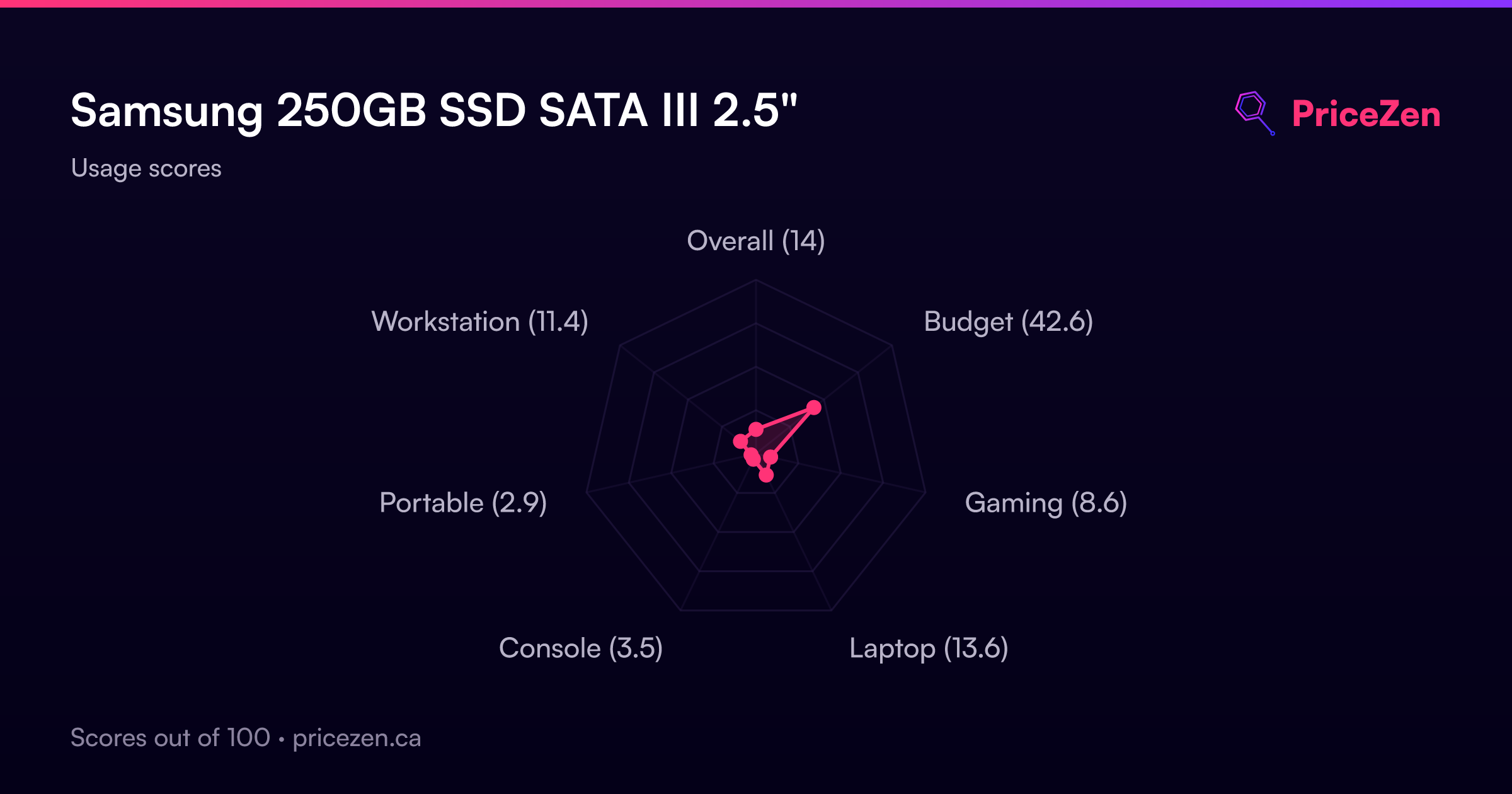
A budget score of 42.9/100 and affordability at 53 make this a defensible pick for exactly one buyer: someone reviving an older laptop or desktop stuck on SATA, who wants 250GB and nothing more. For everyone else, the total score of 13.6/100, speed at 8/100 and random performance at 23 argue pretty loudly against it. We'd only recommend it as a compatibility purchase, not a performance one. Check your ports first, then decide.
Usage Scores
- Overall14
- Budget42.6
- Gaming8.6
- Laptop13.6
- Console3.5
- Portable2.9
- Workstation11.4