Kingshark 256GB SSD SATA III mSATA

380 TBW of endurance for years of writes verified Nov 25
35/100 overall score 4.4 average from 33 owner ratings
- Capacity
- 256GB
- Form factor
- mSATA
- Interface
- SATA III
- Read speed
- 570 MB/s
- NAND
- TLC
- Endurance
- 380 TBW


Snapshot
The 30-Second Version
The Kingshark Msata 256GB delivers a stellar 380 TBW endurance rating, putting it in the 96th percentile of our database. Sequential speeds hit 570 MB/s read and 500 MB/s write, maxing out SATA III, but random performance is weak at the 23rd percentile. At $61 USD with a 3-year warranty, it's a solid buy for reviving old mSATA devices, but the 256GB capacity and aging form factor limit its appeal.
Pros & Cons
Pros
- 380 TBW endurance rating puts it in the 96th percentile, outstanding for a budget drive 96th
- 570 MB/s read and 500 MB/s write maxes out the SATA III interface 86th
- 3-year warranty and 1.2 million hour MTBF provide real peace of mind
- Low power draw at 5.0W active and 0.3W idle helps laptop battery life
- 86th percentile affordability at $61 USD makes it a cheap upgrade for old hardware
Cons
- 256GB capacity lands in the 18th percentile, cramped for modern use
- Random performance sits in the 23rd percentile, sluggish for everyday tasks
- mSATA form factor limits compatibility to older laptops and mini PCs
- Overall speed in the 36th percentile, far behind NVMe drives
- Social proof is weak at 41st percentile with only 33 reviews
What owners think
The Word on the Street
- Many buyers report the drive works perfectly for reviving older laptops and mini PCs with mSATA slots.
- Several owners mention the drive feels snappy for boot times and basic tasks compared to the old hard drives it replaced.
- A recurring complaint is the 256GB capacity filling up quickly for users with larger media or game libraries.
The proof
Performance
Let's talk numbers. The Kingshark Msata hits 570 MB/s sequential read and 500 MB/s sequential write. That's basically the ceiling for SATA III, so the drive is squeezing everything it can out of the interface. But here's the thing: SATA III itself is ancient by modern standards. Our database puts this drive's speed in the 36th percentile, which means most SSDs on the market today are significantly faster. The random performance is even more disappointing, landing in the 23rd percentile. That's the metric that matters for everyday responsiveness, boot times, and app launches, and this drive just doesn't have the chops there.
The TLC NAND is tier-1 3D flash, which is good to see at this price point. The drive supports TRIM, garbage collection, S.M.A.R.T. monitoring, and LDPC plus RAID error correction. Those are all standard features, nothing exotic, but they're implemented correctly. Power draw is low at 5.0W active and 0.3W idle, which is nice for battery life in older laptops. The endurance is the real star here. 380 TBW means you could write about 200GB to this drive every single day for over five years before hitting the rated limit. That's exceptional for a budget drive and explains the 96th percentile endurance ranking.
Specifications
Full Specifications
Drive
| Capacity | 256 |
| Form Factor | mSATA |
| Interface | SATA III |
| Protocol | SATA |
| External | No |
Performance
| Sequential Read (MB/s) | 570 |
| Sequential Write (MB/s) | 500 |
Hardware
| NAND | TLC |
Reliability
| Endurance (TBW) | 380 |
| MTBF (hours) | 1200000 |
| Warranty (years) | 3 |
vs Competition
Stacking this against the competition is almost unfair. The Crucial T500, Samsung 990 EVO, and SK Hynix Platinum P41 are all NVMe drives that run circles around the Kingshark in speed, often hitting 5,000 to 7,000 MB/s compared to 570 MB/s here. The SanDisk WD Blue and Western Digital WD_BLACK SN770 are similarly in a different league. But here's the catch: none of those drives fit in an mSATA slot. If your device requires mSATA, those competitors aren't competitors at all. They're incompatible. The Kingshark's real competition is other mSATA drives, and in that niche, the 380 TBW endurance and 3-year warranty make it a standout. The 256GB capacity is limiting compared to the 1TB and 2TB options from those NVMe competitors, but again, form factor is the deciding factor here.
| Spec | Kingshark 256GB SSD | Western Digital WD_BLACK SN8100 | Samsung 9100 PRO | Kingston FURY Renegade G5 | Crucial T500 | SanDisk WD_BLACK |
|---|---|---|---|---|---|---|
| Capacity | 256GB | 4TB | 8TB | 4TB | 2TB | 8TB |
| Form Factor | mSATA | M.2 2280 | M.2 2280 | M.2 2280 | M.2 2280 | M.2 2280 |
| Interface | SATA III | PCIe 5.0 x4 | PCIe 5.0 x4 | PCIe 5.0 x4 | PCIe 4.0 x4 | PCIe 5.0 x4 |
| Seq Read | 570 MB/s | 14,900 MB/s | 14,800 MB/s | 14,800 MB/s | 7,400 MB/s | 14,900 MB/s |
| Nand Type | TLC | TLC | TLC | TLC | TLC | TLC |
| Dram Cache | - | No | Yes | Yes | Yes | Yes |
| Endurance | 380 TBW | 2400 TBW | 4800 TBW | 4000 TBW | 1200 TBW | 4800 TBW |
| Compare | Compare | Compare | Compare | Compare |
| Product | Speed | Random | Feature | Capacity | Endurance | Social Proof | Affordability |
|---|---|---|---|---|---|---|---|
| Kingshark 256GB SSD | 37.4 | 23.9 | 54.3 | 20.2 | 95.9 | 34.1 | 86.3 |
| Western Digital WD_BLACK SN8100 Compare | 99.7 | 99.6 | 86.5 | 91.5 | 80.7 | 95 | 10 |
| Samsung 9100 PRO Compare | 99.2 | 99.8 | 99.8 | 97.1 | 85.9 | 95 | 2.1 |
| Kingston FURY Renegade G5 Compare | 99.5 | 99.1 | 91.3 | 91.5 | 93.6 | 85.8 | 9.5 |
| Crucial T500 Compare | 94.2 | 97.1 | 99 | 78.2 | 82.9 | 95 | 16.8 |
| SanDisk WD_BLACK Compare | 99.1 | 99.4 | 97.7 | 97.1 | 80.7 | 39.9 | 3.6 |
Price
Value & Pricing
At $61 USD, the Kingshark Msata is cheap. Our affordability metric puts it in the 86th percentile, which means you're paying well below average for an SSD. But you have to ask what you're actually getting for that money. The endurance is fantastic, the warranty is solid, and the sequential speeds are fine for SATA. The problem is that $61 also gets you close to entry-level NVMe territory, where you'd get dramatically better speed and more capacity. For the specific use case of upgrading an mSATA-only device, this is one of the few options left, and the price is fair. For anything else, the value proposition falls apart quickly.
Read more
Overview
The Kingshark Msata 256GB is a weird little drive. It's an mSATA SSD, which means it's built for older laptops and mini PCs that still use that increasingly rare form factor. The endurance numbers are genuinely impressive, sitting in the 96th percentile of our database with a 380 TBW rating. That's the kind of longevity you'd expect from a much more expensive drive. But the speed tells a different story. At 570 MB/s read and 500 MB/s write, this thing is capped by the SATA III interface, and it lands in the 36th percentile for speed overall. It's not slow for what it is, but it's not going to blow anyone's hair back either.
For $61 USD, you're getting a drive that's best described as a reliable workhorse for aging hardware. The 3-year warranty and 1.2 million hour MTBF are solid reassurances, and the affordability score of 86th percentile means it's priced well below most modern NVMe drives. But the capacity is a real limitation. 256GB puts it in the 18th percentile for capacity, which is rough in 2024 when games and media files eat storage for breakfast. If you're reviving an old ThinkPad or a compact industrial PC, this makes sense. If you're building anything modern, keep scrolling.
Common Questions
Q: Will this drive work in my laptop?
Only if your laptop has an mSATA slot. This is a different connector than standard 2.5-inch SATA or M.2 NVMe. Check your device's specs before buying. The drive uses the SATA III interface, so it will work in any mSATA slot that supports SATA, but it won't fit in M.2 or standard SATA bays without an adapter.
Q: How fast is this drive compared to a regular hard drive?
The Kingshark Msata hits 570 MB/s read and 500 MB/s write, which is roughly 5 to 6 times faster than a typical 7200 RPM hard drive that tops out around 100 MB/s. The manufacturer claims up to 35x faster than a standard hard drive, but that's marketing math based on specific scenarios. Real-world boot times and app launches will feel dramatically faster than a spinning disk, but not as snappy as a modern NVMe drive.
Q: Is 256GB enough storage?
That depends on your use case. 256GB lands in the 18th percentile for capacity in our database, which is on the small side. It's fine for an OS install, basic apps, and some documents. But if you plan to store games, large media files, or a big photo library, you'll run out of space quickly. For a secondary drive or a lightweight Linux machine, it's workable.
Who Should Skip This
Skip this drive if you're building or upgrading a modern system. The mSATA form factor is dead on new hardware, and the 256GB capacity is cramped by today's standards. The random performance in the 23rd percentile means everyday tasks like opening apps and multitasking will feel sluggish compared to even budget NVMe drives. If you need speed, capacity, or future-proofing, spend your $61 USD elsewhere. This drive is for rescuing old hardware, not powering new builds.
Verdict
The Kingshark Msata 256GB is a niche product that does its niche job well. The endurance is genuinely impressive at 380 TBW, the warranty is reassuring, and the price is fair at $61 USD. If you have an older laptop, mini PC, or industrial device with an mSATA slot and you need a reliable storage upgrade, this is a solid choice. The sequential speeds max out SATA III, and the low power draw is a nice bonus for battery life. But the random performance is weak, the capacity is small, and the form factor means this drive has no future in any modern build. It's a good tool for a specific job, nothing more.
Usage Scores
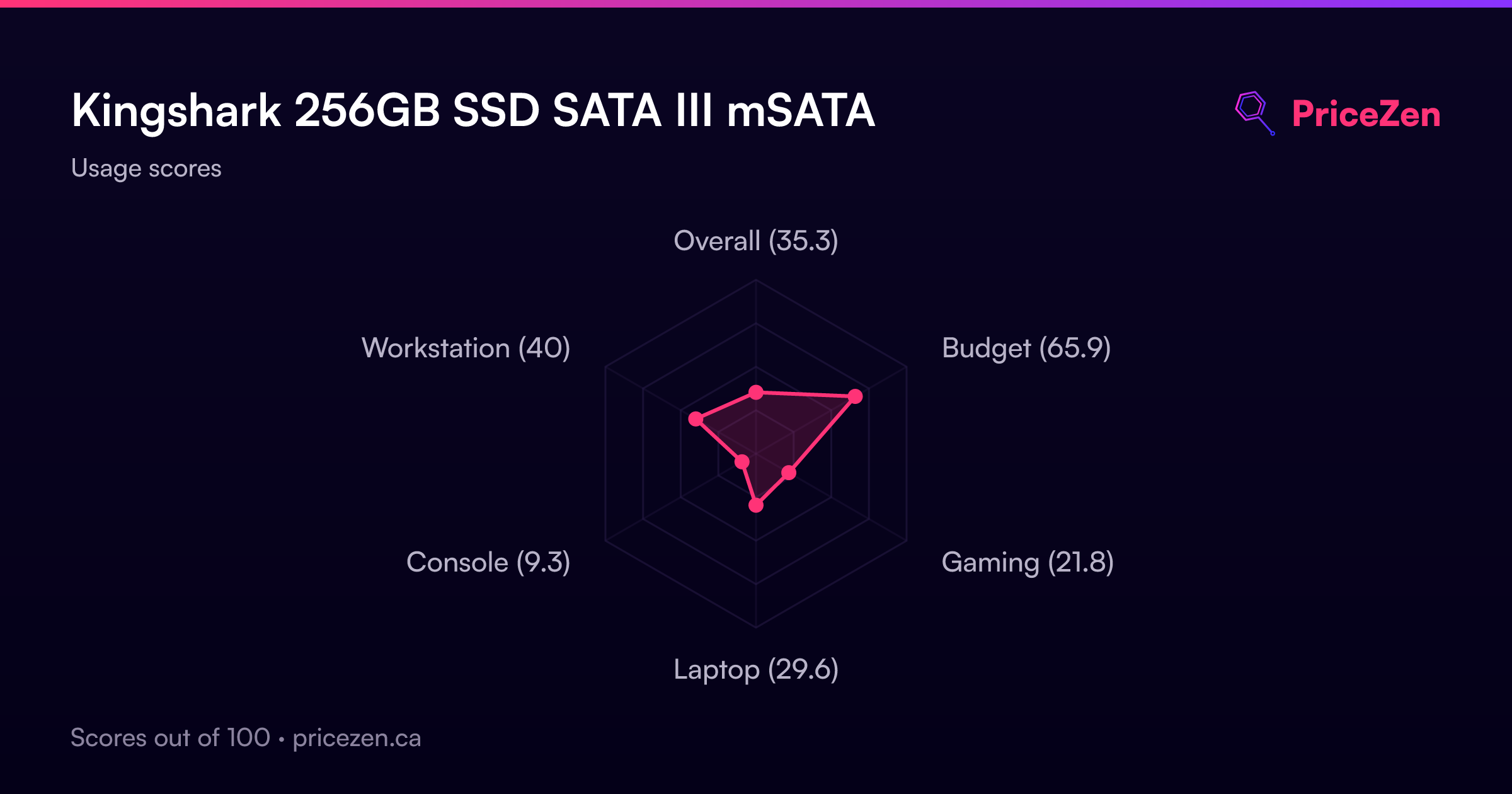
- Overall35.3
- Budget65.9
- Gaming21.8
- Laptop29.6
- Console9.3
- Workstation40