Western Digital Blue SA510 250GB SATA III 2.5"
The 250GB SATA III drive delivers 555 MB/s reads and 440 MB/s writes with TLC NAND, a DRAM-less design, and a 5-year warranty backed by 100 TBW endurance. Its low power draw extends laptop battery life and reduces vibrations compared to HDDs, while the included Acronis True Image software simplifies cloning your entire drive. This is best for budget-conscious users upgrading older desktops or laptops that lack M.2 slots, offering a reliable drop-in performance boost.












Snapshot
The 30-Second Version
The 250GB WD Blue SA510 looks like a sensible cheap SSD upgrade on paper, with 555 MB/s reads, 100 TBW endurance and a 5-year warranty. But owner sentiment scores 18/100, the lowest in our category data, driven by repeated reports of drives dying within weeks or months and a painful warranty process. Prices swing from USD 80 at Best Buy to USD 149 at Amazon, and from CAD 95 to CAD 341 north of the border. Only consider it for a non-critical SATA-only machine you back up constantly, and skip it for anything you care about.
Pros & Cons
Pros
- 555 MB/s reads and 440 MB/s writes are near the SATA III ceiling, a huge jump over any hard drive 79th
- 100 TBW endurance rating lands well above average for the category
- 5-year warranty and 1,750,000 h MTBF on paper
- 2.5-inch SATA fits older laptops and desktops that can't take NVMe
- Cheapest listing is USD 80 at Best Buy, and low power draw helps laptop battery life
Cons
- Owner sentiment scores 18/100, the worst we track in this category, with repeated reports of early death
- Multiple buyers report failures within weeks or months, often just past the return window
- Warranty claims are described by owners as frustrating and discouraging
- DRAM-less design, and one owner reported minute-long freezes every hour or two
- 250GB capacity ranks in the 13th percentile, and speed sits at the 22nd against other SSDs
What owners think
The Word on the Street
How owner sentiment changed over time
ExclusiveBased on when customers actually wrote their reviews - so you can see whether early praise held up.
10 written reviews, Aug 2022 – Jul 2024: 3 happy, 7 unhappy
Across all 277 store ratings: 4.2★. Most owners rate without writing a review. The chart counts the 10 written reviews.
Each dot is one written review, in the month it was written. Happy = 4-5★, mixed = 3★, unhappy = 1-2★.
The proof
Performance
Let's talk about what the numbers mean in practice. 555 MB/s read and 440 MB/s write are close to the practical ceiling of the SATA III interface, so as a hard drive replacement this thing will feel dramatically snappier than any spinning disk. Boot times, app launches, file copies: all of that improves. The catch is that our speed ranking puts it at the 22nd percentile against other internal SSDs, meaning it lags behind most of the category. That's not a flaw in this specific unit, it's the SATA tax. Random performance is more middling at 80K read IOPS and 78K write IOPS, sitting around the 42nd percentile, so heavy multitasking and lots of small-file work won't feel special.
The DRAM-less design is the other thing worth understanding. Without a dedicated cache chip for the mapping table, sustained writes and busy mixed workloads tend to be where these designs stumble, and one owner explicitly described intermittent freezes lasting about a minute every hour or two during the drive's short life. Endurance is the genuine bright spot: 100 TBW rated, a 5-year warranty, and 1,750,000 hours MTBF, which lands endurance at the 79th percentile, well above average. On paper this drive should last for years. In the field, owners report it doesn't. That gap between rated endurance and real-world survival is the whole story here, and no benchmark score fixes it.
Specifications
Full Specifications
Drive
| Capacity | 250 |
| Form Factor | 2.5" |
| Interface | SATA III |
| Protocol | SATA |
| External | No |
Performance
| Sequential Read (MB/s) | 555 |
| Sequential Write (MB/s) | 440 |
| Random Read (IOPS) | 80000 |
| Random Write (IOPS) | 78000 |
Hardware
| NAND | TLC |
| DRAM Cache | No |
Reliability
| Endurance (TBW) | 100 |
| MTBF (hours) | 1750000 |
| Warranty (years) | 5 |
Features
| Hardware Encryption | No |
vs Competition
The competitors our system surfaces alongside this drive are the Samsung 9100 PRO, Crucial T500, MSI 1TB SSD, Corsair MP700 Elite and Kingston 1TB SSD. That comparison is a bit unfair to the SA510 by design, because those are modern drives aimed at newer machines, and this is a SATA part built for compatibility with older slots. But it's also exactly why the SA510's speed ranking sits down at the 22nd percentile and its capacity at the 13th. If your motherboard has an M.2 slot, cross-shopping the Samsung 9100 PRO or Crucial T500 makes far more sense than settling for a SATA ceiling you don't have to accept.
Where the SA510 legitimately wins is fit and endurance rating. A 2.5-inch SATA bay is all some older laptops have, and 100 TBW with a 5-year warranty is a strong paper promise, well above average in our rankings. The MSI 1TB SSD and Kingston 1TB SSD also point at the capacity problem: 250GB fills up fast once you add an OS and a couple of games. So the honest framing is this: if SATA is your only option, the SA510 is a candidate on specs alone. If it isn't, nothing in this drive's numbers argues for choosing it over the alternatives, and the owner reliability reports argue loudly against.
| Spec | Western Digital Blue SA510 | Samsung 9100 PRO | Kingston FURY Renegade G5 | Crucial T700 | Corsair MP700 PRO | Seagate FireCuda 530R |
|---|---|---|---|---|---|---|
| Capacity | 250GB | 4TB | 4TB | 2TB | 4TB | 4TB |
| Form Factor | 2.5" | M.2 2280 | M.2 2280 | M.2 2280 | M.2 2280 | M.2 2280 |
| Interface | SATA III | PCIe 5.0 x4 | PCIe 5.0 x4 | PCIe 5.0 x4 | PCIe 5.0 x4 | PCIe 4.0 x4 |
| Seq Read | 555 MB/s | 14,800 MB/s | 14,800 MB/s | 12,400 MB/s | 12,400 MB/s | 7,400 MB/s |
| Nand Type | TLC | TLC | TLC | TLC | TLC | TLC |
| Dram Cache | No | Yes | Yes | Yes | Yes | No |
| Endurance | 100 TBW | 2400 TBW | 4000 TBW | 1200 TBW | 3000 TBW | 5050 TBW |
| Compare | Compare | Compare | Compare | Compare |
| Product | Speed | Random | Feature | Capacity | User Sentiment | Endurance | Social Proof | Affordability |
|---|---|---|---|---|---|---|---|---|
| Western Digital Blue SA510 | 24.1 | 41.8 | 54.4 | 15.3 | 0.9 | 79.3 | 51.2 | 59.1 |
| Samsung 9100 PRO Compare | 99.2 | 99.8 | 99.8 | 91.6 | 0 | 86 | 99.6 | 6 |
| Kingston FURY Renegade G5 Compare | 99.5 | 99.1 | 91.3 | 91.6 | 66.8 | 93.6 | 85.7 | 9.3 |
| Crucial T700 Compare | 96.8 | 97.7 | 97.7 | 78.3 | 80.1 | 83 | 74.9 | 25.8 |
| Corsair MP700 PRO Compare | 96.8 | 81.7 | 91.3 | 91.6 | 0 | 91 | 85.7 | 8.6 |
| Seagate FireCuda 530R Compare | 93.1 | 97 | 54.4 | 91.6 | 66.8 | 95.7 | 85.7 | 8.5 |
Price
Value & Pricing
Pricing is genuinely messy on this one. In the US we track three listings spanning USD 80 to USD 149, a USD 69 spread for the identical drive. Best Buy is cheapest right now at USD 80, Newegg sits at USD 100, and Amazon is the outlier at USD 149. If you're buying, there is zero reason to pay the Amazon price. Canadian listings are wilder still: CAD 95 to CAD 341, a CAD 246 spread across three sellers. European listings run EUR 216 to EUR 291, and the UK listing sits at GBP 75. We track these over time partly through our community browser extension, and swings this big usually mean stale third-party inventory rather than a real discount.
Our affordability ranking is 65, solidly middle of the pack, and the budget score of 69.6 is the highest number this drive earns anywhere in our model. At USD 80 it's a cheap way to make an old SATA machine usable. But value isn't just price divided by megabytes. A drive that costs little and then takes your data with it isn't a bargain, it's a bill you haven't received yet. Given the failure reports, we'd only call this good value if you're treating it as disposable and backing up religiously.
Amazon 1 offer From CA$364
Canada Computers 1 offer From CA$95
Price history
Read more
Overview
The WD Blue SA510 in its 250GB, 2.5-inch SATA III form is the classic "rescue an old laptop" drive. It's the part you buy when a machine is still running a spinning hard disk and every boot feels like waiting for a kettle. On paper it does that job: 555 MB/s reads, 440 MB/s writes, TLC NAND, low power draw compared to a mechanical drive, and no moving parts to rattle around inside a thin notebook.
But we have to be straight with you before you get excited about the spec sheet. Our system pulls specs, prices, ratings and owner reviews from multiple stores, and the owner feedback on this drive is the worst signal we've seen in this category. The sentiment score sits at 18 out of 100, which puts it in the bottom of everything we track here. That's not a rounding error or a handful of grumpy reviewers. Multiple verified buyers describe drives dying within weeks or months, often right after the return window closes. Meanwhile the aggregate star rating reads 4.2 out of 5 across 277 reviews, which tells you how misleading a star average can be when the failures show up later.
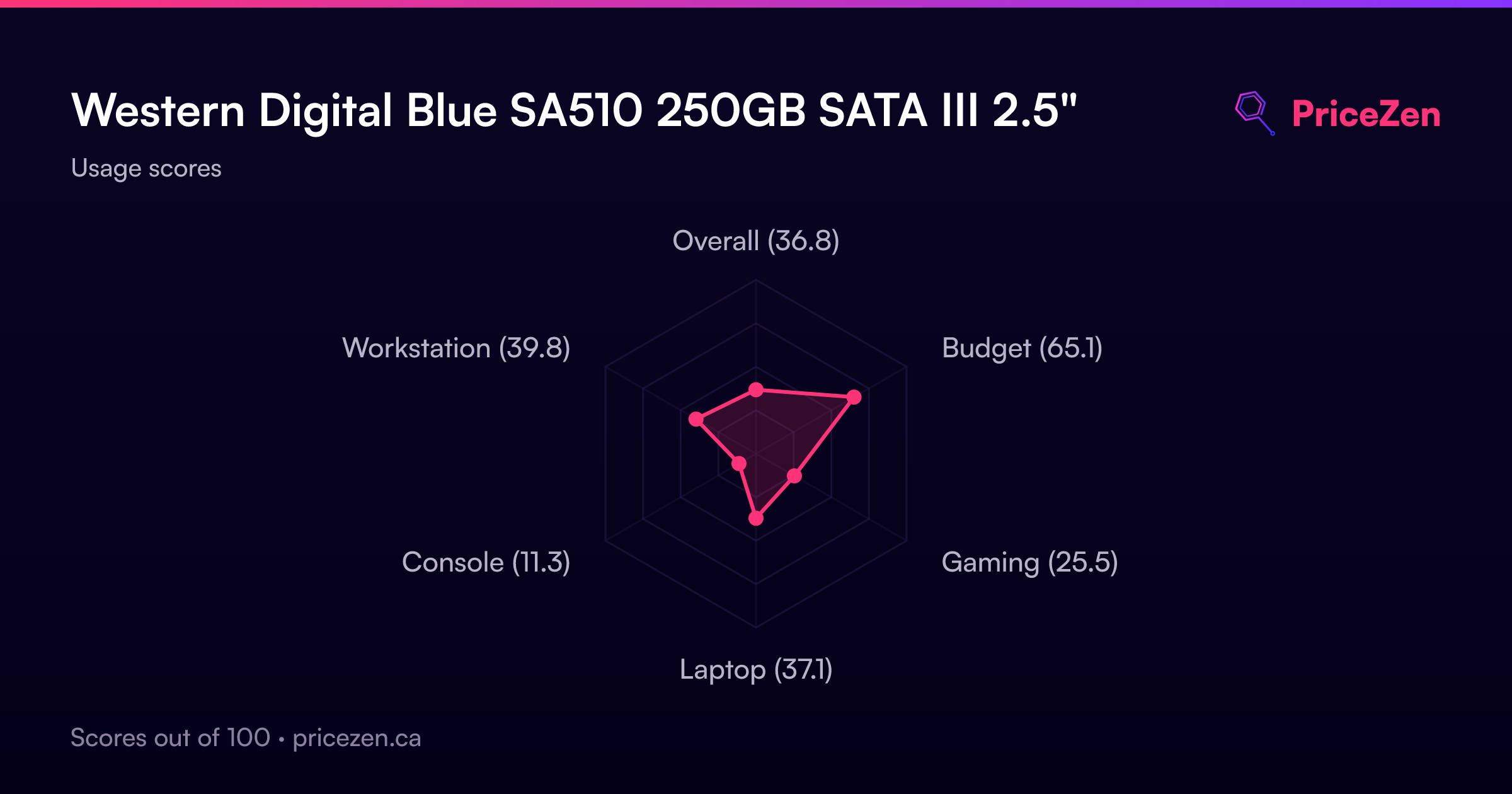
So who is this actually for? Honestly, a narrow crowd: someone with a SATA-only machine, a tight budget, a full backup habit, and the patience to deal with a warranty claim if things go sideways. Our scoring model puts it at 69.6 for budget use and just 37.5 overall, with workstation duty at 39.3. Those numbers already say "cheap stopgap," not "drive you trust with your only copy of anything." The owner reports push it further toward the caution column.
Common Questions
Q: Is the WD Blue SA510 reliable enough for my main system drive?
Based on what owners report, we'd say no. The sentiment score in our data is 18 out of 100, the weakest in this category, with multiple verified buyers describing total failure within weeks or months. The 100 TBW rating and 1,750,000 hour MTBF look great on the spec sheet, but they clearly aren't predicting what buyers actually experience.
Q: Will 250GB be enough, and is it worth paying more for a bigger drive?
250GB ranks in the 13th percentile for capacity among the internal SSDs we track, so it's tight. It works for an OS plus office apps and light media, but games and creative projects will fill it quickly. If your budget stretches, a larger drive is the better long-term buy, especially since you'd be taking on this model's reliability risk either way.
Q: How much should I actually pay for this drive?
In the US, Best Buy has it at USD 80, Newegg at USD 100 and Amazon at USD 149, so the same drive costs almost double depending on where you click. In Canada the spread is even wider, CAD 95 to CAD 341. If you buy at all, buy at the bottom of that range, because the premium listings offer nothing extra.
Q: Does the DRAM-less design matter for everyday use?
For light tasks like booting, browsing and document work, the 555 MB/s read and 440 MB/s write figures mean it'll still feel far faster than a hard drive. Under heavier sustained or mixed workloads, DRAM-less designs are where slowdowns tend to appear, and one owner reported recurring minute-long freezes. Our random performance ranking of 42 places it around the middle of the pack, not a standout.
Who Should Skip This
Skip this if the drive will hold anything you can't afford to lose: your work machine, your photo library, a client project, a school laptop during exam season. The pattern in owner reports is drives failing early and catastrophically, sometimes bricking the computer, followed by a warranty process buyers describe as exhausting. A 5-year warranty is cold comfort when the claim itself is the punishment. Also skip it if your machine has an M.2 slot, because you'd be accepting a 22nd-percentile speed ranking and 250GB of space for no compatibility reason at all. Look at the Samsung 9100 PRO or Crucial T500 instead.
And if you need a drive for portable or external duty, our model scores this at 8.5 out of 100 in that role, which is about as clear a "don't" as we can give. The only buyer we'd shrug at is someone reviving a SATA-only beater laptop for USD 80, with a full backup already in place and zero emotional attachment to the hardware.
Verdict
For a cheap revival of an old SATA-only laptop used for browsing, documents and media, the SA510 at USD 80 from Best Buy can technically do the job. The sequential speeds are near the interface limit, power draw is low, and the form factor drops into machines that can't take anything newer. If you go this route, treat it as a gamble: keep a full image backup, keep your receipt, and know where the warranty portal is before you need it.
For anything you depend on, we can't recommend it. Workstation scoring is 39.3, portable is a dismal 8.5, and the overall score is 37.5. Layer on an owner sentiment score of 18 out of 100 built from repeated reports of drives bricking machines within months, plus a warranty process owners describe as designed to wear you down, and the risk stops being theoretical. Nobody can pay us to soften that. A storage drive has one job it can't fail at, and too many buyers say this one did.
Usage Scores
- Overall36.8
- Budget65.1
- Gaming25.5
- Laptop37.1
- Console11.3
- Workstation39.8