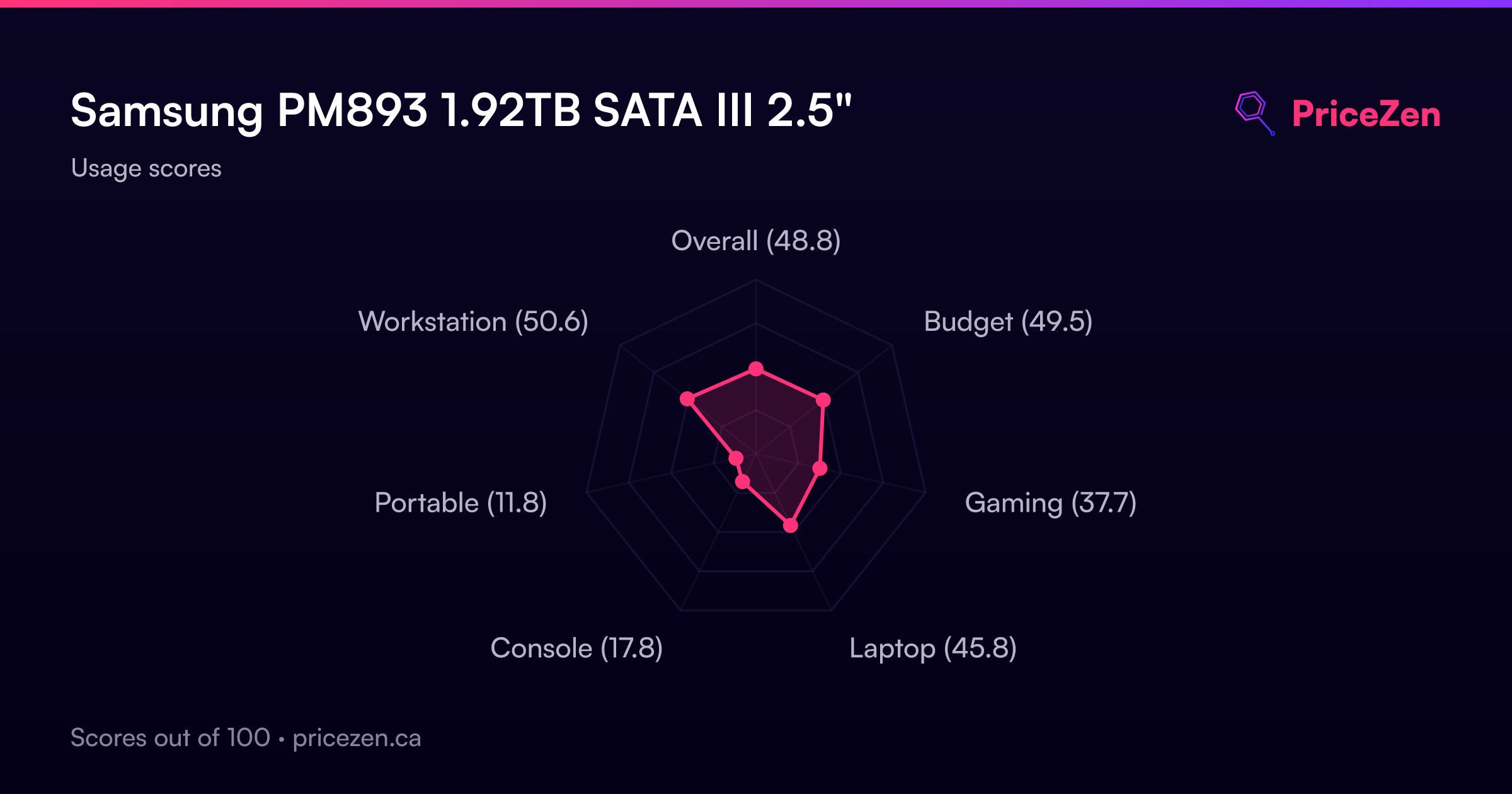
Samsung PM893 1.92TB SATA III 2.5"
The 1.92TB SATA III drive delivers 550 MB/s reads with a 3504 TBW endurance rating, making it a dependable choice for sustained workloads. Hardware encryption adds a security layer, while the 2.5-inch form factor fits standard server bays without extra adapters. Best for workstation users needing high-capacity, encrypted storage with long-term write durability.



Snapshot
The 30-Second Version
The Samsung PM893 is a 1.92TB SATA SSD built for endurance, not speed. Its 3504 TBW rating is top-tier, but 550 MB/s reads and weak random performance make it a poor choice for everyday use. Pricing ranges from USD 1,044 to USD 1,601, so shop carefully. Buy it for servers and write-heavy workloads, skip it for desktops and gaming.
Pros & Cons
Pros
- 3504 TBW endurance rating is top-tier, 96th percentile in our database 96th
- 1.92TB capacity is solid for a SATA enterprise drive 69th
- Hardware encryption included for data-at-rest protection
- SATA III compatibility means it works in almost any server or older system
- Samsung's enterprise reliability track record is strong
Cons
- 550 MB/s read speed is slow, 21st percentile overall
- Random performance is weak, 23rd percentile
- Price is high, 5th percentile for affordability
- Feature set is barebones beyond encryption, 33rd percentile
- Social proof is nearly nonexistent, 7th percentile
The proof
Performance
The 550 MB/s read speed is the SATA III ceiling, so Samsung squeezed what they could out of the interface. Sequential writes will be in the same ballpark, and for a SATA drive, that's fine. But the random performance is where things get rough. The random score sits in the 23rd percentile, which means small file operations, think booting an OS or launching apps, will feel sluggish compared to even budget NVMe drives. This drive is built for big, sequential data movement, not snappy everyday responsiveness.
That 3504 TBW endurance rating is the real story. To put it in perspective, you could write about 1.9TB to this drive every single day for five years and still be within spec. Most consumer SSDs tap out at 600 TBW or less. The PM893 uses Samsung's enterprise-grade V-NAND and a controller tuned for consistency rather than peak speed. That's why it's in the 96th percentile for endurance. It's not exciting, but it's reassuring.
Specifications
Full Specifications
Drive
| Capacity | 1920 |
| Form Factor | 2.5" |
| Interface | SATA III |
| Protocol | SATA |
| External | No |
Performance
| Sequential Read (MB/s) | 550 |
Reliability
| Endurance (TBW) | 3504 |
Features
| Hardware Encryption | Yes |
vs Competition
The competitors listed here are all NVMe drives, and that tells you something about where the market has gone. The Kingston FURY Renegade G5, WD_BLACK WDS800T2XHE, Crucial T710, Seagate FireCuda 530R, and SanDisk WD_BLACK WDS800T1X0M are all PCIe 4.0 or 5.0 drives with speeds in the thousands of MB/s. They'll run circles around the PM893 in any real-world task that isn't a sustained sequential write marathon. But none of them come close to 3504 TBW. Most consumer NVMe drives top out around 1200-1800 TBW, and some are far lower.
So the comparison isn't really apples to apples. If you need speed, buy the Kingston or the Crucial. If you need endurance and don't care about boot times, the PM893 is the only one here built for that. The WD_BLACK drives are gaming-focused, with high peak speeds but lower endurance ratings. The FireCuda 530R is a solid middle ground, but it's still a consumer drive. The PM893 is the only enterprise-grade option in this list, and that's both its strength and its weakness.
| Spec | Samsung PM893 | Western Digital WD_BLACK SN850X | Kingston FURY Renegade G5 | SanDisk WD_BLACK | Seagate FireCuda 530R | Corsair MP700 PRO |
|---|---|---|---|---|---|---|
| Capacity | 1.92TB | 8TB | 4TB | 8TB | 4TB | 4TB |
| Form Factor | 2.5" | M.2 2280 | M.2 2280 | M.2 2280 | M.2 2280 | M.2 2280 |
| Interface | SATA III | PCIe 4.0 x4 | PCIe 5.0 x4 | PCIe 5.0 x4 | PCIe 4.0 x4 | PCIe 5.0 x4 |
| Seq Read | 550 MB/s | 7,200 MB/s | 14,800 MB/s | 14,900 MB/s | 7,400 MB/s | 12,400 MB/s |
| Nand Type | - | TLC | TLC | TLC | TLC | TLC |
| Dram Cache | - | true | true | true | false | true |
| Endurance | 3504 TBW | 4800 TBW | 4000 TBW | 4800 TBW | 5050 TBW | 3000 TBW |
| Compare | Compare | Compare | Compare | Compare |
| Product | Speed | Random | Feature | Capacity | Endurance | Affordability |
|---|---|---|---|---|---|---|
| Samsung PM893 | 21.7 | 23.5 | 33.4 | 69.3 | 96.1 | 5.7 |
| Western Digital WD_BLACK SN850X Compare | 87.7 | 96.5 | 94.1 | 98 | 88 | 4.1 |
| Kingston FURY Renegade G5 Compare | 99.5 | 99 | 90.9 | 92.5 | 93.5 | 7.9 |
| SanDisk WD_BLACK Compare | 99.1 | 99.3 | 97.6 | 98 | 80.4 | 3.3 |
| Seagate FireCuda 530R Compare | 92.9 | 96.8 | 53.3 | 92.5 | 95.6 | 7.8 |
| Corsair MP700 PRO Compare | 96.7 | 81 | 90.9 | 92.5 | 90.8 | 9.9 |
Price
Value & Pricing
Pricing on this drive is all over the place. We're seeing USD 1,044 to USD 1,601 across three US listings, which is a spread of USD 557 for the exact same drive. That's wild. If you're buying, shop around. The cheapest listing is your friend here, because at USD 1,044 you're paying about USD 0.54 per GB, which is steep for SATA in 2025. At USD 1,601, you're paying USD 0.83 per GB, which is frankly absurd for a drive that tops out at 550 MB/s.
The affordability score is in the 5th percentile, meaning this is one of the most expensive SATA SSDs per gigabyte we track. You're paying for the endurance rating and the enterprise validation, not the speed. For a home user, that's a bad deal. For a business that needs a drive to survive years of constant writes without failing, the math changes. Downtime and data loss cost more than the drive.
Amazon 1 offer From CA$2,685
Price history
Read more
Overview
The Samsung PM893 is a 1.92TB SATA SSD aimed squarely at servers, workstations, and anyone who needs a drive that just keeps going. This isn't a flashy NVMe stick for your gaming rig. It's a 2.5-inch workhorse built for sustained writes, 24/7 operation, and the kind of endurance that makes IT folks sleep better at night. Samsung rates it for 3504 TBW, which puts it in the 96th percentile for endurance in our database. That's the headline here.
But here's the thing. SATA III caps out around 550 MB/s, and this drive hits that ceiling. In a world where NVMe drives are pushing 7000 MB/s, the PM893 looks slow on paper. And it is slow, at least in raw throughput. The speed score lands in the 21st percentile. So you're trading speed for stamina, and that's a trade-off that only makes sense in specific situations.
Who's this for? Someone running a small server, a NAS with heavy write loads, or a workstation that churns through logs, databases, or video caches. If you're booting Windows and loading games, look elsewhere. If you need a drive that won't flinch after a few years of constant writes, this is a serious contender.
Common Questions
Q: Is this drive good for gaming?
No. The 550 MB/s read speed and weak random performance, 23rd percentile in our database, mean game load times will be noticeably slower than even a budget NVMe drive. This is an enterprise SATA drive built for sustained writes, not quick bursts of small file reads that games rely on.
Q: How long will this drive last?
Samsung rates it for 3504 TBW, which is in the 96th percentile for endurance. That means you could write about 1.9TB per day for five years and still be within the warranty spec. For most server or NAS workloads, this drive should easily outlast the system it's installed in.
Q: Why is this SATA drive so expensive?
You're paying for enterprise validation and endurance, not speed. The PM893 uses Samsung's enterprise-grade V-NAND and a controller tuned for consistency under sustained load. Consumer drives are cheaper because they're built for lighter workloads and lower write volumes. The affordability score here is in the 5th percentile, so it's genuinely one of the priciest SATA drives per gigabyte we track.
Q: Can I use this in a regular desktop PC?
Technically yes, it's a standard 2.5-inch SATA drive. But you'd be paying a premium for endurance you'll never use, and the random performance is weak enough that your OS will feel sluggish compared to even a USD 60 NVMe drive. It works, but it's not the right tool for that job.
Who Should Skip This
If you're building a gaming PC, a general-purpose desktop, or upgrading a laptop, this drive is not for you. The random performance is in the 23rd percentile, which means everyday tasks like booting Windows, launching apps, and loading games will feel noticeably slower than a cheap NVMe drive. And you'd be paying a huge premium for endurance you'll never touch. A typical home user writes maybe 10-20GB per day, which means you'd need decades to hit 3504 TBW.
Instead, look at a mid-range NVMe drive like the Crucial T710 or the Kingston FURY Renegade G5. They're faster, cheaper per gigabyte, and more than durable enough for consumer workloads. If you need bulk storage on a budget, a SATA drive like the Crucial MX500 or Samsung 870 EVO will give you similar speeds at a fraction of the price. The PM893 only makes sense when write endurance is the primary concern, and for most people, it just isn't.
Verdict
For a home server or NAS that handles constant writes, like security camera footage, database logs, or backups, the PM893 makes a lot of sense. The endurance rating means you won't be replacing it every couple of years, and the SATA interface is fine for those workloads. The 1.92TB capacity is enough to be useful without being overkill. Just make sure you're getting it at the lower end of that price range.
For a desktop or laptop, skip it. The random performance is too weak for a snappy OS drive, and the price per gigabyte is painful. You'd be better off with a mid-range NVMe drive that costs less and feels dramatically faster. This is a specialized tool for a specialized job, and if that job isn't yours, there's no reason to pay the enterprise tax.
Usage Scores
- Overall48.8
- Budget49.5
- Gaming37.7
- Laptop45.8
- Console17.8
- Portable11.8
- Workstation50.6