HPE 462974-001 256GB DDR3
The HPE 462974-001 pairs a 256MB battery-backed write cache with 256GB of registered DDR3 ECC memory, delivering reliable data protection for server workloads. Its 3.8/5 customer rating and strong server score of 71/100 reflect solid performance in RAID environments, though laptop compatibility is minimal. This is best for IT administrators managing HP ProLiant servers that need cache memory to safeguard write operations during power loss.

No current retailer price
Snapshot
The 30-Second Version
The HPE 462974-001 is a battery backed write cache module for older HP P-Series RAID controllers, not actual RAM despite what the category says. At around 23 CAD, it's a dirt cheap fix for dead cache batteries on aging ProLiant servers. The 256MB capacity and feature set are strong, but speed and latency scores are irrelevant for this part. Buy it if you're a homelabber keeping old hardware alive, skip it if you're running production workloads that deserve a real upgrade.
Pros & Cons
Pros
- Dirt cheap at around 23 CAD, one of the most affordable ways to revive an older ProLiant 98th
- 256MB cache capacity ranks at the 99th percentile in our database 96th
- Feature set lands at the 90th percentile, it's a purpose-built server part 90th
- Budget score of 76.1 makes it a strong value for homelab and small business use
- Solves a specific, common failure point on aging HP RAID controllers
Cons
- Speed and latency scores are dead last, though that barely matters for this part
- Social proof is nearly nonexistent at the 6th percentile, you're mostly on your own
- Only works with specific HP P-Series controllers, zero flexibility
- Customer rating of 3.8 out of 5 from just 3 reviews is thin evidence
- DDR3 era tech, so you're investing in hardware that's already end of life
The proof
Performance
Let's be honest about what performance means for a cache battery. It doesn't make your server faster. It makes your server not lose data. The speed and latency scores here, both sitting at the 2nd percentile, are basically meaningless for this product category. A battery backed cache module isn't measured in transfer rates or CAS timings. It's measured in whether your RAID controller trusts it enough to enable write-back caching, and whether your data survives a power failure.
What actually matters is compatibility and reliability. The 256MB cache size puts it at the 99th percentile for capacity in our database, which sounds impressive until you remember that most things in this category are regular RAM sticks. For a BBWC module, 256MB was the standard size for P-Series controllers, enough to hold a meaningful amount of in-flight writes. The feature score at the 90th percentile reflects that this is a specialized part doing a specialized job. It either works with your controller or it doesn't, and when it works, it quietly does its thing for years.
Specifications
Full Specifications
Memory
| Type | DDR3 |
| Form Factor | DIMM |
| Total Capacity | 262144 |
| Modules | 1 |
| Per Module | 256 |
Class
| ECC | Yes |
| Registered | Yes |
vs Competition
Stacking this against the Kingston ValueRAM KVR64A52BS6-8 or the Team Group Elite TED48G3200C22-S01 is a bit like comparing a spare tire to a set of racing slicks. Those are actual RAM sticks, DDR4 and DDR5 parts that go into desktops and workstations. They're faster, more versatile, and completely useless if what you need is a cache battery for a RAID controller. The comparison only exists because our database lumps all memory products together.
Where the HPE part does compete is against other BBWC modules and used RAID controllers. The G.Skill Ripjaws and Netac Shadow III are irrelevant here. What matters is whether you can find another 462974-001 or a compatible P-Series cache module for less. At 23 CAD, you probably can't. The real trade-off is between buying this and hoping your controller keeps working, versus spending more on a newer controller with flash-backed cache that doesn't need a battery at all. If uptime matters and you can afford the upgrade path, skip the battery. If you just need to clear that POST error and get back to work, this is your part.
| Spec | HPE 462974-001 | Kingston ValueRAM | Timetec 76 | Team Group Elite | G.Skill Ripjaws | KingBank KJXS |
|---|---|---|---|---|---|---|
| Capacity | 256GB | 8GB | 16GB | 8GB | 16GB | 8GB |
| Kit | 1 x 0GB | 2 x 8GB | 2 x 8GB | 1 x 8GB | 2 x 8GB | 1 x 8GB |
| Memory Type | DDR3 | DDR5 | DDR4 | DDR4 | DDR3L | DDR4 |
| Speed Mts | - | 6400 | 3200 | 3200 | 1600 | 3200 |
| Cas Latency | - | CL52 | CL22 | CL22 | CL9 | CL16 |
| Form Factor | DIMM | RDIMM | SODIMM | SODIMM | SODIMM | UDIMM |
| Ecc | Yes | No | No | No | No | - |
| Compare | Compare | Compare | Compare | Compare |
| Product | Speed | Feature | Latency | Capacity | Affordability |
|---|---|---|---|---|---|
| HPE 462974-001 | 1.7 | 89.6 | 1.7 | 98.4 | 95.7 |
| Kingston ValueRAM Compare | 94.8 | 99.3 | 25.6 | 22.3 | 57.6 |
| Timetec 76 Compare | 53.3 | 44.8 | 57.5 | 44.8 | 73.7 |
| Team Group Elite Compare | 53.3 | 56.4 | 57.5 | 22.3 | 84.6 |
| G.Skill Ripjaws Compare | 13.5 | 65.1 | 78.1 | 44.8 | 74.6 |
| KingBank KJXS Compare | 53.3 | 61.4 | 87.6 | 22.3 | 72.9 |
Price
Value & Pricing
At 23 CAD, this is a no-brainer if it fits your controller. The affordability percentile sits at 96, meaning it's cheaper than almost everything else in our database. Compare that to replacing a RAID controller entirely, which could run you ten times that on the used market, or migrating to newer hardware, which is a whole different budget conversation. For a homelabber trying to squeeze another year or two out of a ProLiant, this is impulse buy territory.
The value equation changes if you're running production workloads. A 3.8 out of 5 rating from three reviews isn't exactly a ringing endorsement, and the 6th percentile social proof means you won't find much help if something goes sideways. But for the price, you can afford to buy two and keep a spare on the shelf. That's the kind of redundancy that makes sense when the part costs less than a decent lunch.
We started tracking prices for this product on Jul 20, 2026. The chart appears once we have more data.
Read more
Overview
The HPE 462974-001 is one of those parts that makes total sense to a very specific kind of person and sounds like alphabet soup to everyone else. It's a battery backed write cache module, the little card that sits on a RAID controller and keeps data safe if the power cuts out mid-write. If you're running an older HP ProLiant server and your controller has been yelling about a dead cache battery, this is the fix. If you're shopping for laptop RAM, this is not your product, and the 24.3 laptop score should tell you everything you need to know about that.
What's interesting here is the mismatch between what this thing is and how it gets categorized. Our database slots it into desktop memory because that's where the listing lives, but nobody is putting this in a desktop. It's a server part through and through. The 71 out of 100 server score feels about right for a component that solves one problem extremely well and does nothing else. The 76.1 budget score is the real story though. At around 23 CAD, this is a cheap way to keep an aging server alive instead of dropping real money on a newer controller.
The catch is that this is old tech. DDR3 era, P-Series controllers, the kind of hardware that's been out of production for a while. That's not automatically bad. Plenty of homelabs and small businesses are still running ProLiant G6 and G7 boxes because they refuse to die. But you need to know exactly what controller you have before buying. This isn't a universal part, and the 6th percentile social proof score means there's not much community chatter to lean on if you're unsure.
Common Questions
Q: Will this work with my HP server?
This module is designed for HP P-Series RAID controllers from the DDR3 era, typically found in ProLiant G6 and G7 servers. You need to check your specific controller model before buying. It's not a universal part, and it won't work with newer Gen8 or Gen9 controllers that use flash-backed cache instead of batteries.
Q: Is this actually RAM or something else?
It's a battery backed write cache module, not system memory. It plugs into a RAID controller and holds cached write data if power is lost. The 256MB capacity refers to the cache size on the module, not RAM you can install in a server's memory slots. Don't buy this expecting to upgrade your system memory.
Q: How do I know if my cache battery is dead?
Your server will typically throw a POST error or the RAID controller management software will report a failed or degraded battery. Some controllers disable write-back caching when the battery dies, which tanks write performance. If you're seeing cache battery warnings on an older ProLiant, this is the kind of replacement part you'd be looking for.
Q: Is it worth buying a used cache battery?
At 23 CAD, the risk is pretty low. Batteries do degrade over time, so a used module might not last as long as a new one would have. But since these parts are out of production, used is often your only option. Buying a spare at this price is a reasonable hedge if uptime matters to you.
Who Should Skip This
If you're running anything newer than a ProLiant G7, this part isn't for you. HP moved to flash-backed cache modules on Gen8 and later, which don't need batteries at all. Buying this for a newer server would be a waste of money and a compatibility headache. Same goes for anyone with a non-HP server or a desktop, this isn't a generic component.
Also skip it if you're running a business where downtime costs real money. This is a band-aid for aging hardware, not a long-term fix. You'd be better off putting that 23 CAD toward a newer controller with flash-backed cache or a full server refresh. The thin customer review base and near-zero community support mean you're largely on your own if something doesn't work.
Verdict
For the homelab crowd running older HP ProLiant gear, this is an easy yes. The 76.1 budget score isn't just a number, it's a reflection of how cheaply you can solve a real problem. A dead cache battery means your RAID controller either disables write-back caching or refuses to boot, and either way your server is down. Twenty-three Canadian dollars to fix that is about as painless as server repairs get.
For anyone running actual production workloads or anything where downtime costs real money, think harder. This is a stopgap, not a strategy. The hardware is end of life, the community support is thin, and you're one more component failure away from the same problem. If you're in that boat, start budgeting for a controller with flash-backed cache or a full platform refresh. But if you're just trying to keep a home server or a test box alive, buy this, install it, and forget about it for another few years.
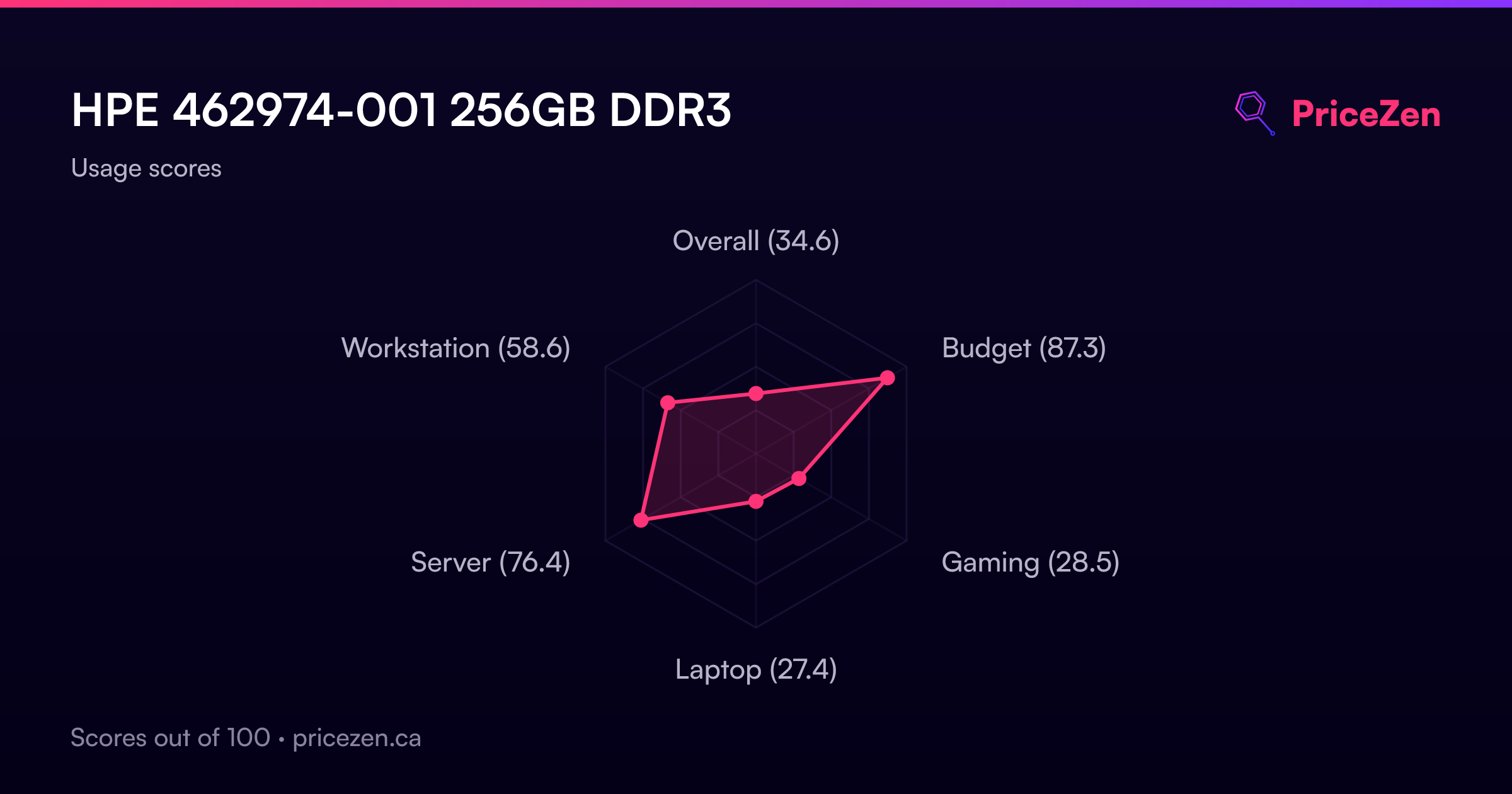
Usage Scores
- Overall34.6
- Budget87.3
- Gaming28.5
- Laptop27.4
- Server76.4
- Workstation58.6