Crucial 8GB DDR4-2666 CL19 (CT8G4DFRA266)

8GB of DDR4 that just plugs in verified Nov 21
37/100 overall score 4.7 average from 5,452 owner ratings
Close to the usual price of CA$113.60.
90-day low CA$92.41Usual CA$113.60High CA$119.81
Price over the last 90 days: low CA$92.41 on Sep 8, high CA$119.81. Usual price CA$113.60. Today CA$113.60.
- Capacity
- 8GB
- Kit
- 1 x 8GB
- Memory
- DDR4
- Speed
- 2666 MT/s
- CAS latency
- CL19
- Form factor
- UDIMM
Compare prices at 1 store
Cheapest first. New, refurbished and bundled offers are kept apart, so you compare like with like.
| Store | Sold by | Colour and condition | Price | vs lowest | Last checked | Link |
|---|---|---|---|---|---|---|
| New1 offerSingle unit | ||||||
| Amazon | Marketplace seller | Not listed | CA$113.60 | Lowest price | Today | Go to store |
 Source: PriceZen, checked Nov 28, 2026
A price counts as current when we checked it in the last 7 days. “Marketplace seller” means a third-party seller on that store, not the store itself.
Price history
The usual store price is CA$113.60, and the lowest price in the last 90 days was CA$92.41.
Checked that dayNot checked that day, still on offer
Source: PriceZen, checked Nov 28, 2026











Snapshot
The 30-Second Version
The Crucial CT8G4DFRA266 is a no-frills 8GB DDR4 stick that prioritizes compatibility over speed. It runs at 2666 MT/s with CL19 timings, which puts it in the bottom half of our database for both speed and latency. The real selling point is plug-and-play operation on OEM systems from HP and Lenovo without needing XMP. Pricing varies wildly from $60 to $190 in the US, so shop carefully. Buy it for old office PCs, skip it for anything that supports faster memory.
Pros & Cons
Pros
- Plug-and-play compatibility with OEM systems like HP and Lenovo 87th
- Runs at full speed without needing XMP or BIOS tweaks 83rd
- Low 1.2V power draw keeps heat and energy costs down
- Easy installation, even for first-time upgraders
- Strong social proof with a 4.7-star average across 5,452 reviews
Cons
- 2666 MT/s speed lands in the 38th percentile, well below modern kits
- CL19 latency is sluggish compared to 3200 MT/s CL16 alternatives
- User sentiment score of 65/100 reflects a notable rate of DOA sticks
- Single 8GB stick limits you to single-channel bandwidth
- No heat spreader, which matters if you ever push voltage or overclock
What owners think
The Word on the Street
- A recurring theme is that this memory just works in OEM systems. Multiple owners with HP and Lenovo desktops report installing it without any BIOS changes and seeing immediate improvements in responsiveness.
- Several buyers mention that the Crucial system scanner tool helped them pick the right module, and the installation process was straightforward even for people who had never opened a PC case before.
- A significant number of verified buyers report receiving dead sticks or having modules fail within weeks of installation, with symptoms including blue screens and boot failures.
- Compatibility is a double-edged sword in the reviews. While many praise how well it works with OEM systems, others report issues with certain motherboards that refused to boot until the stick was removed.
How owner sentiment changed over time
ExclusiveBased on when customers actually wrote their reviews - so you can see whether early praise held up.
51 written reviews, Jan 2021 – Apr 2026: 32 happy, 12 unhappy, 7 without stars
Across all 5,452 store ratings: 4.7★. Most owners rate without writing a review. The chart counts the 51 written reviews.
Each dot is one written review, in the month it was written. Happy = 4-5★, mixed = 3★, unhappy = 1-2★.
The proof
Performance
Let's talk about what 2666 MT/s at CL19 actually means. The 2666 MT/s transfer rate translates to about 21.3 GB/s of theoretical bandwidth per stick. That's fine for web browsing, document editing, and light multitasking. But the CL19 latency is where things get sluggish. At 2666 MT/s, CL19 works out to roughly 14.25 nanoseconds of latency. Compare that to a 3200 MT/s CL16 kit, which sits around 10 nanoseconds. That gap shows up in memory-sensitive workloads like gaming and content creation.
The 1.2V operating voltage is standard for DDR4 and keeps power draw low. Crucial claims up to 40% power reduction compared to DDR3, which matters if you're running a fleet of office machines. The single-rank 1Rx8 configuration is also worth noting. Single-rank sticks are generally easier on memory controllers, which helps with compatibility on older or budget motherboards. But you lose a bit of bandwidth compared to dual-rank modules. For the target audience here, that trade-off is absolutely worth it.
Specifications
Full Specifications
Memory
| Type | DDR4 |
| Form Factor | UDIMM |
| Total Capacity | 8192 |
| Modules | 1 |
| Per Module | 8192 |
| Pins | 288 |
| Rank | 1Rx8 |
Performance
| Speed | 2666 |
| CAS Latency | 19 |
| Timings | 19-19-19 |
| Voltage | 1.2 |
Class
| ECC | No |
| Registered | No |
Features
| RGB | No |
| Heat Spreader | No |
vs Competition
Stacked against the Corsair Vengeance RGB Pro SL or the G.Skill TridentZ RGB, this Crucial stick looks positively ancient. Those kits run at 3200 MT/s with CL16 timings, include heat spreaders, and offer dual-channel configurations out of the box. The Corsair and G.Skill options are aimed at gamers and enthusiasts who want every frame they can get. The Crucial CT8G4DFRA266 is aimed at someone who just wants their Dell OptiPlex to stop freezing when they open Excel.
The Kingston FURY Beast KF432C16BBK2/16 is probably the most direct comparison in terms of price bracket. It's a 16GB kit at 3200 MT/s CL16, which means dual-channel and faster speeds for roughly the same money as a single Crucial stick at some retailers. The Team Group T-FORCE VULCAN Z is another budget-friendly option that outpaces this Crucial module on paper. The trade-off is compatibility. Those kits often need XMP enabled to hit their rated speeds, and on OEM boards that don't expose XMP settings, they'll default to 2133 or 2400 MT/s. The Crucial stick runs at 2666 MT/s natively, no questions asked. That's the whole pitch.
| Spec | Crucial 8GB DDR4 | Corsair Vengeance RGB | G.Skill TridentZ RGB | PNY XLR8 Gaming EPIC-X RGB | Kingston FURY Renegade | Timetec Pinnacle Konduit RGB |
|---|---|---|---|---|---|---|
| Capacity | 8GB | 32GB | 32GB | 32GB | 16GB | 32GB |
| Kit | 1 x 8GB | 2 x 16GB | 2 x 16GB | 2 x 16GB | 1 x 16GB | 4 x 8GB |
| Memory Type | DDR4 | DDR5 | DDR4 | DDR4 | DDR5 | DDR4 |
| Speed Mts | 2666 | 6200 | 4000 | 3200 | 7200 | 3200 |
| Cas Latency | CL19 | CL36 | CL18 | CL16 | CL38 | CL16 |
| Form Factor | UDIMM | UDIMM | UDIMM | UDIMM | DIMM | UDIMM |
| Ecc | No | No | No | No | No | No |
| Compare | Compare | Compare | Compare | Compare |
| Product | Speed | Feature | Latency | Capacity | User Sentiment | Social Proof | Affordability |
|---|---|---|---|---|---|---|---|
| Crucial 8GB DDR4 | 37.2 | 18 | 36 | 22.3 | 10 | 87.3 | 82.6 |
| Corsair Vengeance RGB Compare | 92.6 | 89.5 | 76.8 | 70.5 | 77.5 | 69.1 | 16.7 |
| G.Skill TridentZ RGB Compare | 64.6 | 89.5 | 98.1 | 70.5 | 0 | 96.4 | 41 |
| PNY XLR8 Gaming EPIC-X RGB Compare | 53.3 | 89.5 | 87.6 | 70.5 | 77.5 | 87.3 | 45.6 |
| Kingston FURY Renegade Compare | 98.3 | 66.8 | 80.6 | 44.8 | 0 | 0 | 35.7 |
| Timetec Pinnacle Konduit RGB Compare | 53.3 | 89.5 | 87.6 | 70.5 | 77.5 | 87.3 | 39.5 |
Price
Value & Pricing
Pricing on this stick is all over the map depending on where you shop. In the US, we're seeing listings from $60 to $190 for what should be the same module. That's a $130 spread, which is wild for budget RAM. The $60 price point is reasonable for 8GB of DDR4 in 2025, but anything above $100 is highway robbery. If you're shopping in the US, the cheapest listing is the one to grab. In Europe, the spread is tighter at EUR 71 to EUR 83, which is more sane but still worth checking before you click buy.
For context, you can often find 16GB kits (2x8GB) of faster 3200 MT/s memory for around $50 to $70 these days. So paying $60 for a single 8GB stick at 2666 MT/s only makes sense if your system specifically needs this exact spec. The affordability percentile of 82 suggests it's priced competitively within its category, but the category itself is budget memory. If your motherboard supports faster speeds, you're leaving performance on the table by choosing this stick.
Read more
Overview
The Crucial CT8G4DFRA266 is the plain toast of the RAM world. No heat spreaders, no RGB, no aggressive XMP profiles. Just a single 8GB stick of DDR4 running at 2666 MT/s with CL19 timings. And for a lot of people, that's exactly what they need. This is the stick you buy when your mom's HP Pavilion is choking on Chrome tabs and you just want it to work without fiddling with BIOS settings.
Crucial has built a reputation on compatibility, and this module leans hard into that. It's a 1Rx8 unbuffered DIMM that plays nice with OEM systems from HP, Lenovo, and Dell. The plug-and-play nature is the real selling point here. You drop it in, the system recognizes it, and you're done. No enabling XMP, no voltage tweaking, no praying to the memory gods.
But here's the thing. Our database shows this stick sitting at the 38th percentile for speed and 36th for latency. That's not a typo. This is budget memory for budget systems, and the numbers reflect that. The 2666 MT/s speed was mid-range when DDR4 launched, but in 2025 it's the slow lane. That said, for office PCs and older desktops that can't run faster memory anyway, this is often the exact right tool for the job.
Common Questions
Q: Will this work in my HP or Lenovo desktop without changing BIOS settings?
Yes, that's the main reason people buy this specific module. The CT8G4DFRA266 runs at 2666 MT/s natively without requiring XMP or manual configuration. Multiple verified buyers with HP Pavilion and Lenovo systems report installing it and having it recognized immediately at full speed. Just make sure your system supports DDR4 UDIMMs and has a free 288-pin slot.
Q: Is 8GB enough memory for my needs?
For basic office work, web browsing, and light multitasking, 8GB is workable but not generous. If you're running Chrome with a dozen tabs, a few Office apps, and a video call, you'll likely hit the ceiling. Our database ranks this stick at the 23rd percentile for capacity, which means most memory products on the market offer more. If your system has four DIMM slots, consider buying two of these for 16GB total and dual-channel bandwidth.
Q: Why is this memory slower than other DDR4 kits?
This module runs at 2666 MT/s with CL19 timings, which was a mid-range spec when DDR4 first launched. Modern DDR4 kits commonly run at 3200 MT/s or faster with tighter CL16 timings. The slower speed and higher latency put this stick at the 38th percentile for speed and 36th for latency in our database. The trade-off is compatibility. Faster kits often require XMP profiles that OEM motherboards don't support, while this Crucial stick runs at its rated speed out of the box.
Q: Should I buy one 8GB stick or a 16GB kit?
If your system supports faster memory, a 16GB kit at 3200 MT/s is the better value. You'll get dual-channel bandwidth and better performance for roughly the same price as a single 8GB stick at some retailers. However, if you have an OEM system that can't run faster than 2666 MT/s, buying two of these Crucial sticks for 16GB total is a solid upgrade path. Just be aware that single sticks run in single-channel mode, which reduces memory bandwidth until you add a second module.
Who Should Skip This
If you're building a gaming PC, a content creation workstation, or any system where memory speed actually matters, this is not your stick. The 2666 MT/s speed and CL19 latency will hold back CPU performance in games and memory-intensive applications. You'd be much better served by a 3200 MT/s CL16 kit from Corsair, G.Skill, or Kingston, which will cost about the same and deliver meaningfully better performance. Our database puts this module at the 38th percentile for speed, and that gap shows up in frame rates and render times.
You should also skip this if you're buying for a system that supports DDR5. There's no reason to invest in slow DDR4 when DDR5 platforms are widely available and prices have come down significantly. And if you're the type who likes to tinker with overclocking, the lack of a heat spreader and the locked-down nature of this module will frustrate you. This is a set-it-and-forget-it product, not an enthusiast part.
Verdict
If you have an older OEM desktop from HP, Lenovo, or Dell that's running slow because it only has 4GB or 8GB of RAM, this Crucial stick is a solid, low-risk upgrade. The plug-and-play nature means you won't be digging through BIOS menus or troubleshooting boot loops. You install it, the system sees it, and you get back to work. For office machines, home PCs used for browsing and email, and budget builds where compatibility matters more than raw speed, this is a reasonable choice.
But if you're building a new system or upgrading a machine that supports faster memory, look elsewhere. The 2666 MT/s speed and CL19 latency are simply too far behind the curve. A 3200 MT/s CL16 kit will cost about the same and deliver noticeably better performance in games, content creation, and heavy multitasking. The only reason to buy this specific stick is if your system can't handle anything faster or you need the guaranteed plug-and-play compatibility that Crucial is known for.
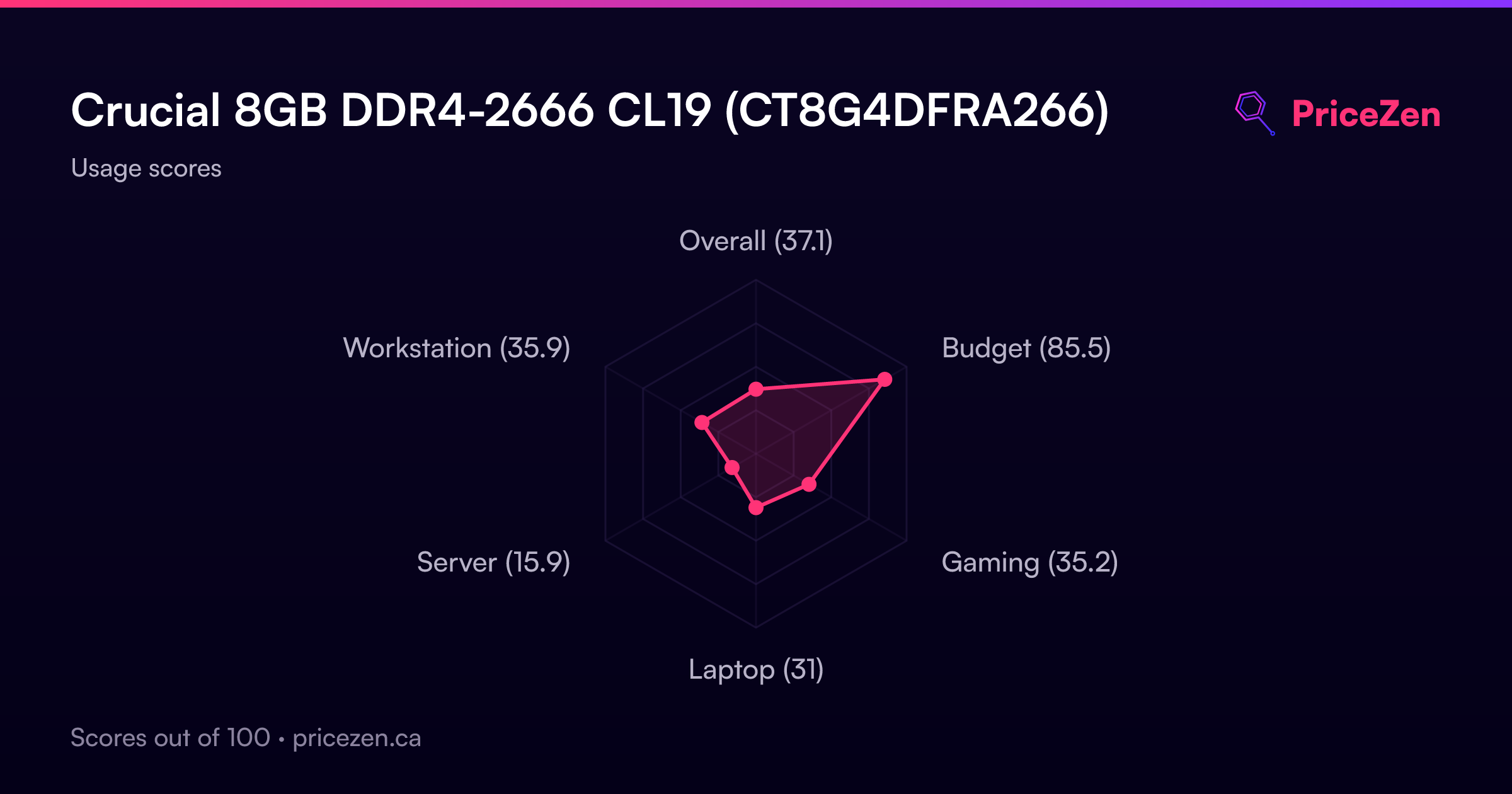
Usage Scores
- Overall37.1
- Budget85.5
- Gaming35.2
- Laptop31
- Server15.9
- Workstation35.9