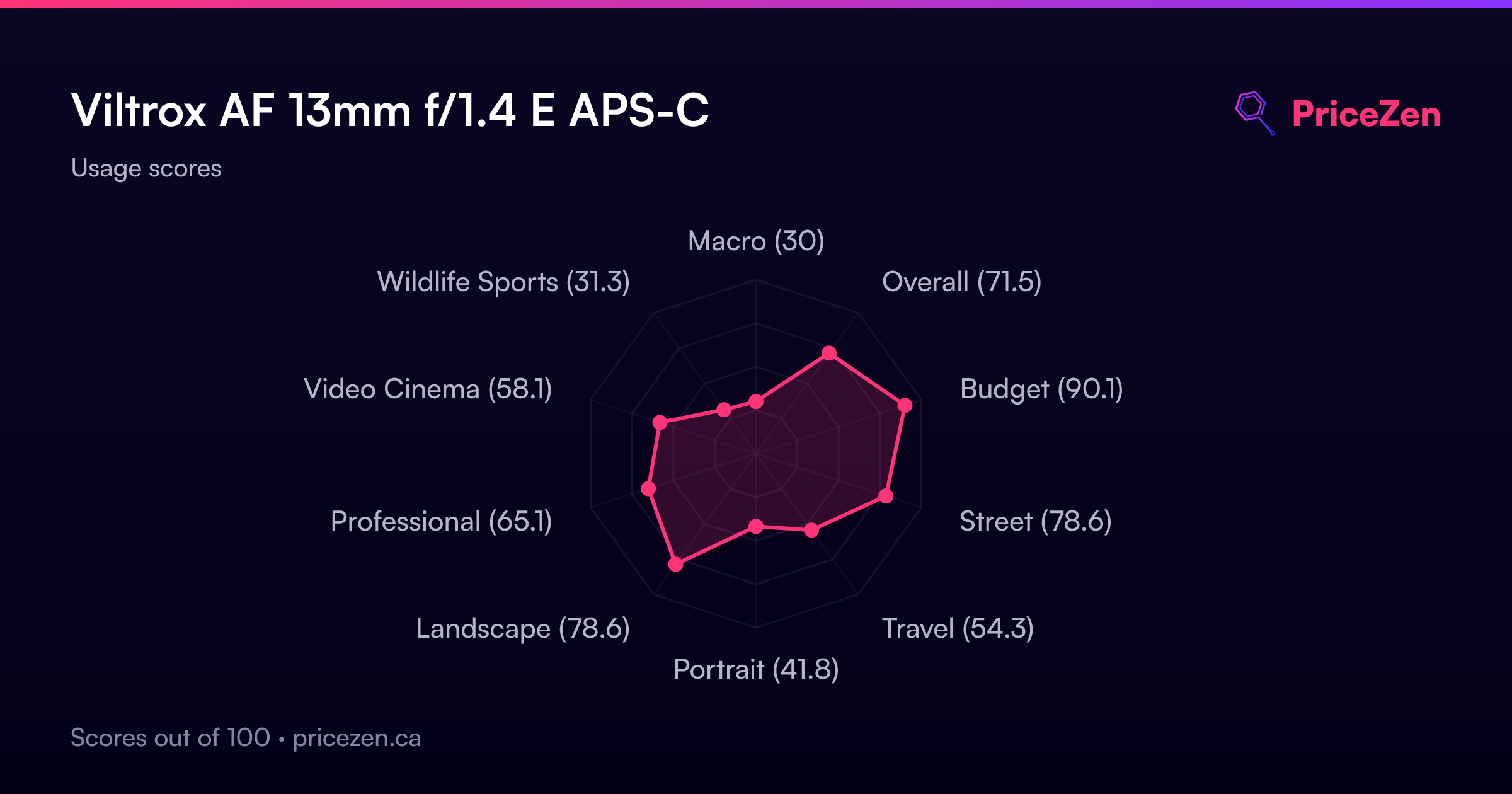
Viltrox AF 13mm f/1.4 E APS-C
A 13mm f/1.4 ultra-wide prime for Fujifilm X-mount APS-C cameras, its fast aperture and 14-element optics with 4 ED elements deliver sharp, low-distortion images in low light. The STM autofocus is quiet and quick for video, and the non-bulb design protects the lens during close-ups. Best for landscape and architecture photographers who need a bright, compact wide-angle for handheld night shots and indoor work.












Snapshot
The 30-Second Version
The Viltrox AF 13mm f/1.4 XF is a shockingly good ultra-wide prime for Fuji shooters. It delivers exceptional sharpness, a fast f/1.4 aperture, and solid build quality for under $500 USD. Autofocus is quick and supports eye AF, though it occasionally misses. Our scoring model puts it at 72 overall, held back by how narrow its job is rather than by image quality. If you shoot astro, landscapes, or architecture and want first-party performance at half the price, this is the lens to beat.
Pros & Cons
Pros
- Exceptional sharpness, especially in the center, even wide open at f/1.4 89th
- Fast f/1.4 aperture makes it a low-light and astro monster 86th
- All-metal build with weather sealing at a budget-friendly price 84th
- STM autofocus is quick, quiet, and supports eye AF on Fuji bodies 82nd
- Close focusing down to 13mm opens up creative near-macro shots
Cons
- Corner sharpness doesn't quite match Fuji's native lenses
- Autofocus occasionally misses, especially in tricky lighting
- At 420g, it's noticeably heavier than many APS-C primes
- Versatility score is low at the 34th percentile, it's a one-trick wide-angle
- Some quality control issues reported, with a few buyers receiving faulty units
- Overall score of 72 puts it mid-pack in our ranking rather than near the top
What owners think
The Word on the Street
How owner sentiment changed over time
ExclusiveBased on when customers actually wrote their reviews - so you can see whether early praise held up.
Happy owners: 91% lately, 90% in Apr 2020 – Sep 2022
Too few reviews to call that a change.
Across all 499 store ratings: 4.6★. Most owners rate without writing a review. The chart counts the 115 written reviews with stars and their own date.
10 written reviews without stars are left out of the trend.
Show the numbers
| Period | Reviews | Happy | Mixed | Unhappy | Happy share |
|---|---|---|---|---|---|
| Apr 2020 – Sep 2022 | 10 | 9 | 1 | 0 | 90% |
| Oct 2022 – Sep 2023 | 11 | 10 | 1 | 0 | 91% |
| Oct 2023 – Sep 2024 | 11 | 10 | 0 | 1 | 91% |
| Oct – Dec 2024 | 12 | 12 | 0 | 0 | 100% |
| Jan – Jun 2025 | 10 | 9 | 1 | 0 | 90% |
| Jul – Sep 2025 | 20 | 17 | 2 | 1 | 85% |
| Oct – Dec 2025 | 30 | 25 | 2 | 3 | 83% |
| Jan – Feb 2026 | 11 | 10 | 1 | 0 | 91% |
- Jan – Mar 202610 of 11 happy · 1 without stars
Buyers praised sharpness, value, and build quality, but noted autofocus issues and open-box packaging concerns.
- Sharpness and image quality are excellent for architecture and landscapes.
- Good value for price compared to Fuji alternatives.
- Autofocus can struggle, even with eye detection enabled.
- Some units arrived with open-box packaging or damaged carton.
- Oct – Dec 202525 of 30 happy · 4 without stars
Q4 2025 reviews praise sharpness, fast apertures, and low-light performance for the price, but note manual focus struggles, vignetting, and rare defects.
- Excellent optical quality and sharpness, even wide open, competing with pricier lenses.
- Manual focus unreliable in low light; kit lenses sometimes outperform for sharpness.
- Vignetting noted, but firmware updates can improve it; build quality solid but some materials feel weak.
- Rare defect reports: used items sent as new, autofocus failures, and inconsistent quality control.
- Jul – Sep 202517 of 20 happy · 2 without stars
Buyers praise this lens for its sharpness, autofocus, low-light performance, and value. A minor build issue (aperture ring alignment) was noted on one copy.
- Excellent optical sharpness and image quality across multiple use cases.
- Fast and reliable autofocus, especially useful for video and night photography.
- Great value for the price, outperforming expectations for its class.
- Aperture ring misalignment reported on one unit, a build quality concern for a pro-level lens.
- Apr – Jun 20255 of 6 happy · 1 without stars
Buyers praise image quality and value but report accidental aperture changes, noisy aperture motor, and firmware setup hassles.
- Excellent sharpness, bokeh, and value for the price; several call it a steal.
- Aperture ring moves too easily, causing unwanted changes; no lock to auto mode.
- Autofocus is fast and accurate but can hunt; some find focus motor noise noticeable.
- Firmware updates require phone app and account setup; verification email issues reported.
Each column joins calendar quarters until it holds at least 10 reviews with stars and their own date. Happy = 4-5★, mixed = 3★, unhappy = 1-2★. Period summaries are in English.
The proof
Performance
Sharpness is the headline here, and it's legitimately impressive. The optical design packs 14 elements in 11 groups, including 2 aspherical elements and 4 ED elements, plus Viltrox's HD nano multi-layer coating. In our database, this lens sits in the 89th percentile for optical quality, which puts it well above average and nipping at the heels of lenses costing twice as much. Center sharpness is excellent even wide open at f/1.4, which is not something you can say about every fast ultra-wide. Corner sharpness does soften a bit compared to Fuji's native glass, and a few owners have mentioned that the corners don't quite match the center. But for most real-world shooting, you'd have to pixel-peep to notice.
The f/1.4 aperture is the other big story. It ranks in the 97th percentile for aperture speed, which means it's one of the fastest ultra-wides you can put on a Fuji body. That translates to real low-light capability. You can shoot indoors without cranking ISO, freeze motion in dim gymnasiums, or capture stars without star trails. The 9-blade diaphragm also helps produce smooth bokeh, and this lens ranks in the 97th percentile for bokeh quality. Now, an ultra-wide isn't typically a bokeh machine, but at f/1.4 and close focusing distances, you can get some genuinely pleasing background separation. Minimum focus distance is just 13mm, which is absurdly close and opens up some fun near-macro creative shots.
Specifications
Full Specifications
Optics
| Type | Prime |
| Focal Length Min | 13 |
| Focal Length Max | 13 |
| Elements | 14 |
| Groups | 11 |
| Aspherical Elements | 2 |
| ED Elements | 4 |
| Coating | anti-fouling coating |
Aperture
| Max Aperture | f/1.4 |
| Min Aperture | f/16 |
| Constant | Yes |
| Diaphragm Blades | 9 |
Build
| Mount | Nikon Z |
| Format | APS-C |
| Weather Sealed | Yes |
| Weight | 0.4 kg / 0.9 lbs |
| Filter Thread | 67 |
AF & Stabilization
| AF Type | STM |
| Stabilization | No |
Focus
| Min Focus Distance | 220 |
| Max Magnification | 1:10 |
vs Competition
Our ranking currently places the Sigma 17-40mm f/1.8 DC Art, the Tamron 70-180mm f/2.8 Di III VC VXD G2, the Sony FE 85mm f/1.4 GM, the Nikon NIKKOR Z 70-180mm f/2.8 and the Canon RF 24-105mm f/4L IS USM alongside this Viltrox, and that group tells you something useful about where it sits. These are zooms and portrait primes doing very different jobs, so none of them is a straight substitute for a 13mm ultra-wide on a Fuji body. What they have in common is breadth, and breadth is exactly what our scoring model rewards.
The Sigma 17-40mm f/1.8 DC Art is the closest thing to a rival in spirit, because it's chasing speed rather than reach. But it covers a range of focal lengths instead of one, and that flexibility is a big part of why it ranks where it does. The Viltrox counters with a wider field of view, roughly a 20mm full-frame equivalent, and an f/1.4 aperture that sits in the 97th percentile for speed in our data. For astro, architecture and tight interiors, that width is the whole point, and no zoom in this group replaces it.
The two telephoto zooms, the Tamron 70-180mm f/2.8 Di III VC VXD G2 and the Nikon NIKKOR Z 70-180mm f/2.8, plus the Canon RF 24-105mm f/4L IS USM, are the opposite end of the kit. They're the lenses you reach for when you want to cover a lot of situations without swapping glass, and the Canon in particular is built around general-purpose coverage. The Sony FE 85mm f/1.4 GM is a specialist too, just a specialist in subject separation rather than width. Its appeal is the same kind of appeal the Viltrox has at f/1.4, only applied to portraits instead of star fields.
So the honest read is this: the Viltrox scores 72 overall because it does one thing rather than many, not because the images fall apart. Its optical quality sits in the 89th percentile in our database, which is well above average. If you want a lens that handles whatever the day throws at you, one of those zooms is the smarter buy. If you specifically need a fast ultra-wide for Fuji, the Viltrox remains one of the most affordable ways to get there.
| Spec | Viltrox AF 13mm f/1.4 E | Sigma 70-200mm f/2.8 DG DN OS Sports | Tamron 70-180mm f/2.8 Di III VC VXD G2 | Sony FE 85mm f/1.4 GM II | Canon RF 35mm f/1.4L VCM | Nikon NIKKOR Z 50mm f/1.2 S |
|---|---|---|---|---|---|---|
| Focal Length | 13mm | 70-200mm | 70-180mm | 85mm | 35mm | 50mm |
| Max Aperture | f/1.4 | f/2.8 | f/2.8 | f/1.4 | f/1.4 | f/1.2 |
| Mount | Nikon Z | Sony E | Sony E | Sony E | Canon RF | Nikon Z |
| Format Coverage | APS-C | full-frame | full-frame | full-frame | full-frame | full-frame |
| Stabilization | No | Yes | Yes | No | Yes | No |
| Weather Sealed | Yes | Yes | Yes | Yes | Yes | Yes |
| Weight (g) | 420 | 1345 | 855 | 642 | 555 | 1090 |
| AF Type | STM | HLA (High-response Linear Actuator) | VXD | XD Linear Motor | Nano USM | Multi-Focus Stepping Motor AF System |
| Lens Type | prime | zoom | zoom | prime | prime | prime |
| Compare | Compare | Compare | Compare | Compare |
| Product | AF | Bokeh | Build | Macro | Reach | Video | Optical | Aperture | User Sentiment | Wide Angle | Portability | Versatility | Social Proof | Affordability | Stabilization |
|---|---|---|---|---|---|---|---|---|---|---|---|---|---|---|---|
| Viltrox AF 13mm f/1.4 E | 68.9 | 20.9 | 77 | 17.2 | 10.8 | 70 | 85.9 | 89.3 | 84.4 | 82.3 | 62.4 | 32.5 | 79.3 | 63 | 41.4 |
| Sigma 70-200mm f/2.8 DG DN OS Sports Compare | 95.4 | 88.7 | 98.9 | 55.6 | 83.5 | 85.7 | 99.9 | 43.5 | 76.4 | 28.9 | 11.9 | 78.4 | 72.3 | 23.7 | 99.9 |
| Tamron 70-180mm f/2.8 Di III VC VXD G2 Compare | 95.4 | 86 | 90.6 | 82.8 | 81.5 | 81.9 | 95.9 | 43.5 | 69.4 | 28.9 | 24.6 | 76.5 | 91.4 | 29.3 | 97.3 |
| Sony FE 85mm f/1.4 GM II Compare | 95.4 | 94.1 | 90.6 | 21 | 65.3 | 70 | 70.4 | 89.3 | 94.7 | 19.3 | 39.7 | 32.5 | 91.4 | 20.9 | 41.4 |
| Canon RF 35mm f/1.4L VCM Compare | 89.9 | 59.2 | 77 | 52.2 | 28.8 | 70 | 70.4 | 89.3 | 94.7 | 52.9 | 47.4 | 32.5 | 79.3 | 21.6 | 92.5 |
| Nikon NIKKOR Z 50mm f/1.2 S Compare | 68.9 | 80.1 | 77 | 42.1 | 43.1 | 70 | 86.5 | 96.4 | 94.7 | 39.6 | 17.7 | 32.5 | 95.7 | 21.5 | 41.4 |
Price
Value & Pricing
Here's where things get really interesting. In the US, this lens is listed between $389 and $486 across 19 listings. That's a $97 spread, which is significant. If you're shopping, it pays to compare vendors. The best deal we're seeing is at the lower end of that range, so don't just grab the first listing you see. For context, the Fujinon XF 14mm f/2.8 typically sells for around $900, and the XF 8-16mm f/2.8 is well over $1,000. So you're getting a faster aperture than the 14mm at roughly half the price.
In Brazil, the spread is even wider. Prices range from BRL 2,579 to BRL 3,223, a difference of BRL 644. That's a substantial chunk of change, and the cheapest listing is the obvious pick if you're buying in that market. The value proposition holds up across currencies. You're getting 90% of the performance of first-party glass for 50-60% of the cost. That's the kind of math that makes budget-conscious shooters very happy.
The Camera Store 1 offer From CA$559
Amazon 1 offer From CA$559
Price history
Read more
Overview
The Viltrox AF 13mm f/1.4 XF is an ultra-wide prime built for Fujifilm X-mount APS-C cameras, and the spec sheet still reads like a wish list: f/1.4 aperture, autofocus, weather sealing, and a 13mm focal length that gives you roughly a 20mm full-frame equivalent field of view. That's a seriously wide perspective for landscapes, astro, architecture, and cramped indoor spaces.
Who's this for? If you shoot Fuji and you want a fast, wide prime without paying first-party money, this Viltrox is aimed squarely at you. It's also a strong pick for astrophotographers who want that f/1.4 to keep ISO down and shutter speeds manageable when shooting the Milky Way. And vloggers or content creators who need a wide, bright lens for tight spaces will find a lot to like here.
What makes it interesting is the combination of speed and price. An f/1.4 ultra-wide with autofocus and weather sealing for under $500 USD is basically unheard of from the big brands. Viltrox has been quietly building a reputation for punching above its weight, and this lens is a good example of it. The catch is that our scoring model now puts it at 72 overall, which lands it mid-pack rather than near the top of the category. The optics are genuinely strong, but the narrow focal range and the compromises owners report pull the total down. Buy it for what it does brilliantly, not as an all-rounder.
Common Questions
Q: Is this lens good for astrophotography?
Yes, it's one of the best budget options for astro on Fuji X-mount. The f/1.4 aperture lets in a lot of light, which means you can keep ISO lower and shutter speeds shorter to avoid star trails. The 13mm focal length gives you a wide field of view to capture more of the Milky Way. The optical design with ED elements helps control chromatic aberration on bright stars.
Q: Does the autofocus work well for video?
The STM motor is designed to be quick and quiet, which makes it a solid choice for video work. It supports eye AF and face detection on compatible Fuji bodies. Viltrox also claims the lens effectively eliminates focus breathing when changing focus distances during video, which is a nice bonus for run-and-gun shooters. That said, a few users have reported occasional AF misses, so it's not flawless.
Q: How does this compare to the Fujinon XF 14mm f/2.8?
The Viltrox is a full stop faster at f/1.4 versus f/2.8, which makes a big difference in low light. It's also significantly cheaper, often less than half the price. The Fuji is smaller, lighter, and has slightly better corner sharpness and that classic Fuji color rendering. If you prioritize speed and value, go Viltrox. If you want the most compact option with flawless corners, the Fuji is still worth considering.
Q: Is the lens weather sealed?
Yes, the Viltrox 13mm f/1.4 XF features weather sealing, which is uncommon at this price point. That means you can shoot in light rain or dusty conditions without too much worry. Just remember that weather sealing is only fully effective when paired with a weather-sealed camera body, and it's not a guarantee against water damage in heavy downpours.
Who Should Skip This
If you're a travel photographer who wants to keep your kit light and flexible, this lens might frustrate you. At 420g, it's not a featherweight, and the 13mm focal length is a specialist tool. You'll be swapping lenses constantly if this is your only wide option. A general-purpose zoom like the Canon RF 24-105mm f/4L IS USM, or a fast standard zoom like the Sigma 17-40mm f/1.8 DC Art, is the sort of lens that covers far more of a trip without a lens change, and that flexibility is a big reason both rank above the Viltrox in our scoring.
Pixel-peeping landscape shooters who demand perfect corner-to-corner sharpness should also think twice. The Viltrox is sharp, but owners say the corners don't match Fuji's native glass. If you're printing large or cropping heavily into the edges, you'll notice the difference, and paying more for first-party wide glass is worth considering. And if you've had bad luck with third-party lens quality control, be aware that a small number of buyers have reported receiving faulty units. Most retailers will exchange them, but it's an extra hassle to consider.
Verdict
For astrophotography and low-light landscape work, this is still an easy recommendation. The f/1.4 aperture combined with the 13mm focal length is a killer combo for Milky Way shots, and the sharpness holds up well even wide open. You'd have to spend significantly more to get anything meaningfully better. The weather sealing is a nice bonus for shooting in less-than-ideal conditions.
For everyday walkaround use or travel, it's a tougher sell, and our overall score of 72 reflects that. The 34th percentile versatility score tells the story. This is a specialist lens. It's wide, it's fast, and it's sharp, but it's not flexible, and the lenses sitting above it in our ranking are the ones that cover more ground. If you're only going to carry one lens on a trip, this isn't it. But if you already have a standard zoom or a normal prime and you want to add an ultra-wide to your kit without breaking the bank, this Viltrox is still one of the best values available to Fuji shooters right now.
Usage Scores
- Macro29.8
- Overall70.7
- Budget90
- Street79.1
- Travel54.4
- Portrait41.8
- Landscape79.1
- Professional65
- Video Cinema58.1
- Wildlife Sports31.2