HP ZBook 14" Ultra G1a 2025, Ryzen AI Max PRO 390, 32GB, 512GB SSD, Radeon 8050S, Magnesium

Workstation power in a 1.6 kg body verified Nov 20
66/100 overall score 4.0 average from 5 owner ratings
- CPU
- AMD Ryzen AI Max Pro 390
- RAM
- 32 GB
- Storage
- 512 GB
- Screen
- 14" 1920x1200
- GPU
- AMD Radeon 8050S
- OS
- Windows 11 Pro
- Weight
- 1.6 kg
- Battery
- 74 Wh
Compare prices at 3 stores
Cheapest first. New, refurbished and bundled offers are kept apart, so you compare like with like.
| Store | Sold by | Colour and condition | Price | vs lowest | Last checked | Link |
|---|---|---|---|---|---|---|
| New3 offersSingle unit | ||||||
| Not checked in the last 7 days, so these prices may have changed | ||||||
| B&H Photo | B&H Photo | Not listed | Price not confirmed | Not known | Go to store | |
| Out of stock when last checked | ||||||
| Newegg | Marketplace seller | Meteor Silver | No price | Out of stock | Oct 26 | Go to store |
| Amazon | Not known | Not listed | No price | Out of stock | Nov 13 | Go to store |
 Source: PriceZen, checked Nov 13, 2026
A price counts as current when we checked it in the last 7 days. “Marketplace seller” means a third-party seller on that store, not the store itself.
Price history
Checked that dayNot checked that day, still on offer
Source: PriceZen, checked Sep 25, 2026











Snapshot
The 30-Second Version
The HP ZBook Ultra G1a is a 14-inch mobile workstation built around AMD's unified memory architecture, and it's genuinely great for running local AI models. The 32GB of LPDDR5X and Ryzen AI Max PRO 390 deliver excellent CPU performance, though the 512GB SSD and 60Hz display hold it back. It's a strong value against the MacBook Pro M4 Max for AI-focused buyers, but not the right pick for gamers or CUDA-dependent workflows.
Pros & Cons
Pros
- Excellent CPU performance, 91st percentile in our database 93rd
- 32GB unified memory is fantastic for local AI workloads 92nd
- Magnesium chassis feels premium and stays cool under load 86th
- ROCm support opens up AMD GPU compute for AI tasks 82nd
- Wi-Fi 7 and Thunderbolt 4 give you modern connectivity
Cons
- 512GB SSD is tight for AI datasets and model files
- 3.13kg weight is heavy for a 14-inch laptop
- 60Hz display feels dated next to high-refresh competitors
- GPU performance trails NVIDIA options for CUDA work
- Reliability scores sit at a disappointing 33rd percentile
What owners think
The Word on the Street
- Buyers consistently praise the exceptional power packed into the compact 14-inch chassis, with several noting it rivals far more expensive machines for AI workloads.
- The magnesium build quality and cool operation under load are recurring highlights, with owners describing the chassis as light, rigid, and premium-feeling.
- Some users note that GPU performance still trails NVIDIA options for certain workloads, and a few reviews focus more on retailer service than the product itself.
How owner sentiment changed over time
ExclusiveBased on when customers actually wrote their reviews - so you can see whether early praise held up.
5 written reviews, Dec 2025 – Feb 2026: 5 without stars
Across all 5 store ratings: 4.0★. The chart counts the 5 written reviews.
Each dot is one written review, in the month it was written. Happy = 4-5★, mixed = 3★, unhappy = 1-2★.
The proof
Performance
The Ryzen AI Max PRO 390 is a 12-core part running at 3.2GHz, and in our database it lands at the 91st percentile for CPU performance. That puts it ahead of most laptops we've tested, though it's not quite at the absolute top of the charts. The 32GB of LPDDR5X at 8500 MHz is the real differentiator. That's fast memory, and the unified architecture means the Radeon 8050S can access it directly. For AI workloads, that's a big deal. Users report running large language models locally that would choke on a discrete GPU with 8GB of VRAM.
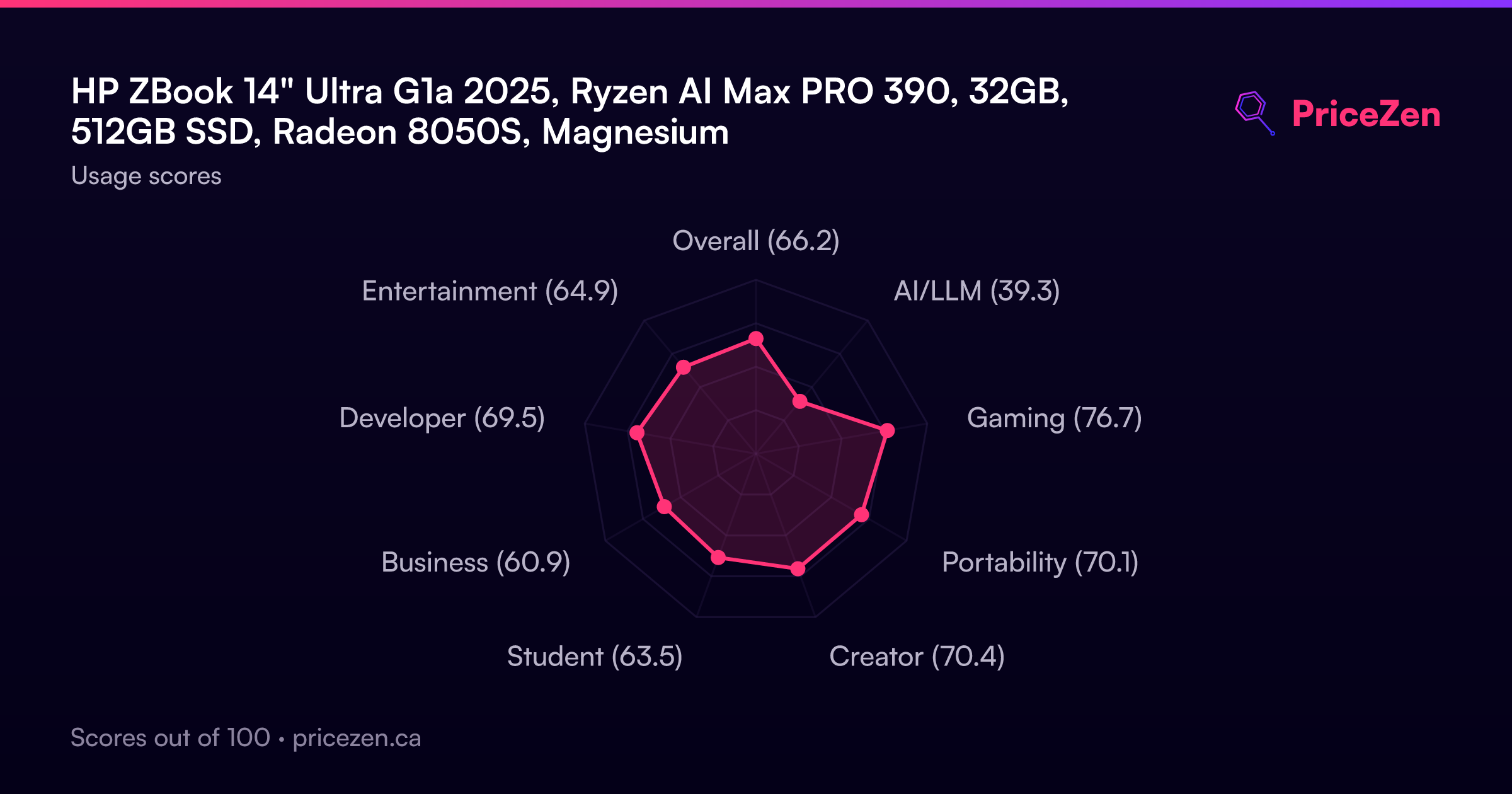
The Radeon 8050S sits at the 70th percentile for GPU performance. That's respectable but not class-leading. If you're doing CUDA-dependent work, you'll feel the gap compared to NVIDIA options. ROCm support helps, and AMD has been improving it steadily, but it's still not as plug-and-play as the NVIDIA ecosystem. For general compute, rendering, and multitasking, this machine flies. For gaming, our scoring puts it at 72.1 out of 100, which is fine for a workstation but won't impress anyone coming from a dedicated gaming laptop. The 512GB NVMe SSD is PCIe 4.0, so it's fast, but the capacity is the weak link. You'll likely want an external drive or a quick upgrade.
Specifications
Full Specifications
Processor
| CPU | AMD Ryzen AI Max Pro 390 |
| Cores | 12 |
| Frequency | 3.2 GHz |
| L3 Cache | 64 MB |
Graphics
| GPU | AMD Radeon 8050S |
| Type | Discrete |
Memory & Storage
| RAM | 32 GB |
| RAM Generation | LPDDR5X |
| Storage | 512 GB |
| Storage Type | NVMe SSD |
Display
| Size | 14" |
| Resolution | 1920x1200 (Full HD) |
| Panel | IPS |
| Refresh Rate | 60 Hz |
| Brightness | 400 nits |
| Color Gamut | 100% sRGB |
Connectivity
| USB-C Ports | 3 |
| USB Ports | 1 |
| Thunderbolt | Thunderbolt 4 |
| HDMI | HDMI 2.1 |
| Wi-Fi | Wi-Fi 7 |
| Bluetooth | Bluetooth 5.4 |
Physical
| Weight | 1.6 kg / 3.5 lbs |
| Battery | 74 Wh |
| OS | Windows 11 Pro |
vs Competition
Against the Apple MacBook Pro M4 Max, the ZBook Ultra G1a is the value play. The MacBook has a better display, better battery life, and a more polished overall experience, but you'll pay a lot more for it. The HP's unified memory approach is genuinely competitive with Apple's for AI workloads, and that's not something we say often about Windows laptops. The ASUS ROG Zephyrus G14 is the gaming alternative. It has a higher refresh display and a discrete NVIDIA GPU, which will beat the Radeon 8050S in most gaming and CUDA tasks, but it can't match the HP's memory bandwidth for large model inference.
The Lenovo Legion Pro 7i is a bigger, heavier machine with more raw GPU power, but it's not really in the same portability conversation. The MSI Prestige and Microsoft Surface Laptop 7th Edition are thinner and lighter, but they're not workstations. They don't have the memory architecture or the sustained compute headroom this HP offers. If your workflow is AI-first, the ZBook Ultra G1a is the most interesting Windows option in this group. If you need CUDA or high-refresh gaming, look elsewhere.
| Spec | HP ZBook 14" Ultra G1a | Apple MacBook Pro 14.2" M4 Pro | ASUS ROG Zephyrus 14" GA403WW-G14.R95080 | Lenovo Legion Pro 7i Gen 10 16" | Samsung Galaxy Book5 Pro 14" NP944XHA-KG3US | Dell Premium 14.5" LDA14250-7667SLV-PUS |
|---|---|---|---|---|---|---|
| CPU | AMD Ryzen AI Max Pro 390 | Apple M4 Pro | AMD Ryzen AI 9 HX 370 | Intel Core Ultra 9 275HX | Intel Core Ultra 7 258V | Intel Core Ultra 7 255H |
| RAM (GB) | 32 | 48 | 32 | 32 | 32 | 32 |
| Storage (GB) | 512 | 4096 | 2048 | 1024 | 1024 | 1024 |
| Screen | 14" 1920x1200 | 14.2" 3024x1964 | 14" 2880x1800 | 16" 2560x1600 | 14" 2880x1800 | 14.5" 3200x2000 |
| GPU | AMD Radeon 8050S | Apple (16-Core) | NVIDIA GeForce RTX 5080 | NVIDIA GeForce RTX 5070 Ti | Intel Arc Graphics 140V | Intel Arc Graphics |
| OS | Windows 11 Pro | macOS | Windows 11 Home | Windows 11 Home | Windows 11 Pro | Windows 11 Home |
| Weight (kg) | 1.6 | 1.6 | 1.6 | 2.7 | 1.2 | 1.7 |
| Battery (Wh) | 74 | 72 | - | 99 | 63 | 62 |
| Compare | Compare | Compare | Compare | Compare |
| Product | CPU | GPU | RAM | Ports | Screen | Portability | Storage | User Sentiment | Reliability | Social Proof | Affordability |
|---|---|---|---|---|---|---|---|---|---|---|---|
| HP ZBook 14" Ultra G1a | 92.8 | 86.2 | 92 | 80.3 | 71.7 | 73.6 | 51.1 | 81.5 | 33.7 | 17.4 | 18.5 |
| Apple MacBook Pro 14.2" M4 Pro Compare | 92.4 | 78.9 | 90.6 | 73.8 | 99.1 | 68.9 | 98.4 | 90.9 | 98.2 | 99.7 | 4.7 |
| ASUS ROG Zephyrus 14" GA403WW-G14.R95080 Compare | 91.2 | 98.3 | 90.8 | 89.4 | 96 | 73.6 | 89.7 | 99.1 | 60.6 | 95.6 | 6.2 |
| Lenovo Legion Pro 7i Gen 10 16" Compare | 97.2 | 96.7 | 89 | 97.3 | 95 | 9.5 | 79.3 | 90.9 | 82 | 99.7 | 5.9 |
| Samsung Galaxy Book5 Pro 14" NP944XHA-KG3US Compare | 65.8 | 69.6 | 79.5 | 83.5 | 90.3 | 89.4 | 79.3 | 0 | 82 | 95.6 | 21.3 |
| Dell Premium 14.5" LDA14250-7667SLV-PUS Compare | 87 | 69.6 | 89 | 66.7 | 96.8 | 61.3 | 65.4 | 90.9 | 33.7 | 95.6 | 14.9 |
Price
Value & Pricing
Value is where this gets interesting. At $1,899 to $1,973 in the US, the ZBook Ultra G1a undercuts a comparably specced MacBook Pro M4 Max by a significant margin, and buyers in our sentiment data specifically call out the value compared to Apple's offering. The Canadian pricing is all over the place though. You'll see CAD 2,580 at one vendor and CAD 4,282 at another, a spread of CAD 1,702 for what appears to be the same machine. If you're shopping in Canada, check the retailer carefully before you buy. The 512GB SSD is the main value compromise. You're getting workstation-class compute with consumer-laptop storage, and that's a trade-off worth weighing against alternatives like the ASUS ROG Zephyrus G14 or the Lenovo Legion Pro 7i, both of which offer more storage and better GPUs at similar or lower prices, though without the unified memory advantage for AI work.
Read more
Overview
The HP ZBook Ultra G1a is a 14-inch mobile workstation that's trying to do something genuinely interesting: cram desktop-class AI horsepower into a laptop you can actually carry. It sits in the premium workstation bracket, with US listings running between $1,899 and $1,973, and Canadian pricing spread across a wild CAD 2,580 to CAD 4,282 range depending on the vendor. The headline spec is the AMD Ryzen AI Max PRO 390, a 12-core chip paired with 32GB of LPDDR5X and integrated Radeon 8050S graphics. HP is clearly aiming this at developers and creators who want to run local LLMs and AI workflows without dragging around a desktop tower.
So is the HP ZBook Ultra G1a good for AI work? That's the whole pitch, and the answer is mostly yes, with caveats. The unified memory architecture is the star here. AMD's approach lets the CPU and GPU share that 32GB pool directly, which matters a lot when you're loading large models. Our database puts the RAM at the 93rd percentile and the CPU at the 91st, so this thing has serious compute chops. But the storage is only 512GB, which lands at a middling 52nd percentile, and that's going to feel tight if you're juggling multiple model files and datasets.
Build quality is a real strong point. The magnesium chassis keeps it rigid without feeling like a brick, though at 3.13kg it's not exactly an ultrabook. The 14-inch 1920x1200 IPS panel with 400 nits and full sRGB coverage is solid for color work, but the 60Hz refresh rate tells you this isn't aimed at gamers. It's a workstation first, and that focus shows in both the good and the awkward ways.
Common Questions
Q: Is the HP ZBook Ultra G1a good for running local AI models?
Yes, this is one of the best Windows laptops for local AI work thanks to its 32GB of unified memory, which lets the CPU and Radeon 8050S GPU share the same high-bandwidth pool. Users report running large LLMs that would struggle on laptops with discrete GPUs and limited VRAM.
Q: How does the HP ZBook Ultra G1a compare to the MacBook Pro M4 Max?
The ZBook Ultra G1a offers similar unified memory advantages for AI workloads at a significantly lower price, with US listings around $1,899 to $1,973. The MacBook Pro has a better display, longer battery life, and a more polished experience, but you'll pay a premium for those extras.
Q: Is the HP ZBook Ultra G1a good for gaming?
It's okay but not great. Our gaming score for this machine is 72.1 out of 100, and the 60Hz display limits the experience. The integrated Radeon 8050S can handle casual gaming, but a dedicated gaming laptop like the ASUS ROG Zephyrus G14 will be noticeably better.
Q: Can I upgrade the storage on the HP ZBook Ultra G1a?
The 512GB NVMe SSD uses a standard M.2 2280 form factor, so it should be replaceable. Given that 512GB is on the small side for AI datasets and model files, many buyers will likely want to upgrade or add external storage.
Who Should Skip This
Skip the ZBook Ultra G1a if you're a gamer, a CUDA-dependent developer, or someone who needs lots of onboard storage. The 60Hz display and integrated Radeon 8050S won't satisfy anyone looking for high-refresh gaming, and the 512GB SSD fills up fast with AI models and creative assets. If you need NVIDIA's CUDA ecosystem for machine learning or rendering, the ASUS ROG Zephyrus G14 or Lenovo Legion Pro 7i are better fits. And if you want a thin, light ultrabook for general productivity, the Microsoft Surface Laptop 7th Edition or MSI Prestige will be more comfortable to carry than this 3.13kg workstation.
Verdict
Should you buy the HP ZBook Ultra G1a? If you're a developer or researcher who wants to run local AI models on a portable machine without spending MacBook Pro money, this is one of the most compelling options we've seen. The unified memory is the killer feature, and the build quality backs it up. Users in our sentiment data consistently praise the power-to-size ratio and the cool operation under load. The magnesium chassis is a nice touch that makes the 3.13kg weight feel more intentional than accidental.
But this isn't a machine for everyone. The 512GB SSD is a real limitation for AI work, the 60Hz display feels like a cost-cutting measure on a premium workstation, and the reliability scores in our database are a concern at the 33rd percentile. The GPU is fine but not exciting. If you're doing CUDA-heavy work or want a gaming-capable machine, the ROG Zephyrus G14 or Legion Pro 7i will serve you better. For the AI-focused buyer who knows exactly what they need, the ZBook Ultra G1a delivers a lot of capability for the price.
Usage Scores
- Overall66.2
- AI/LLM39.3
- Gaming76.7
- Portability70.1
- Creator70.4
- Student63.5
- Business60.9
- Developer69.5
- Entertainment64.9