ZOTAC GeForce RTX 5060 Twin Edge 8GB GDDR7 Gray

Drives several monitors with ports to spare verified Nov 29
67/100 overall score 4.7 average from 133 owner ratings
- GPU
- GeForce RTX 5060
- VRAM
- 8GB GDDR7
- Boost clock
- 2527 MHz
- TDP
- 170 W
- Memory bus
- 128 bit
- Ray tracing
- Yes
- Class
- consumer
Compare prices at 2 stores
Cheapest first. New, refurbished and bundled offers are kept apart, so you compare like with like.
| Store | Sold by | Colour and condition | Price | vs lowest | Last checked | Link |
|---|---|---|---|---|---|---|
| New2 offersSingle unit | ||||||
| Out of stock when last checked | ||||||
| Amazon | Not known | Not listed | No price | Out of stock | 2 days ago | Go to store |
| Newegg | Not known | Gray | No price | Out of stock | Not known | Go to store |
 Source: PriceZen, checked Nov 27, 2026
A price counts as current when we checked it in the last 7 days. “Marketplace seller” means a third-party seller on that store, not the store itself.
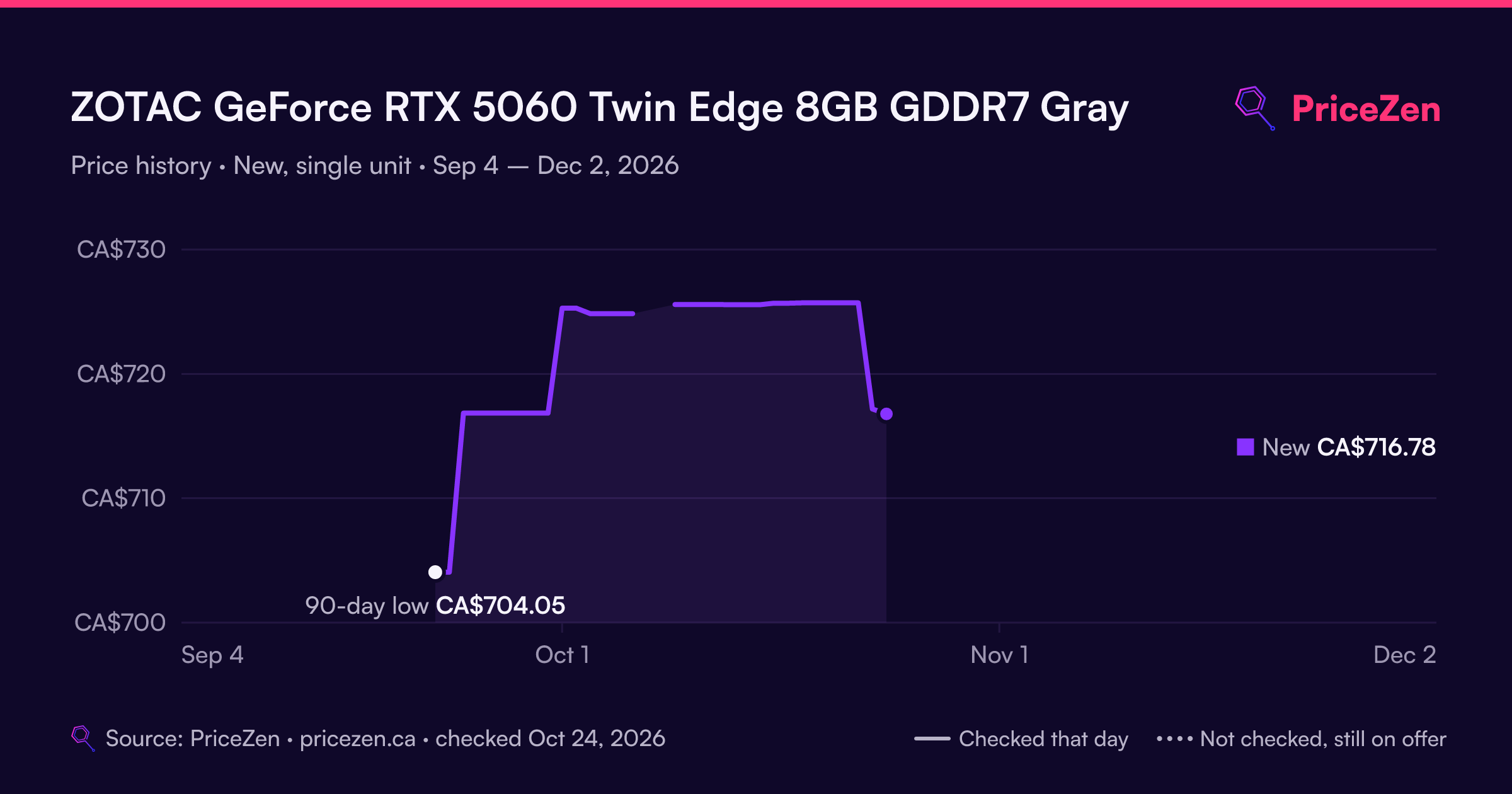
Price history
Checked that dayNot checked that day, still on offer
Source: PriceZen, checked Oct 24, 2026











Snapshot
The 30-Second Version
The ZOTAC RTX 5060 Twin Edge is a compact, efficient 1080p gaming card with DLSS 4 and top-tier connectivity. It scores 73.6 for 1080p gaming and lands in the top 15% for efficiency. Worth buying if you can find it near USD 380, skip it at USD 800.
Pros & Cons
Pros
- SFF-ready at 221mm, fits in almost any case 94th
- Excellent efficiency for a 170W card 94th
- Top-tier connectivity with 3x DP 2.1b and HDMI 2.1b 88th
- DLSS 4 support extends the card's useful life 84th
Cons
- 8GB VRAM is just average and may limit future titles
- AI and compute performance are weak spots
- Ray tracing is middle-of-the-pack at best
- Thermals only land at the 44th percentile
What owners think
The Word on the Street
- Owners consistently praise the compact size and efficiency, with several noting it fits easily in small cases and runs cool and quiet.
- Many buyers say the card delivers excellent 1080p performance for the price, calling it a great value for budget-conscious builders.
- A few users report strange driver-related bugs on this model, though they note the card itself performs fine otherwise.
How owner sentiment changed over time
ExclusiveBased on when customers actually wrote their reviews - so you can see whether early praise held up.
11 written reviews, Jun 2025 – Feb 2026: 10 happy, 1 unhappy
Across all 133 store ratings: 4.7★. Most owners rate without writing a review. The chart counts the 11 written reviews.
- Jan – Mar 20264 of 4 happy
Buyers praised this midrange GPU as a great value for casual gaming, with solid 4K performance and quiet operation. A few noted minor setup issues like fan adjustments and display cable needs.
- Great value and performance for casual gaming, handles 4K content easily.
- Quiet and cool running, with good thermal management out of the box.
- Some buyers needed to tweak fan settings in UEFI for optimal performance.
- One buyer had display posting issues resolved with a DisplayPort to HDMI cable.
- Jul – Sep 20253 of 4 happy
Buyers praise the card's small size, efficiency, and value for 1080p gaming, but one reports a critical H265 decoder bug on the 50-series that forced a return.
- Excellent for small cases, efficient, good value for 1080p and 2K gaming
- High frame rates in Fortnite, Roblox, and rhythm games; budget-friendly 50-series
- Works well after PSU upgrade; not top-tier but a good value upgrade
- Critical H265 decoder bug with current drivers; not present on older cards
Each dot is one written review, in the month it was written. Happy = 4-5★, mixed = 3★, unhappy = 1-2★. Period summaries are in English.
The proof
Performance
The RTX 5060 Twin Edge delivers 19.18 TFLOPS of FP32 compute and a PassMark G3D score of 20,712. That's solidly middle-of-the-pack for raster performance, which translates to smooth 1080p gaming at high settings in most titles. The 8GB of GDDR7 at 448 GB/s is enough for current games at 1080p, though it sits right around average for VRAM capacity. Ray tracing lands at the 59th percentile, so it's fine but not a standout. The 2,600MHz boost clock keeps things snappy, and DLSS 4 support helps stretch performance further. Where this card genuinely shines is efficiency, it's in the top 15% for power draw versus output, which is impressive for a 170W card.
Specifications
Full Specifications
Chipset
| GPU Chipset | GeForce RTX 5060 |
| Brand | NVIDIA |
| Architecture | Blackwell |
| Class | consumer |
| Process | 5 |
Memory
| VRAM | 8 GB |
| Memory Type | GDDR7 |
| Memory Bus | 128 |
| Bandwidth | 448 |
Compute
| CUDA Cores | 3840 |
| Tensor Cores | 120 |
| RT Cores | 30 |
| Base Clock | 2527 |
| Boost Clock | 2527 |
| FP16 TFLOPS | 19.18 |
| FP32 TFLOPS | 19.18 |
Performance
| PassMark G3D | 20712 |
| GPU Compute | 10484 |
Power & Cooling
| TDP | 170 |
| Recommended PSU | 550 |
| Power Connectors | 8-Pin |
| Cooler | Dual Fan |
| Fans | 2 |
Connectivity
| Interface | PCI Express 5.0 x8 |
| DisplayPort | 3 |
| HDMI | 1 |
| Max Displays | 4 |
| Max Resolution | 4K (2160p) |
Physical
| Length | 221 |
| Slot Width | 2 |
| Form Factor | SFF |
| Weight | 1.1 kg / 2.5 lbs |
Features
| Ray Tracing | Yes |
| Upscaling | DLSS 4 |
| AV1 Encode | Yes |
| VR Ready | Yes |
| DirectX | 12 Ultimate |
| RGB | No |
vs Competition
Against the RTX 5070 Ti cards from ASUS and PNY, the 5060 Twin Edge is clearly a step down in raw performance, but it's also a fraction of the size and power draw. The Gigabyte AORUS and MSI Suprim RTX 5080 cards are in a completely different league for 4K gaming, but they're also massive, power-hungry, and way more expensive. The Sapphire PULSE is an AMD option that trades blows differently, but if you want DLSS 4 and NVIDIA's feature set in a small package, the ZOTAC is the only one of these that fits in a compact build. For pure 1080p gaming, the 5060 Twin Edge holds its own against cards that cost significantly more.
| Spec | ZOTAC GeForce RTX 5060 Twin Edge | Gigabyte GeForce RTX 5070 Ti Eagle Ice | ASUS GeForce RTX 5080 PRIME EVO OC | MSI GeForce RTX 5070 Ti Ventus 3X OC | PNY GeForce RTX 5080 ARGB OC | Sapphire Radeon RX 7900 XTX NITRO+ |
|---|---|---|---|---|---|---|
| Chipset | GeForce RTX 5060 | GeForce RTX 5070 Ti | GeForce RTX 5080 | GeForce RTX 5070 Ti | GeForce RTX 5080 | Radeon RX 7900 XTX |
| Vram | 8GB GDDR7 | 16GB GDDR7 | 16GB GDDR7 | 16GB GDDR7 | 16GB GDDR7 | 24GB GDDR6 |
| Boost Clock Mhz | 2527 | 2542 | 2685 | 2482 | 2620 | 2680 |
| Tdp W | 170 | 300 | 360 | 300 | 360 | 339 |
| Memory Bus Bits | 128 | 256 | 256 | 256 | 256 | 384 |
| Ray Tracing | Yes | Yes | Yes | Yes | Yes | Yes |
| GPU Class | consumer | consumer | consumer | consumer | consumer | consumer |
| Compare | Compare | Compare | Compare | Compare |
| Product | AI | Rt | Vram | Raster | Compute | Feature | Thermal | Efficiency | Connectivity | Social Proof | Affordability |
|---|---|---|---|---|---|---|---|---|---|---|---|
| ZOTAC GeForce RTX 5060 Twin Edge | 39.1 | 58.7 | 46.1 | 49.5 | 45.8 | 88.4 | 41.6 | 83.6 | 94.2 | 93.7 | 61.9 |
| Gigabyte GeForce RTX 5070 Ti Eagle Ice Compare | 78.9 | 88.6 | 85.9 | 88.9 | 87.8 | 95.7 | 91.8 | 71.6 | 94.2 | 93.7 | 23 |
| ASUS GeForce RTX 5080 PRIME EVO OC Compare | 85.5 | 97.7 | 89.1 | 94.5 | 93.3 | 88.4 | 91.8 | 56.6 | 94.2 | 93.7 | 19.3 |
| MSI GeForce RTX 5070 Ti Ventus 3X OC Compare | 78.9 | 92.4 | 85.9 | 88.9 | 87.8 | 95.7 | 91.8 | 71.6 | 94.2 | 84.1 | 21.2 |
| PNY GeForce RTX 5080 ARGB OC Compare | 85.5 | 97.7 | 89.1 | 94.5 | 93.3 | 95.7 | 91.8 | 56.6 | 94.2 | 75.1 | 16.1 |
| Sapphire Radeon RX 7900 XTX NITRO+ Compare | 95.3 | 96.4 | 92 | 83.4 | 95.6 | 95.7 | 91.8 | 51.3 | 98.8 | 69.5 | 13.6 |
Price
Value & Pricing
Pricing is all over the place right now. We're seeing USD 380 to USD 800 across three US listings, which is a wild spread for the same card. At USD 380, this is a genuinely good deal for a 1080p gaming card with DLSS 4. At USD 800, you're getting fleeced, that's RTX 5070 territory. If you can find it near the low end of that range, the value proposition is strong. Just don't pay a premium for the compact form factor unless you actually need it.
Read more
Overview
The ZOTAC RTX 5060 Twin Edge is a compact little card that punches above its weight class for 1080p gaming. It's SFF-ready at 221mm, sips power at 170W, and packs 8GB of GDDR7 on a 128-bit bus. Nothing flashy here, just a no-frills card that gets the job done without hogging your case or your power bill.
Our database puts it at 66.3 overall, which sounds mediocre until you look closer. Connectivity and features are near the top of the charts, and efficiency is a genuine strength. The weak spots are AI workloads and raw compute, but if you're buying this for gaming, those numbers matter a lot less than the 1080p score of 73.6.
Common Questions
Q: Will this card fit in my small form factor case?
At 221mm long and 2 slots thick, it's designed for SFF builds and should fit in most compact cases that support a dual-slot GPU.
Q: Is 8GB of VRAM enough for modern games?
For 1080p gaming at high settings, 8GB is generally sufficient today, though some newer titles at max settings may push past that limit.
Q: What power supply do I need for this card?
ZOTAC recommends a 550W PSU, and the card uses a single 8-pin PCIe power connector with a 170W TDP.
Who Should Skip This
If you're targeting 1440p or 4K gaming, look elsewhere. The 8GB VRAM and mid-tier raster performance will hold you back at higher resolutions. AI enthusiasts and content creators who need serious compute should also pass, this card scores just 36.2 for AI workloads, which is one of the weakest areas in our database. And if you're not building a small form factor rig, you can probably find more raw performance for the same money in a larger card.
Verdict
This card is for people who want solid 1080p gaming in a small form factor without breaking the bank or their power supply. It's not a 1440p or 4K card, and it's not for AI tinkerers. But if you're building a compact rig and want DLSS 4, good efficiency, and a card that just works, the ZOTAC RTX 5060 Twin Edge is a smart pick. Just make sure you're paying closer to USD 380 than USD 800.
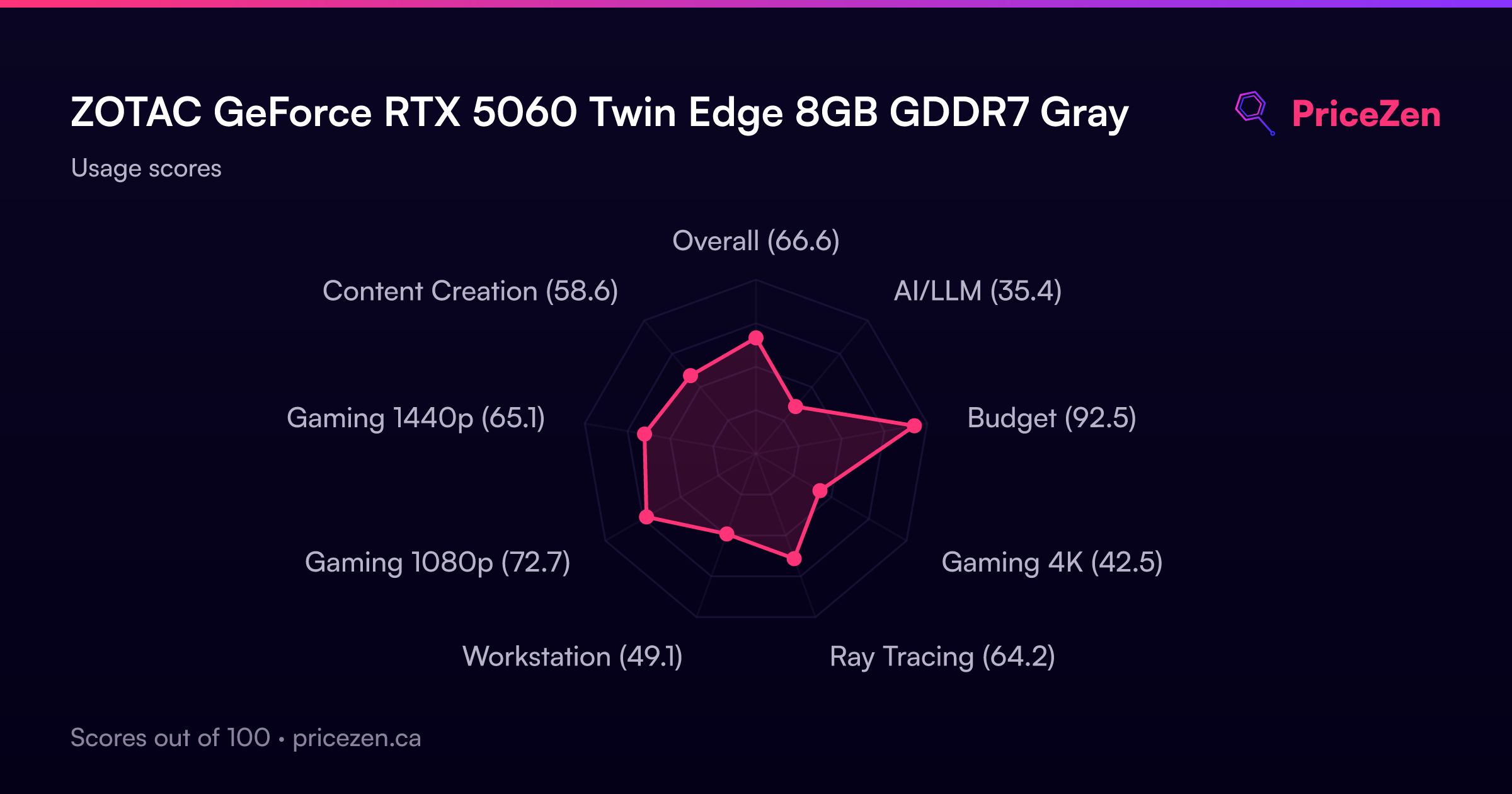
Usage Scores
- Overall66.6
- AI/LLM35.4
- Budget92.5
- Gaming 4K42.5
- Ray Tracing64.2
- Workstation49.1
- Gaming 1080p72.7
- Gaming 1440p65.1
- Content Creation58.6