EVGA GeForce GTX 1070 8GB GDDR5 Black

8GB of VRAM in a 150W card verified Nov 22
35/100 overall score 4.5 average from 1,017 owner ratings
- GPU
- GeForce GTX 1070
- VRAM
- 8GB GDDR5
- Boost clock
- 1683 MHz
- TDP
- 150 W
- Memory bus
- 256 bit
- Class
- consumer
Compare prices at 1 store
Cheapest first. New, refurbished and bundled offers are kept apart, so you compare like with like.
| Store | Sold by | Colour and condition | Price | vs lowest | Last checked | Link |
|---|---|---|---|---|---|---|
| New1 offerSingle unit | ||||||
| Not checked in the last 7 days, so these prices may have changed | ||||||
| Newegg | Marketplace seller | Black | CA$699.00 | Nov 15 | Go to store | |
 Source: PriceZen, checked Nov 15, 2026
A price counts as current when we checked it in the last 7 days. “Marketplace seller” means a third-party seller on that store, not the store itself.
Snapshot
The 30-Second Version
Owners love this card, with a 4.5/5 rating across 1017 reviews and praise for its cooling and 1440p gaming, but the specs tell an older story. You get 8GB of GDDR5 at 256 GB/s, 1920 CUDA cores and a 13513 PassMark G3D benchmark score that sits in the bottom third of current GPUs. At CAD 699 from Newegg, the price is the sticking point owners themselves complain about. Buy it cheap for an older rig, skip it at full retail.
Pros & Cons
Pros
- Owner sentiment of 88/100 and 4.5/5 across 1017 reviews, among the happiest GPU owners we track 85th
- 8GB GDDR5 on a 256-bit bus at 256 GB/s, and owners report solid 1440p gaming 75th
- Modest 150W TDP with a 500W PSU recommendation, easy to slot into an existing build 75th
- Dual-fan ACX 3.0 cooler with 10 power phases, repeatedly praised for quiet running
- Wide output selection: 3x DP 1.4, HDMI 2.0b and Dual-Link DVI-D for legacy displays
Cons
- CAD 699 at Newegg is the recurring price complaint from owners, and our affordability ranking is only middling
- PassMark G3D of 13513 puts raster performance in the bottom third of current GPUs
- Ray tracing and modern feature support rank near the back of the category
- AI and LLM work is its weakest area at 17.7/100, with compute in the lower quarter
- Some units need a VBIOS update before drivers install, and orientation can affect noise
What owners think
The Word on the Street
- Performance is the loudest theme by far, with multiple owners describing the card as a beast and specifically calling out solid 1440p gaming. Several report meaningful overclocking headroom well past the stock boost clock.
- Cooling comes up repeatedly as a strength, with owners noting the card stays quiet even when the fans ramp up. EVGA's customer support also gets singled out, including from buyers who needed help troubleshooting a fresh build.
- Price is the most consistent complaint, and even enthusiastic reviewers tend to frame their recommendation around getting it at MSRP rather than at a markup. Availability frustration shows up alongside it.
- Installation quirks divide owners: some had to update both the primary and secondary VBIOS before drivers would install, and a few report noise or clearance issues depending on card orientation and radiator placement in the case.
How owner sentiment changed over time
ExclusiveBased on when customers actually wrote their reviews - so you can see whether early praise held up.
8 written reviews, Jul 2016 – Feb 2018: 8 happy
Across all 1,017 store ratings: 4.5★. Most owners rate without writing a review. The chart counts the 8 written reviews.
Each dot is one written review, in the month it was written. Happy = 4-5★, mixed = 3★, unhappy = 1-2★.
The proof
Performance
Let's start with the number that matters most for buyers: a PassMark G3D benchmark score of 13513. That's an external benchmark result, not something we ran, and in our data it places this card's raster throughput below most of what's currently on sale. Practically, that means older titles and esports games at 1080p should be comfortable, and owners specifically report solid 1440p gaming, which lines up with the 8GB buffer and 256 GB/s of bandwidth. But 8GB of GDDR5 ranks in the lower quarter of cards we track for memory, so newer games with heavy texture packs are where you'll be dialling settings down rather than up. The 6.46 TFLOPS figure tells a similar story on the compute side, sitting well behind the pack.
The trade-off worth naming is efficiency versus enthusiasm. A 150W TDP is modest in absolute terms, but relative to the frame rates it produces, our efficiency ranking puts it right around the middle of the field, and thermal performance lands slightly below average despite the dual-fan ACX 3.0 cooler and 10 power phases. Owners disagree with that ranking a bit: cooling is one of the most repeated praises in the reviews we collected, with several reporting quiet operation even when the fans spin up. The catch shows up in specific installs. Some owners mention noise depending on how the card is oriented in the case, and a couple flag placement restrictions when pairing it with a radiator. There's also a firmware wrinkle: at least one buyer had to flash both the primary and secondary VBIOS before drivers would install cleanly.
Specifications
Full Specifications
Chipset
| GPU Chipset | GeForce GTX 1070 |
| Brand | NVIDIA |
| Architecture | Pascal |
| Class | consumer |
| Process | 16 |
Memory
| VRAM | 8 GB |
| Memory Type | GDDR5 |
| Memory Bus | 256 |
| Bandwidth | 256.3 |
Compute
| CUDA Cores | 1920 |
| Base Clock | 1506 |
| Boost Clock | 1683 |
| FP32 TFLOPS | 6.46 |
Performance
| PassMark G3D | 13513 |
| GPU Compute | 6121 |
Power & Cooling
| TDP | 150 |
| Recommended PSU | 500 |
| Power Connectors | Two available 8-pin or 6+2pin PCI-E power dongles |
| Cooler | Dual Fan |
| Fans | 2 |
Connectivity
| Interface | PCI Express 3.0 |
| DisplayPort | 3 |
| HDMI | 1 |
| Max Displays | 4 |
| Max Resolution | 7680 x 4320 |
Physical
| Length | 267 |
| Slot Width | 2 |
Features
| Ray Tracing | No |
| VR Ready | Yes |
| DirectX | 12 |
| RGB | Yes |
vs Competition
Cross-shopping this against the Gigabyte GeForce RTX 5070 Ti Eagle Ice, the MSI GeForce RTX 5070 Ti Ventus 3X OC or the ASUS GeForce RTX 5080 PRIME EVO OC is not a fair fight on raw numbers, and we'd rather say so plainly. Those cards sit at the top of our competitor list for this category, while the EVGA's 13513 G3D benchmark score and 6.46 TFLOPS put its raster and compute throughput well down the table. Ray tracing is the starkest gap: this card ranks near the bottom of everything we compare there, so if you want modern lighting effects at playable frame rates, the EVGA isn't the conversation you should be having. Same for anything AI-shaped, where its 17.7/100 score is the weakest mark on its entire scorecard.
Where the EVGA still argues for itself is simplicity and proven reliability. A 150W TDP, a 500W PSU recommendation, a 267mm 2-slot dual-fan design and a DVI-D port for that old monitor add up to a drop-in upgrade for an aging machine, and the ZOTAC GeForce RTX 5080 APOCALYPSE and PNY GeForce RTX 5080 ARGB OC are aimed at a completely different kind of build. Owner satisfaction is the other lever: an 86th percentile sentiment ranking means the people who bought this card rarely regret it. So the split is clean. Building new with a real budget? Cross-shop the RTX 5070 Ti and RTX 5080 options. Keeping an older rig alive cheaply, and you find this at a sane price? The EVGA still earns its reputation.
| Spec | EVGA GeForce GTX 1070 | Gigabyte GeForce RTX 5070 Ti Eagle Ice | MSI GeForce RTX 5070 Ti Ventus 3X OC | ASUS GeForce RTX 5070 Ti TUF Gaming OC | ZOTAC GeForce RTX 5080 APOCALYPSE | PNY GeForce RTX 5080 OC |
|---|---|---|---|---|---|---|
| Chipset | GeForce GTX 1070 | GeForce RTX 5070 Ti | GeForce RTX 5070 Ti | GeForce RTX 5070 Ti | GeForce RTX 5080 | GeForce RTX 5080 |
| Vram | 8GB GDDR5 | 16GB GDDR7 | 16GB GDDR7 | 16GB GDDR7 | 16GB GDDR7 | 16GB GDDR7 |
| Boost Clock Mhz | 1683 | 2542 | 2482 | 2610 | 2730 | 2730 |
| Tdp W | 150 | 300 | 300 | 300 | 360 | 360 |
| Memory Bus Bits | 256 | 256 | 256 | 256 | 256 | 256 |
| Ray Tracing | No | Yes | Yes | Yes | Yes | Yes |
| GPU Class | consumer | consumer | consumer | consumer | consumer | consumer |
| Compare | Compare | Compare | Compare | Compare |
| Product | AI | Rt | Vram | Raster | Compute | Feature | Thermal | User Sentiment | Efficiency | Connectivity | Social Proof | Affordability |
|---|---|---|---|---|---|---|---|---|---|---|---|---|
| EVGA GeForce GTX 1070 | 26.6 | 25.6 | 23.5 | 28.1 | 21.8 | 27.5 | 41.6 | 85 | 48.1 | 43.1 | 74.9 | 74.9 |
| Gigabyte GeForce RTX 5070 Ti Eagle Ice Compare | 78.9 | 88.6 | 86 | 88.9 | 87.9 | 95.7 | 91.8 | 85 | 71.6 | 94.2 | 93.4 | 22.9 |
| MSI GeForce RTX 5070 Ti Ventus 3X OC Compare | 78.9 | 92.4 | 86 | 88.9 | 87.9 | 95.7 | 91.8 | 85 | 71.6 | 94.2 | 83.9 | 21 |
| ASUS GeForce RTX 5070 Ti TUF Gaming OC Compare | 78.9 | 92.4 | 86 | 88.9 | 87.9 | 95.7 | 91.8 | 57.6 | 71.6 | 99.3 | 93.4 | 22.8 |
| ZOTAC GeForce RTX 5080 APOCALYPSE Compare | 85.5 | 97.7 | 89.1 | 94.4 | 93.3 | 95.7 | 91.8 | 99.5 | 56.6 | 94.2 | 98.7 | 23.2 |
| PNY GeForce RTX 5080 OC Compare | 85.5 | 97.7 | 89.1 | 94.4 | 93.3 | 65.6 | 91.8 | 57.6 | 56.6 | 81.3 | 98.7 | 15.4 |
Price
Value & Pricing
Here's where we'd pump the brakes. We track this card at CAD 699, with a single in-stock new listing at Newegg. That's the only price point in our data, so there's no cross-store shopping to do and no discount to hunt. Owners themselves list high price as a recurring gripe, and several of the positive reviews qualify their praise with something like "good value at MSRP," which is a very different sentence from "good value at CAD 699." Our model gives it 64.2/100 for budget builds, which sounds generous until you notice the affordability percentile is only around the middle of the pack.
The honest read: this is a card whose value depends entirely on the number on the tag, and the number we're seeing right now doesn't reflect what the hardware delivers against current alternatives. If you already own one, keep it, it's clearly still making people happy. If you're buying fresh at this price, you're paying a premium driven by scarcity rather than performance.
We started tracking prices for this product on Nov 15, 2026. The chart appears once we have more data.
Read more
Overview
The EVGA GeForce GTX 1070 FTW DT Gaming ACX 3.0 is a card with two very different stories attached to it, and we think both are worth hearing. On paper it's a Pascal-era board: 1920 CUDA cores on a 16nm process, 8GB of GDDR5 across a 256-bit bus at 256 GB/s, a 1506 MHz core clock boosting to 1683 MHz, and 6.46 FP32 TFLOPS of compute. Owners, meanwhile, absolutely love it. It carries a 4.5/5 rating across 1017 reviews and an 88/100 sentiment score in our system, which puts owner happiness among the best we track for any graphics card. That gap between how people feel about a product and where its silicon sits today is basically the whole review.
So who's this for? Someone building or patching up a cheap gaming box who wants a known quantity rather than a gamble. The 150W TDP and 500W recommended PSU mean you're not rebuilding your power situation around it, the dual-fan cooler sits in a standard 2-slot footprint at 267mm long, and you get 3x DisplayPort 1.4, HDMI 2.0b and a Dual-Link DVI-D for older monitors. It's flagged VR Ready and supports DX12. If your library is a few years deep and your monitor tops out at 1080p or 1440p, this is the sort of card that quietly does the job.
What makes it interesting is the mismatch. Our scoring model ranks it 64.2/100 for budget use but only 38.6/100 for 1080p gaming and 35.8/100 overall, with AI and LLM work its weakest area at 17.7/100. Raster performance lands in the bottom third of the GPUs we compare, and ray tracing and modern feature support sit near the back too. Yet the people who own one keep calling it a beast. Both things are true: it was a genuinely excellent card, and the market has moved a long way past it.
Common Questions
Q: Can it still handle 1440p gaming?
Owners consistently report solid 1440p performance, and the 8GB GDDR5 buffer with 256 GB/s of bandwidth helps here. Just calibrate expectations: its 13513 PassMark G3D benchmark score puts raster throughput in the bottom third of the GPUs we compare, so newer demanding titles will need reduced settings while older games and esports should run comfortably.
Q: Will my power supply handle it?
The card has a 150W TDP and a 500W recommended PSU, and it needs two available 8-pin or 6+2-pin PCI-E power connectors, so check your cables before ordering. Physically it's 267mm long and takes 2 slots, which fits most mid-tower cases, though owners pairing it with liquid cooling mention watching radiator placement.
Q: Is it good for AI work or local LLMs?
No, and this is the clearest weak spot on its scorecard at 17.7/100. Its 6.46 FP32 TFLOPS and 8GB of GDDR5 rank in the lower quarter of cards we track for compute and memory, and ray tracing support sits near the back of the category too. If AI or modern rendering features are the goal, look at the RTX-class competitors instead.
Q: Is CAD 699 a fair price right now?
We'd say no. That's the single in-stock listing we track at Newegg, and high price is one of the recurring gripes from owners, several of whom frame their praise around getting it at MSRP. With an overall score of 35.8/100 against the current field, you're paying for scarcity rather than performance at that number.
Who Should Skip This
Skip this if you're building a new gaming PC with a real budget, if you care about ray tracing, or if you plan to run local AI models. Its ray tracing and feature rankings sit near the bottom of every GPU we compare, and AI is its weakest area at 17.7/100. The Gigabyte GeForce RTX 5070 Ti Eagle Ice, MSI GeForce RTX 5070 Ti Ventus 3X OC and ASUS GeForce RTX 5080 PRIME EVO OC are the cards to cross-shop for that kind of work, and the ZOTAC GeForce RTX 5080 APOCALYPSE or PNY GeForce RTX 5080 ARGB OC if you want maximum headroom.
Also skip it if CAD 699 is the only price you can find, which is exactly what our tracking shows right now. Owners love this card, but the ones leaving five-star reviews are largely people who bought it at a sensible price. Paying a scarcity premium for a bottom-third raster performer is the one scenario where the enthusiasm in those reviews doesn't transfer to you.
Verdict
If you're upgrading a tired office PC or a hand-me-down gaming rig for 1080p and lighter 1440p play, and you find this card at a price that reflects its age, we'd say go for it. The owner record is genuinely strong: performance and cooling come up over and over in the reviews we collected, and EVGA's customer support gets singled out for praise more than once, which matters on older hardware. The 8GB buffer, modest power draw and generous port selection make it a low-drama upgrade.
If you're spending CAD 699 of your own money on a new build, though, we can't recommend it. Our overall score of 35.8/100 and 1080p gaming score of 38.6/100 tell you exactly what you're getting relative to the current field, and the competitors above give you far more headroom for ray tracing, compute and future titles. This is a card we'd happily inherit, cautiously buy used, and skip at full retail. Great reputation, wrong price tag.
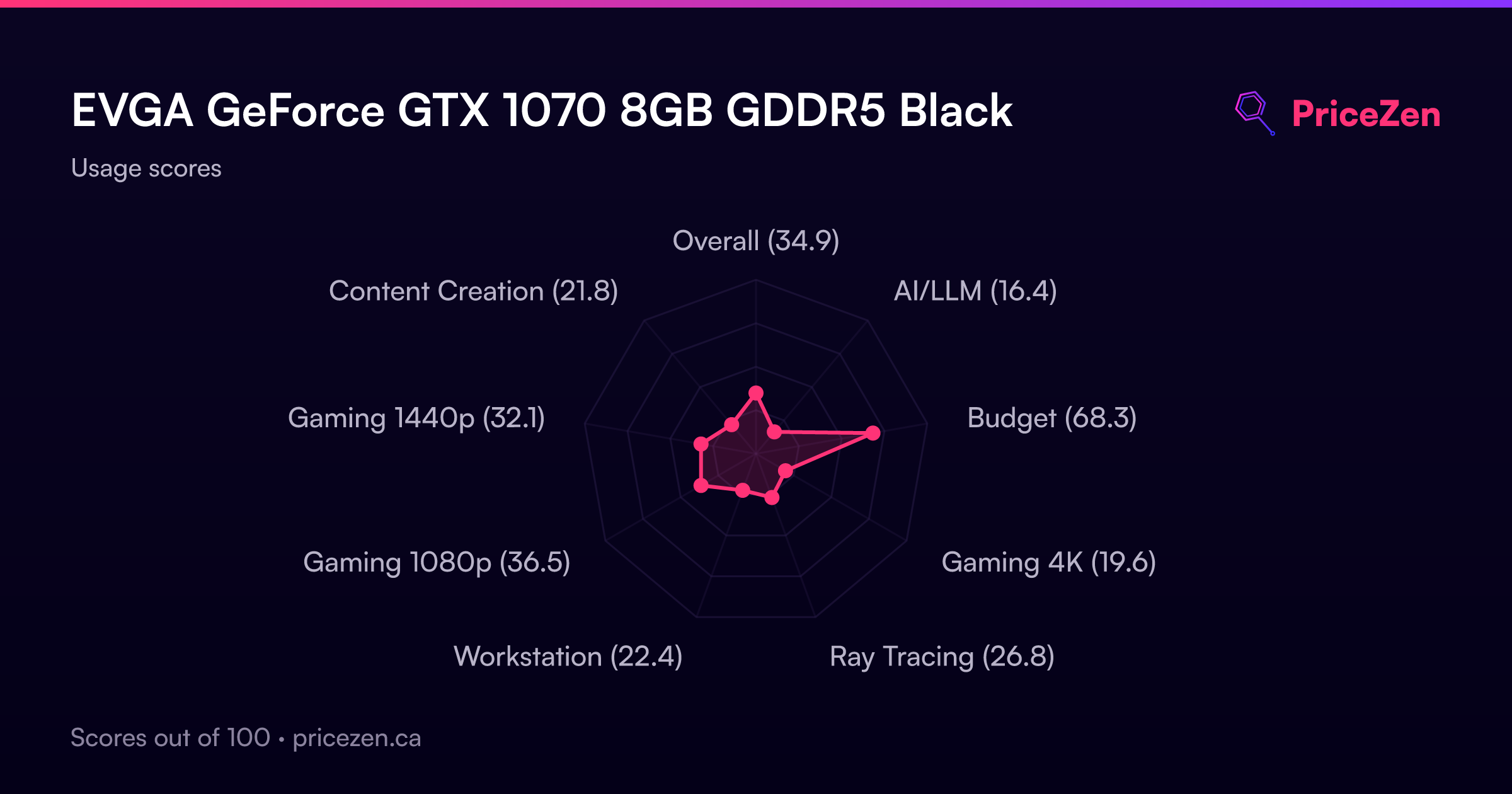
Usage Scores
- Overall34.9
- AI/LLM16.4
- Budget68.3
- Gaming 4K19.6
- Ray Tracing26.8
- Workstation22.4
- Gaming 1080p36.5
- Gaming 1440p32.1
- Content Creation21.8