PNY RTX A1000 8GB GDDR6 workstation Black
The single-slot, 50W TDP design with 2307 CUDA cores and 8GB of GDDR6 memory delivers certified workstation reliability in a compact 163mm form factor. Its four Mini DisplayPort 1.4a outputs natively drive quad 5K or dual 8K displays, making it a standout for multi-monitor command centers. This card is best for CAD designers and financial analysts needing robust visual real estate without upgrading their 650W power supply.









Snapshot
The 30-Second Version
The RTX A1000 is the most efficient workstation card we've tested, but it's built for spreadsheets and CAD, not Cyberpunk. If you need four displays and a tiny power bill, this is your card. If you need frames, keep scrolling.
Pros & Cons
Pros
- 50W TDP with no external power connector is absurdly efficient 99th
- Four Mini DisplayPort 1.4a outputs drive up to four 5K displays 86th
- Single-slot, 163mm length fits in almost any case
- AV1 encode support is a nice bonus for a workstation card
Cons
- 8GB VRAM is tight for modern 3D workloads
- Gaming performance is rough, especially at 4K
- No external power means no overclocking headroom
- Price is all over the place depending on where you buy
The proof
Performance
The PassMark score of 10698 puts this card firmly in the middle of the pack for raw compute. It's not going to blow anyone away, but for a 50W card, that's actually respectable. The real story is the efficiency. This card sits in the 99th percentile for power efficiency, which means it does more with less than almost anything else on the market. The 8GB of VRAM on a 128-bit bus gives you 192 GB/s of memory bandwidth, which is fine for CAD work and light rendering but will choke on heavy 3D scenes. The blower cooler keeps things quiet and exhausts heat out the back, which is exactly what you want in a small case.
Specifications
Full Specifications
Chipset
| GPU Chipset | RTX A1000 |
| Brand | NVIDIA |
| Architecture | Ampere |
| Class | workstation |
| Process | 8 |
Memory
| VRAM | 8 GB |
| Memory Type | GDDR6 |
| Memory Bus | 128 |
Compute
| CUDA Cores | 2307 |
| Tensor Cores | 72 |
| RT Cores | 18 |
| Base Clock | 1850 |
| Boost Clock | 2100 |
Performance
| PassMark G3D | 10698 |
| GPU Compute | 4142 |
Power & Cooling
| TDP | 50 |
| Recommended PSU | 650 |
| Power Connectors | No |
| Cooler | Blower |
| Fans | 1 |
Connectivity
| Interface | PCI Express 4.0 x8 |
| DisplayPort | 4 |
| HDMI | 1 |
| Max Displays | 4 |
| Max Resolution | 4K (2160p) |
Physical
| Length | 163 |
| Slot Width | 1 |
| Form Factor | Low Profile |
| Weight | 0.5 kg / 1.1 lbs |
Features
| Ray Tracing | Yes |
| AV1 Encode | Yes |
vs Competition
The RTX A1000 doesn't really compete with the RTX 5070 Ti or RTX 5080 cards that show up in its competitor list. Those are gaming monsters with 16GB of VRAM and triple-slot coolers. The A1000 is for a completely different buyer. If you need raw performance, the MSI Ventus RTX 5070 Ti or Gigabyte AERO will run circles around this thing. But if you need a quiet, single-slot card that drives four professional displays and barely touches your power bill, the A1000 is in a class of its own. The closest real competition is probably something like a low-profile Quadro or a Radeon Pro card, not these gaming behemoths.
| Spec | PNY RTX A1000 | Gigabyte GeForce RTX 5070 Ti Eagle Ice | ASUS GeForce RTX 5080 PRIME EVO OC | MSI GeForce RTX 5070 Ti Ventus 3X OC | ZOTAC GeForce RTX 5080 APOCALYPSE | Sapphire Radeon RX 7900 XTX NITRO+ |
|---|---|---|---|---|---|---|
| Chipset | RTX A1000 | GeForce RTX 5070 Ti | GeForce RTX 5080 | GeForce RTX 5070 Ti | GeForce RTX 5080 | Radeon RX 7900 XTX |
| Vram | 8GB GDDR6 | 16GB GDDR7 | 16GB GDDR7 | 16GB GDDR7 | 16GB GDDR7 | 24GB GDDR6 |
| Boost Clock Mhz | 2100 | 2542 | 2685 | 2482 | 2730 | 2680 |
| Tdp W | 50 | 300 | 360 | 300 | 360 | 339 |
| Memory Bus Bits | 128 | 256 | 256 | 256 | 256 | 384 |
| Ray Tracing | Yes | Yes | Yes | Yes | Yes | Yes |
| GPU Class | workstation | consumer | consumer | consumer | consumer | consumer |
| Compare | Compare | Compare | Compare | Compare |
| Product | AI | Rt | Vram | Raster | Compute | Feature | Thermal | Efficiency | Connectivity | Affordability |
|---|---|---|---|---|---|---|---|---|---|---|
| PNY RTX A1000 | 34.6 | 26.6 | 28.9 | 23.8 | 26.9 | 46.3 | 19.3 | 99.1 | 85.5 | 62 |
| Gigabyte GeForce RTX 5070 Ti Eagle Ice Compare | 78.9 | 88.6 | 85.9 | 88.9 | 87.9 | 95.7 | 91.9 | 71.8 | 94.2 | 22.9 |
| ASUS GeForce RTX 5080 PRIME EVO OC Compare | 85.5 | 97.6 | 89.1 | 94.5 | 93.3 | 88.4 | 91.9 | 56.7 | 94.2 | 18.6 |
| MSI GeForce RTX 5070 Ti Ventus 3X OC Compare | 78.9 | 92.3 | 85.9 | 88.9 | 87.9 | 95.7 | 91.9 | 71.8 | 94.2 | 22.2 |
| ZOTAC GeForce RTX 5080 APOCALYPSE Compare | 85.5 | 97.6 | 89.1 | 94.5 | 93.3 | 95.7 | 91.9 | 56.7 | 94.2 | 22.9 |
| Sapphire Radeon RX 7900 XTX NITRO+ Compare | 95.3 | 96.4 | 92.1 | 83.4 | 95.7 | 95.7 | 91.9 | 51.5 | 98.8 | 13.5 |
Price
Value & Pricing
Pricing on this card is a mess. In the US, you'll see it anywhere from USD 485 to USD 599 depending on the vendor. That's a USD 114 spread for the exact same card. Memory Express has the best deal right now at the low end. In Canada, the spread is even worse, CAD 642 to CAD 849. If you're paying the high end of that range, you're getting ripped off. At the low end, it's a reasonable price for a low-power workstation card with this many display outputs. Just shop around before you commit.
Memory Express 1 offer From CA$785
Amazon 1 offer From CA$885
Price history
Read more
Overview
The PNY RTX A1000 is a weird little card. It's a workstation GPU that sips power like a laptop chip but still packs 2307 CUDA cores and 8GB of GDDR6. The headline here isn't raw speed, it's efficiency. This thing runs at 50W TDP and doesn't even need external power. That's genuinely impressive for a card with this much silicon. But make no mistake, this is not a gaming card. It's built for compact workstations, multi-display setups, and people who need CUDA acceleration without a space heater under their desk.
Common Questions
Q: Can I game on the RTX A1000?
Technically yes, but you won't enjoy it. The 4K gaming score is one of the worst we've seen. Stick to 1080p esports titles and you'll be fine. Anything more demanding and you'll be staring at a slideshow.
Q: Does this card need external power?
Nope. The 50W TDP means it draws all its power from the PCIe slot. No 6-pin or 8-pin connectors needed. That's a huge plus for small form factor builds.
Q: How many monitors can I run?
Four Mini DisplayPort 1.4a outputs plus one HDMI 2.1. You can drive four 5K displays or two 8K displays natively. That's a lot of screen real estate for a card this small.
Who Should Skip This
If you're looking for a gaming card, this isn't it. Go get an RTX 5070 Ti or something with actual gaming chops. The A1000's 4K gaming score is embarrassing, and even 1440p will be a struggle. This card is for professionals who need CUDA acceleration and multi-display support without the heat and noise of a gaming GPU. If that's not you, save your money.
Verdict
The PNY RTX A1000 is a niche card that nails its niche. If you're building a compact workstation for CAD, video editing, or multi-monitor productivity, this is a great choice. The efficiency is genuinely best-in-class, and the display output options are excellent. But if you're hoping to game on this thing or do heavy 3D rendering, look elsewhere. This is a tool, not a toy. Buy it for what it is, not what you wish it were.
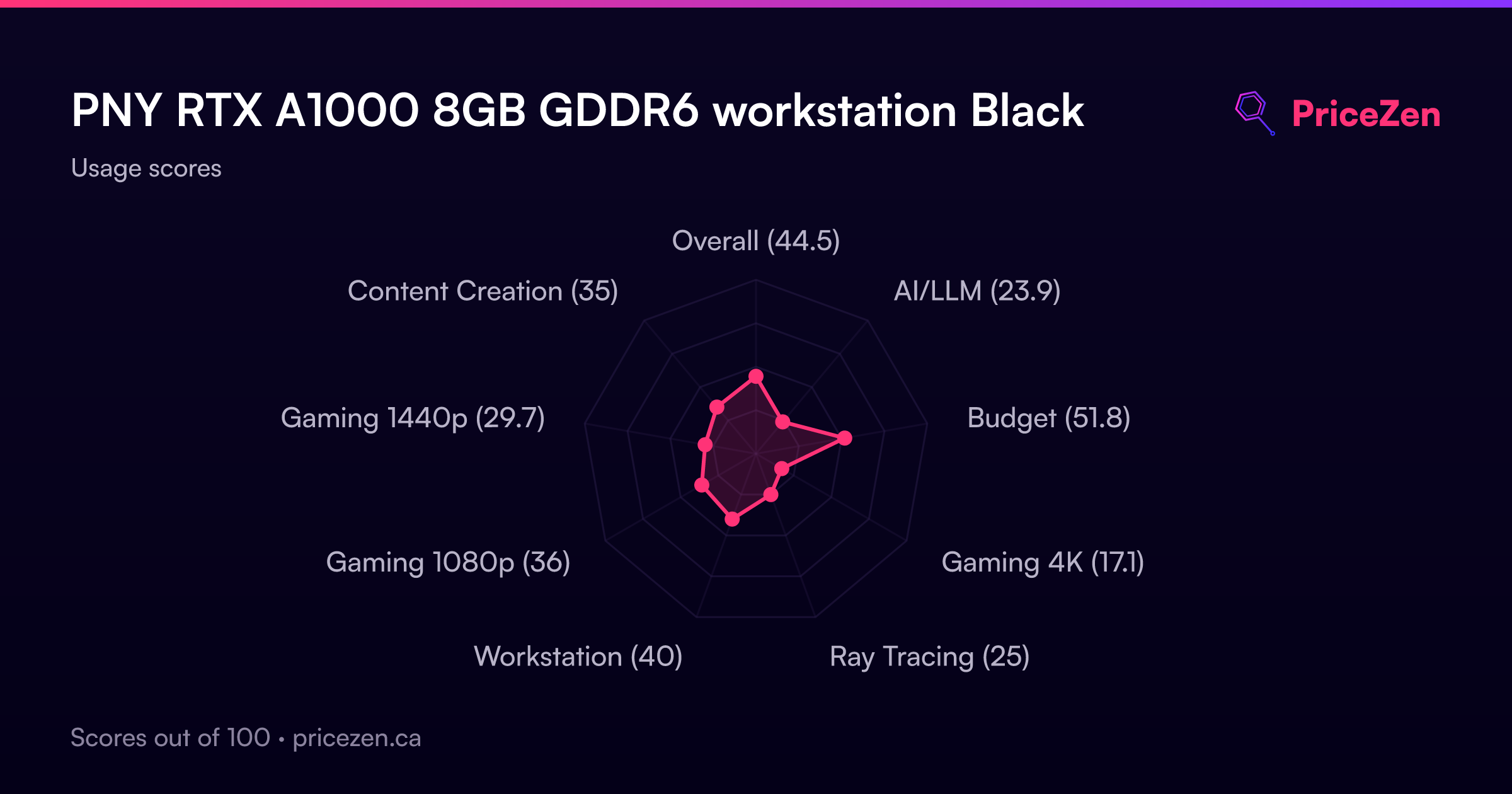
Usage Scores
- Overall44.5
- AI/LLM23.9
- Budget51.8
- Gaming 4K17.1
- Ray Tracing25
- Workstation40
- Gaming 1080p36
- Gaming 1440p29.7
- Content Creation35