ASUS GeForce RTX 5060 Ti Dual OC 16GB GDDR7 Black
The 16GB GDDR7 memory and 85W TDP on the Blackwell architecture deliver efficient 1440p gaming with DLSS 4, while the Axial-tech dual-fan cooler keeps the compact 2.5-slot card quiet under load. Its SFF-Ready design and 0dB silent mode make it a practical drop-in upgrade for small form factor builds without sacrificing thermal headroom. This card is best for space-constrained gamers seeking a cool, quiet GPU for high-refresh 1080p or entry-level 1440p titles.












Snapshot
The 30-Second Version
The ASUS Dual RTX 5060 Ti OC Edition is a quiet, efficient 1440p gaming card with 16GB of GDDR7 VRAM and excellent thermals in a compact 2.5-slot design. It's a great fit for small form factor builds, but the $840 price tag and narrow 128-bit memory bus hold it back from being a clear value pick. If you can find it closer to $700 or you specifically need a compact, quiet card, it's worth considering.
Pros & Cons
Pros
- 16GB GDDR7 VRAM is generous for this price class 94th
- Quiet operation with 0dB fan stop at low loads 89th
- Excellent temperatures under gaming load 84th
- Compact 2.5-slot design fits most SFF cases 83rd
- Standard 8-pin power connector, no adapter needed
- DLSS 4 support extends 1440p and 4K viability
Cons
- 128-bit memory bus limits bandwidth
- Priced above MSRP at $840 USD
- Minimal factory overclock, only +30MHz over default
- Raster performance is just average for the price
- Compute and workstation performance is weak
What owners think
The Word on the Street
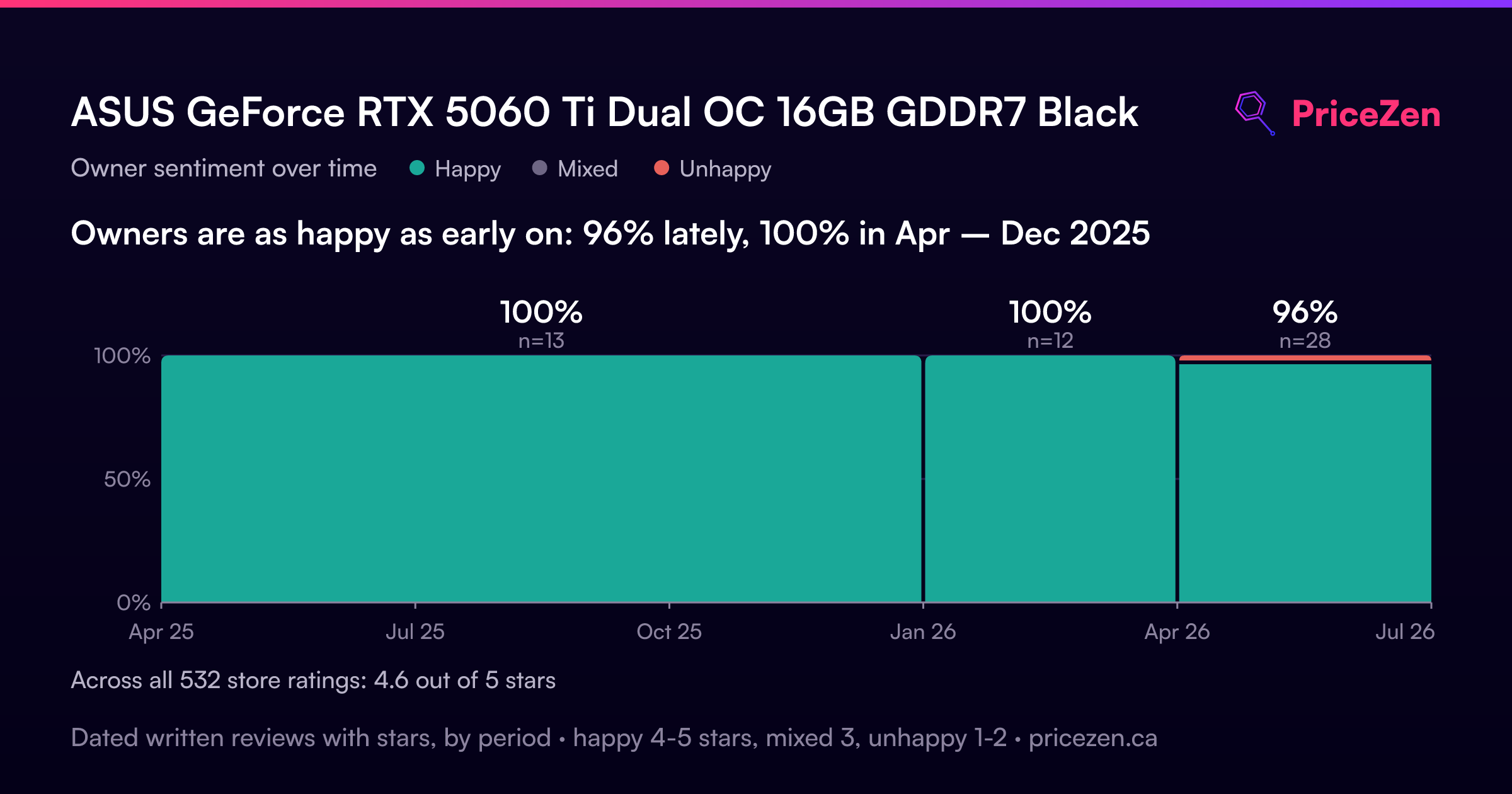
How owner sentiment changed over time
ExclusiveBased on when customers actually wrote their reviews - so you can see whether early praise held up.
Owners are as happy as early on: 96% lately, 100% in Apr – Dec 2025
Across all 532 store ratings: 4.6★. Most owners rate without writing a review. The chart counts the 53 written reviews with stars and their own date.
30 reviews from months with approximate dates (the day we first saw a review) are left out of the trend.
6 written reviews without stars are left out of the trend.
Show the numbers
| Period | Reviews | Happy | Mixed | Unhappy | Happy share |
|---|---|---|---|---|---|
| Apr – Dec 2025 | 13 | 13 | 0 | 0 | 100% |
| Jan – Mar 2026 | 12 | 12 | 0 | 0 | 100% |
| Apr – Jun 2026 | 28 | 27 | 0 | 1 | 96% |
- Apr – Jun 202627 of 28 happy · 2 without stars
Buyers praise this GPU for smooth 1440p gaming, AI workloads, and compact efficiency. Some mention it does not meet MSRP, but overall value and performance are well received.
- Great 1440p gaming performance with high frame rates (120-140 fps).
- Solid value for money, especially for its 16GB VRAM in AI/task workloads.
- Compact, efficient, and easy to install with good packaging.
- One reviewer notes the card is above MSRP, but others find it a good mid-range buy.
- Jan – Mar 202640 of 40 happy · 2 without stars
Buyers praised strong price-to-performance, quiet operation, and easy installation. A few reported driver issues or crashes, but most were satisfied with 1440p gaming and AI workloads.
- Excellent price-to-performance, great for 1440p gaming and AI tasks.
- Quiet, cool-running card with low power draw and simple 8-pin connector.
- Easy plug-and-play installation, but a few users needed DDU or BIOS tweaks.
- Some reports of random crashes, black screens, or instability requiring workarounds.
- Jul – Sep 20253 of 3 happy · 1 without stars
Buyers in Q3 2025 praised the RTX 5060 Ti for its price-to-performance, noting it's a great budget upgrade from older cards. They recommend the 16GB version and report no driver issues.
- Excellent value at MSRP, especially compared to higher-tier cards costing much more.
- Significant performance boost over older GPUs like GTX 1080 Ti and RTX 3050.
- Recommended to get the 16GB version over the 8GB for future-proofing.
- No driver issues reported with the latest September driver.
- Apr – Jun 20254 of 4 happy · 1 without stars
Buyers praise the 5060 Ti for excellent price-to-performance, strong overclocking headroom, and solid 1440p gaming. One reviewer notes it pairs well with lower-end CPUs thanks to AI features, while another reports good temps.
- Great price-to-performance, especially at MSRP $479, compared to higher-end 50 series cards.
- Exceptional overclocking headroom and stability, with one user reaching 3,000 MHz core clock.
- Solid 1440p performance and good temps, suitable as an entry-level card.
- AI features help compensate for lower-end CPUs, enabling high settings in demanding games.
Each column joins calendar quarters until it holds at least 10 reviews with stars and their own date. Happy = 4-5★, mixed = 3★, unhappy = 1-2★. Period summaries are in English.
The proof
Performance
The PassMark G3D score of 22,099 puts this card in the middle of the pack for current-gen GPUs, which is about what you'd expect from a 5060 Ti. In practice, that translates to comfortable 60+ fps at 1440p in most modern titles with high settings, and you can push into 4K territory if you're willing to lean on DLSS 4. The 19.18 TFLOPS of FP32 compute is respectable, but the 36th percentile compute ranking tells the real story: this is a gaming card first, not a productivity workhorse. If you're doing heavy rendering or AI training, the 767 AI TOPS sounds impressive on paper, but the 69th percentile AI ranking means there are better options in this price range for that kind of work.
The cooling story is where this card shines. Owners consistently report excellent temperatures under load, and the Axial-tech fan design with the barrier ring does exactly what ASUS claims. The 0dB technology means the fans stop entirely at low loads, so desktop use is silent. Under gaming load, noise stays low enough that you won't notice it over game audio. The 180W TDP is modest for this performance class, and the standard 8-pin power connector means no adapter headaches. Thermal performance lands at the 56th percentile, which is average on paper, but the real-world reports from owners suggest it runs cooler than that number implies.
Specifications
Full Specifications
Chipset
| GPU Chipset | GeForce RTX 5060 Ti |
| Brand | NVIDIA |
| Architecture | Blackwell |
| Class | consumer |
| Process | 5 |
Memory
| VRAM | 16 GB |
| Memory Type | GDDR7 |
| Memory Bus | 128 |
| Bandwidth | 448 |
| ECC | No |
Compute
| CUDA Cores | 4608 |
| Tensor Cores | 120 |
| RT Cores | 30 |
| Base Clock | 2602 |
| Boost Clock | 2632 |
| FP16 TFLOPS | 19.18 |
| FP32 TFLOPS | 19.18 |
Performance
| PassMark G3D | 22099 |
| GPU Compute | 10484 |
Power & Cooling
| TDP | 250 |
| Recommended PSU | 550 |
| Power Connectors | 1 x 8-pin |
| Cooler | Dual Fan |
| Fans | 2 |
Connectivity
| Interface | PCI Express 5.0 x8 |
| DisplayPort | 3 |
| HDMI | 1 |
| Max Displays | 4 |
| Max Resolution | 7680 x 4320 |
Physical
| Length | 229 |
| Slot Width | 2.5 |
| Form Factor | Full Height |
| Weight | 0.9 kg / 2.0 lbs |
Features
| Ray Tracing | Yes |
| Upscaling | DLSS 4 |
| AV1 Encode | Yes |
| VR Ready | Yes |
| DirectX | 12 Ultimate |
| RGB | No |
vs Competition
Against the MSI Ventus RTX 5070 Ti, the ASUS Dual 5060 Ti loses on raw performance but wins on efficiency and size. The 5070 Ti is a bigger, hotter, more power-hungry card that delivers noticeably higher frame rates, but it's also physically larger and typically more expensive. If you have a mid-tower with good airflow and want maximum frames per dollar, the MSI is the better buy. If you're building in a compact case and care about noise, the ASUS makes more sense.
The Gigabyte AERO RTX 5080 and ZOTAC APOCALYPSE RTX 5080 are in a completely different performance class, so comparing them directly isn't fair. Those cards are for 4K gaming and heavy productivity work. The Sapphire NITRO+ is an AMD option that competes more directly on price, and it's worth considering if you don't care about DLSS 4 or ray tracing performance. The PNY ARGB OC RTX 5080 is another step up in price and performance. The honest take: the ASUS Dual 5060 Ti's real competition is the RTX 5070 at MSRP, and right now the 5070 is often the smarter buy if you can find one at retail.
| Spec | ASUS GeForce RTX 5060 Ti Dual OC | Gigabyte GeForce RTX 5070 Ti Eagle Ice | MSI GeForce RTX 5070 Ti Ventus 3X OC | ZOTAC GeForce RTX 5080 APOCALYPSE | PNY GeForce RTX 5080 ARGB OC | Sapphire Radeon RX 9070 XT PULSE |
|---|---|---|---|---|---|---|
| Chipset | GeForce RTX 5060 Ti | GeForce RTX 5070 Ti | GeForce RTX 5070 Ti | GeForce RTX 5080 | GeForce RTX 5080 | Radeon RX 9070 XT |
| Vram | 16GB GDDR7 | 16GB GDDR7 | 16GB GDDR7 | 16GB GDDR7 | 16GB GDDR7 | 16GB GDDR6 |
| Boost Clock Mhz | 2632 | 2542 | 2482 | 2730 | 2620 | 2970 |
| Tdp W | 250 | 300 | 300 | 360 | 360 | 304 |
| Memory Bus Bits | 128 | 256 | 256 | 256 | 256 | 256 |
| Ray Tracing | true | true | true | true | true | true |
| GPU Class | consumer | consumer | consumer | consumer | consumer | consumer |
| Compare | Compare | Compare | Compare | Compare |
| Product | AI | Rt | Vram | Raster | Compute | Feature | Thermal | User Sentiment | Efficiency | Connectivity | Social Proof | Affordability |
|---|---|---|---|---|---|---|---|---|---|---|---|---|
| ASUS GeForce RTX 5060 Ti Dual OC | 68.7 | 64.9 | 83 | 56.4 | 51 | 89 | 55.4 | 45.3 | 44.7 | 94.1 | 83.8 | 46.4 |
| Gigabyte GeForce RTX 5070 Ti Eagle Ice Compare | 79.6 | 88.6 | 86 | 89 | 88.2 | 96 | 91.7 | 85.4 | 72.2 | 94.1 | 93.3 | 26.9 |
| MSI GeForce RTX 5070 Ti Ventus 3X OC Compare | 79.6 | 92.5 | 86 | 89 | 88.2 | 96 | 91.7 | 85.4 | 72.2 | 94.1 | 83.8 | 23.4 |
| ZOTAC GeForce RTX 5080 APOCALYPSE Compare | 85.7 | 97.5 | 89 | 94.5 | 93.5 | 96 | 91.7 | 99.5 | 57.1 | 94.1 | 98.7 | 20.4 |
| PNY GeForce RTX 5080 ARGB OC Compare | 85.7 | 97.5 | 89 | 94.5 | 93.5 | 96 | 91.7 | 45.3 | 57.1 | 94.1 | 74.8 | 14.5 |
| Sapphire Radeon RX 9070 XT PULSE Compare | 89.3 | 84.7 | 73.8 | 75.3 | 90.2 | 96 | 72.3 | 96 | 45.7 | 88.8 | 93.3 | 43.3 |
Price
Value & Pricing
At $840 USD, this card is in a weird spot. You're paying a premium over what the RTX 5060 Ti should cost, and that pushes it dangerously close to RTX 5070 territory. The 16GB of VRAM is the main justification for the price, and it's a legitimate one if you play games that eat VRAM like Cyberpunk 2077 with mods or Flight Simulator. But the 35th percentile affordability ranking in our database confirms what the price tag suggests: this is not a value play. If you can find it closer to $700, the math changes considerably. The MSI Ventus RTX 5070 Ti and other competitors in this range offer more raw performance for similar money, though you'll often sacrifice the compact form factor and quiet operation that make this ASUS card appealing.
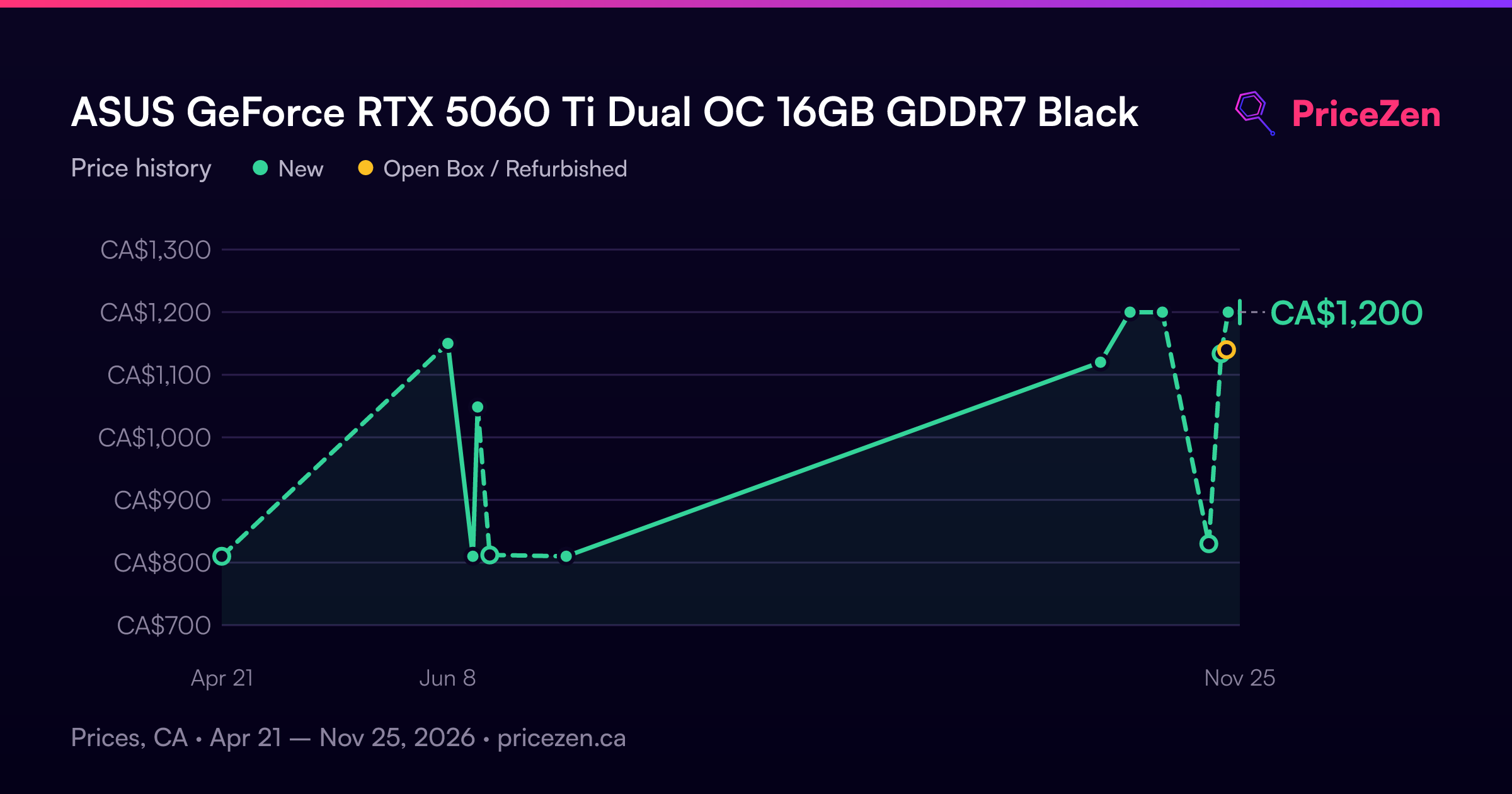
Amazon 1 offer From CA$1,200
Price history
Read more
Overview
The ASUS Dual GeForce RTX 5060 Ti OC Edition sits in that midrange sweet spot for 1440p gaming, and it's one of the more interesting Blackwell cards we've tested this cycle. You get 16GB of GDDR7 on a 128-bit bus, a 2632MHz boost clock in OC mode, and a 180W TDP that won't demand a PSU upgrade for most builds. At $840 USD, it's priced above what we'd call a budget card, but it's not trying to be one either. The Dual branding means ASUS focused on a compact 2.5-slot design with their Axial-tech fans, and that's a big part of why this card has been getting attention from small form factor builders.
Is the RTX 5060 Ti good for 1440p gaming? Based on our database, yes, with some caveats. The 16GB of VRAM is a genuine advantage over the 8GB cards in this class, and DLSS 4 does a lot of heavy lifting at higher resolutions. But the 128-bit memory bus is the elephant in the room. It's narrow for a card with this much VRAM, and that shows up in bandwidth-sensitive workloads. For pure rasterization, this card lands at the 57th percentile in our database, which is solid but not spectacular. The efficiency story is better, at the 86th percentile, which tells you ASUS and NVIDIA tuned this thing to sip power rather than chase benchmark glory.
What people search for with this card usually comes down to one question: is it worth the money over a used RTX 4070 Super or a discounted RTX 5070? The answer depends on whether you value the 16GB of VRAM and DLSS 4 support over raw raster performance. We'll dig into that below.
Common Questions
Q: Is the RTX 5060 Ti good for 1440p gaming?
Yes, the RTX 5060 Ti handles 1440p gaming well, especially with 16GB of VRAM and DLSS 4 support. You can expect 60+ fps in most modern titles at high settings.
Q: How does the RTX 5060 Ti compare to the RTX 5070?
The RTX 5070 offers noticeably better raw performance, but the 5060 Ti is more efficient and often available in smaller form factors. At current pricing, the 5070 is often the better value if you can find one at MSRP.
Q: Does the ASUS Dual RTX 5060 Ti fit in small form factor cases?
Yes, the 2.5-slot design and compact dimensions make it a good fit for many SFF cases. Just check your case clearance, as some owners note it's still a fairly large card.
Q: What power supply do I need for the RTX 5060 Ti?
ASUS recommends a 300W PSU minimum, and the card uses a standard 8-pin power connector. A quality 500-600W unit gives you comfortable headroom for the rest of your system.
Who Should Skip This
Skip this card if you're doing heavy productivity work like video rendering, 3D modeling, or AI training. The 36th percentile compute ranking and 51.9 workstation score mean it'll feel sluggish in those workloads compared to similarly priced alternatives. Also skip it if you're a value-focused buyer with a standard ATX case, since the $840 price tag buys you more raw performance elsewhere. If you don't care about DLSS 4 or ray tracing, AMD options like the Sapphire NITRO+ offer competitive raster performance at better prices. And if you're gaming at 4K natively without upscaling, this card will struggle, so look at the RTX 5070 Ti or higher instead.
Verdict
Should you buy the ASUS Dual RTX 5060 Ti OC Edition? If you're building a small form factor PC and want a quiet, cool, efficient card with 16GB of VRAM and DLSS 4 support, this is one of the best options available right now. The compact design, standard power connector, and excellent thermal performance make it a genuinely great fit for ITX builds. Owners are happy with it, and the 4.5-star rating across 206 reviews backs that up.
But if you have a standard ATX case and you're just looking for the most frames per dollar at 1440p, this card is harder to recommend at $840. The narrow memory bus and average raster performance mean you're paying a premium for the form factor and efficiency rather than raw speed. Wait for a price drop, or look at the RTX 5070 instead. This is a good card, but it's not a great deal at current pricing.
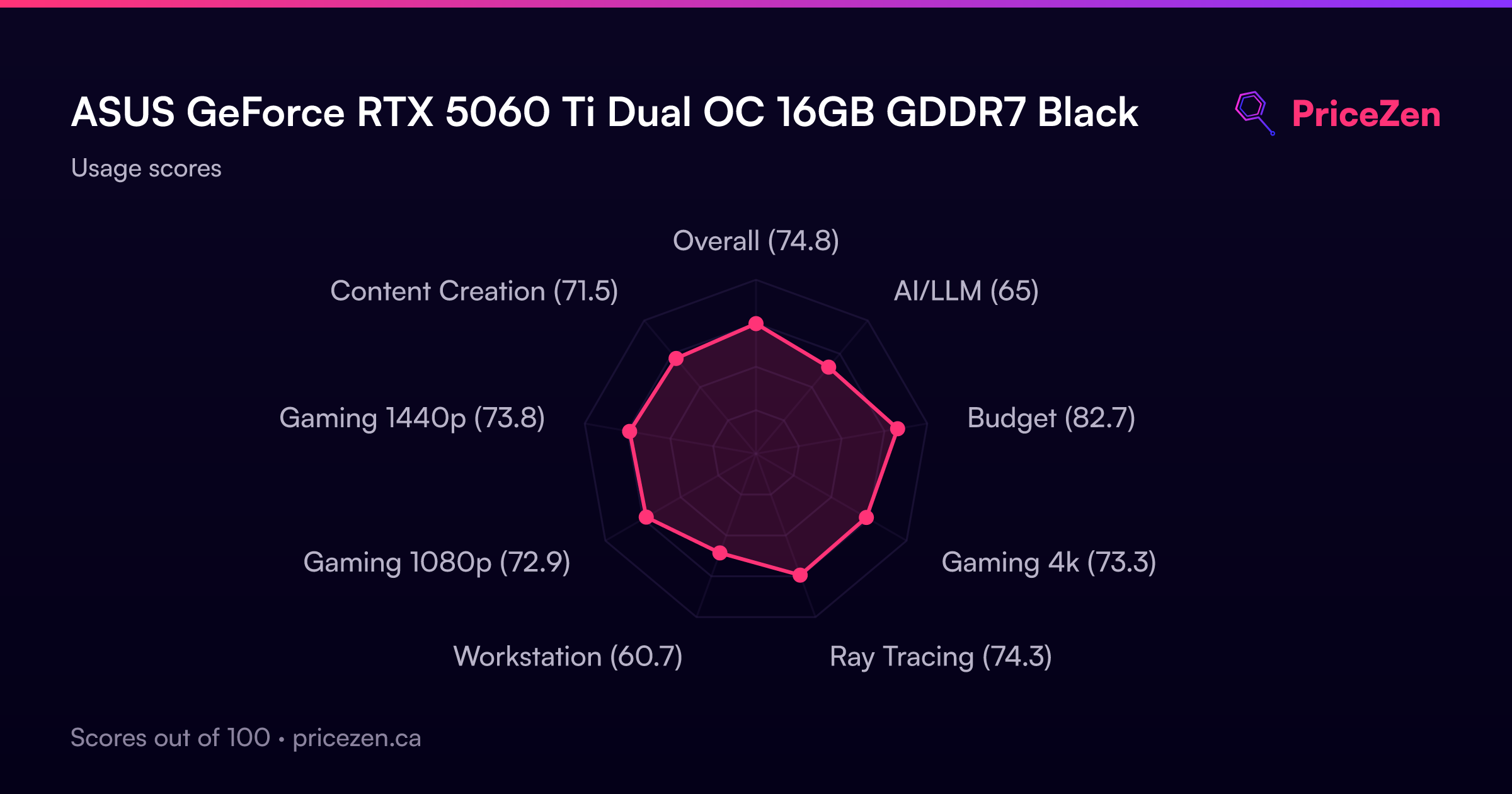
Usage Scores
- Overall74.8
- AI/LLM65
- Budget82.7
- Gaming 4k73.3
- Ray Tracing74.3
- Workstation60.7
- Gaming 1080p72.9
- Gaming 1440p73.8
- Content Creation71.5