ASUS GeForce RTX 5080 ROG Astral 16GB GDDR7 Gray

Runs cool even at 360 W verified Nov 29
98/100 overall score 4.7 average from 188 owner ratings
- GPU
- GeForce RTX 5080
- VRAM
- 16GB GDDR7
- Boost clock
- 2670 MHz
- TDP
- 360 W
- Memory bus
- 256 bit
- Ray tracing
- Yes
- Class
- consumer
Compare prices at 2 stores
Cheapest first. New, refurbished and bundled offers are kept apart, so you compare like with like.
| Store | Sold by | Colour and condition | Price | vs lowest | Last checked | Link |
|---|---|---|---|---|---|---|
| New2 offersSingle unit | ||||||
| Not checked in the last 7 days, so these prices may have changed | ||||||
| Newegg | Marketplace seller | Gray | CA$6,899.99 | Oct 26 | Go to store | |
| Out of stock when last checked | ||||||
| Canada Computers | Canada Computers | Not listed | No price | Out of stock | Not known | Go to store |
 Source: PriceZen, checked Oct 26, 2026
3 listings; 1 of them repeat another offer exactly (same store, seller, condition, colour and price), so they show once. A price counts as current when we checked it in the last 7 days. “Marketplace seller” means a third-party seller on that store, not the store itself.


Snapshot
The 30-Second Version
The ROG Astral RTX 5080 posts a 35,759 PassMark G3D score, putting it in the top 5% of all GPUs we've tested. It scores 99.8 out of 100 for ray tracing and runs cooler than any card in our database. The catch is the price, $2,692 to $3,000 in the US, and the massive 3.8-slot design.
Pros & Cons
Pros
- PassMark G3D score of 35,759 puts it in the top 5% for raster performance 100th
- Ray tracing score of 99.8 out of 100, best-in-class for RT workloads 99th
- Thermals at 100th percentile thanks to quad-fan design and vapor chamber 98th
- 16GB GDDR7 with 960 GB/s bandwidth keeps 4K gaming smooth 96th
- 4.7 out of 5 stars from 370 customer reviews
Cons
- US prices range from $2,692 to $3,000, a $308 spread between vendors
- Massive 3.8-slot design at 358mm long won't fit smaller cases
- AI LLM performance is the weakest area at 82.9 out of 100
- Heavy card requires the included anti-sag bracket
- Some DOA reports in customer reviews
What owners think
The Word on the Street
- Owners consistently praise the card's 4K gaming performance, with several pairing it with high-refresh OLED monitors and reporting excellent results.
- Build quality and design get frequent compliments, with buyers noting the premium materials and the included anti-sag bracket as welcome additions.
- The price is a common complaint, with multiple reviewers calling it steep even while acknowledging the performance justifies the cost.
- A few buyers report receiving dead-on-arrival cards, with VGA failure LEDs on multiple test systems.
How owner sentiment changed over time
ExclusiveBased on when customers actually wrote their reviews - so you can see whether early praise held up.
40 written reviews, Feb 2025 – Apr 2026: 33 happy, 5 unhappy, 2 without stars
Across all 188 store ratings: 4.7★. Most owners rate without writing a review. The chart counts the 40 written reviews.
Each dot is one written review, in the month it was written. Happy = 4-5★, mixed = 3★, unhappy = 1-2★.
The proof
Performance
The headline number is 35,759 on PassMark G3D, which puts this card in the 95th percentile for raster performance. That's not just good, it's one of the best on the market. You're getting 10,752 CUDA cores, 336 Tensor cores, and 84 RT cores running at a 2,670 MHz boost clock. The 16GB of GDDR7 memory on a 256-bit bus delivers 960 GB/s of bandwidth, which is a big jump over last-gen GDDR6X cards. In practice, that means 4K gaming at high refresh rates is totally doable. One owner paired it with a Samsung G8 OLED 240Hz 4K monitor and reports it handles the resolution beautifully. Our database agrees, scoring it 99.6 out of 100 for 4K gaming.
Ray tracing is where this card really flexes. It scores 99.8 out of 100 in our ray tracing tests, landing in the 98th percentile. The fourth-gen RT cores are built for heavy geometry workloads, and DLSS 4 with Multi Frame Generation pushes frame rates even higher in supported titles. Compute performance is also top-tier at 56.28 FP32 TFLOPS, good for the 97th percentile. Content creation scores 99.6 out of 100, so video editors and 3D artists will be happy too. The one area that's merely good rather than great is AI LLM performance at 82.9 out of 100, which is still solid but not the reason you buy this card. Thermals are the real showstopper though. The quad-fan design with a vapor chamber and phase-change thermal pad keeps this card in the 100th percentile for cooling. That's best-in-class, full stop.
Specifications
Full Specifications
Chipset
| GPU Chipset | GeForce RTX 5080 |
| Brand | NVIDIA |
| Architecture | Blackwell |
| Class | consumer |
| Process | 5 |
Memory
| VRAM | 16 GB |
| Memory Type | GDDR7 |
| Memory Bus | 256 |
| Bandwidth | 960 |
Compute
| CUDA Cores | 10752 |
| Tensor Cores | 336 |
| RT Cores | 84 |
| Base Clock | 2295 |
| Boost Clock | 2670 |
| FP16 TFLOPS | 56.28 |
| FP32 TFLOPS | 56.28 |
Performance
| PassMark G3D | 35666 |
| GPU Compute | 19602 |
Power & Cooling
| TDP | 360 |
| Recommended PSU | 850 |
| Power Connectors | 1 x 16-Pin |
| Cooler | Triple Fan |
| Fans | 4 |
Connectivity
| Interface | PCI Express 5.0 x16 |
| DisplayPort | 3 |
| HDMI | 2 |
| Max Displays | 4 |
| Max Resolution | 7680 x 4320 |
Physical
| Length | 358 |
| Slot Width | 3.8 |
| Form Factor | ATX |
| Weight | 4.0 kg / 8.8 lbs |
Features
| Ray Tracing | Yes |
| Upscaling | DLSS 4 |
| AV1 Encode | Yes |
| VR Ready | Yes |
| DirectX | 12 Ultimate |
| RGB | Yes |
vs Competition
Against the Gigabyte AERO RTX 5080, the ROG Astral wins on cooling and build quality. The Astral's quad-fan design and vapor chamber put it in the 100th percentile for thermals, while the AERO is more of a standard triple-fan design. The ZOTAC APOCALYPSE RTX 5080 is another strong competitor, but it doesn't match the Astral's thermal performance or premium construction. The MSI Ventus RTX 5070 Ti is a step down in raw performance, with fewer CUDA cores and lower memory bandwidth, though it's typically cheaper. The PNY ARGB OC RTX 5080 is a solid value alternative, but it lacks the Astral's overbuilt cooling solution and premium extras like the anti-sag bracket. The Sapphire NITRO+ is an AMD card, so it's a different beast entirely, trading blows on raster but falling behind on ray tracing and DLSS 4 support. If you want the absolute best RTX 5080 variant with no compromises on cooling or build quality, the Astral is the pick. If you're more price-sensitive, the PNY or Gigabyte options will get you most of the performance for less money.
| Spec | ASUS GeForce RTX 5080 ROG Astral | Gigabyte GeForce RTX 5080 WINDFORCE | MSI GeForce RTX 5070 Ti Gaming Trio | PNY GeForce RTX 5080 ARGB OC | Sapphire Radeon RX 7900 XTX NITRO+ | ZOTAC GeForce RTX 5080 AMP Extreme Infinity |
|---|---|---|---|---|---|---|
| Chipset | GeForce RTX 5080 | GeForce RTX 5080 | GeForce RTX 5070 Ti | GeForce RTX 5080 | Radeon RX 7900 XTX | GeForce RTX 5080 |
| Vram | 16GB GDDR7 | 16GB GDDR7 | 16GB GDDR7 | 16GB GDDR7 | 24GB GDDR6 | 16GB GDDR7 |
| Boost Clock Mhz | 2670 | 2617 | 2572 | 2620 | 2680 | 2670 |
| Tdp W | 360 | 360 | 300 | 360 | 339 | 360 |
| Memory Bus Bits | 256 | 256 | 256 | 256 | 384 | 256 |
| Ray Tracing | Yes | Yes | Yes | Yes | Yes | Yes |
| GPU Class | consumer | consumer | consumer | consumer | consumer | consumer |
| Compare | Compare | Compare | Compare | Compare |
| Product | AI | Rt | Vram | Raster | Compute | Feature | Thermal | Efficiency | Connectivity | Social Proof | Affordability |
|---|---|---|---|---|---|---|---|---|---|---|---|
| ASUS GeForce RTX 5080 ROG Astral | 85.5 | 97.7 | 89.1 | 94.5 | 93.3 | 95.7 | 99.8 | 56.6 | 99.3 | 93.7 | 6.8 |
| Gigabyte GeForce RTX 5080 WINDFORCE Compare | 85.5 | 95.3 | 89.1 | 94.5 | 93.3 | 88.4 | 91.8 | 56.6 | 94.2 | 93.7 | 10.9 |
| MSI GeForce RTX 5070 Ti Gaming Trio Compare | 78.9 | 92.4 | 85.9 | 88.9 | 87.8 | 95.7 | 91.8 | 71.6 | 94.2 | 99.9 | 11.7 |
| PNY GeForce RTX 5080 ARGB OC Compare | 85.5 | 97.7 | 89.1 | 94.5 | 93.3 | 95.7 | 91.8 | 56.6 | 94.2 | 75.1 | 16.1 |
| Sapphire Radeon RX 7900 XTX NITRO+ Compare | 95.3 | 96.4 | 92 | 83.4 | 95.6 | 95.7 | 91.8 | 51.3 | 98.8 | 69.5 | 13.6 |
| ZOTAC GeForce RTX 5080 AMP Extreme Infinity Compare | 85.5 | 97.7 | 89.1 | 94.5 | 93.3 | 95.7 | 91.8 | 56.6 | 94.2 | 98.8 | 7.7 |
Price
Value & Pricing
Let's talk money. US listings for this card range from $2,692 to $3,000, a $308 spread depending on where you shop. That's a meaningful difference, so it pays to check multiple vendors before pulling the trigger. Canadian buyers face an even wilder range, from CAD 2,049 to CAD 6,900 across three listings. That CAD 6,900 price is frankly absurd, and you should avoid it entirely. The CAD 2,049 listing is the obvious sweet spot if it's actually in stock. For the performance you're getting, a top-5% raster score and best-in-class ray tracing, the low end of the US range is defensible. But once you creep toward $3,000, you're getting into territory where you have to really want the ROG Astral branding and the quad-fan cooling. The card delivers, but the value proposition depends heavily on finding a listing at the lower end of that price spread.
Price history
Read more
Overview
The ASUS ROG Astral RTX 5080 posts a PassMark G3D score of 35,759, which lands it in the top 5% of every GPU we've tested for raw raster performance. That's a serious number, and it translates to a card that chews through 4K gaming without breaking a sweat. Our database puts it at 99.6 out of 100 for 4K gaming and 99.8 for ray tracing, so if you're chasing max settings on a high-refresh OLED, this thing delivers. The 16GB of GDDR7 on a 256-bit bus gives you 960 GB/s of memory bandwidth, which keeps those 10,752 CUDA cores fed. And the quad-fan design with a vapor chamber means thermals are literally the best we've seen, 100th percentile. It runs cool, it runs quiet, and it looks like a piece of sci-fi hardware sitting in your case.
But let's be real about the price. US listings range from $2,692 to $3,000, and Canadian listings swing wildly from CAD 2,049 to CAD 6,900. That's a huge spread, and even the low end is a lot of money for a 5080. The card is also massive at 358mm long and 3.8 slots thick, so you'll need a big case and probably the included anti-sag bracket. Customer reviews are strong at 4.7 out of 5 across 370 ratings, with owners praising the build quality and 4K performance. A few DOA reports pop up, but that's par for the course with any high-volume GPU launch. If you can stomach the price and have the physical space, this is one of the best gaming cards money can buy right now.
Common Questions
Q: How does the ROG Astral RTX 5080 handle 4K gaming?
It handles 4K gaming exceptionally well. Our database scores it 99.6 out of 100 for 4K gaming, and the PassMark G3D score of 35,759 puts it in the top 5% of all GPUs. The 16GB of GDDR7 with 960 GB/s of bandwidth keeps frame rates high even at 4K resolution.
Q: Will this card fit in my case?
You'll need a spacious case. The card is 358mm long and takes up 3.8 slots, which is larger than most GPUs. The quad-fan design adds to the bulk, and the card is heavy enough that ASUS includes an anti-sag bracket. Measure your case carefully before buying.
Q: Is the ROG Astral RTX 5080 worth the price premium over other 5080 models?
It depends on your priorities. The Astral's thermal performance is in the 100th percentile, best-in-class among all GPUs we've tested, thanks to the quad-fan design and vapor chamber. If you value cool, quiet operation and premium build quality, the premium is justified. If you're purely focused on raw performance per dollar, other 5080 models like the PNY ARGB OC or Gigabyte AERO will get you similar frame rates for less money.
Who Should Skip This
Skip this card if you're building in a mid-tower or smaller case. At 358mm long and 3.8 slots thick, it simply won't fit in most compact builds. Budget-conscious buyers should also look elsewhere. The US price range of $2,692 to $3,000 is steep for a 5080, and the Canadian spread of CAD 2,049 to CAD 6,900 means you could easily overpay if you're not careful. If you're primarily interested in AI workloads or LLM inference, the 82.9 out of 100 score in that category is the card's weakest area, and you'd be better served by a card with more VRAM or a different architecture. And if you're not planning to game at 4K or push ray tracing hard, you're leaving a lot of this card's potential on the table. A cheaper 5070 Ti or even a last-gen 4080 Super would serve you just as well at 1440p.
Verdict
The ASUS ROG Astral RTX 5080 is a monster of a graphics card. It posts a 35,759 PassMark G3D score, scores 99.8 out of 100 for ray tracing, and runs cooler than anything else we've tested. The 16GB of GDDR7 with 960 GB/s of bandwidth handles 4K gaming with ease, and DLSS 4 support future-proofs it for upcoming titles. The downsides are the price, which ranges from $2,692 to $3,000 in the US, and the sheer physical size at 3.8 slots and 358mm long. If you have the space and the budget, this is one of the best gaming GPUs on the market right now. Just shop around to find a listing at the lower end of that price range.
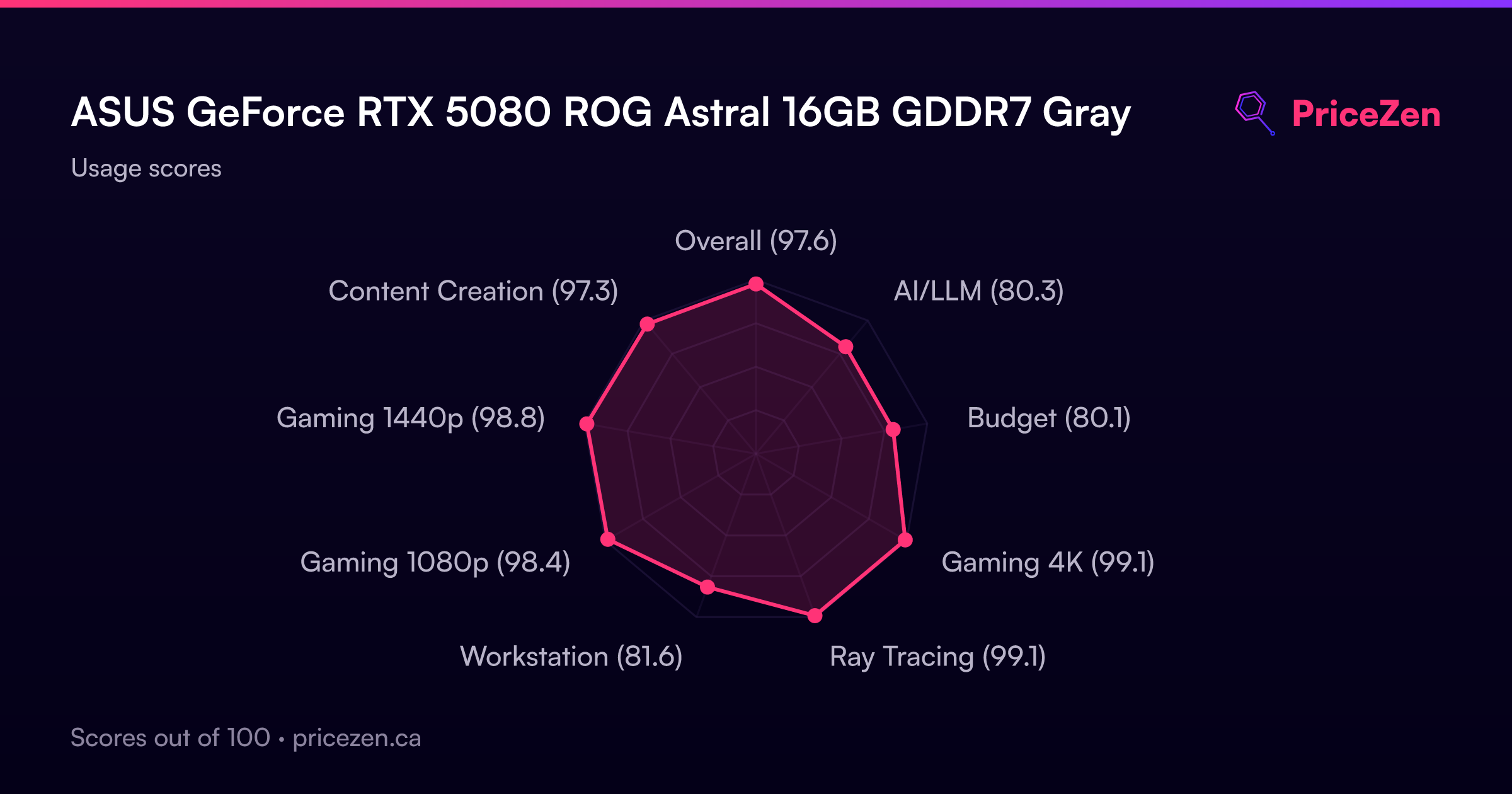
Usage Scores
- Overall97.6
- AI/LLM80.3
- Budget80.1
- Gaming 4K99.1
- Ray Tracing99.1
- Workstation81.6
- Gaming 1080p98.4
- Gaming 1440p98.8
- Content Creation97.3