Yanmis Radeon RX 580 8GB GDDR5

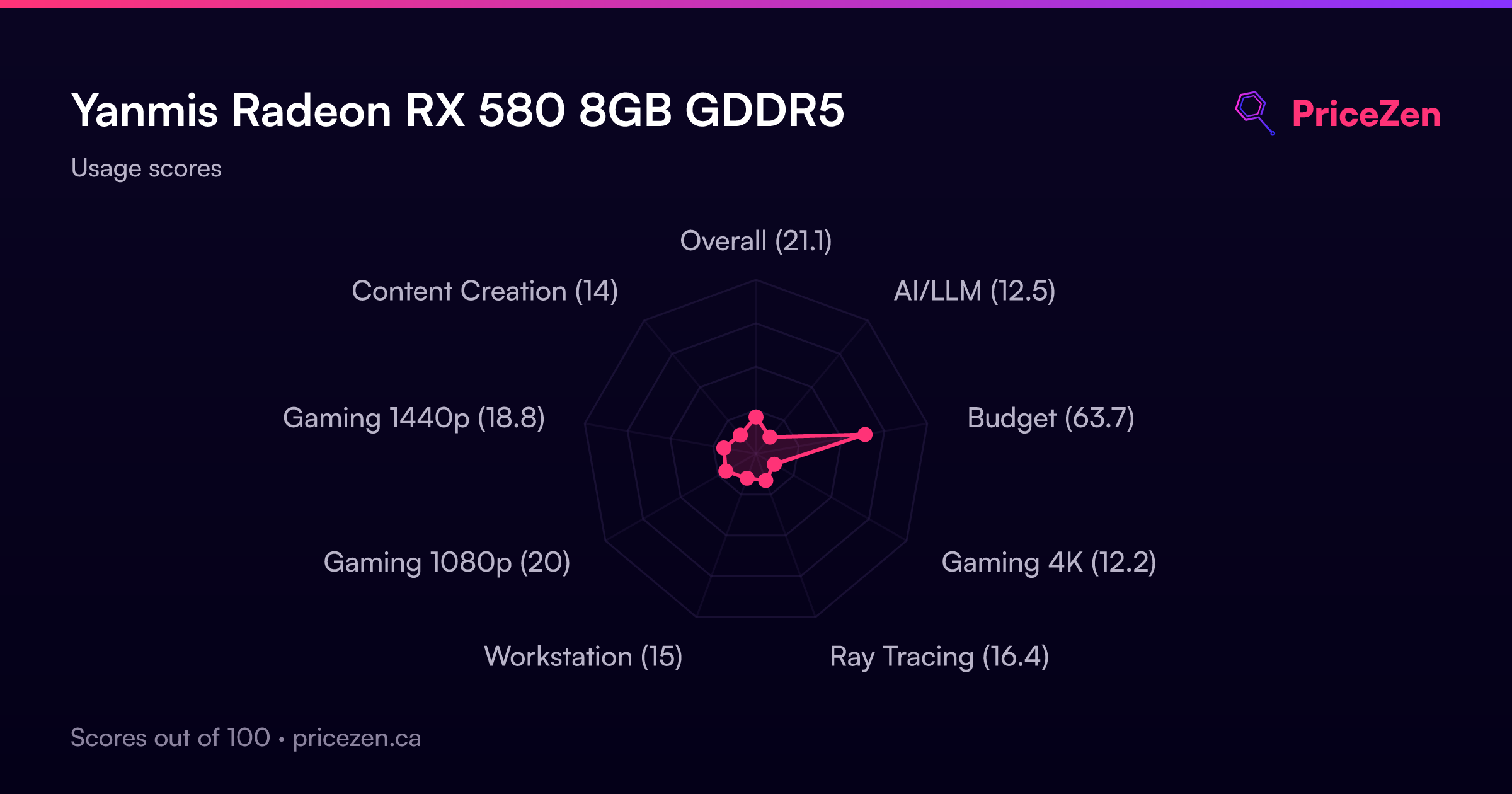
21/100 overall score
Close to the usual price of CA$191.46.
90-day low CA$189.63Usual and high CA$191.46
Price over the last 90 days: low CA$189.63 on Nov 14, high CA$191.46. Usual price CA$191.46. Today CA$191.34.
- GPU
- Radeon RX 580
- VRAM
- 8GB GDDR5
- TDP
- 185 W
- Memory bus
- 256 bit
- Class
- consumer
Compare prices at 1 store
Cheapest first. New, refurbished and bundled offers are kept apart, so you compare like with like.
| Store | Sold by | Colour and condition | Price | vs lowest | Last checked | Link |
|---|---|---|---|---|---|---|
| New1 offerSingle unit | ||||||
| Amazon | Marketplace seller | Not listed | CA$191.34 | Lowest price | 3 days ago | Go to store |
 Source: PriceZen, checked Nov 26, 2026
A price counts as current when we checked it in the last 7 days. “Marketplace seller” means a third-party seller on that store, not the store itself.
Price history
CA$191.34 is CA$0.12 under the usual store price, and only CA$1.71 above its 90-day low.
Checked that dayNot checked that day, still on offer
Source: PriceZen, checked Nov 26, 2026











Snapshot
The 30-Second Version
The Yanmis RX 580 is a rebadged 2017-era GPU with 8GB of GDDR5 and a PassMark score of 8788. It's fine for office work, media playback, and light video editing, but gaming performance is weak by today's standards. At $173 USD, you're paying for the 'new in box' factor from a brand nobody knows. Buy it for productivity, skip it for gaming.
Pros & Cons
Pros
- 8GB GDDR5 on a 256-bit bus is generous for the price 84th
- PassMark score of 8788 handles office and media work easily
- Supports up to 7680x4320 output for high-res productivity displays
- Dual-fan cooler keeps things quieter than blower-style alternatives
- Plug and play with Windows 10, 11, Vista, and Linux
Cons
- 185W TDP is thirsty for the performance you get
- Gaming performance is weak by modern standards, 21.8/100 for 1080p
- Unknown brand with questionable warranty and support
- Requires a 600W PSU, which is overkill for a card this old
- No modern features like ray tracing or DLSS support
The proof
Performance
Let's talk numbers. The PassMark G3D score sits at 8788, which puts it in the bottom quarter of cards in our database for raw raster performance. That's not surprising for a 2017-era GPU, but it's worth being clear about what this means. You're not running Cyberpunk at high settings. You're not even running it at medium settings, probably. What you are getting is a card that handles desktop work, video playback, and older or lighter titles without breaking a sweat.
The core clock of 1284MHz and memory clock of 7000MHz are right in line with reference RX 580 specs. Nothing overclocked, nothing cut down. The 256-bit memory bus is actually a nice thing to see at this price point. It means the 8GB of VRAM can actually be fed properly, which helps with high-resolution displays and multi-monitor setups. The card supports up to 7680x4320 output, so if you're driving a 4K monitor for productivity work, it'll do the job. Just don't expect to game at that resolution. The gaming_4k score of 13.2 out of 100 tells you everything you need to know there.
Specifications
Full Specifications
Chipset
| GPU Chipset | Radeon RX 580 |
| Brand | AMD |
| Class | consumer |
Memory
| VRAM | 8 GB |
| Memory Type | GDDR5 |
| Memory Bus | 256 |
Compute
| Stream Processors | 2048 |
| Base Clock | 1284 |
Performance
| PassMark G3D | 8788 |
| GPU Compute | 3438 |
Power & Cooling
| TDP | 185 |
| Recommended PSU | 600 |
| Power Connectors | 6pin or 8pin |
| Cooler | Fan |
| Fans | 2 |
Connectivity
| Interface | PCI Express 3.0 x16 |
| DisplayPort | 3 |
| HDMI | 1 |
| Max Resolution | 7680 x 4320 |
Physical
| Weight | 0.9 kg / 2.0 lbs |
Features
| DirectX | 12 |
vs Competition
The Sapphire PULSE 11325-04CPO is the natural comparison here. Same chip, same memory, but from a brand that actually has a reputation for building decent AMD cards. The Sapphire card typically runs cooler and quieter, and you know you can get driver support and warranty service if something goes wrong. The Yanmis card undercuts it on price, but you're rolling the dice on quality control.
Then there's the MSI Ventus G5060-8V3C and the ASUS Dual DUAL-RX9060XT-16G. These are newer cards with much better performance, but they also cost significantly more. If you're building a gaming rig, the extra money is worth it. The RX 580 is a 1080p card from another era, and even at 1080p it struggles with anything released in the last few years. The Gigabyte Vision GV-N3080VISION OC-10GD is in a completely different league, but it's also in a completely different price bracket. The point is, this Yanmis card only makes sense if your budget is hard-capped and you need something new, not used.
| Spec | Yanmis Radeon RX 580 | Sapphire Radeon RX 7900 GRE PULSE | ASUS Radeon RX 9060 XT Dual | XFX Radeon RX 7800 XT SPEEDSTER QICK319 | Gigabyte GeForce RTX 3080 Vision OC | MSI GeForce RTX 5060 SHADOW |
|---|---|---|---|---|---|---|
| Chipset | Radeon RX 580 | Radeon RX 7900 GRE | Radeon RX 9060 XT | Radeon RX 7800 XT | GeForce RTX 3080 | GeForce RTX 5060 |
| Vram | 8GB GDDR5 | 16GB GDDR6 | 16GB GDDR6 | 16GB GDDR6 | 10GB GDDR6X | 8GB GDDR7 |
| Boost Clock Mhz | - | 2290 | 3250 | 2430 | 1800 | 2527 |
| Tdp W | 185 | 268 | 140 | 236 | 320 | 145 |
| Memory Bus Bits | 256 | 256 | 128 | 256 | 320 | 128 |
| Ray Tracing | - | Yes | Yes | Yes | Yes | Yes |
| GPU Class | consumer | consumer | consumer | consumer | consumer | consumer |
| Compare | Compare | Compare | Compare | Compare |
| Product | AI | Rt | Vram | Raster | Compute | Feature | Thermal | Efficiency | Connectivity | Social Proof | Affordability |
|---|---|---|---|---|---|---|---|---|---|---|---|
| Yanmis Radeon RX 580 | 25.4 | 18.7 | 22 | 19.3 | 13.2 | 10.5 | 30.9 | 15.6 | 32.8 | 20.3 | 84.3 |
| Sapphire Radeon RX 7900 GRE PULSE Compare | 88.7 | 89.8 | 71.5 | 76.7 | 90.3 | 71.4 | 71.8 | 63.9 | 85.9 | 0 | 58.2 |
| ASUS Radeon RX 9060 XT Dual Compare | 75.2 | 55.2 | 68.3 | 44.8 | 57.3 | 88.4 | 54.2 | 92.6 | 75.3 | 93.7 | 61 |
| XFX Radeon RX 7800 XT SPEEDSTER QICK319 Compare | 82.9 | 78.3 | 72.4 | 63.1 | 80.3 | 88.4 | 71.8 | 64.8 | 87.3 | 78.5 | 57.9 |
| Gigabyte GeForce RTX 3080 Vision OC Compare | 51.7 | 74.6 | 54.7 | 64.8 | 74.7 | 77.7 | 91.8 | 30.7 | 63.6 | 54.7 | 49.2 |
| MSI GeForce RTX 5060 SHADOW Compare | 39.1 | 58.6 | 46.1 | 49.4 | 45.8 | 88.4 | 54.2 | 95.3 | 94.2 | 93.7 | 62.2 |
Price
Value & Pricing
At $173 USD, this card is in a weird spot. It's cheap, but it's not that cheap. You can find used RX 580s from reputable brands like Sapphire or XFX for less on the secondhand market, and those come with a known track record. The CAD price of $190 and INR price of 29,139 tell a similar story. You're paying a small premium for the 'new in box' factor, and whether that's worth it depends on how much you value a warranty that may or may not actually exist.
The affordability percentile of 87 is the one bright spot in the rankings. This card is genuinely more affordable than most of what's out there. But affordability only matters if the product does what you need. For office work and media, it's a solid deal. For gaming, you're better off saving a bit more or looking at the used market.
Read more
Overview
The Yanmis RX 580 is one of those cards that shows up on Amazon with a name that looks like someone fell asleep on the keyboard. Yanmisng2g40sdve-11. Try saying that three times fast. Underneath the alphabet soup, though, is a familiar chip: the Polaris-based Radeon RX 580 with 8GB of GDDR5 and 2048 stream processors. This is a card that was a budget darling back in 2017, and now it's resurfacing through a no-name brand at a price that's hard to ignore.
Who is this for? Honestly, it's for people who need a working GPU without spending real money. Office machines, media PCs, light video editing rigs, maybe some older games at 1080p. The 8GB framebuffer is the main draw here. A lot of cards in this price range give you 4GB, and that extra VRAM matters if you're juggling multiple displays or working with larger video files.
The catch is that you're buying from a brand with basically zero track record. The cooler looks like a generic dual-fan design, the PCB is described as 'stable' which is not exactly a spec, and the warranty situation is anyone's guess. But if you know what you're getting into, there's a case to be made for this thing as a cheap workhorse.
Common Questions
Q: Can this card run modern games at 1080p?
It depends on the game. The RX 580 was a solid 1080p card in 2017, but modern titles have moved on. With a PassMark score of 8788 and a 1080p gaming score of 21.8 out of 100, you'll be running most newer games at low settings to hit playable framerates. Older games and esports titles like CS:GO, League of Legends, and Overwatch will run fine, but don't expect much from AAA releases from the last few years.
Q: What power supply do I need for this card?
The card has a 185W TDP and requires either a 6-pin or 8-pin PCIe power connector. The manufacturer recommends a 600W or higher power supply, which is honestly more than the card actually needs. A quality 450-500W unit would handle it fine in most systems, but if you're running a power-hungry CPU or lots of drives, the 600W recommendation gives you headroom.
Q: Is this card good for video editing?
For basic video editing and production work, the 8GB of GDDR5 on a 256-bit bus is actually helpful. You'll have enough VRAM for 1080p and even some 4K timelines in lighter projects. The card supports DirectX 12 and works with Windows 10, Windows 11, and Linux. Just keep expectations realistic. This isn't a workstation card, and heavy effects work or high-bitrate 4K editing will push it hard.
Q: Does this card support multiple monitors?
Yes, and that's one of its stronger points. You get three DisplayPort outputs, one HDMI, and one DVI, so running three or four monitors is straightforward. The card supports resolutions up to 7680x4320, so even 4K displays will work for productivity tasks. Just remember that gaming across multiple monitors or at 4K is not realistic with this GPU.
Who Should Skip This
If you're building a gaming PC, skip this. The 1080p gaming score of 21.8 out of 100 is a clear signal that this card is not meant for modern games. You'd be better off with a used GTX 1660 Super, an RTX 3050, or even a used RX 6600 if you can stretch the budget. Those cards will run circles around the RX 580 in every gaming scenario.
Also skip this if you care about warranty and support. Yanmis is not a brand with a track record, and when a card fails, you want a company that will actually answer an email. Sapphire, XFX, MSI, and ASUS all have established RMA processes. With a no-name brand, you're essentially buying a card with no safety net. For a few dollars more, or even the same price on the used market, you can get a card from a company that will still exist next year.
Verdict
If you're building an office PC or a media center and you need a cheap GPU with plenty of video outputs, this card does the job. Three DisplayPort connections plus HDMI and DVI means you can run a multi-monitor setup without adapters. The 8GB of VRAM is plenty for desktop work, and the dual-fan cooler should keep noise levels reasonable.
For gaming, look elsewhere. The 1080p gaming score of 21.8 out of 100 is rough. You'll be turning settings down to low on anything modern, and even then you're looking at sub-60fps in a lot of titles. If gaming is your goal, save up for something newer or hunt down a used card from a brand you've actually heard of.
Usage Scores
- Overall21.1
- AI/LLM12.5
- Budget63.7
- Gaming 4K12.2
- Ray Tracing16.4
- Workstation15
- Gaming 1080p20
- Gaming 1440p18.8
- Content Creation14