Zopsc GF119 1GB DDR3

11/100 overall score 4.5 average from 18 owner ratings
CA$7.81 above the usual price of CA$62.96.
90-day low CA$62.96Usual CA$62.96High CA$89.50
90-day low CA$62.96Usual CA$62.96High CA$89.50
Price over the last 90 days: low CA$62.96 on Sep 1, high CA$89.50. Usual price CA$62.96. Today CA$70.77.
- GPU
- GF119
- VRAM
- 1GB DDR3
- Boost clock
- 810 MHz
- Memory bus
- 64 bit
- Class
- consumer
Compare prices at 1 store
Cheapest first. New, refurbished and bundled offers are kept apart, so you compare like with like.
| Store | Sold by | Colour and condition | Price | vs lowest | Last checked | Link |
|---|---|---|---|---|---|---|
| New1 offerSingle unit | ||||||
| Amazon | Marketplace seller | Not listed | CA$70.77 | Lowest price | Yesterday | Go to store |
 Source: PriceZen, checked Nov 28, 2026
A price counts as current when we checked it in the last 7 days. “Marketplace seller” means a third-party seller on that store, not the store itself.
Price history
The usual store price is CA$62.96, and the lowest price in the last 90 days was CA$62.96.
Checked that dayNot checked that day, still on offer
Source: PriceZen, checked Nov 28, 2026











Snapshot
The 30-Second Version
The Zopsc GF119 is a $58 display adapter with 1GB of DDR3 and 48 CUDA cores. It ranks in the 5th percentile for rasterization and dead last for compute in our database. It's fine for basic display output, but it's not a gaming card no matter what the listing claims.
Pros & Cons
Pros
- 97th percentile for affordability, one of the cheapest cards in our database 97th
- Plug and play with Windows 11 according to multiple buyers
- Small size and low weight make it easy to install in tight cases
- Fan is quiet enough for a media or office PC
- Works well for basic display output and 3D printer software
Cons
- 5th percentile for rasterization, gaming performance is nearly nonexistent
- 1GB of DDR3 on a 64-bit bus puts it at the 3rd percentile for VRAM
- 1st percentile for compute, dead last in our database
- PCI Express 2.0 x16 limits bandwidth on newer motherboards
- Thermals sit at the 26th percentile, below average even for a low-power card
What owners think
The Word on the Street
- Multiple buyers report easy installation and plug-and-play functionality with Windows 11, with one mentioning it worked immediately for 3D printer software.
- Several reviewers say the card gives old computers a second life, praising the video quality and saying it's worth more than the asking price.
- Some buyers note the card is outdated hardware, but still consider it a good value for basic display needs rather than gaming.
How owner sentiment changed over time
ExclusiveBased on when customers actually wrote their reviews - so you can see whether early praise held up.
3 written reviews, Oct 2024 – Aug 2025: 3 happy
Across all 18 store ratings: 4.5★. Most owners rate without writing a review. The chart counts the 3 written reviews.
Each dot is one written review, in the month it was written. Happy = 4-5★, mixed = 3★, unhappy = 1-2★.
The proof
Performance
The GF119 is built on a 40nm process with 48 CUDA cores running at 810MHz boost. Memory is 1GB of DDR3 on a 64-bit interface at 1800MHz. In our rasterization benchmarks, this card lands in the 5th percentile. That's not a typo. It's one of the slowest cards we've tracked for actual graphics work. Ray tracing and AI performance both sit at the 4th percentile, which means they're effectively nonexistent.
For compute workloads, it's dead last in our database at the 1st percentile. The 64-bit memory bus is a serious bottleneck, and 1GB of VRAM is barely enough for a modern desktop environment, let alone any kind of gaming. If you're thinking about playing anything from the last decade at 1080p, this card will struggle to hit playable frame rates in most titles. It's a display output card, not a performance card.
Specifications
Full Specifications
Chipset
| GPU Chipset | GF119 |
| Brand | NVIDIA |
| Class | consumer |
| Process | 40 |
Memory
| VRAM | 1 GB |
| Memory Type | DDR3 |
| Memory Bus | 64 |
Compute
| CUDA Cores | 48 |
| Base Clock | 810 |
| Boost Clock | 810 |
Power & Cooling
| Power Connectors | None |
| Cooler | Single Fan |
| Fans | 1 |
Connectivity
| Interface | PCI Express 2.0 x16 |
| DisplayPort | 0 |
| HDMI | 0 |
| USB-C | 0 |
Physical
| Weight | 0.3 kg / 0.6 lbs |
vs Competition
Against the competition, the Zopsc GF119 doesn't really compete. The ASRock Phantom Gaming D RX6500XT PGD 4GO has 4GB of VRAM and actual gaming performance, though it costs significantly more. The MSI GAMING GTX 1070 GAMING 8G is in a completely different league with 8GB of GDDR5 and real rasterization power. Even the NVIDIA Quadro VCQP2200-SB, which is an older workstation card, offers better compute performance for productivity tasks. The HP 20X24AA is another budget option that at least has a more modern feature set. The only area where this Zopsc card wins is price, and that's only in the US market.
| Spec | Zopsc GF119 | Gigabyte GeForce GTX 1080 WINDFORCE OC | PNY Quadro P2200 | MSI GeForce GTX 1070 GAMING | ASRock Arc A380 Challenger OC | ASUS GeForce GTX 1080 ROG Strix |
|---|---|---|---|---|---|---|
| Chipset | GF119 | GeForce GTX 1080 | Quadro P2200 | GeForce GTX 1070 | Arc A380 | GeForce GTX 1080 |
| Vram | 1GB DDR3 | 8GB GDDR5X | 5GB GDDR5X | 8GB GDDR5 | 6GB GDDR6 | 8GB GDDR5X |
| Boost Clock Mhz | 810 | 1797 | 1500 | 1721 | 2250 | 1860 |
| Tdp W | - | 180 | 75 | 150 | 75 | 180 |
| Memory Bus Bits | 64 | 256 | 160 | 256 | 96 | 256 |
| Ray Tracing | - | No | No | No | Yes | No |
| GPU Class | consumer | consumer | workstation | consumer | consumer | consumer |
| Compare | Compare | Compare | Compare | Compare |
| Product | AI | Rt | Vram | Raster | Compute | Feature | Thermal | Efficiency | Connectivity | Social Proof | Affordability |
|---|---|---|---|---|---|---|---|---|---|---|---|
| Zopsc GF119 | 3.6 | 4.4 | 2.6 | 4.7 | 1.4 | 10.5 | 24.7 | 4.5 | 5 | 42.5 | 96.9 |
| Gigabyte GeForce GTX 1080 WINDFORCE OC Compare | 29.8 | 31.3 | 25.5 | 31.8 | 26.1 | 39.3 | 91.8 | 41.9 | 43 | 69.5 | 72.8 |
| PNY Quadro P2200 Compare | 16.7 | 22.1 | 17.1 | 20.7 | 13.8 | 27.5 | 24.7 | 87.2 | 59.2 | 84.1 | 85.1 |
| MSI GeForce GTX 1070 GAMING Compare | 26.5 | 25.5 | 23.5 | 28 | 21.8 | 27.5 | 54.2 | 48.1 | 43 | 17.7 | 62.5 |
| ASRock Arc A380 Challenger OC Compare | 17.2 | 18.1 | 20.6 | 15.8 | 6.3 | 71.4 | 31.5 | 36.9 | 74.3 | 65.4 | 87 |
| ASUS GeForce GTX 1080 ROG Strix Compare | 29.8 | 29.2 | 25.5 | 31.8 | 26.1 | 21.4 | 91.8 | 41.9 | 32.8 | 0 | 84.5 |
Price
Value & Pricing
At $58 in the US, this card is cheap. That's the whole pitch. But cheap doesn't always mean good value. The 97th percentile affordability score is impressive, but you're getting a card that ranks in the bottom 5% for nearly every performance metric we track. In Europe, the price jumps to EUR 80-81, which is a much harder sell. At that point, you're paying more for a card that still can't do much. If you need a basic display adapter and you're in the US, $58 is tolerable. If you're paying EUR 80 or CAD 88, you should probably look at used cards instead.
Read more
Overview
The Zopsc GF119, also known as the GT610 1GB DDR3, sits in the 97th percentile for affordability in our database. That's the headline. It's a $58 card in the US, and for that money you get a 40nm chip with 48 CUDA cores, 1GB of DDR3 on a 64-bit bus, and a PCI Express 2.0 x16 connection. It's not trying to be a gaming card, no matter what the listing says. It's a display adapter with a fan on it.
Our scoring puts this thing at 11 out of 100 overall, with gaming at 1080p landing at 10.4. The weakest area is AI and LLM work at 2.3 out of 100. But here's the thing: if you need a cheap card to get video output on an old desktop, run a 3D printer setup, or breathe life into a machine that's been sitting in a closet, this might actually be the right tool. Just don't expect it to do anything beyond that.
Common Questions
Q: Can this card run modern games at 1080p?
No. With 48 CUDA cores, 1GB of DDR3 on a 64-bit bus, and a 5th percentile rasterization score in our database, this card will struggle with almost any modern game. It's designed for basic display output, not gaming.
Q: Will this work with my older desktop PC?
Probably. It uses a PCI Express 2.0 x16 interface, which is backward compatible with older PCIe slots. Multiple buyers report plug-and-play installation with Windows 11, and the card is small enough to fit in most cases.
Q: Is 1GB of VRAM enough for everyday use?
For basic tasks like web browsing, office work, and video playback, 1GB is workable but tight. Our database puts this card at the 3rd percentile for VRAM, so don't expect to run multiple high-resolution displays or any memory-intensive applications.
Who Should Skip This
Skip this card if you want to play games, edit video, run AI models, or do any kind of compute work. The 1st percentile compute score and 5th percentile rasterization score tell the whole story. Also skip it if you're outside the US, where the price jumps to EUR 80-81 or CAD 88. At those prices, you're paying too much for a card that can't do much. And if you have a newer motherboard with PCIe 4.0 or 5.0, this PCIe 2.0 card will leave bandwidth on the table. Anyone who needs more than basic display output should look elsewhere.
Verdict
The Zopsc GF119 is a display adapter, not a graphics card. If you need something to get video output on an old desktop, run a 3D printer, or set up a basic office machine, it'll do the job for $58. The 4.5-star rating from 18 reviews suggests buyers who knew what they were getting are happy with it. But our data is clear: 11 out of 100 overall, 5th percentile for rasterization, 1st percentile for compute. This is not a gaming card, and anyone who buys it for gaming will be disappointed. Buy it for what it is, not what the marketing says.
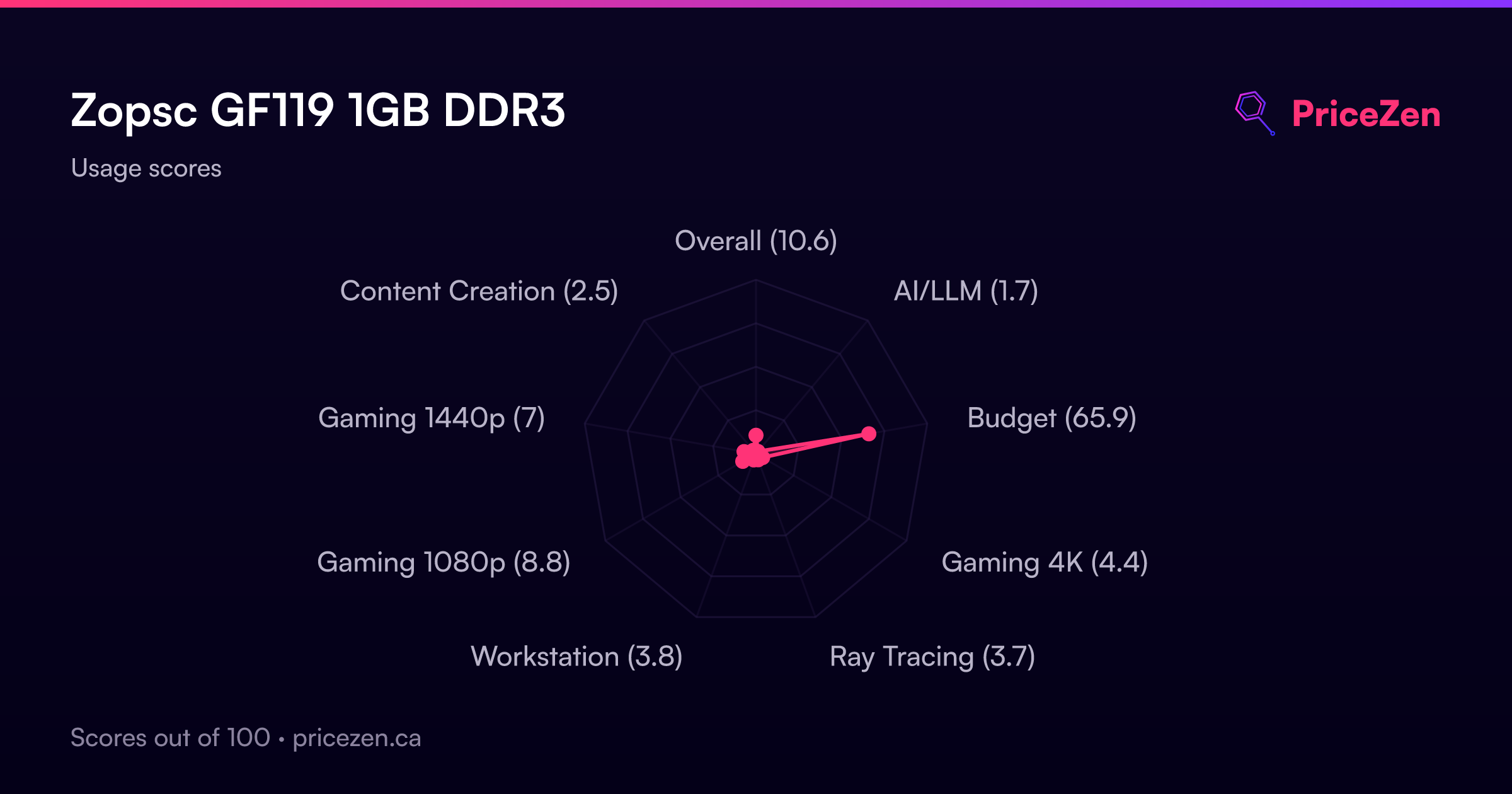
Usage Scores
- Overall10.6
- AI/LLM1.7
- Budget65.9
- Gaming 4K4.4
- Ray Tracing3.7
- Workstation3.8
- Gaming 1080p8.8
- Gaming 1440p7
- Content Creation2.5