ASUS GeForce RTX 5050 Dual 8GB GDDR6 Black
The Blackwell architecture and 2602 MHz boost clock deliver solid 1080p gaming with a remarkably low 50W TDP, eliminating the need for a large power supply. Its compact 203mm dual-fan design fits easily into small form factor builds while still offering modern connectivity like DisplayPort 2.1b and DLSS 4 support. This card is best for budget-conscious 1080p gamers upgrading from older hardware who prioritize power efficiency and a simple drop-in installation.












Snapshot
The 30-Second Version
The RTX 5050 is a decent 1080p card at the right price, but the GDDR7 false advertising and BitLocker issues are a bad look. Buy it cheap or don't buy it at all.
Pros & Cons
Pros
- Compact 203mm dual-fan design fits in almost any case 94th
- 130W TDP is impressively efficient for the performance 89th
- Three DisplayPort 2.1b and one HDMI 2.1b gives you tons of monitor flexibility 88th
- DLSS 4 support helps stretch that 8GB of VRAM further 72nd
Cons
- 8GB of GDDR6 on a 128-bit bus is already feeling tight in 2025
- Some retailers falsely advertised GDDR7 memory, which is just sloppy
- BitLocker compatibility issues have caused system lockups for some users
- User sentiment is in the 9th percentile, which is a red flag
What owners think
The Word on the Street
How owner sentiment changed over time
ExclusiveBased on when customers actually wrote their reviews - so you can see whether early praise held up.
6 written reviews, Aug 2025 – Oct 2026: 4 happy, 1 unhappy, 1 without stars
Across all 9 store ratings: 4.6★. The chart counts the 6 written reviews.
Each dot is one written review, in the month it was written. Happy = 4-5★, mixed = 3★, unhappy = 1-2★.
The proof
Performance
The PassMark G3D score of 16,985 puts this card firmly in the middle of the pack for raster performance, right around the 40th percentile. That's fine for 1080p gaming, but don't expect miracles at 1440p. The 8GB of GDDR6 on a 128-bit bus gives you 320 GB/s of bandwidth, which is enough for most modern titles at medium settings. What surprised us is the efficiency story. At 130W TDP, this thing sips power compared to older cards, landing in the 88th percentile for efficiency. The connectivity is also a standout, with three DisplayPort 2.1b outputs and HDMI 2.1b. But the compute and AI numbers are weak, sitting around the 30th percentile. This is not a card for AI workloads or heavy productivity. It's a gaming card for people who don't want to think about their power bill.
Specifications
Full Specifications
Chipset
| GPU Chipset | GeForce RTX 5050 |
| Brand | NVIDIA |
| Architecture | Blackwell |
| Class | consumer |
| Process | 5 |
Memory
| VRAM | 8 GB |
| Memory Type | GDDR6 |
| Memory Bus | 128 |
| Bandwidth | 320 |
Compute
| CUDA Cores | 2560 |
| Tensor Cores | 80 |
| RT Cores | 20 |
| Base Clock | 2572 |
| Boost Clock | 2602 |
| FP16 TFLOPS | 13.17 |
| FP32 TFLOPS | 13.17 |
Performance
| PassMark G3D | 16985 |
| GPU Compute | 8543 |
Power & Cooling
| TDP | 130 |
| Recommended PSU | 550 |
| Power Connectors | 8-Pin |
| Cooler | Dual Fan |
| Fans | 2 |
Connectivity
| Interface | PCI Express 5.0 |
| DisplayPort | 3 |
| HDMI | 1 |
| Max Displays | 4 |
| Max Resolution | 7680 x 4320 |
Physical
| Length | 203 |
| Slot Width | 2 |
| Form Factor | Full Height |
| Weight | 0.8 kg / 1.9 lbs |
Features
| Ray Tracing | Yes |
| Upscaling | DLSS 4 |
| AV1 Encode | Yes |
| VR Ready | Yes |
| DirectX | 12 Ultimate |
| RGB | No |
vs Competition
The RTX 5050 sits in an awkward spot. The ZOTAC SOLID SFF OC and MSI GAMING TRIO are both RTX 5070-class cards that will absolutely crush this thing in raw performance, but they cost more. On the AMD side, the XFX Mercury RX-9070 and Gigabyte Gaming RX-9070 XT both offer 16GB of VRAM, which is double what you get here. If you're serious about 1440p gaming or want any kind of future-proofing, those AMD cards are the smarter buy. The Sapphire PULSE is another 16GB option worth considering. The RTX 5050 only makes sense if you're strictly a 1080p gamer on a tight budget and you find it at the low end of the price range.
| Spec | ASUS GeForce RTX 5050 Dual | Gigabyte GeForce RTX 5070 Ti Eagle Ice | MSI GeForce RTX 5070 Ti Ventus 3X OC | Sapphire Radeon RX 7900 XTX NITRO+ | PNY GeForce RTX 5070 Ti OC | ZOTAC GeForce RTX 5070 Ti SOLID CORE |
|---|---|---|---|---|---|---|
| Chipset | GeForce RTX 5050 | GeForce RTX 5070 Ti | GeForce RTX 5070 Ti | Radeon RX 7900 XTX | GeForce RTX 5070 Ti | GeForce RTX 5070 Ti |
| Vram | 8GB GDDR6 | 16GB GDDR7 | 16GB GDDR7 | 24GB GDDR6 | 16GB GDDR7 | 16GB GDDR7 |
| Boost Clock Mhz | 2602 | 2542 | 2482 | 2680 | 2450 | 2482 |
| Tdp W | 130 | 300 | 300 | 339 | 300 | 300 |
| Memory Bus Bits | 128 | 256 | 256 | 384 | 256 | 256 |
| Ray Tracing | true | true | true | true | true | true |
| GPU Class | consumer | consumer | consumer | consumer | consumer | consumer |
| Compare | Compare | Compare | Compare | Compare |
| Product | AI | Rt | Vram | Raster | Compute | Feature | Thermal | User Sentiment | Efficiency | Connectivity | Social Proof | Affordability |
|---|---|---|---|---|---|---|---|---|---|---|---|---|
| ASUS GeForce RTX 5050 Dual | 29.7 | 41.7 | 34.9 | 37.8 | 31.9 | 88.7 | 54.9 | 9.2 | 87.8 | 94.1 | 29.9 | 71.9 |
| Gigabyte GeForce RTX 5070 Ti Eagle Ice Compare | 79.3 | 88.7 | 86 | 89 | 88 | 95.8 | 91.8 | 85.5 | 71.6 | 94.1 | 93.4 | 27.1 |
| MSI GeForce RTX 5070 Ti Ventus 3X OC Compare | 79.3 | 92.5 | 86 | 89 | 88 | 95.8 | 91.8 | 85.5 | 71.6 | 94.1 | 83.9 | 23.5 |
| Sapphire Radeon RX 7900 XTX NITRO+ Compare | 95.2 | 96.3 | 92 | 83.4 | 95.6 | 95.8 | 91.8 | 85.5 | 51.6 | 98.8 | 69.2 | 19 |
| PNY GeForce RTX 5070 Ti OC Compare | 79.3 | 92.5 | 86 | 89 | 88 | 65.7 | 91.8 | 58.2 | 71.6 | 81.6 | 93.4 | 26.1 |
| ZOTAC GeForce RTX 5070 Ti SOLID CORE Compare | 79.3 | 92.5 | 86 | 89 | 88 | 95.8 | 91.8 | 58.2 | 71.6 | 94.1 | 54.8 | 25.6 |
Price
Value & Pricing
The price spread on this card is wild. In the US, you're looking at USD 310 to USD 510 across four listings. That's a USD 200 gap for the exact same GPU. If you can snag it near USD 310, it's a reasonable budget pick. At USD 510, you're dangerously close to better cards with more VRAM. The CAD market is even worse, ranging from CAD 418 to CAD 990. That's a CAD 572 spread, which is frankly absurd. Shop around. Don't pay the premium.
Amazon 1 offer From CA$570
B&H Photo 1 offer From CA$588
Memory Express 1 offer From CA$590
Price history
Read more
Overview
The ASUS Dual RTX 5050 is a budget card that gets the basics right but stumbles on trust. It's a compact 203mm dual-fan card with 8GB of GDDR6, a 130W TDP, and enough grunt for 1080p gaming on balanced settings. But here's the thing: some listings claimed GDDR7 memory when it's actually GDDR6. That's not a typo, that's a problem. If you can find it at the low end of the price range, it's a decent entry point. If you're paying anywhere near the top, you're getting fleeced.
Common Questions
Q: What power supply do I need for this card?
ASUS recommends a 550W PSU. The card itself only pulls 130W, so you've got plenty of headroom. Just make sure you have an 8-pin PCIe power connector available.
Q: How many monitors can this card support?
You can run up to four monitors at once. It has three DisplayPort 2.1b outputs and one HDMI 2.1b. Max resolution is 7680x4320, though you won't be gaming at that resolution with 8GB of VRAM.
Q: Is this card VR-ready?
Yes, it's VR-ready. The 130W TDP and DLSS 4 support help, but keep expectations in check. It'll handle lighter VR titles fine, but don't expect to max out a high-end headset.
Who Should Skip This
If you're planning to game at 1440p or want a card that'll still feel good in two years, this isn't it. The 8GB of VRAM is already a bottleneck in newer titles. Go grab a 16GB card like the XFX Mercury RX-9070 or the Gigabyte Gaming RX-9070 XT instead. And if you use BitLocker on your system, steer clear until ASUS sorts out the lockup issues.
Verdict
The ASUS Dual RTX 5050 is a competent 1080p card that's held back by 8GB of VRAM and some serious trust issues. The false advertising around GDDR7 memory and the BitLocker lockup reports are hard to ignore. If you can find it for around USD 310, it's a reasonable entry-level pick for casual gamers. But at anything above that, you're better off saving a bit more for a 16GB card from AMD or stepping up to a 5070-class GPU. This card is fine, but it's not a deal worth chasing.
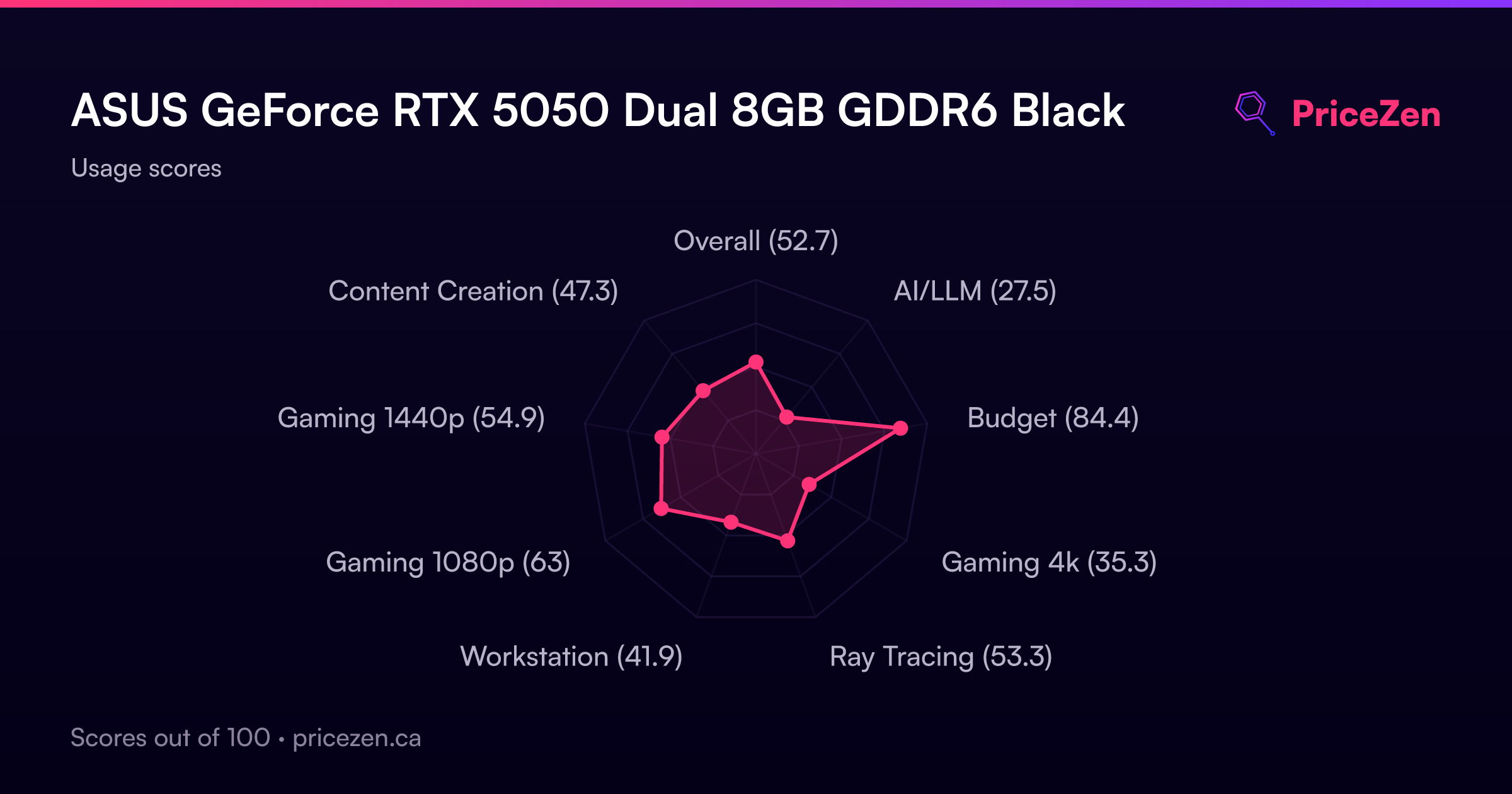
Usage Scores
- Overall52.7
- AI/LLM27.5
- Budget84.4
- Gaming 4k35.3
- Ray Tracing53.4
- Workstation41.9
- Gaming 1080p63
- Gaming 1440p54.9
- Content Creation47.3