VBESTLIFE Radeon R5 230 2GB GDDR3
The 40nm Radeon R5 230 chip with 2GB of GDDR3 memory and a slim, space-saving design provides basic display upgrades without needing external power thanks to an 18W TDP. Its flexible multi-display support includes HDMI, DVI, and a removable VGA connector, making it suitable for compact ITX chassis or HTPC builds. This card is best for office users needing to add extra monitors for productivity, not for gaming or GPU-accelerated tasks.







Snapshot
The 30-Second Version
The VBESTLIFE R5 230 is a USD 35 display adapter, not a graphics upgrade, and it's honest about that. Its standout traits are 18W slot-only power and an included slim bracket for ITX and HTPC builds, while a PassMark G3D score of 202 and a 64-bit GDDR3 bus rule out gaming entirely. It tops our affordability ranking and sits near the bottom of almost everything else. Buy it to fix a dead video output or drive a second monitor, skip it for anything involving frame rates.
Pros & Cons
Pros
- USD 35 at Amazon, top of our affordability ranking 99th
- 18W full-load draw with no external power connector needed
- Slim bracket included, fits ITX and HTPC cases
- HDMI, DVI-D and removable VGA cover older monitors
- Supports two displays for a cheap dual-screen desk setup
Cons
- PassMark G3D of 202 puts it near the bottom for 3D work
- 64-bit GDDR3 bus starves the 2GB of usable bandwidth
- PCI Express 1.1 x16 is generations behind current slots
- Compute and AI scores rank among the worst we track
- Only one HDMI output listed, connectivity ranks poorly
The proof
Performance
The number that tells the story is PassMark G3D: 202. For context on what that means in practice, that's a score in the territory of "draws a desktop, plays video, handles a browser" rather than anything resembling 3D work. Our raster ranking places it near the bottom of every graphics card we track, and compute sits even lower, effectively dead last. The 64-bit memory bus is the choke point here. Even though 2GB sounds reasonable on paper, GDDR3 at 1066 MHz across 64 bits means the chip spends most of its time waiting for data. VRAM capacity ranks among the weakest we track too, because 2GB of slow memory isn't the same asset as 2GB of fast memory.
Where the specs do help is everything that isn't rendering. 18W TDP means the fan barely has anything to cool, and the whole thing runs off slot power with no PCIe cable. Core at 625 MHz with 160 shaders is enough for desktop compositing, photo touch-ups and light video timeline scrubbing at modest resolutions, which is roughly what the seller claims and roughly what the benchmarks support. But there's a trade-off attached to that low power figure: our efficiency ranking is poor despite the tiny wattage, because efficiency is performance per watt, and 202 G3D divided by 18W still isn't a good deal. Low draw is a compatibility win, not a performance one. And with PCI Express 1.1 x16 as the bus, don't expect modern bandwidth either.
Specifications
Full Specifications
Chipset
| GPU Chipset | Radeon R5 230 |
| Brand | AMD |
| Architecture | 40nm |
| Class | consumer |
| Process | 40 |
Memory
| VRAM | 2 GB |
| Memory Type | GDDR3 |
| Memory Bus | 64 |
Compute
| Stream Processors | 160 |
| Base Clock | 625 |
Performance
| PassMark G3D | 202 |
Power & Cooling
| TDP | 18 |
| Power Connectors | None |
| Cooler | Fan |
| Fans | 1 |
Connectivity
| Interface | PCI Express 1.1 x16 |
| DisplayPort | 0 |
| HDMI | 1 |
| USB-C | 0 |
| Max Displays | 2 |
Physical
| Form Factor | Low Profile |
| Weight | 0.2 kg / 0.5 lbs |
Features
| Ray Tracing | No |
vs Competition
Cross-shop the XFX Radeon RX 570, MSI Radeon RX 580 Armor OC and Peladn Radeon RX 580 Black if there's any gaming in your plans at all. We only have their names in our data, so we'll argue from this card's side of the ledger: a G3D score of 202, a 64-bit GDDR3 bus and a 1080p gaming score of 10.6/100 mean the R5 230 isn't in the same conversation. Those cards are built for actual frame rates. This one is built to make a monitor light up. The gap isn't a few percent, it's categorical, and no amount of price advantage closes it if your goal is playing something.
The PNY Quadro P600 and AMD Radeon Pro WX 7100 are the more interesting cross-shops, because they target the same "small, professional, low-drama" buyer. If you need multi-monitor productivity or workstation app certification, our feature and connectivity rankings for this card (both weak) suggest you'll hit walls fast. Where the VBESTLIFE genuinely wins is physical size and power: 18W with no external connector and an included slim bracket is a combination aimed squarely at cramped ITX and HTPC builds. If your case is tiny and your PSU is ancient, that's the one scenario where this beats the alternatives rather than just costing less.
| Spec | VBESTLIFE Radeon R5 230 | HP RTX A4000 | PNY Quadro P1000 | 51Risc Radeon RX 590 | Kelinx Radeon RX 580 | SRhonyra Radeon RX 580 |
|---|---|---|---|---|---|---|
| Chipset | Radeon R5 230 | RTX A4000 | Quadro P1000 | Radeon RX 590 | Radeon RX 580 | Radeon RX 580 |
| Vram | 2GB GDDR3 | 16GB GDDR6 | 4GB GDDR5 | 8GB GDDR5 | 8GB GDDR5 | 8GB GDDR5 |
| Boost Clock Mhz | - | - | 1400 | - | 1750 | 1340 |
| Tdp W | 18 | 140 | 47 | 175 | 185 | 185 |
| Memory Bus Bits | 64 | - | 128 | 256 | 256 | 256 |
| Ray Tracing | false | true | false | - | - | - |
| GPU Class | consumer | workstation | workstation | consumer | consumer | consumer |
| Compare | Compare | Compare | Compare | Compare |
| Product | AI | Rt | Vram | Raster | Compute | Feature | Thermal | Efficiency | Connectivity | Social Proof | Affordability |
|---|---|---|---|---|---|---|---|---|---|---|---|
| VBESTLIFE Radeon R5 230 | 6.4 | 6.1 | 4.7 | 6.4 | 1.7 | 10.8 | 25.6 | 8.7 | 16.6 | 27.8 | 99.2 |
| HP RTX A4000 Compare | 66.6 | 35 | 62.9 | 41.7 | 35.9 | 33.5 | 16.5 | 92.1 | 36.1 | 0 | 19.7 |
| PNY Quadro P1000 Compare | 13.2 | 15.5 | 12.1 | 14.8 | 8.8 | 28.4 | 16.5 | 53.6 | 48.1 | 69 | 88.5 |
| 51Risc Radeon RX 590 Compare | 25.5 | 20.7 | 20.7 | 21.2 | 23.3 | 25.1 | 55.3 | 17.8 | 38.5 | 51.7 | 88 |
| Kelinx Radeon RX 580 Compare | 25.8 | 19.4 | 20.4 | 20 | 17.6 | 10.8 | 55.3 | 16.2 | 30.6 | 62.2 | 90.6 |
| SRhonyra Radeon RX 580 Compare | 26.4 | 22.5 | 22.7 | 20 | 13.9 | 40.7 | 55.3 | 16.2 | 25.9 | 60.5 | 87.3 |
Price
Value & Pricing
Price is the whole argument. We track this at USD 35 on Amazon, CAD 45 in Canada, BRL 267 in Brazil and MXN 655 in Mexico, each in its own currency and each from a single listing, so there's no store-to-store shopping to be done here. Amazon is the only US seller in our data. Our affordability percentile is 99, meaning almost nothing in the graphics card category costs less. If your problem is "my PC has no video output," this solves it for less than a decent keyboard.
But value and worth aren't the same thing. The total score of 10.2/100 means you're buying very little capability per dollar even at this price, and stepping up to any of the real GPUs in this category buys dramatically more. The honest framing: this is a repair part priced like a repair part, not a budget gaming card. Judge it against the cost of replacing a motherboard or a whole office PC and it looks smart. Judge it against anything you'd actually play games on and it doesn't compete.
Amazon 1 offer From CA$45
Price history
Read more
Overview
Let's be honest about what this is. The VBESTLIFE Radeon R5 230 is a 40nm Caicos-era chip with 160 stream processors, a 625 MHz core and 2GB of GDDR3 sitting on a 64-bit bus. That's not a gaming card, and the listing itself says as much: basic graphics for everyday work, not AAA titles. What it actually does well is exist cheaply. At USD 35 on Amazon, our affordability ranking puts it at the very top of the pile, essentially the cheapest way to get a display output into a machine that doesn't have one.
So who's this for? Someone whose integrated graphics died, someone building an HTPC or a small office box, someone who needs a second monitor on an old desktop. The card pulls about 18W under full load with no external power connector, which means it'll run off basically any power supply you already own. It ships with two metal plates, a slim bracket included, so it fits ITX and small-form-factor cases where a normal card physically won't go. That combination, tiny, low draw, cheap, is the entire pitch.
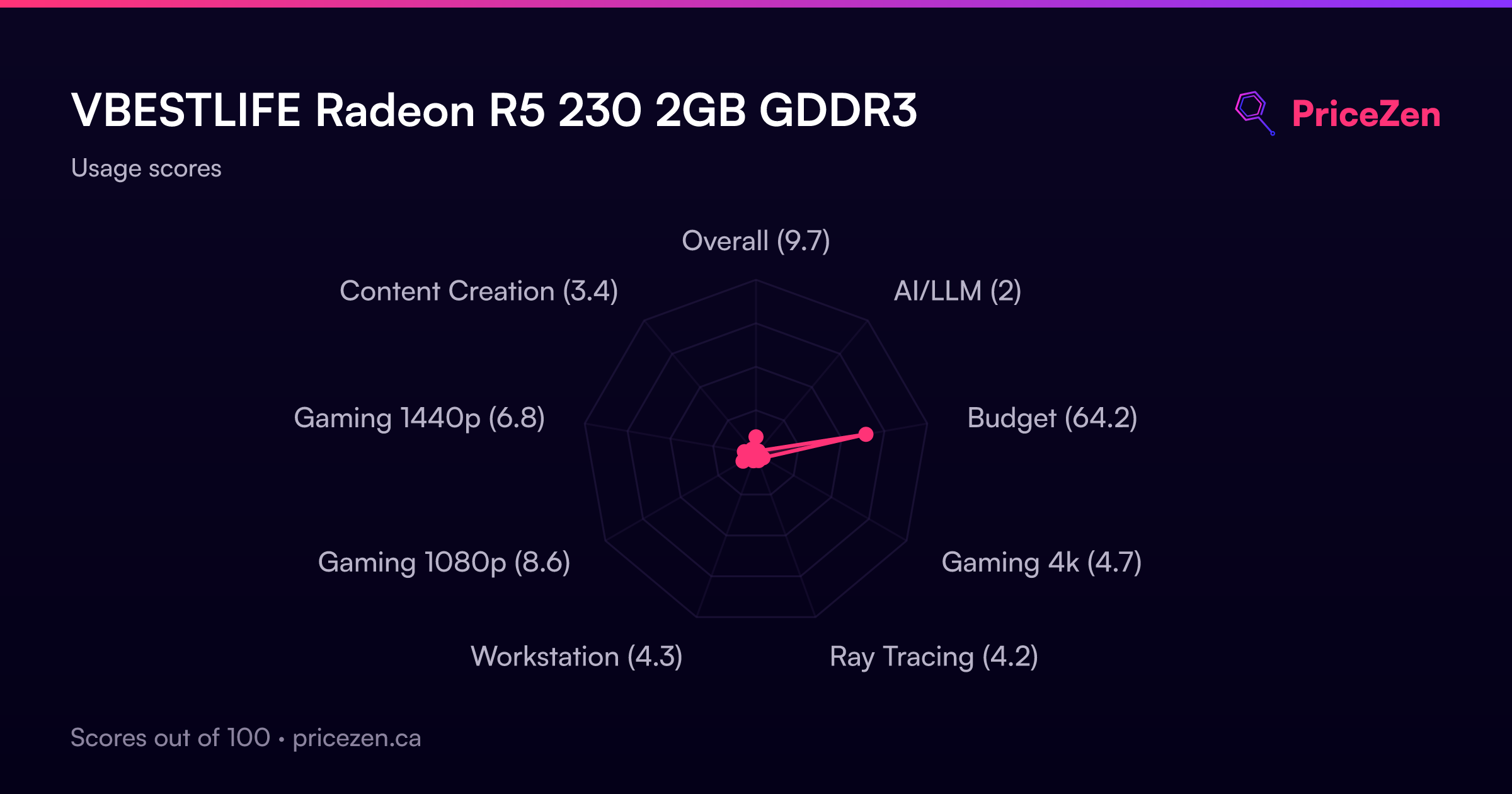
The interesting part is how lopsided the scorecard is. Our model gives it 64.1/100 for budget and 10.2/100 overall, with 1080p gaming at 10.6/100 and AI workloads bottoming out at 2.8/100. Those aren't rounding errors, they're different products living in the same category. If you buy this expecting a graphics upgrade, you'll be disappointed. If you buy it expecting a working HDMI port for the price of a couple of pizzas, it does exactly that.
Common Questions
Q: Can I actually game on this?
Not in any meaningful way. Our 1080p gaming score is 10.6/100 and the PassMark G3D result of 202 sits near the bottom of the graphics cards we track. Older 2D titles and very light indies might run, but anything modern is off the table, and the seller explicitly says it's not for AAA games.
Q: Do I need a bigger power supply or a PCIe power cable?
No. Full-load consumption is around 18W and the card draws everything from the slot, with no external power connector required. That makes it a safe drop-in for old prebuilt desktops and small HTPC power supplies that don't have spare PCIe cables.
Q: Will it fit a small case, and how many monitors can it run?
It ships with two metal plates including a slim bracket, so it works in ITX and compact chassis as well as full-size towers. It supports up to two displays across HDMI, DVI-D and VGA, and the VGA connector is removable if you need the low-profile setup.
Q: Is 2GB of VRAM enough, and does the PCIe 1.1 interface matter?
For desktop work, video playback and dual monitors, 2GB is fine. But it's GDDR3 on a 64-bit bus at 1066 MHz, so bandwidth is the real limit, and our VRAM ranking reflects that. PCI Express 1.1 x16 is also several generations old, though it'll still slot into a modern PCIe board.
Who Should Skip This
Gamers, obviously, but also anyone doing GPU-accelerated creative or AI work. A 2.8/100 AI score and a compute ranking near the very bottom mean Stable Diffusion, local LLMs, CUDA-style acceleration and heavy Premiere or DaVinci timelines are simply not happening. Video editors should look at the AMD Radeon Pro WX 7100 or PNY Quadro P600 class of card instead, and anyone chasing frame rates should be shopping the XFX Radeon RX 570, MSI Radeon RX 580 Armor OC or Peladn Radeon RX 580 Black.
Also skip it if you need lots of displays or modern connections. Our connectivity ranking is weak, with one HDMI output listed and legacy DVI-D and VGA filling out the rest. If you're running three or four monitors, or you need DisplayPort for a high-refresh panel, this card will bottleneck your desk before it bottlenecks your software. And if your CPU already has working integrated graphics, spending USD 35 here may well leave you with worse performance than what you've got.
Verdict
If you're reviving an old office desktop, building a quiet media box, or you just need a second display output on a machine whose onboard video gave up, buy it. USD 35, 18W, slot-powered, slim bracket in the box, HDMI plus DVI-D plus VGA. That's a specific job and this card does that job without asking anything of your power supply or your case. For that buyer we'd call it a sensible purchase rather than a compromise.
If you want to play games, edit video seriously, run anything with a GPU-accelerated AI workload, or keep this card for more than a stopgap, skip it. The 2.8/100 AI score and near-bottom compute ranking aren't things you grow out of, they're the ceiling. Save toward one of the RX 570 or RX 580 options instead. Buying this as a "starter gaming card" is the one path we'd actively talk you out of, because you'll be replacing it almost immediately and the USD 35 will have bought you nothing but delay.
Usage Scores
- Overall9.7
- AI/LLM2
- Budget64.2
- Gaming 4k4.7
- Ray Tracing4.2
- Workstation4.3
- Gaming 1080p8.6
- Gaming 1440p6.8
- Content Creation3.4