ZOTAC GeForce RTX 3090 AMP Extreme 24GB GDDR6X
The 24GB GDDR6X frame buffer and 10,496 CUDA cores deliver a 35.58 TFLOPS FP32 compute throughput, making it a powerhouse for 8K rendering and massive AI model training. Its IceStorm 2.0 cooler with a HoloBlack metal frontplate and dual BIOS manages the 420W TDP while maintaining a distinctive, premium build. This card is best for machine learning researchers and 3D artists who need massive VRAM capacity and raw compute without stepping up to workstation-class hardware.

No current retailer price
Where we saw it before. Check the store for today's price.











Snapshot
The 30-Second Version
The ZOTAC RTX 3090 AMP Extreme Holo is a former flagship that still shines for AI and content creation thanks to its 24GB of GDDR6X VRAM, ranking among the best for AI workloads. It's a power-hungry beast at 420W with a 356mm triple-slot design that won't fit in every case. The listing we track currently sits at USD 2,799, and the affordability ranking is near the bottom. Buy it for the memory capacity and compute headroom, not for gaming efficiency.
Pros & Cons
Pros
- 24GB GDDR6X VRAM at 936 GB/s bandwidth, still top-tier for AI and content creation 95th
- Strong ray tracing performance with 82 RT cores, 87th percentile in our database 94th
- Excellent thermal management with triple-fan IceStorm 2.0 cooler, 92nd percentile 92nd
- High factory boost clock of 1815MHz out of the box 88th
- DLSS support extends the card's useful life for 4K gaming
Cons
- 420W TDP is brutal, efficiency ranks in the 23rd percentile
- 356mm length and 3-slot design won't fit in many cases
- Requires an 800W PSU and three 8-pin power connectors
- Rasterization performance is only middle-of-the-pack compared to newer cards
- No DisplayPort 2.0, limited to DP 1.4a
What owners think
The Word on the Street
How owner sentiment changed over time
ExclusiveBased on when customers actually wrote their reviews - so you can see whether early praise held up.
2 written reviews, Apr – Jun 2023: 2 happy
Across all 11 store ratings: 5.0★. Most owners rate without writing a review. The chart counts the 2 written reviews.
Each dot is one written review, in the month it was written. Happy = 4-5★, mixed = 3★, unhappy = 1-2★.
The proof
Performance
Let's talk raw numbers. The PassMark G3D score of 26,521 puts this card in solid territory for rasterization, landing around the 70th percentile in our database. That's respectable but not earth-shattering by today's standards. The compute side is where things get more interesting, with 35.58 TFLOPS of FP32 and FP16 performance. That puts it in the 83rd percentile for compute, which is strong, and the AI-specific ranking is even better at the 94th percentile. The 328 Tensor cores and 24GB of VRAM are doing serious work there.
Ray tracing performance is a standout at the 87th percentile, with 82 RT cores handling the load. Combined with DLSS support, this card can push 4K ray-traced gaming at playable frame rates in most titles. The thermal performance is also impressive for a 420W card, ranking in the 92nd percentile. Zotac's triple-fan IceStorm 2.0 cooler is clearly earning its keep. But the efficiency story is rough. At the 23rd percentile, this card is a power hog by modern standards. You'll need an 800W power supply and three 8-pin connectors, and your room will notice the heat output during long sessions.
Specifications
Full Specifications
Chipset
| GPU Chipset | GeForce RTX 3090 |
| Brand | NVIDIA |
| Architecture | Ampere |
| Class | consumer |
| Process | 8 |
Memory
| VRAM | 24 GB |
| Memory Type | GDDR6X |
| Memory Bus | 384 |
| Bandwidth | 936.2 |
Compute
| CUDA Cores | 10496 |
| Tensor Cores | 328 |
| RT Cores | 82 |
| Base Clock | 1395 |
| Boost Clock | 1815 |
| FP16 TFLOPS | 35.58 |
| FP32 TFLOPS | 35.58 |
Performance
| PassMark G3D | 26521 |
| GPU Compute | 15150 |
Power & Cooling
| TDP | 420 |
| Recommended PSU | 800 |
| Power Connectors | 3 x 8-pin |
| Cooler | Triple Fan |
| Fans | 3 |
Connectivity
| Interface | PCI Express 4.0 16x |
| DisplayPort | 3 |
| HDMI | 1 |
| Max Displays | 4 |
| Max Resolution | 7680 x 4320 |
Physical
| Length | 356 |
| Slot Width | 3 |
| Form Factor | Full Height |
| Weight | 3.0 kg / 6.7 lbs |
Features
| Ray Tracing | Yes |
| Upscaling | DLSS |
| VR Ready | Yes |
| DirectX | 12 Ultimate |
| RGB | Yes |
vs Competition
The ASUS GeForce RTX 5090 TUF Gaming sits at the top of the current comparison set, and against it the 3090 AMP Extreme Holo gives ground on raw rasterization, where our ranking puts this card around the 70th percentile. Where the Zotac still holds its own is compute: 35.58 TFLOPS of FP32 and FP16, the 83rd percentile for compute and the 94th percentile for AI workloads, all fed by 24GB of GDDR6X running at 936 GB/s. If your workload is memory-bound rather than frame-rate-bound, that combination is the reason this older flagship stays in the conversation.
The Gigabyte GeForce RTX 5070 Ti Eagle Ice and the MSI GeForce RTX 5070 Ti Ventus 3X OC are the more practical picks for a gaming build, and the efficiency gap is the clearest argument for them. This card sits near the bottom for efficiency, pulls 420W, needs an 800W supply and three 8-pin connectors, and stretches 356mm across three slots. Owners regularly mention checking case clearance before installing it, which isn't a homework assignment most people want with a new GPU.
The Sapphire Radeon RX 7900 XTX NITRO+ is the AMD side of the comparison, and the deciding factor here is ray tracing. The 3090's ray tracing ranking is genuinely strong, handled by 82 RT cores, and DLSS support gives it a well-supported upscaling path for 4K play. If ray tracing sits high on your list, the Zotac holds up better than its age suggests. If you mostly want frames without ray tracing and a calmer power draw, the newer cards in this group are the easier recommendation.
| Spec | ZOTAC GeForce RTX 3090 AMP Extreme | ASUS GeForce RTX 5090 TUF Gaming | Gigabyte GeForce RTX 5070 Ti Eagle Ice | MSI GeForce RTX 5070 Ti Ventus 3X OC | Sapphire Radeon RX 7900 XTX NITRO+ | PNY GeForce RTX 5080 ARGB OC |
|---|---|---|---|---|---|---|
| Chipset | GeForce RTX 3090 | GeForce RTX 5090 | GeForce RTX 5070 Ti | GeForce RTX 5070 Ti | Radeon RX 7900 XTX | GeForce RTX 5080 |
| Vram | 24GB GDDR6X | 32GB GDDR7 | 16GB GDDR7 | 16GB GDDR7 | 24GB GDDR6 | 16GB GDDR7 |
| Boost Clock Mhz | 1815 | 2407 | 2542 | 2482 | 2680 | 2620 |
| Tdp W | 420 | 575 | 300 | 300 | 339 | 360 |
| Memory Bus Bits | 384 | 512 | 256 | 256 | 384 | 256 |
| Ray Tracing | Yes | Yes | Yes | Yes | Yes | Yes |
| GPU Class | consumer | consumer | consumer | consumer | consumer | consumer |
| Compare | Compare | Compare | Compare | Compare |
| Product | AI | Rt | Vram | Raster | Compute | Feature | Thermal | Efficiency | Connectivity | Social Proof | Affordability |
|---|---|---|---|---|---|---|---|---|---|---|---|
| ZOTAC GeForce RTX 3090 AMP Extreme | 94 | 87.8 | 94.6 | 69 | 82.6 | 78 | 91.8 | 20.2 | 55.2 | 44.6 | 9 |
| ASUS GeForce RTX 5090 TUF Gaming Compare | 97.2 | 90.6 | 97.8 | 98.8 | 97.7 | 95.8 | 72.1 | 23.5 | 99.3 | 98.7 | 2.2 |
| Gigabyte GeForce RTX 5070 Ti Eagle Ice Compare | 79.2 | 88.7 | 86 | 89.1 | 88 | 95.8 | 91.8 | 71.7 | 94.2 | 93.3 | 24.4 |
| MSI GeForce RTX 5070 Ti Ventus 3X OC Compare | 79.2 | 92.5 | 86 | 89.1 | 88 | 95.8 | 91.8 | 71.7 | 94.2 | 83.8 | 23.8 |
| Sapphire Radeon RX 7900 XTX NITRO+ Compare | 95.2 | 96.4 | 92 | 83.5 | 95.7 | 95.8 | 91.8 | 51.6 | 98.8 | 69.1 | 19.1 |
| PNY GeForce RTX 5080 ARGB OC Compare | 85.5 | 97.6 | 89.1 | 94.5 | 93.4 | 95.8 | 91.8 | 56.8 | 94.2 | 74.8 | 15.2 |
Price
Value & Pricing
The main listing we track right now sits at USD 2,799, and the affordability ranking is near the bottom, meaning this card is expensive relative to most GPUs in our database. That's not surprising for a former flagship with this much memory on board, but it does mean you need to be clear-eyed about what you're paying for. We track prices over time across stores, partly through our community browser extension, so if you're set on this card it's worth watching the listing rather than buying on impulse.
The value case really comes down to the 24GB of VRAM. If you need that much memory for AI workloads or heavy content creation, there aren't many cheaper options that offer it, and the AI ranking is among the best, backing up why people still chase these cards. Newer cards are faster in games but will hit memory walls in certain professional applications, and that's the trade you're making here. If you're primarily gaming, though, you're paying a premium for memory you won't fully use, and a newer mid-range card would give you better performance per dollar along with a much friendlier power bill.
Read more
Overview
The ZOTAC GeForce RTX 3090 AMP Extreme Holo is a card that refuses to be subtle. It's huge, it's hungry, and it packs 24GB of GDDR6X memory, which still puts it ahead of most cards on the market today for VRAM capacity. This is the kind of GPU you buy when you need serious compute headroom for AI workloads, 4K gaming, or heavy ray tracing, and you're willing to deal with the power bill and case clearance headaches that come with it. Zotac's HoloBlack design with the Spectra 2.0 RGB lighting is definitely a look, and the IceStorm 2.0 cooling setup is doing a lot of work keeping this 420W beast in check.
Who is this for? Honestly, it's for a pretty specific crowd. If you're just gaming at 1080p or even 1440p, this card is massive overkill and you'd be better served by something newer and more efficient. But if you're doing local AI inference, 3D rendering, or want to max out 4K with ray tracing without worrying about running out of VRAM, the 3090 still makes a compelling case. The 24GB frame buffer is the headline feature here, and it's the main reason this card remains relevant even as newer generations hit the shelves.
What makes it interesting is the value proposition in the used market. Newer cards like the RTX 5080 and 5070 Ti are faster in rasterization and way more efficient, but they typically ship with 16GB of VRAM. For AI and content creation workloads that eat memory for breakfast, this older flagship still has a trick up its sleeve. The AMP Extreme Holo variant also runs a higher boost clock at 1815MHz compared to the reference 3090, so you're getting a bit more performance out of the box than a stock card would give you.
Common Questions
Q: Will this card fit in my case?
At 356mm long and taking up 3 slots, this is one of the larger cards you can buy. You'll need a case with plenty of GPU clearance and three available expansion slots. Measure carefully before buying, and check that your case has adequate airflow for a 420W card.
Q: What power supply do I need for the RTX 3090?
Zotac recommends an 800W power supply minimum, and the card requires three 8-pin PCIe power connectors. Given the 420W TDP and potential power spikes, a quality unit from a reputable brand with some headroom above that minimum is a safer bet, especially if you're running a high-end CPU alongside it.
Q: Is 24GB of VRAM overkill for gaming?
For most games at 1080p or 1440p, yes, 24GB is more than you'll use. At 4K with ray tracing and high-resolution textures you'll lean on more of it, but the real benefit of 24GB is for AI workloads, 3D rendering, and content creation where memory capacity directly determines what you can work with.
Q: How does the RTX 3090 compare to newer cards like the RTX 5090?
The ASUS GeForce RTX 5090 TUF Gaming leads this comparison group on raw gaming performance, while our ranking puts the 3090 around the 70th percentile for rasterization. The Zotac's argument is elsewhere: 24GB of GDDR6X at 936 GB/s, the 83rd percentile for compute and the 94th percentile for AI. For gaming, go newer. For memory-intensive inference or rendering, the 3090's VRAM can be the deciding factor.
Who Should Skip This
If you're building a gaming PC in a mid-tower or smaller case, this card is going to be a headache. At 356mm long and 3 slots thick, it simply won't fit in many popular cases, and even in larger cases it can block access to other components. You'd be better served by a more compact modern card like the MSI GeForce RTX 5070 Ti Ventus 3X OC, which is the easier fit for a straightforward gaming build.
If power consumption matters to you, whether for electricity costs, heat output, or just not wanting to buy an 800W+ power supply, look elsewhere. The efficiency ranking is near the bottom, meaning this card is one of the least efficient options in our database. A newer card will give you similar or better gaming performance while drawing significantly less power. And if you're primarily a 1080p or 1440p gamer, this card is massive overkill. Save your money and get something mid-range that will run cooler and quieter while still maxing out your monitor's refresh rate.
Verdict
For AI researchers, 3D artists, and content creators who need maximum VRAM without paying for a workstation card, the ZOTAC RTX 3090 AMP Extreme Holo is still a compelling option. The 24GB of GDDR6X at 936 GB/s is the headline feature, and the AI ranking is among the best, backing that up. The thermal solution is genuinely excellent, with the triple-fan IceStorm 2.0 cooler landing near the top and owners reporting reasonable temperatures under sustained load. At USD 2,799 it's a serious purchase, so buy it because you know exactly which memory-hungry workload needs it.
For pure gamers, the recommendation is murkier. If you're at 4K with ray tracing enabled, this card can still deliver a good experience, especially with DLSS, and the ray tracing ranking is nothing to sneeze at. But the power draw is punishing, the case requirements are demanding, and the newer cards in our comparison set offer better gaming performance with far less heat. Unless you specifically need the VRAM, a modern card will serve you better for gaming. The 3090 is a specialist's card at this point, not a general recommendation.
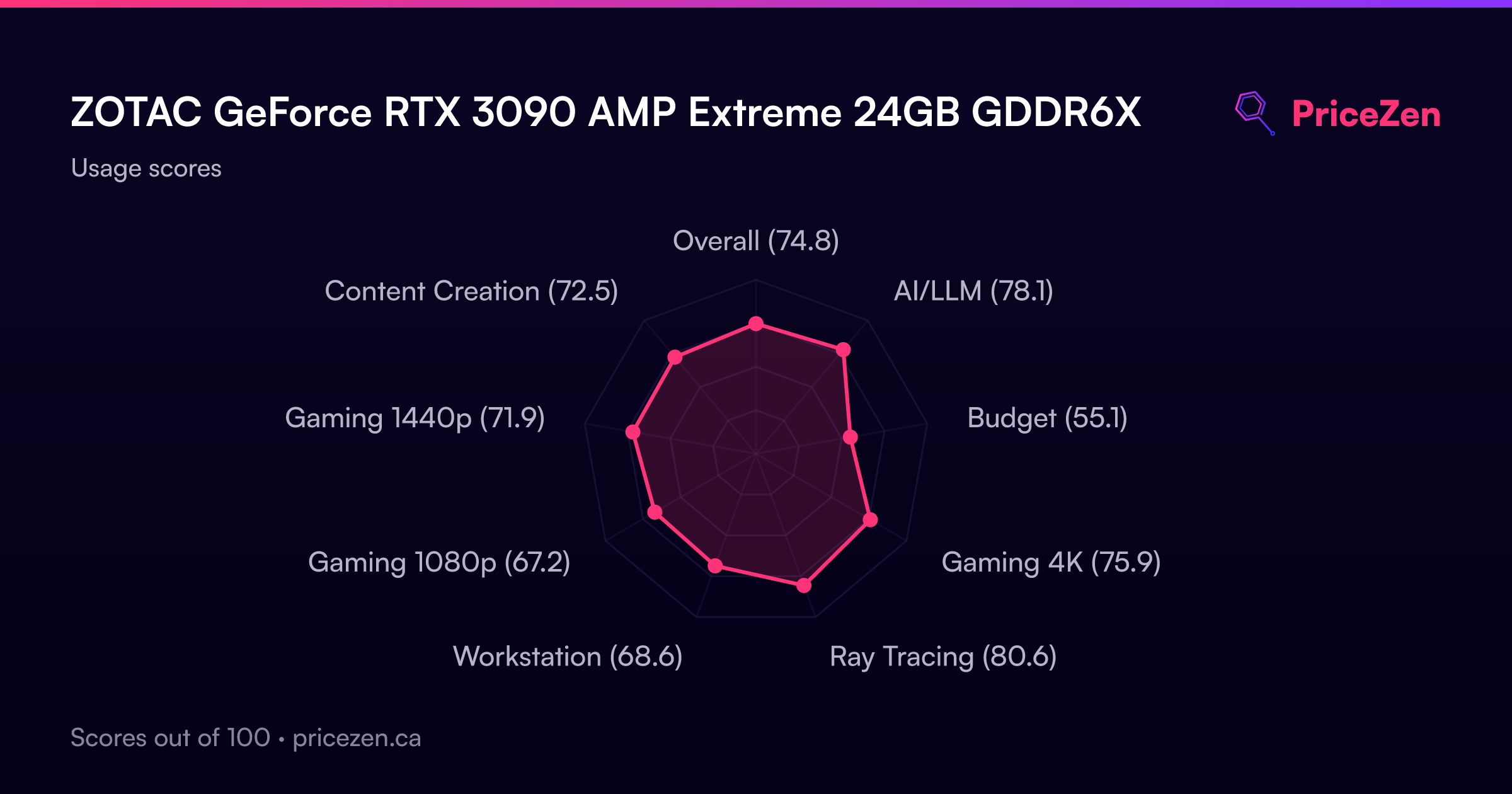
Usage Scores
- Overall74.8
- AI/LLM78.1
- Budget55.1
- Gaming 4K75.9
- Ray Tracing80.6
- Workstation68.6
- Gaming 1080p67.2
- Gaming 1440p71.9
- Content Creation72.5