AMD Radeon PRO WX 3200 4GB GDDR5 workstation
The 4GB GDDR5 frame buffer with a 384-bit interface delivering 504 GB/s bandwidth stands out for driving quad-monitor setups in 2D workflows. Its bulk packaging and included full-height bracket make it a straightforward, no-frills drop-in upgrade for legacy enterprise systems. This card is best for IT administrators refreshing office workstations that require reliable multi-display support without high 3D performance demands.









Snapshot
The 30-Second Version
The AMD Radeon PRO WX 3200 is a budget workstation card with surprisingly strong compute performance (66th percentile) and impressive 504 GB/s memory bandwidth, but only 4GB of VRAM and weak raster performance hold it back. At $160 USD, it's cheap and drives four monitors, making it a decent choice for office setups and light Blender work. But the 295W TDP, poor thermals, and 22.8 overall score mean most buyers should look at used cards or save for something better.
Pros & Cons
Pros
- Strong compute performance for the price, 66th percentile in our database 87th
- 504 GB/s memory bandwidth is genuinely impressive for a budget card
- Supports four monitors with a full height bracket included
- Affordability ranks in the 86th percentile, making it very budget-friendly
- Three five-star reviews praising Blender and 3D modeling performance
Cons
- Only 4GB of VRAM, bottom fifth of our database
- Raster performance in the 15th percentile, gaming is rough
- 295W TDP is high for the performance delivered, efficiency ranks in the 10th percentile
- Thermal performance in the 7th percentile, one of the worst we've seen
- Connectivity and feature sets are limited, 16th and 11th percentiles respectively
What owners think
The Word on the Street
How owner sentiment changed over time
ExclusiveBased on when customers actually wrote their reviews - so you can see whether early praise held up.
2 written reviews, 2024: 2 happy
Across all 3 store ratings: 5.0★. The chart counts the 2 written reviews.
Each dot is one written review, in the month it was written. Happy = 4-5★, mixed = 3★, unhappy = 1-2★.
The proof
Performance
The compute numbers are actually the bright spot here. 55.3 FP16 TFLOPS and 27.65 FP32 TFLOPS put this card in the 66th percentile for compute, which is solidly above average. For Blender users doing viewport work or light rendering, that's genuinely usable performance. The 54 RT cores and 1295MHz boost clock are modest by modern standards, but they're enough for entry-level 3D modeling. The customer reviews back this up, with multiple buyers praising Blender performance specifically.
But the raster performance is a different story. At the 15th percentile, this card lags behind most of what we've tested. Gaming at 4K scores just 6.8 out of 100, which is the weakest area in our entire evaluation. Even at lower resolutions, you're looking at a card that struggles with anything beyond esports titles or older games. The 4GB of VRAM is the main culprit. Modern games and even some workstation applications want 8GB or more, and 4GB just doesn't cut it anymore. The 384-bit memory bus helps with bandwidth, but bandwidth can't make up for capacity when you run out of frame buffer.
Specifications
Full Specifications
Chipset
| GPU Chipset | Radeon PRO WX 3200 |
| Brand | AMD |
| Class | workstation |
Memory
| VRAM | 4 GB |
| Memory Type | GDDR5 |
Compute
| Base Clock | 1295 |
| Boost Clock | 1295 |
Connectivity
| Max Displays | 4 |
Physical
| Weight | 0.3 kg / 0.6 lbs |
vs Competition
Let's talk about what else is out there. The MSI Ventus G5060-8V3C and ASUS PRIME PRIME-RTX5060TI-8G are both modern RTX 50-series cards that absolutely demolish the WX 3200 in every performance metric. They cost more, sure, but the gap in raster performance, VRAM, and features is enormous. If you're building a workstation for actual 3D work or rendering, those cards are worth saving for. The WX 3200's compute score of 66th percentile sounds decent until you realize the RTX 5060 Ti is in a completely different league.
The Gigabyte Vision GV-N3080VISION OC-10GD is an interesting comparison. It's a previous generation card with 10GB of VRAM, and used prices have come down significantly. For workstation users who need more memory headroom, the 3080 Vision is a much better choice, even if it costs a bit more upfront. The Sapphire PULSE 11330-02-20G and XFX Radeon RX 9060 XT SWIFT are AMD's current offerings, and they're simply better cards in every way except price. The WX 3200's only real advantage is that it's cheap and drives four monitors. If those are your only requirements, it's fine. Otherwise, every competitor here is a better buy.
| Spec | AMD Radeon PRO WX 3200 | ASUS GeForce RTX 5070 PRIME | ZOTAC GeForce RTX 5070 Solid OC | XFX Radeon RX 7900 XT Gaming | Gigabyte GeForce RTX 5070 Gaming OC | MSI GeForce RTX 5070 SHADOW |
|---|---|---|---|---|---|---|
| Chipset | Radeon PRO WX 3200 | GeForce RTX 5070 | GeForce RTX 5070 | Radeon RX 7900 XT | GeForce RTX 5070 | GeForce RTX 5070 |
| Vram | 4GB GDDR5 | 12GB GDDR7 | 12GB GDDR7 | 20GB GDDR6 | 12GB GDDR7 | 12GB GDDR7 |
| Boost Clock Mhz | 1295 | 2512 | 2542 | 2400 | 2625 | 2542 |
| Tdp W | - | 250 | 250 | 257 | 250 | 250 |
| Memory Bus Bits | - | 192 | 192 | 320 | 192 | 192 |
| Ray Tracing | - | true | true | true | true | true |
| GPU Class | workstation | consumer | consumer | consumer | consumer | consumer |
| Compare | Compare | Compare | Compare | Compare |
| Product | AI | Rt | Vram | Raster | Feature | Thermal | Efficiency | Connectivity | Social Proof | Affordability |
|---|---|---|---|---|---|---|---|---|---|---|
| AMD Radeon PRO WX 3200 | 10.2 | 2.1 | 11.1 | 2.3 | 10.8 | 6.4 | 2.3 | 15.2 | 38 | 86.5 |
| ASUS GeForce RTX 5070 PRIME Compare | 61.6 | 82.9 | 65.4 | 79.3 | 95.9 | 91.7 | 79 | 94.1 | 93.3 | 44.8 |
| ZOTAC GeForce RTX 5070 Solid OC Compare | 61.6 | 82.9 | 65.4 | 79.3 | 95.9 | 91.7 | 79 | 94.1 | 83.8 | 38.9 |
| XFX Radeon RX 7900 XT Gaming Compare | 87.7 | 86.1 | 81.2 | 81.1 | 47 | 72.3 | 77.2 | 88.1 | 74.8 | 36.8 |
| Gigabyte GeForce RTX 5070 Gaming OC Compare | 61.6 | 76.9 | 65.4 | 79.3 | 95.9 | 91.7 | 79 | 94.1 | 74.8 | 39.7 |
| MSI GeForce RTX 5070 SHADOW Compare | 61.6 | 82.9 | 65.4 | 79.3 | 88.7 | 55.3 | 79 | 94.1 | 93.3 | 40.9 |
Price
Value & Pricing
At $160 USD, this card is cheap. That's the headline. The affordability score of 47.6 out of 100 might seem low for something this inexpensive, but it reflects the fact that you're getting very little for your money in terms of modern features and gaming capability. The 86th percentile affordability ranking means it's more affordable than most cards in our database, but affordability only matters if the card does what you need.
Here's the thing. For $160, you could also find used GTX 1660 Supers or RX 580s that would absolutely crush this card in gaming and match it in most workstation tasks. The WX 3200's value proposition hinges entirely on the four monitor outputs and the workstation driver support. If you need those specific things, the price is fair. If you don't, you're paying for a name and a niche feature set. The pricing varies wildly by region too, from 160 USD to 234 CAD to 925 BRL, so your local market will heavily influence whether this makes sense.
Amazon 1 offer From CA$236
Price history
Read more
Overview
The AMD Radeon PRO WX 3200 is one of those cards that makes you do a double take. On paper, it's a workstation GPU with a 5nm RDNA 3.0 chip, 4GB of GDDR5 on a 384-bit bus, and a 295W TDP. But the specs tell a strange story. That memory bandwidth of 504 GB/s is genuinely impressive for a card in this price bracket, yet the VRAM capacity is just 4GB, which puts it in the bottom fifth of our database. It's a weird mix of old and new, and that tension defines the whole product.
This is a card aimed at budget-conscious workstation users who need multi-monitor support and don't care about gaming. The full height bracket and four monitor outputs make it a practical choice for office setups, trading desks, or basic CAD work. The listing even mentions IPC server use, which tells you the seller sees this as a utility card, not a performance part. And at around $160 USD, it's priced like a budget option, though the value proposition gets murkier once you look at what else is out there.
The elephant in the room is the naming. The WX 3200 was originally a Polaris-based card from 2019. This listing claims RDNA 3.0 and 5nm, which doesn't match the historical product. We're not here to litigate the listing's accuracy, but it's worth knowing that what you're buying may not be what the name suggests. The three customer reviews are all five stars and mention Blender performance, which is encouraging, but three reviews is a tiny sample size. We'll dig into what the numbers actually say.
Our database scores this card at 22.8 out of 100 overall, with a budget score of 47.6 and a workstation score of 28.8. Those aren't great numbers. But context matters. If you need a cheap card that drives four displays and handles light 3D work, this might still fit the bill. If you're expecting anything close to modern GPU performance, you'll be disappointed. Let's get into the details.
Common Questions
Q: Is this card good for gaming?
No, not really. The raster performance ranks in the 15th percentile of our database, and 4K gaming scores just 6.8 out of 100. The 4GB of VRAM is a major limitation for modern games. You might get playable frame rates in older titles or esports games at 1080p, but this is fundamentally a workstation card, not a gaming GPU.
Q: Can this card handle 4 monitors?
Yes, the card supports four monitors and comes with a full height bracket. This is actually one of its strongest selling points. For office productivity, trading setups, or any multi-display workflow, the WX 3200 is well suited. Just keep in mind that the connectivity score is in the 16th percentile, so you'll want to verify the specific output ports match your monitors.
Q: Is 4GB of VRAM enough for 3D modeling and rendering?
For light to moderate Blender work and entry-level CAD, 4GB can be sufficient, and the customer reviews support this. The compute performance is in the 66th percentile, which is above average. However, for complex scenes, high-resolution textures, or GPU rendering with large datasets, 4GB will become a bottleneck quickly. If you're doing serious 3D work, consider a card with 8GB or more.
Q: Why does this card have a 295W TDP?
That's a good question, and honestly, it's a bit puzzling. A 295W TDP is high for a card with this level of performance, which is why the efficiency score is in the 10th percentile. You'll need at least a 450W power supply according to the specs. The thermal performance is also in the 7th percentile, so expect the card to run warm. Make sure your case has decent airflow.
Who Should Skip This
If you're building a gaming PC, skip this card entirely. The raster performance is in the 15th percentile, and 4GB of VRAM is simply not enough for modern games. You'd be much better off with a used GTX 1660 Super, RX 580, or saving for a current generation budget card like the RX 9060 XT. The gaming experience on the WX 3200 will be frustrating, especially at anything above 1080p.
Serious 3D artists and video editors should also look elsewhere. The 4GB VRAM ceiling will choke on complex Blender scenes, high-resolution video timelines, or any GPU rendering workload. The Gigabyte Vision 3080 with 10GB of VRAM is a much better choice for those use cases, even at a higher price. And if you're concerned about power efficiency or thermals, this card's 295W TDP and 7th percentile thermal performance make it a poor fit for small form factor builds or systems with limited cooling.
Verdict
If you need a cheap card to drive four monitors for office work, trading, or basic productivity, the WX 3200 does that job. The full height bracket, multi-monitor support, and low price make it a reasonable choice for that specific use case. The compute performance is also decent enough for light Blender work or entry-level CAD, and the three five-star reviews suggest real users are happy with it for those tasks.
But for everyone else, this card is a tough sell. The 4GB of VRAM is a hard ceiling that will frustrate you in modern applications. The 295W TDP means you need a beefy power supply for a card that delivers budget performance. And the thermal performance in the 7th percentile suggests this thing runs hot. If you're building a gaming PC, look elsewhere. If you're doing serious 3D rendering or video editing, save up for something with more VRAM. This card is a niche product for a niche audience, and that's okay, as long as you know what you're getting into.
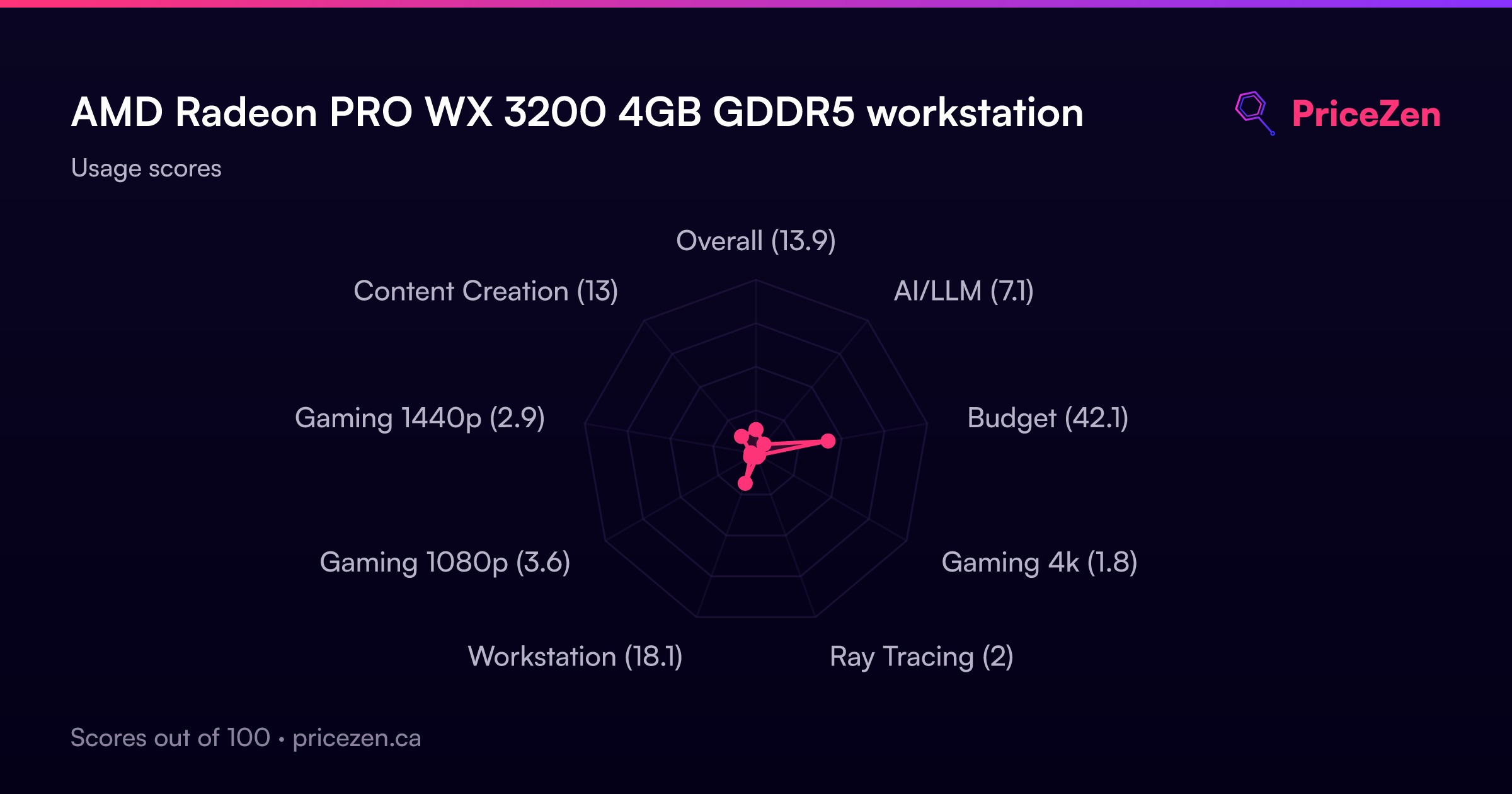
Usage Scores
- Overall13.9
- AI/LLM7.1
- Budget42.2
- Gaming 4k1.8
- Ray Tracing2
- Workstation18.1
- Gaming 1080p3.6
- Gaming 1440p2.9
- Content Creation13