MSI GeForce RTX 3070 Ti Gaming X Trio 8GB GDDR6X

8GB of GDDR6X on a 256-bit bus verified Nov 25
50/100 overall score 3.7 average from 32 owner ratings
- GPU
- GeForce RTX 3070 Ti
- VRAM
- 8GB GDDR6X
- Boost clock
- 2000 MHz
- TDP
- 290 W
- Memory bus
- 256 bit
- Ray tracing
- Yes
- Class
- consumer
Compare prices at 1 store
Cheapest first. New, refurbished and bundled offers are kept apart, so you compare like with like.
| Store | Sold by | Colour and condition | Price | vs lowest | Last checked | Link |
|---|---|---|---|---|---|---|
| Refurbished and renewed1 offerNot new: condition and warranty vary by seller | ||||||
| Out of stock when last checked | ||||||
| Amazon | Not known | Renewed | No price | Out of stock | Nov 22 | Go to store |
 Source: PriceZen, checked Nov 22, 2026
A price counts as current when we checked it in the last 7 days. “Marketplace seller” means a third-party seller on that store, not the store itself.
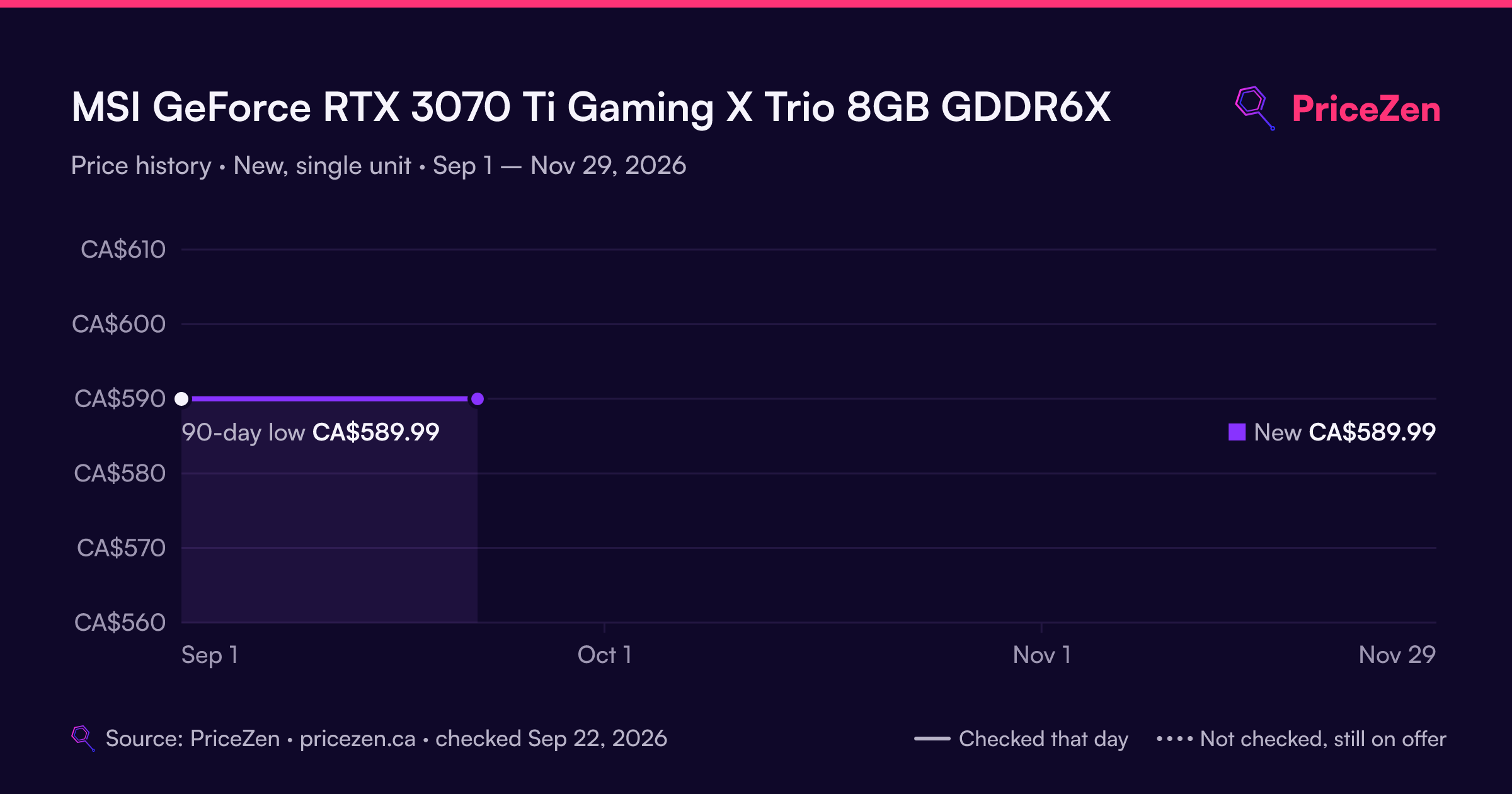
Price history
Checked that dayNot checked that day, still on offer
Source: PriceZen, checked Sep 22, 2026








Snapshot
The 30-Second Version
The MSI RTX 3070 Ti Gaming X Trio is a strong 1440p performer with a 2000MHz boost clock and a capable triple-fan cooler, available refurbished around $440 USD. The 8GB of VRAM is the main long-term concern, and multiple buyers report missing support brackets causing GPU sag. User sentiment is mixed at 72/100, with praise for performance and value but complaints about size and occasional crashes. If you need a budget 1440p card and can live with refurbished quirks, it's worth a look. If you want 4K or future-proofing, skip it.
Pros & Cons
Pros
- Strong 1440p gaming performance with a 2000MHz boost clock 83rd
- Triple-fan Torx 3.0 cooler keeps temperatures low under load 72nd
- 16.6 TFLOPS of FP32 compute handles most modern titles easily 67th
- Factory overclocked out of the box, no manual tuning needed 66th
- Refurbished pricing around $440 USD offers solid value
Cons
- 8GB of VRAM is limiting for 4K or future titles
- Missing support bracket causes noticeable GPU sag, per multiple buyers
- Large physical size won't fit in smaller cases
- User sentiment score of 72/100 reflects mixed real-world experiences
- 290W TDP means you'll need a beefy power supply
What owners think
The Word on the Street
- A recurring theme is that the card delivers excellent 1440p gaming performance, with several owners noting smooth frame rates in demanding titles.
- Multiple buyers report that the support bracket is missing from refurbished units, leading to noticeable GPU sag that requires a third-party fix.
- The refurbished condition draws mixed reactions, with some praising the clean appearance and others noting cosmetic damage or missing accessories.
- A few users experienced crashes or lockups, particularly in VR and after about a year of use, which raises questions about long-term reliability.
How owner sentiment changed over time
ExclusiveBased on when customers actually wrote their reviews - so you can see whether early praise held up.
9 written reviews, Nov 2022 – Nov 2024: 6 happy, 2 mixed, 1 unhappy
Across all 32 store ratings: 3.7★. Most owners rate without writing a review. The chart counts the 9 written reviews.
Each dot is one written review, in the month it was written. Happy = 4-5★, mixed = 3★, unhappy = 1-2★.
The proof
Performance
Let's talk numbers. The PassMark G3D score of 23,203 puts this card in the 63rd percentile for raster performance, which is solidly above average but not earth-shattering. In plain English, that means it'll chew through most games at 1440p with high settings without breaking a sweat. The 16.6 TFLOPS of FP32 compute is respectable, though it lands right around the middle of the pack at the 49th percentile. For gaming, that's plenty. For heavy compute workloads, you'll feel the ceiling.
The 8GB of GDDR6X is the spec that gives me pause. At 448 GB/s of bandwidth, it's fast, but 8GB is starting to feel tight for newer titles at higher resolutions. The VRAM capacity ranks in the 44th percentile, which means half the cards in our database have more memory. If you're playing at 1080p or 1440p with sensible texture settings, you're fine. But if you're eyeing 4K or planning to keep this card for another three years, that 8GB buffer is going to become a bottleneck sooner than you'd like. The ray tracing score of 62.8 out of 100 tells a similar story. It can do RT, but it's not going to blow you away compared to the 40-series or 50-series cards.
Specifications
Full Specifications
Chipset
| GPU Chipset | GeForce RTX 3070 Ti |
| Brand | NVIDIA |
| Architecture | Ampere |
| Class | consumer |
| Process | 8 |
Memory
| VRAM | 8 GB |
| Memory Type | GDDR6X |
| Memory Bus | 256 |
| Bandwidth | 448 |
Compute
| CUDA Cores | 5888 |
| Tensor Cores | 184 |
| RT Cores | 46 |
| Base Clock | 2000 |
| Boost Clock | 2000 |
| FP16 TFLOPS | 16.6 |
| FP32 TFLOPS | 16.6 |
Performance
| PassMark G3D | 23203 |
| GPU Compute | 11474 |
Power & Cooling
| TDP | 290 |
| Recommended PSU | 550 |
| Power Connectors | None |
| Cooler | Triple Fan |
| Fans | 3 |
Connectivity
| Interface | PCI Express |
| DisplayPort | 1 |
| HDMI | 1 |
Physical
| Weight | 0.3 kg / 0.7 lbs |
Features
| Ray Tracing | Yes |
| Upscaling | DLSS |
| AV1 Encode | Yes |
| DirectX | 12 |
| RGB | Yes |
vs Competition
The competitive landscape has shifted a lot since this card launched. The Gigabyte AERO GV-N507TAERO OC-16GD and ASUS TUF Gaming TUF-RTX5070TI-O16G-WHITE-GAMING are both RTX 5070 Ti cards with 16GB of VRAM, and they absolutely destroy the 3070 Ti in ray tracing, AI workloads, and 4K gaming. But they also cost dramatically more. If you're shopping new and have the budget, those are the obvious picks. The 3070 Ti simply can't compete on features like DLSS 3 frame generation or AV1 encode efficiency.
Where the 3070 Ti still makes sense is against other used or refurbished options. The Sapphire NITRO+ 11322-01-40G and XFX Mercury RX-97TRGBBB9 are AMD cards that trade blows with the 3070 Ti in raster performance, often with more VRAM. The ZOTAC SOLID SFF OC ZT-B50710J3-10P is a compact 5070 option that's more efficient and newer, but again, pricier. If you're dead set on NVIDIA and want something that'll handle 1440p without costing a fortune, the 3070 Ti holds its own. Just don't expect it to age as gracefully as cards with 12GB or 16GB of memory.
| Spec | MSI GeForce RTX 3070 Ti Gaming X Trio | ASUS GeForce RTX 5090 TUF Gaming | Gigabyte GeForce RTX 5070 Ti Eagle Ice | ZOTAC GeForce RTX 5080 APOCALYPSE | PNY GeForce RTX 5080 ARGB OC | Sapphire Radeon RX 7900 XTX NITRO+ |
|---|---|---|---|---|---|---|
| Chipset | GeForce RTX 3070 Ti | GeForce RTX 5090 | GeForce RTX 5070 Ti | GeForce RTX 5080 | GeForce RTX 5080 | Radeon RX 7900 XTX |
| Vram | 8GB GDDR6X | 32GB GDDR7 | 16GB GDDR7 | 16GB GDDR7 | 16GB GDDR7 | 24GB GDDR6 |
| Boost Clock Mhz | 2000 | 2407 | 2542 | 2730 | 2620 | 2680 |
| Tdp W | 290 | 575 | 300 | 360 | 360 | 339 |
| Memory Bus Bits | 256 | 512 | 256 | 256 | 256 | 384 |
| Ray Tracing | Yes | Yes | Yes | Yes | Yes | Yes |
| GPU Class | consumer | consumer | consumer | consumer | consumer | consumer |
| Compare | Compare | Compare | Compare | Compare |
| Product | AI | Rt | Vram | Raster | Compute | Feature | Thermal | User Sentiment | Efficiency | Connectivity | Social Proof | Affordability |
|---|---|---|---|---|---|---|---|---|---|---|---|---|
| MSI GeForce RTX 3070 Ti Gaming X Trio | 41.3 | 65.6 | 41.8 | 61.2 | 47.3 | 82.8 | 71.8 | 27.2 | 32.9 | 28.1 | 23.8 | 66.6 |
| ASUS GeForce RTX 5090 TUF Gaming Compare | 97.2 | 90.5 | 97.8 | 98.8 | 97.8 | 95.7 | 71.8 | 85.1 | 23 | 99.3 | 98.7 | 2.2 |
| Gigabyte GeForce RTX 5070 Ti Eagle Ice Compare | 78.9 | 88.6 | 85.9 | 88.9 | 87.8 | 95.7 | 91.8 | 85.1 | 71.6 | 94.2 | 93.4 | 23 |
| ZOTAC GeForce RTX 5080 APOCALYPSE Compare | 85.5 | 97.7 | 89.1 | 94.5 | 93.3 | 95.7 | 91.8 | 99.5 | 56.5 | 94.2 | 98.7 | 23.6 |
| PNY GeForce RTX 5080 ARGB OC Compare | 85.5 | 97.7 | 89.1 | 94.5 | 93.3 | 95.7 | 91.8 | 71.2 | 56.5 | 94.2 | 75 | 15.9 |
| Sapphire Radeon RX 7900 XTX NITRO+ Compare | 95.3 | 96.4 | 92 | 83.4 | 95.6 | 95.7 | 91.8 | 85.1 | 51.3 | 98.8 | 69.4 | 13.7 |
Price
Value & Pricing
At $440 USD for a refurbished unit, the value proposition is genuinely interesting. The affordability score sits at the 62nd percentile, which means it's priced better than a lot of what's out there, but it's not a screaming deal either. You're getting roughly RTX 3070 Ti performance for less than half of what a new RTX 5070 Ti costs, and that's the real appeal. If you're building a mid-range rig on a budget and don't need the latest features, this card delivers a lot of frames per dollar.
But refurbished cards come with a catch. The price looks great until you factor in the risk. Multiple buyers reported missing accessories, cosmetic damage, and in a couple of cases, crashes after a year of use. The customer rating of 3.7 out of 5 stars isn't terrible, but it's not a ringing endorsement either. If you're comfortable with a little uncertainty and maybe buying a third-party support bracket, the value is there. If you want peace of mind, you might be better off spending a bit more on something new or with a longer warranty.
Read more
Overview
The MSI GeForce RTX 3070 Ti Gaming X Trio is one of those cards that made a lot of sense when it launched, and still holds up surprisingly well if you're shopping the refurbished market. It's built on NVIDIA's Ampere architecture with 5888 CUDA cores and 8GB of GDDR6X memory on a 256-bit bus. That's a solid foundation for 1440p gaming, which is exactly where this card feels most at home. The Gaming X Trio variant is MSI's beefed-up triple-fan design, so you're getting a chunky cooler and a factory overclock right out of the box.
Who's this for? Honestly, someone who wants strong 1440p performance without paying current-gen prices. The refurbished listings we're seeing put this around $440 USD, which is a lot less than what a new RTX 4070 or 5070 Ti would run you. If you're still on something like a GTX 1080 Ti or an RTX 2060, this is a meaningful jump. Just know you're buying into a card that's a few years old now, with all the quirks that come with refurbished hardware.
What makes it interesting is the mismatch between specs and real-world feedback. On paper, this thing has a 2000MHz boost clock and 448 GB/s of memory bandwidth, which should translate to smooth frame rates. But the user sentiment score sits at just 72 out of 100, and the customer rating is 3.7 out of 5 stars. Buyers love the performance but keep running into practical annoyances like missing support brackets and a card that's physically enormous. That tension is the story here.
Common Questions
Q: Is 8GB of VRAM enough for modern games?
For 1080p and most 1440p gaming, 8GB is still workable, especially with sensible texture settings. But newer AAA titles are increasingly pushing past that, and at 4K you'll hit the ceiling quickly. The VRAM capacity ranks in the 44th percentile in our database, so half the cards out there have more memory. If you plan to keep this card for several years, the 8GB buffer is the biggest risk factor.
Q: Will this card fit in my case?
The Gaming X Trio is a large triple-fan card, and multiple buyers have reported that it didn't fit in their cases. You'll want to check the exact dimensions of your case and compare them to the card's length before buying. The 290W TDP also means you'll need adequate airflow and a 550W power supply at minimum, though more headroom is always better.
Q: Does the refurbished version come with all the accessories?
Not always. Several buyers reported that the support bracket was missing from their refurbished units, which leads to GPU sag. The card itself may also show cosmetic wear. If you buy refurbished, be prepared to purchase a third-party support bracket separately and accept that the card may not look brand new.
Q: How does this compare to a newer RTX 4070 or 5070 Ti?
The newer cards beat the 3070 Ti in almost every metric, especially ray tracing, AI performance, and VRAM capacity. The RTX 5070 Ti has 16GB of memory and much better efficiency. But those cards cost significantly more. The 3070 Ti makes sense if you're on a tight budget and mainly care about 1440p raster performance, where it still holds up reasonably well.
Who Should Skip This
If you're planning to game at 4K or want to crank ray tracing settings, this card isn't for you. The ray tracing score of 62.8 out of 100 and the 8GB VRAM buffer mean you'll be making compromises immediately, and those compromises will only get worse as games get more demanding. The AI and compute scores in the 43rd and 49th percentiles also make this a poor choice for machine learning or heavy productivity work. Look at something with 12GB or 16GB of VRAM instead, like a used RTX 3080 or a newer 40-series card.
You should also skip this if you have a small case or value quiet operation. Multiple buyers found the card too large for their builds, and a few mentioned it runs louder than their previous GPU. The 290W TDP means more heat and more fan noise under load. If you're building in a compact chassis or want a silent system, a smaller or more efficient card would serve you better. And if you're not comfortable with the risks of refurbished hardware, including missing accessories and potential reliability issues, spend a bit more on something new with a proper warranty.
Verdict
If you're building a 1440p gaming rig on a budget and you find a clean refurbished unit at a good price, the MSI RTX 3070 Ti Gaming X Trio is a solid pick. The triple-fan cooler does its job, the factory overclock means you don't have to fiddle with anything, and the performance is more than enough for most games at 1440p. Just budget for a support bracket, because the sag issue is real and multiple buyers have complained about it.
But if you're planning to game at 4K, do serious ray tracing, or keep your GPU for more than a couple of years, I'd steer you toward something with more VRAM. The 8GB buffer is the biggest long-term liability here, and the AI and compute scores in the 43rd and 49th percentiles mean this card isn't built for heavy productivity workloads either. It's a gaming card, pure and simple, and it does that job well for the price. Just know what you're signing up for.
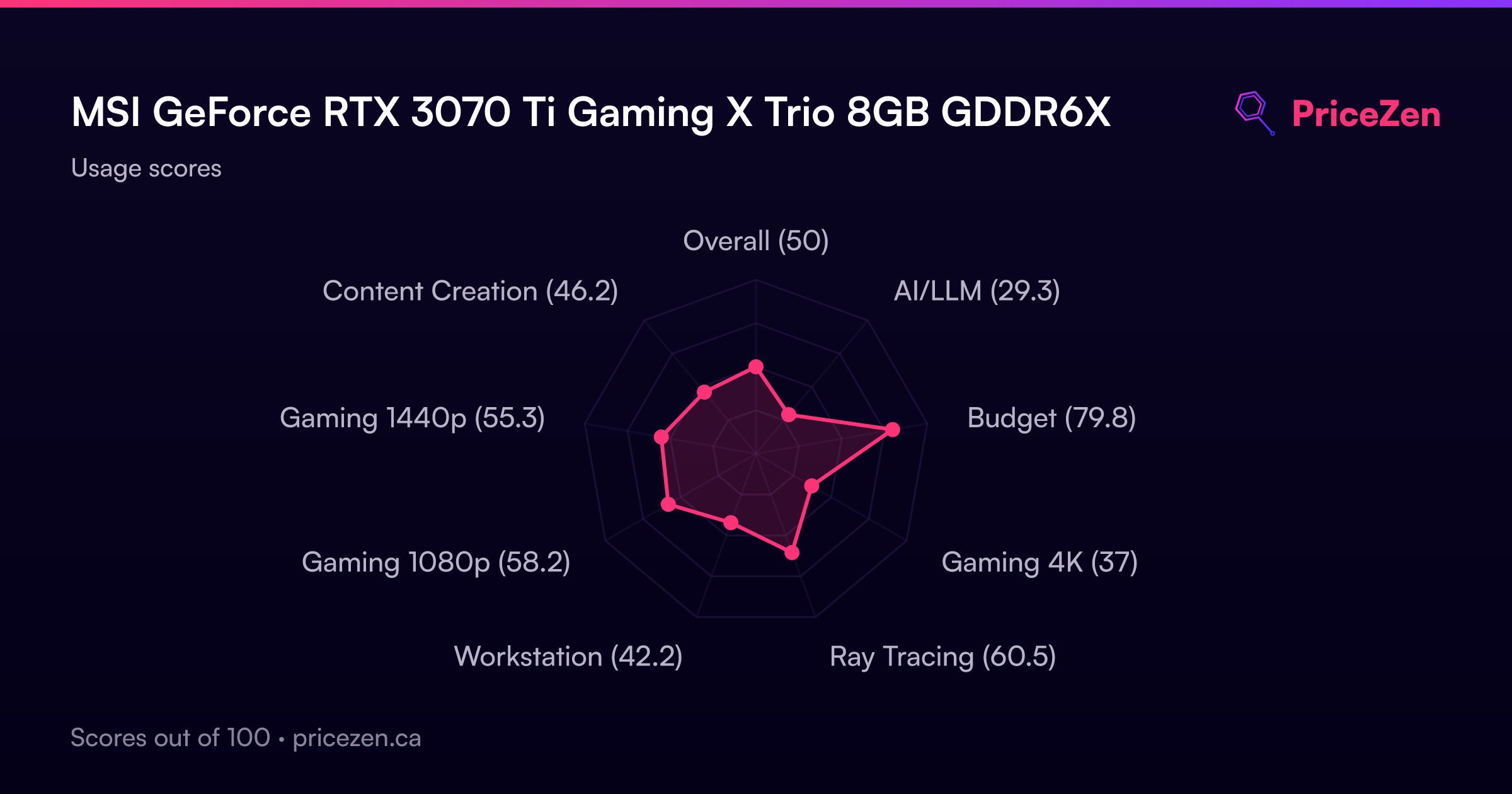
Usage Scores
- Overall50
- AI/LLM29.3
- Budget79.8
- Gaming 4K37
- Ray Tracing60.5
- Workstation42.2
- Gaming 1080p58.2
- Gaming 1440p55.3
- Content Creation46.2