MSI GeForce RTX 4090 Suprim Liquid 24GB GDDR6X
The integrated AIO liquid cooling on the 2800MHz boost clock RTX 4090 chipset keeps temperatures in check under a 450W load, enabling sustained peak performance from its 16384 CUDA cores and 24GB of GDDR6X memory. Its compact 280mm length defies the typical bulk of flagship GPUs, making it a uniquely practical choice for smaller high-end builds. This card is best for 4K gamers and 3D rendering artists who demand maximum frame rates and the fastest ray tracing without thermal throttling.



Snapshot
The 30-Second Version
The MSI RTX 4090 SUPRIM LIQUID X is one of the fastest and coolest GPUs in our data, with thermals in the 100th percentile and ray tracing in the 99th. Owners report the 240mm AIO keeps it under 60°C under load while staying quiet. USD pricing now runs from $3,799 to $5,199, so shop carefully and chase the low listing. If you need maximum 4K performance and have the power budget, this is still a card to beat.
Pros & Cons
Pros
- Best-in-class thermals, often under 60°C under load thanks to the 240mm AIO 100th
- Top-tier 4K and ray tracing performance, 99th percentile in our database 99th
- Quiet operation even under heavy load, a rarity for flagship GPUs 98th
- 24GB of GDDR6X with 576 GB/s bandwidth handles any workload 97th
- Compact 280mm PCB enables multi-GPU setups in smaller cases
Cons
- 450W TDP means you need a serious PSU and a higher power bill
- CAD pricing varies wildly from CAD 2,600 to CAD 6,500 depending on vendor
- Radiator placement is critical, and some cases just won't fit it well
- Coil whine reported by a subset of users
- Initial defective units with thermal pad issues have been reported
What owners think
The Word on the Street
How owner sentiment changed over time
ExclusiveBased on when customers actually wrote their reviews - so you can see whether early praise held up.
39 written reviews, Nov 2022 – Mar 2026: 31 happy, 1 mixed, 7 without stars
Across all 271 store ratings: 4.5★. Most owners rate without writing a review. The chart counts the 39 written reviews.
Each dot is one written review, in the month it was written. Happy = 4-5★, mixed = 3★, unhappy = 1-2★.
The proof
Performance
The raw numbers here are absurd. PassMark G3D comes in at 38,098, which puts this card in the 97th percentile for raster performance and 99th for ray tracing. In practical terms, that means 4K gaming at high refresh rates without breaking a sweat. The 24GB of GDDR6X on a 384-bit bus gives you 576 GB/s of memory bandwidth, which matters a lot when you're pushing 4K textures or working with large 3D scenes.
The 450W TDP is the trade-off. This card pulls serious power under load, and MSI recommends a 1000W PSU. But here's the thing: the liquid cooling means that power gets converted into performance instead of thermal throttling. Users consistently report temperatures under 60°C under load, which is remarkable for a card this powerful. The efficiency percentile sits at 42nd, so it's not winning any green awards, but for the performance you're getting, the power draw is actually reasonable.
Specifications
Full Specifications
Chipset
| GPU Chipset | GeForce RTX 4090 |
| Brand | NVIDIA |
| Architecture | Ada Lovelace |
| Class | consumer |
| Process | 5 |
Memory
| VRAM | 24 GB |
| Memory Type | GDDR6X |
| Memory Bus | 384 |
| Bandwidth | 576 |
Compute
| CUDA Cores | 16384 |
| Tensor Cores | 304 |
| RT Cores | 76 |
| Base Clock | 2800 |
| Boost Clock | 2800 |
| FP16 TFLOPS | 32.98 |
| FP32 TFLOPS | 32.98 |
Performance
| PassMark G3D | 38059 |
| GPU Compute | 26267 |
Power & Cooling
| TDP | 450 |
| Recommended PSU | 1000 |
| Power Connectors | 1 x 16-Pin |
| Cooler | AIO Liquid |
| Fans | 2 |
Connectivity
| Interface | PCI Express 4.0 |
| DisplayPort | 3 |
| HDMI | 1 |
| Max Displays | 4 |
| Max Resolution | 7680 x 4320 |
Physical
| Length | 280 |
| Slot Width | 3 |
| Weight | 3.8 kg / 8.3 lbs |
Features
| Ray Tracing | Yes |
| Upscaling | DLSS 3 |
| AV1 Encode | Yes |
| DirectX | 12 Ultimate |
| RGB | Yes |
vs Competition
The competition has shifted since we first looked at this card. The ASUS GeForce RTX 5090 TUF Gaming now sits in the same top-five group in our ranking, and that's the one that genuinely challenges the 4090's claim to the crown. If your goal is simply the most performance you can buy right now, that's the card to compare against, and our scoring model puts both of them at the sharp end of the category. What the MSI still brings to that fight is its own package: 24GB of GDDR6X on a 384-bit bus, a 240mm AIO that keeps the card itself down to 280mm, and thermals in the 100th percentile of everything we've tracked.
The ZOTAC GeForce RTX 5080 APOCALYPSE is the other close neighbour. It's a newer-generation option, and if power draw is your sticking point, the 4090's 450W TDP and 1000W PSU recommendation are worth holding up against it. Where the MSI counters is memory headroom and cooling behaviour: owners consistently report sub-60°C load temperatures and quiet running, which is not something every flagship air-cooled card can claim.
The Gigabyte GeForce RTX 5070 Ti Eagle Ice rounds out the group, and it's the sensible pick if you've realised you don't actually need this much GPU. Our ranking places it below the MSI on outright performance, which is exactly what you'd expect, but it also means you're not paying for headroom you'll never touch. So the question is unchanged even if the names aren't: do you need maximum compute and VRAM with liquid cooling, or does a newer card further down the stack cover your resolution and workload for less money and less heat?
| Spec | MSI GeForce RTX 4090 Suprim Liquid | ASUS GeForce RTX 5090 TUF Gaming | Gigabyte GeForce RTX 5090 WINDFORCE OC | ZOTAC GeForce RTX 5080 AMP Extreme Infinity | PNY NVIDIA RTX PRO 6000 Blackwell Max-Q Workstation Edition | NVIDIA GeForce RTX 5090 Founder Edition |
|---|---|---|---|---|---|---|
| Chipset | GeForce RTX 4090 | GeForce RTX 5090 | GeForce RTX 5090 | GeForce RTX 5080 | NVIDIA RTX PRO 6000 Blackwell Max-Q Workstation Edition | GeForce RTX 5090 |
| Vram | 24GB GDDR6X | 32GB GDDR7 | 32GB GDDR7 | 16GB GDDR7 | 96GB GDDR7 | 32GB GDDR7 |
| Boost Clock Mhz | 2800 | 2407 | 2467 | 2670 | 2280 | 2407 |
| Tdp W | 450 | 575 | 575 | 360 | 300 | 575 |
| Memory Bus Bits | 384 | 512 | 512 | 256 | 512 | 512 |
| Ray Tracing | Yes | Yes | Yes | Yes | Yes | Yes |
| GPU Class | consumer | consumer | consumer | consumer | workstation | consumer |
| Compare | Compare | Compare | Compare | Compare |
| Product | AI | Rt | Vram | Raster | Compute | Feature | Thermal | User Sentiment | Efficiency | Connectivity | Social Proof | Affordability |
|---|---|---|---|---|---|---|---|---|---|---|---|---|
| MSI GeForce RTX 4090 Suprim Liquid | 92.7 | 99.1 | 93.3 | 96.9 | 97.5 | 83 | 99.8 | 96 | 38.7 | 68.9 | 74.8 | 4.4 |
| ASUS GeForce RTX 5090 TUF Gaming Compare | 97.2 | 90.6 | 97.8 | 98.8 | 97.7 | 95.8 | 72.1 | 85.2 | 23.5 | 99.3 | 98.7 | 2.2 |
| Gigabyte GeForce RTX 5090 WINDFORCE OC Compare | 98.5 | 84.1 | 97.8 | 98.8 | 98.2 | 95.8 | 91.8 | 71.2 | 23.5 | 94.2 | 69.1 | 3.1 |
| ZOTAC GeForce RTX 5080 AMP Extreme Infinity Compare | 85.5 | 97.6 | 89.1 | 94.5 | 93.4 | 95.8 | 91.8 | 71.2 | 56.8 | 94.2 | 98.7 | 7.3 |
| PNY NVIDIA RTX PRO 6000 Blackwell Max-Q Workstation Edition Compare | 99.7 | 99.6 | 99.8 | 87.3 | 99.4 | 99.8 | 25.2 | 96 | 69.2 | 87.3 | 46.7 | 0.3 |
| NVIDIA GeForce RTX 5090 Founder Edition Compare | 97.1 | 90.9 | 96.8 | 98.8 | 97.7 | 52.4 | 31.4 | 85.2 | 23.5 | 81.5 | 93.3 | 4.4 |
Price
Value & Pricing
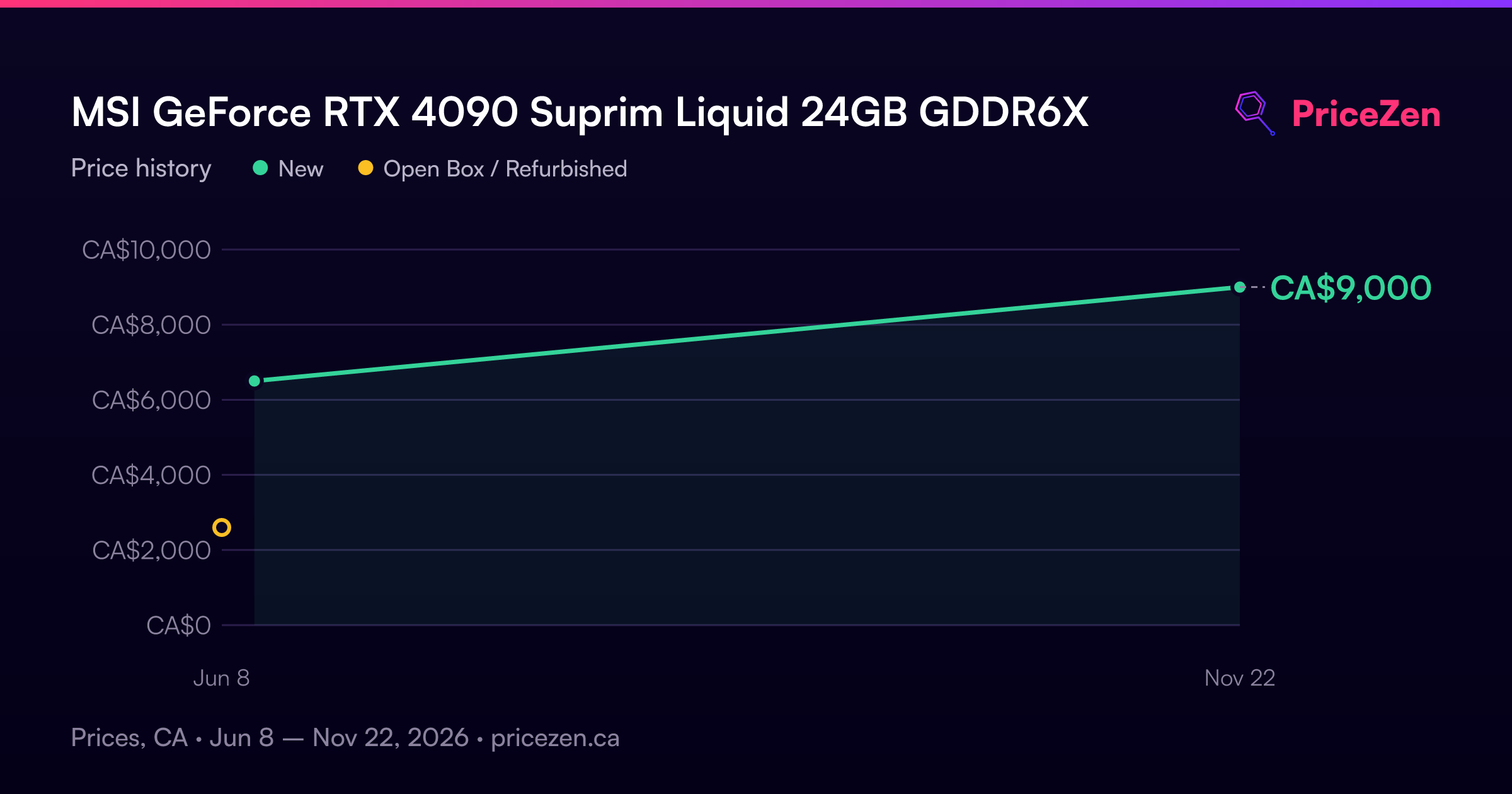
Here's where things get tricky. The USD price now spans $3,799 to $5,199 depending on the listing, which is a lot of money for a graphics card no matter how you slice it. That's a $1,400 spread between the cheapest and most expensive listings we're tracking, so where you buy matters almost as much as whether you buy. We track this card's price over time, partly through our community browser extension, and the low end of that range is the number worth setting an alert for.
At $3,799, you're paying flagship money for flagship performance, and the math still works if you actually need 24GB of VRAM and top-end 4K throughput. At $5,199, you're paying a premium for availability rather than for anything extra under the shroud. Our ranking still puts this card near the very top for raw performance and thermals, but there are newer flagships sitting in the same comparison set now, and at the top of this price range you should be weighing those seriously before you click buy. Bottom line: hunt the low listing, and treat the high one as a reason to wait.
Newegg 2 offers From CA$9,000
Price history
Read more
Overview
The MSI RTX 4090 SUPRIM LIQUID X is what happens when you take the fastest consumer GPU on the planet and strap a closed-loop liquid cooler to it. We're talking 16,384 CUDA cores, 24GB of GDDR6X, and a boost clock of 2,800MHz. This isn't a card for people who just want to play Fortnite at 1080p. This is for the person who wants Cyberpunk 2077 with path tracing at 4K and refuses to compromise on frame rate or fan noise.
What makes this particular 4090 interesting is the cooling. Most 4090s are massive air-cooled slabs that dump heat directly into your case. The SUPRIM LIQUID X uses a 240mm AIO radiator, which means the GPU itself stays compact at 280mm while the heat gets pushed out through your case's fan mounts. That's a big deal if you've got a smaller case or want to run multiple GPUs for rendering work.
MSI positions this as their premium SUPRIM line, and it shows in the build. The shroud is metal, the backplate is solid, and the whole thing feels like it costs what it costs. Our database puts this card in the 100th percentile for thermals and 99th for ray tracing. It's not just fast, it's the fastest thing we've tracked in several categories.
Common Questions
Q: Will this card fit in my case?
The card itself is only 280mm long, which is compact for a 4090. But you need to account for the 240mm radiator and fans. Make sure your case has a spot for a 240mm AIO, ideally mounted at the top or front. The card is 3 slots thick, so check clearance around your PCIe slot too.
Q: Is the liquid cooling worth it over an air-cooled 4090?
If noise and thermals matter to you, absolutely. Owners report the AIO keeps the GPU under 60°C under load while staying much quieter than air-cooled 4090s. The trade-off is installation complexity and the small risk of pump failure or coolant evaporation over time. For most people, the thermal and acoustic benefits outweigh those risks.
Q: What power supply do I need?
MSI recommends a 1000W PSU for this card. The 450W TDP is significant, and you'll want headroom for the rest of your system. Make sure your PSU has a native 16-pin connector or use the included adapter. Don't cheap out on the PSU with a card this expensive.
Q: Is the 4090 still worth buying with the newer cards available?
For 4K gaming and VRAM-heavy workloads, yes, at the right price. The 24GB of GDDR6X here is a real advantage for texture-heavy games and AI work, and our ranking still puts this card in the 99th percentile for ray tracing. The ASUS GeForce RTX 5090 TUF Gaming is the newer flagship to weigh if you want the outright performance ceiling, while the ZOTAC GeForce RTX 5080 APOCALYPSE and Gigabyte GeForce RTX 5070 Ti Eagle Ice make more sense if you'd rather cut power draw and spend. At $3,799 this MSI is still a top-tier choice. At $5,199, think harder.
Who Should Skip This
If you're gaming at 1440p or 1080p, this card is massive overkill. You're paying for performance you'll never use, and the Gigabyte GeForce RTX 5070 Ti Eagle Ice sits in our comparison set as the reminder that plenty of cards will max out those resolutions for far less. The power draw alone makes this a poor choice for mid-range builds.
Also skip this if you're building in a small form factor case without room for a 240mm radiator. The liquid cooling is the whole point of this card, and if you can't mount the radiator properly, you're better off with a compact air-cooled option. And if you're staring at a $5,199 listing, walk away. That's a $1,400 premium over the cheapest listing we track for exactly the same hardware. Set a price alert, wait for the low end to come back, or put the ZOTAC GeForce RTX 5080 APOCALYPSE on your shortlist instead.
Verdict
If you're building a no-compromise 4K gaming rig or a workstation for rendering and AI work, this card is still hard to beat. The liquid cooling solves the biggest problem with flagship GPUs: heat and noise. You get top-tier performance without your PC sounding like a jet engine, and the 24GB of VRAM gives you room for years of texture-heavy games and creative workloads.
But if you're gaming at 1440p or you're sensitive to power consumption, this is overkill. The Gigabyte GeForce RTX 5070 Ti Eagle Ice or the ZOTAC GeForce RTX 5080 APOCALYPSE will serve you well for less money and less heat, and if you want the absolute ceiling instead, the ASUS GeForce RTX 5090 TUF Gaming is the card to look at. Price is the deciding factor here: at $3,799 this is a specialist's card that earns its keep, and at $5,199 it's a specialist's card asking you to overpay. Buy it because you know exactly why you need this much power, and buy it at the low listing.
Usage Scores
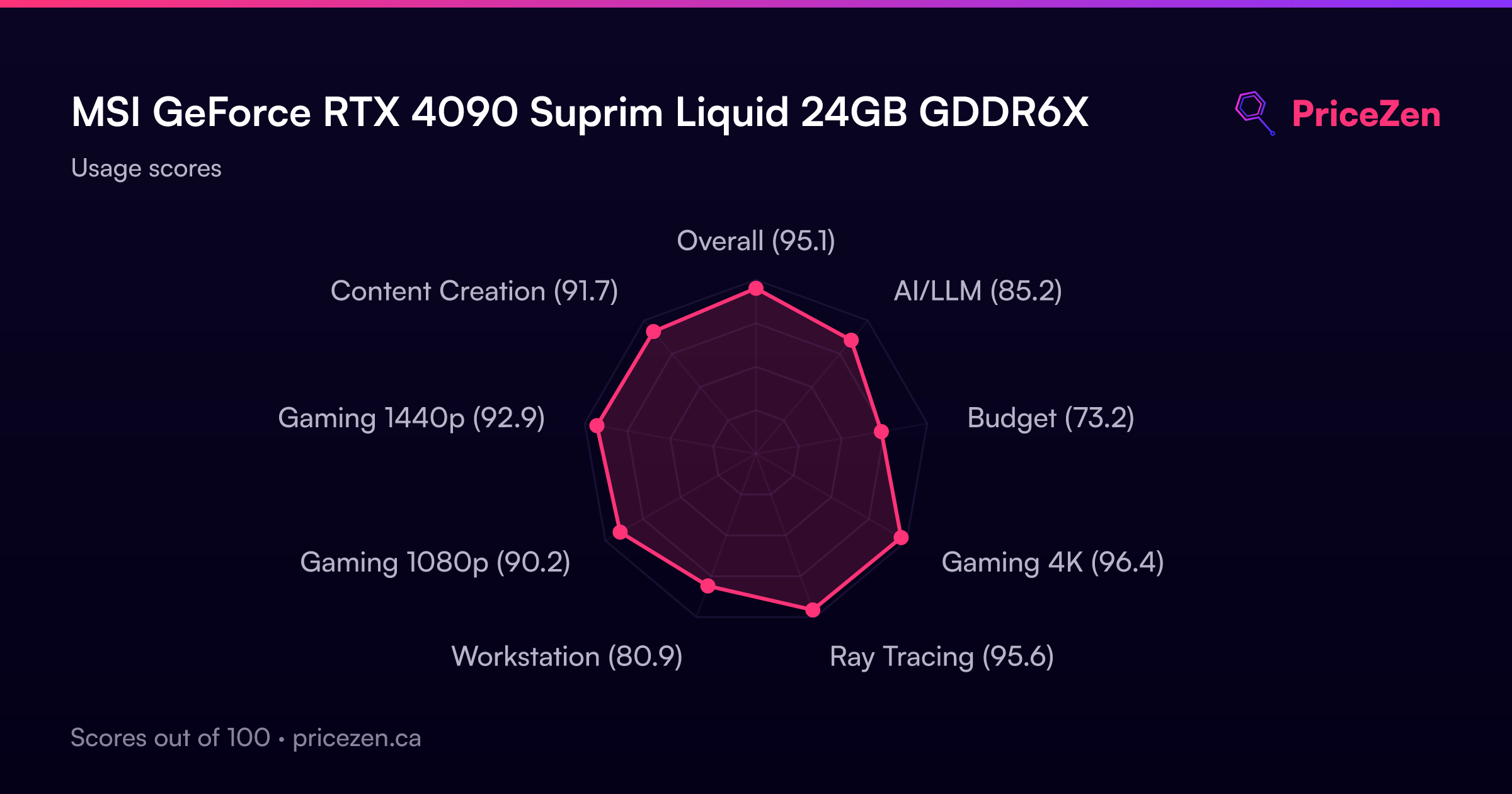
- Overall95.1
- AI/LLM85.2
- Budget73.2
- Gaming 4K96.4
- Ray Tracing95.6
- Workstation80.9
- Gaming 1080p90.2
- Gaming 1440p92.9
- Content Creation91.7