MSI GeForce GTX 1080 Gaming X 8GB GDDR5X
The Pascal-based GTX 1080 with 8GB of GDDR5X memory and a 1847MHz boost clock delivers strong 1080p performance, backed by MSI’s effective dual-fan cooling. Its triple-mode clock profiles let you prioritize raw speed or quiet operation, a practical differentiator for a card of this era. This GPU is best for budget-conscious 1080p gamers upgrading from much older hardware.

No current retailer price











Snapshot
The 30-Second Version
The MSI GeForce GTX 1080 Gaming X is an aging Pascal-era GPU that still handles 1080p gaming on older titles but struggles with modern workloads. Pricing is wildly inconsistent, with US listings from $230 to $379 and European prices reaching over €900. It's only worth considering if you find one at the low end of the price range and don't need modern features like ray tracing or strong AI performance.
Pros & Cons
Pros
- Solid 1080p gaming performance for older titles 69th
- Reliable boost clock without extra software
- Backward compatible DisplayPort 1.4 works with older monitors
- Good compatibility with Windows 10 and modern OSes
- Dual-fan cooling keeps thermals reasonable
Cons
- Stock shortages make it hard to find at fair prices
- Pricing often above MSRP for a card this old
- Requires both 6-pin and 8-pin power connectors
- Some users report minor coil whine in quiet desktop use
- Weak AI and compute performance by modern standards
What owners think
The Word on the Street
How owner sentiment changed over time
ExclusiveBased on when customers actually wrote their reviews - so you can see whether early praise held up.
The proof
Performance
The GTX 1080 Gaming X puts up a PassMark G3D score of 15,606, which lands it in the 34th percentile for raster performance among all GPUs in our database. That's not great by today's standards, but it's still enough for 1080p gaming on medium to high settings in most titles from the last few years. The 8GB of GDDR5X memory runs on a 256-bit bus with 320 GB/s of bandwidth, which was impressive in 2016 but now sits in the 27th percentile for VRAM. Don't expect to crank textures on newer games.
Compute-wise, the card delivers 8.87 FP32 TFLOPS, which puts it in the 26th percentile. That's fine for older workloads but pretty weak for anything AI-related. The ai_llm score of 19.9 out of 100 is the weakest area for this card, so if you're thinking about running local language models, this isn't the card for you. Thermal performance is middle of the pack at the 56th percentile, and efficiency sits at the 44th percentile with a 180W TDP. The boost clock is reliable without extra software, which owners appreciate.
Specifications
Full Specifications
Chipset
| GPU Chipset | GeForce GTX 1080 |
| Brand | NVIDIA |
| Architecture | Pascal |
| Class | consumer |
| Process | 16 |
Memory
| VRAM | 8 GB |
| Memory Type | GDDR5X |
| Memory Bus | 256 |
| Bandwidth | 320.3 |
Compute
| CUDA Cores | 2560 |
| Base Clock | 1708 |
| Boost Clock | 1847 |
| FP32 TFLOPS | 8.873 |
Performance
| PassMark G3D | 15606 |
| GPU Compute | 7627 |
Power & Cooling
| TDP | 180 |
| Recommended PSU | 500 |
| Power Connectors | 1 x 6-pin, 1 x 8-pin |
| Cooler | Dual Fan |
| Fans | 2 |
Connectivity
| Interface | PCI Express 3.0 x16 |
| DisplayPort | 3 |
| HDMI | 1 |
| Max Displays | 4 |
| Max Resolution | 7680 x 4320 |
Physical
| Length | 279 |
| Slot Width | 2 |
| Form Factor | ATX |
| Weight | 1.7 kg / 3.7 lbs |
Features
| Ray Tracing | No |
| AV1 Encode | No |
| VR Ready | Yes |
| DirectX | 12 |
| RGB | Yes |
vs Competition
Compared to the ASUS PRIME RTX 5070, the GTX 1080 Gaming X gets absolutely demolished. The RTX 5070 has 12GB of VRAM, modern ray tracing support, and roughly triple the raw performance. The ZOTAC Solid OC and Gigabyte GAMING OC RTX 5070 variants are similarly far ahead, and they're available at retail without the stock shortage headaches. The PNY OC RTX 5070 is another option that makes the GTX 1080 look like a museum piece.
Against the XFX Gaming RX 7900 series, the gap is even wider. The RX 7900 cards have massively more VRAM and compute power, and they're actually designed for modern workloads. The only scenario where the GTX 1080 makes sense is if you're building a budget system for older games and find one at a genuinely low price. Otherwise, even a mid-range modern card will run circles around it while using less power and offering better features.
| Spec | MSI GeForce GTX 1080 Gaming X | ASUS GeForce RTX 5090 TUF Gaming | Gigabyte GeForce RTX 5070 Ti Eagle Ice | ZOTAC GeForce RTX 5080 APOCALYPSE | PNY GeForce RTX 5080 ARGB OC | Sapphire Radeon RX 9070 XT PULSE |
|---|---|---|---|---|---|---|
| Chipset | GeForce GTX 1080 | GeForce RTX 5090 | GeForce RTX 5070 Ti | GeForce RTX 5080 | GeForce RTX 5080 | Radeon RX 9070 XT |
| Vram | 8GB GDDR5X | 32GB GDDR7 | 16GB GDDR7 | 16GB GDDR7 | 16GB GDDR7 | 16GB GDDR6 |
| Boost Clock Mhz | 1847 | 2407 | 2542 | 2730 | 2620 | 2970 |
| Tdp W | 180 | 575 | 300 | 360 | 360 | 304 |
| Memory Bus Bits | 256 | 512 | 256 | 256 | 256 | 256 |
| Ray Tracing | false | true | true | true | true | true |
| GPU Class | consumer | consumer | consumer | consumer | consumer | consumer |
| Compare | Compare | Compare | Compare | Compare |
| Product | AI | Rt | Vram | Raster | Compute | Feature | Thermal | User Sentiment | Efficiency | Connectivity | Affordability |
|---|---|---|---|---|---|---|---|---|---|---|---|
| MSI GeForce GTX 1080 Gaming X | 31 | 30.4 | 26.5 | 33 | 27.1 | 28.7 | 55.4 | 13.9 | 43.1 | 45 | 69.4 |
| ASUS GeForce RTX 5090 TUF Gaming Compare | 97.1 | 90.5 | 97.7 | 98.8 | 97.7 | 96 | 72.3 | 85.4 | 24.1 | 99.3 | 2.3 |
| Gigabyte GeForce RTX 5070 Ti Eagle Ice Compare | 79.6 | 88.6 | 86 | 89 | 88.2 | 96 | 91.6 | 85.4 | 72.2 | 94.1 | 26.8 |
| ZOTAC GeForce RTX 5080 APOCALYPSE Compare | 85.7 | 97.5 | 89 | 94.5 | 93.5 | 96 | 91.6 | 99.5 | 57.1 | 94.1 | 20.2 |
| PNY GeForce RTX 5080 ARGB OC Compare | 85.7 | 97.5 | 89 | 94.5 | 93.5 | 96 | 91.6 | 45.4 | 57.1 | 94.1 | 14.4 |
| Sapphire Radeon RX 9070 XT PULSE Compare | 89.3 | 84.7 | 73.8 | 75.3 | 90.2 | 96 | 72.3 | 96 | 45.7 | 88.8 | 43.3 |
Price
Value & Pricing
Value is tricky here because the price spread is enormous. In the US, you can find listings between $230 and $379, and the lower end of that range is the only place this card makes any sense. Newegg has the best US deal at $230, which is about the ceiling for what a GTX 1080 should cost in 2025. European buyers face a much rougher situation, with prices ranging from €638 to €913 across Spain, France, and Italy. At those prices, you're paying more than a modern RTX 5070 costs, which is absurd for a card that's nearly a decade old. If you can snag one for under $250 USD, it's a decent budget option for older games. Anything above that and you should look elsewhere.
Read more
Overview
The MSI GeForce GTX 1080 Gaming X is a Pascal-era graphics card that still pops up in listings, mostly on the used market or from resellers holding old stock. It's an 8GB GDDR5X card built on a 16nm process, with 2560 CUDA cores and a boost clock that hits 1847MHz in OC mode. Back in 2016 this thing was a monster. In 2025, it's more of a budget curiosity for people hunting older hardware or building a retro gaming rig.
Pricing is all over the place. US listings range from $230 to $379, while European prices swing between €638 and €913 depending on the country. That's a massive spread for a card this old, and it tells you more about stock scarcity than actual value. If you're searching for a GTX 1080 for 1080p gaming, you should know this card can still handle a lot of older titles, but it's not going to keep up with modern GPUs.
The card itself is a dual-fan design that runs 279mm long and takes up two slots. It needs both a 6-pin and an 8-pin power connector, and MSI recommends a 500W PSU, though some users report better stability with 650W. It's VR Ready, has three DisplayPort 1.4 outputs, one HDMI 2.0, and a DVI-D port for older monitors.
Common Questions
Q: Is the MSI GTX 1080 Gaming X good for 1080p gaming?
Yes, it can handle 1080p gaming on medium to high settings in most older titles. For newer AAA games, you'll need to lower settings to maintain smooth frame rates.
Q: Does the GTX 1080 Gaming X support Windows 10 64-bit?
Yes, the GTX 1080 Gaming X works fine with Windows 10 64-bit and other modern operating systems. Driver support is solid for a card of this generation.
Q: Is DisplayPort 1.4 on the GTX 1080 backward compatible with DisplayPort 1.2?
Yes, DisplayPort 1.4 is backward compatible with DisplayPort 1.2 cables and monitors. You can plug a DisplayPort 1.2 cable into this card and it will work with pretty much any monitor.
Q: What power supply does the MSI GTX 1080 Gaming X need?
MSI recommends a 500W PSU, but many users report better stability with a 650W unit. The card requires both a 6-pin and an 8-pin power connector.
Who Should Skip This
Skip this card if you're building a new system for modern gaming, content creation, or any AI-related work. The GTX 1080 Gaming X lacks ray tracing support, has weak AI performance, and only 8GB of VRAM, which is a bottleneck for newer titles. If you're shopping in Europe where prices hit €638 to €913, you should absolutely look at modern alternatives like the RTX 5070 series or RX 7900 cards instead. Also skip it if you don't want to deal with the hassle of finding one in stock at a reasonable price. The stock shortage situation makes this card more trouble than it's worth for most buyers.
Verdict
Should you buy the MSI GTX 1080 Gaming X? Only if you find it cheap and you know exactly what you're getting. This is a 2016 flagship that can still handle 1080p gaming on older titles, but it's been left behind by modern GPUs in every meaningful way. The 8GB of VRAM is limiting, the AI performance is nearly useless, and the power requirements are awkward with both 6-pin and 8-pin connectors needed.
For most people, the answer is no. The stock shortages and inflated pricing make this card a bad deal in most markets. If you're on a tight budget and spot one for around $230 USD, it could work for a retro gaming build or as a stopgap. But if you're spending anywhere near the European prices of €638 to €913, you're making a mistake. Put that money toward a modern card instead.
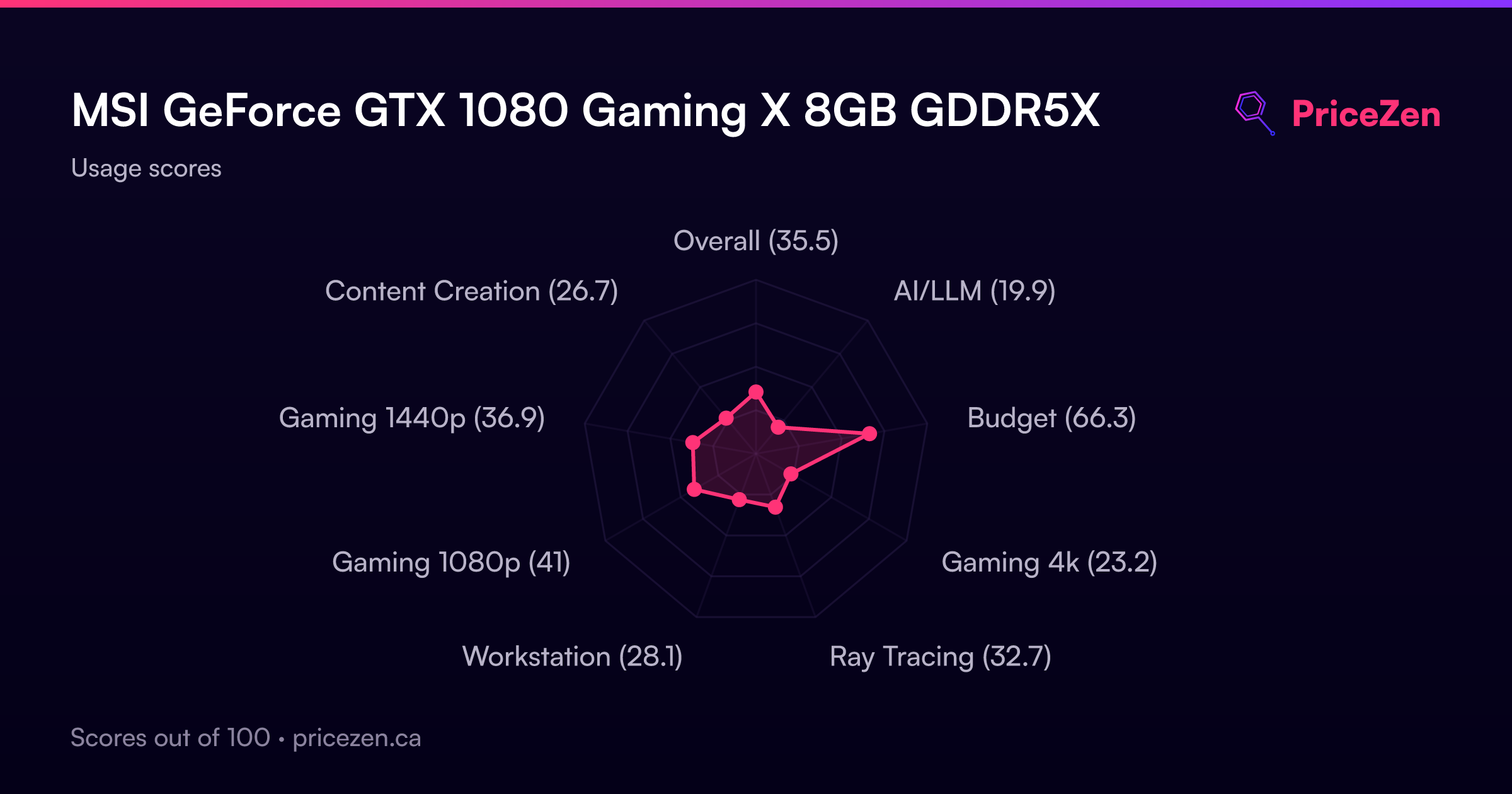
Usage Scores
- Overall35.5
- AI/LLM19.9
- Budget66.3
- Gaming 4k23.2
- Ray Tracing32.7
- Workstation28.1
- Gaming 1080p41
- Gaming 1440p36.9
- Content Creation26.7