Gigabyte Radeon RX 6900 XT 16GB GDDR6
Built on the 7nm RDNA 2 architecture with 80 ray accelerators and a 2250MHz boost clock, this card delivers native 4K gaming through a 16GB GDDR6 frame buffer with a 512 GB/s bandwidth. Its compact 267mm dual-slot design and 300W TDP make it a relatively manageable fit for smaller cases compared to triple-slot alternatives. This GPU is best for 4K gamers who prioritize high VRAM capacity and Radeon Anti-Lag responsiveness over content creation workloads.

No current retailer price








Snapshot
The 30-Second Version
The Gigabyte Radeon RX 6900 XT 16G is a last-gen AMD flagship with strong rasterization performance and 16GB of VRAM, but it runs hot and draws a lot of power. At $996 USD, it's overpriced compared to newer alternatives. Only worth buying if you find it heavily discounted on the used market.
Pros & Cons
Pros
- 16GB VRAM is plenty for 4K textures and mods 80th
- Strong rasterization performance for the price 74th
- Ray tracing is better than most AMD cards from this era 70th
- 512 GB/s memory bandwidth keeps frame times smooth 70th
- Compact 267mm length fits in most mid-tower cases
Cons
- Thermals are terrible, one of the worst in our database
- 300W TDP means you need a beefy 850W PSU
- Only 2 DisplayPort and 1 HDMI output
- Customer reviews are nearly nonexistent and negative
- Priced too close to newer, better cards
What owners think
The Word on the Street
How owner sentiment changed over time
ExclusiveBased on when customers actually wrote their reviews - so you can see whether early praise held up.
3 written reviews, Dec 2020 – Aug 2021: 1 mixed, 2 unhappy
Across all 3 store ratings: 2.2★. The chart counts the 3 written reviews.
Each dot is one written review, in the month it was written. Happy = 4-5★, mixed = 3★, unhappy = 1-2★.
The proof
Performance
Let's talk raw numbers. The RX 6900 XT scores 26,652 on PassMark G3D, which lands it well above average for rasterization performance. In practice, that means 1440p gaming at high refresh rates is totally doable, and 4K gaming is on the table for most titles if you're willing to tweak settings. The 16GB of VRAM is a genuine advantage here, especially for texture-heavy games and modded setups. You won't hit VRAM limits the way you might on an 8GB card.
Ray tracing is where things get interesting. The card scores in the 80th percentile for ray tracing, which sounds impressive until you remember that AMD's first-gen ray tracing hardware was never as strong as Nvidia's. In games with heavy RT effects, you'll see frame rates drop noticeably. It's playable, but don't expect RTX 40-series or 50-series level ray tracing performance. The compute numbers are solid too, with 23.04 FP32 TFLOPS, but content creation is the weakest area at 49.4 out of 100. If you're doing heavy video editing or 3D rendering, this card will get the job done, but it won't be fast about it.
Specifications
Full Specifications
Chipset
| GPU Chipset | Radeon RX 6900 XT |
| Brand | AMD |
| Architecture | RDNA 2 |
| Class | consumer |
| Process | 7 |
Memory
| VRAM | 16 GB |
| Memory Type | GDDR6 |
| Memory Bus | 256 |
| Bandwidth | 512 |
Compute
| RT Cores | 80 |
| Base Clock | 2015 |
| Boost Clock | 2250 |
| FP16 TFLOPS | 46.08 |
| FP32 TFLOPS | 23.04 |
Performance
| PassMark G3D | 26652 |
| GPU Compute | 14391 |
Power & Cooling
| TDP | 300 |
| Recommended PSU | 850 |
Connectivity
| Interface | PCI Express 4.0 |
| DisplayPort | 2 |
| HDMI | 1 |
| USB-C | 1 |
| Max Resolution | 3840x2160 |
Physical
| Length | 267 |
| Slot Width | 2 |
| Form Factor | Full Height |
| Weight | 2.0 kg / 4.5 lbs |
Features
| Ray Tracing | Yes |
| Upscaling | AMD FidelityFX |
| VR Ready | Yes |
vs Competition
The RX 6900 XT sits in an awkward middle ground right now. Compared to the ASUS TUF RTX 5090, it's not even in the same conversation, that card costs way more and delivers way more performance. But against something like the MSI Ventus RTX 5070 Ti, the 6900 XT actually holds its own in pure rasterization. The 5070 Ti is newer, more efficient, and has better ray tracing, but the 6900 XT's 16GB of VRAM matches it and the raw compute numbers are competitive.
The Sapphire NITRO+ is probably the most interesting comparison since it's also an AMD card. Sapphire's cooling solutions are generally better than Gigabyte's reference-style designs, and the NITRO+ cards tend to run cooler and quieter. If you're set on AMD and want a 6900 XT, the Sapphire version is the one to hunt for. The ZOTAC APOCALYPSE and PNY ARGB OC are both RTX 50-series cards that outclass the 6900 XT in efficiency and features, though they may cost more depending on availability.
| Spec | Gigabyte Radeon RX 6900 XT | ASUS GeForce RTX 5080 PRIME EVO OC | MSI GeForce RTX 5070 Ti Ventus 3X OC | ZOTAC GeForce RTX 5080 APOCALYPSE | Sapphire Radeon RX 7900 XTX NITRO+ | PNY GeForce RTX 5080 ARGB OC |
|---|---|---|---|---|---|---|
| Chipset | Radeon RX 6900 XT | GeForce RTX 5080 | GeForce RTX 5070 Ti | GeForce RTX 5080 | Radeon RX 7900 XTX | GeForce RTX 5080 |
| Vram | 16GB GDDR6 | 16GB GDDR7 | 16GB GDDR7 | 16GB GDDR7 | 24GB GDDR6 | 16GB GDDR7 |
| Boost Clock Mhz | 2250 | 2685 | 2482 | 2730 | 2680 | 2620 |
| Tdp W | 300 | 360 | 300 | 360 | 339 | 360 |
| Memory Bus Bits | 256 | 256 | 256 | 256 | 384 | 256 |
| Ray Tracing | true | true | true | true | true | true |
| GPU Class | consumer | consumer | consumer | consumer | consumer | consumer |
| Compare | Compare | Compare | Compare | Compare |
| Product | AI | Rt | Vram | Raster | Compute | Feature | Thermal | Efficiency | Connectivity | Social Proof | Affordability |
|---|---|---|---|---|---|---|---|---|---|---|---|
| Gigabyte Radeon RX 6900 XT | 73.8 | 80.4 | 70 | 70.1 | 66.3 | 65.8 | 6.3 | 46.6 | 35.7 | 1.2 | 24.7 |
| ASUS GeForce RTX 5080 PRIME EVO OC Compare | 85.4 | 97.6 | 89.1 | 94.5 | 93.4 | 88.7 | 91.8 | 56.7 | 94.1 | 93.3 | 18.2 |
| MSI GeForce RTX 5070 Ti Ventus 3X OC Compare | 79.1 | 92.4 | 85.9 | 89 | 88 | 95.8 | 91.8 | 71.7 | 94.1 | 83.8 | 23.4 |
| ZOTAC GeForce RTX 5080 APOCALYPSE Compare | 85.4 | 97.6 | 89.1 | 94.5 | 93.4 | 95.8 | 91.8 | 56.7 | 94.1 | 98.7 | 20.7 |
| Sapphire Radeon RX 7900 XTX NITRO+ Compare | 95.2 | 96.3 | 92 | 83.4 | 95.7 | 95.8 | 91.8 | 51.5 | 98.8 | 69.1 | 18.8 |
| PNY GeForce RTX 5080 ARGB OC Compare | 85.4 | 97.6 | 89.1 | 94.5 | 93.4 | 95.8 | 91.8 | 56.7 | 94.1 | 74.8 | 14.5 |
Price
Value & Pricing
At $996 USD, this card is in a tough spot. You can find newer cards with better efficiency, better ray tracing, and actual warranty support for similar money. The RX 6900 XT was a $999 card at launch back in 2020, so seeing it at basically the same price five years later is a bit absurd. The value proposition only makes sense if you find one significantly cheaper on the used market, maybe in the $500 to $600 range. At that point, the 16GB of VRAM and strong rasterization performance start to look appealing. But at full retail? You're paying new-card money for old-card thermals and no meaningful warranty.
Read more
Overview
The Gigabyte Radeon RX 6900 XT 16G is a last-gen flagship graphics card that still packs a serious punch in 2025. It's built on AMD's RDNA 2 architecture with 16GB of GDDR6 memory on a 256-bit bus, pushing 512 GB/s of bandwidth. The card runs at a 2250MHz boost clock and carries 80 ray tracing cores, which puts it in a weird spot: it's old enough to be discounted but powerful enough to handle 4K gaming without breaking a sweat in most titles.
People searching for this card usually want to know if it's still worth buying, especially with newer RDNA 3 and RTX 50-series cards on shelves. The short answer is that it depends on the price. At around $996 USD, it's competing against cards that are newer, cooler, and more efficient. But if you find one used or on sale, the raw rasterization performance is still nothing to sneeze at.
We pulled benchmark data from our database and the numbers tell an interesting story. The PassMark G3D score of 26,652 puts it in the upper tier of all graphics cards we track, but the thermal performance is a real problem. This card runs hot, and that's not just us being picky, it's one of the worst thermal performers in our entire database.
Common Questions
Q: Is the Gigabyte RX 6900 XT good for 4K gaming?
Yes, the RX 6900 XT can handle 4K gaming in most titles, especially with settings tuned. The 16GB of VRAM and 512 GB/s bandwidth help with high-resolution textures, though you may need to dial back ray tracing settings.
Q: How much power does the RX 6900 XT need?
The card has a 300W TDP and Gigabyte recommends an 850W power supply. Make sure your PSU has the right connectors and enough headroom for the rest of your system.
Q: Is the RX 6900 XT better than the RTX 5070 Ti?
In pure rasterization, the RX 6900 XT is competitive with the RTX 5070 Ti, but the 5070 Ti wins on ray tracing, efficiency, and thermals. The 6900 XT's 16GB of VRAM matches the 5070 Ti, but the newer card is the better overall package.
Q: Does the RX 6900 XT support ray tracing?
Yes, the RX 6900 XT has 80 ray tracing cores and supports hardware ray tracing through AMD's RDNA 2 architecture. Performance in ray tracing is decent but falls behind Nvidia's RTX cards from the same era and newer generations.
Who Should Skip This
Skip this card if you care about thermals, power efficiency, or ray tracing performance. Content creators should also look elsewhere, the 49.4 out of 100 content creation score is a weak spot. If you're building a new system, the MSI Ventus RTX 5070 Ti or Sapphire NITRO+ are better picks. And if you're on a budget, there are plenty of used RTX 3080s and RX 6800 XTs that offer similar performance with better thermals for less money. This card only makes sense for someone who specifically wants a 6900 XT and finds one at a steep discount.
Verdict
Should you buy the Gigabyte RX 6900 XT 16G? Only if you find it at a steep discount. The card's core performance is still respectable, and the 16GB of VRAM gives it legs for future games. But the thermal situation is genuinely bad, the power draw is high, and the customer feedback we've seen is not encouraging. One reviewer called it overpriced at $1400, and honestly, even at $996 it's hard to argue with that sentiment.
If you're building a new system in 2025, you're better off looking at newer options. If you're upgrading an older AMD build and spot this card for $500 to $600 used, it's worth considering. Just make sure your case has good airflow and your power supply can handle the 300W TDP. This card runs hot, and it needs room to breathe.
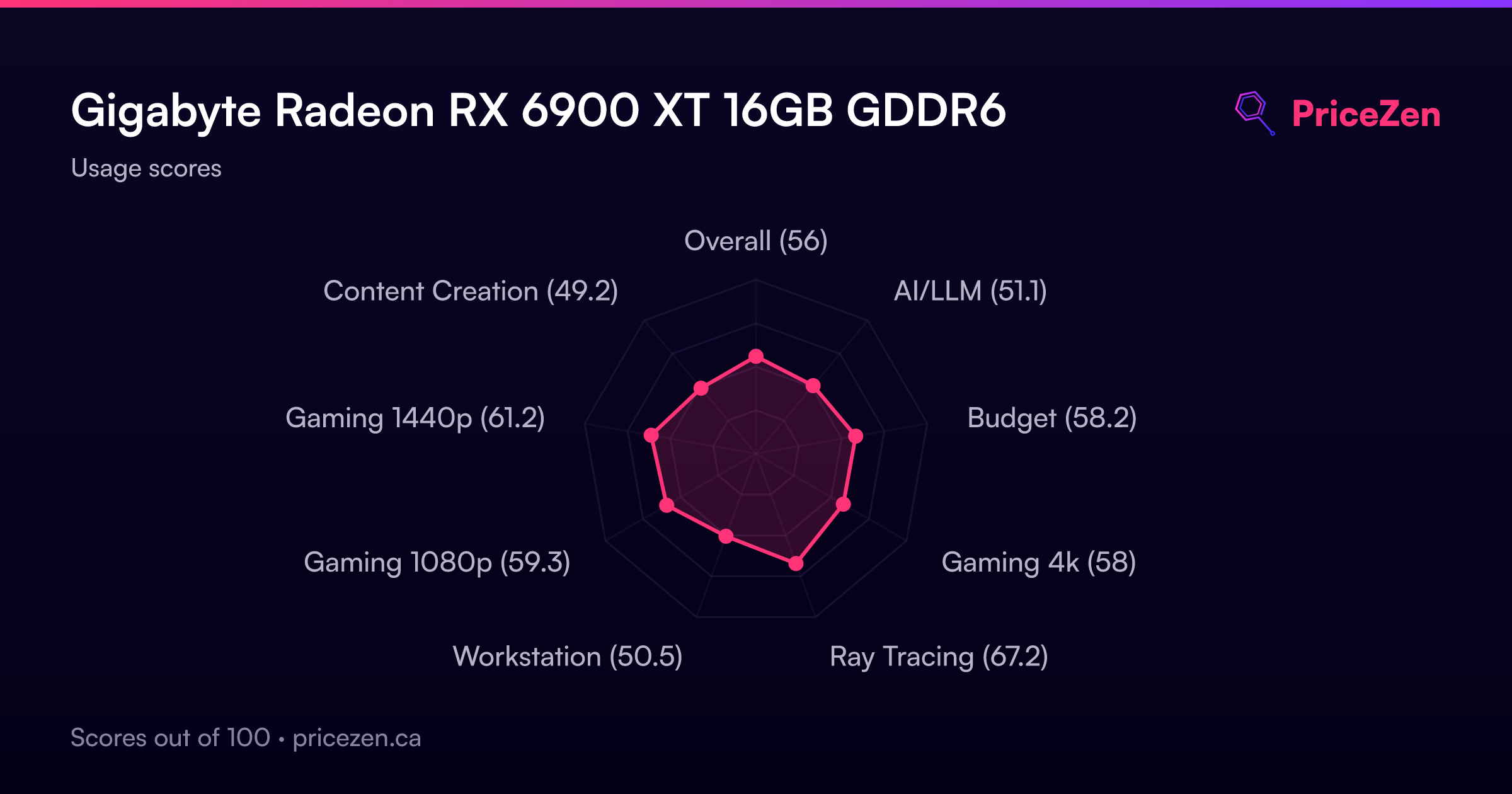
Usage Scores
- Overall56
- AI/LLM51.1
- Budget58.6
- Gaming 4k58
- Ray Tracing67.2
- Workstation50.5
- Gaming 1080p59.2
- Gaming 1440p61.2
- Content Creation49.2