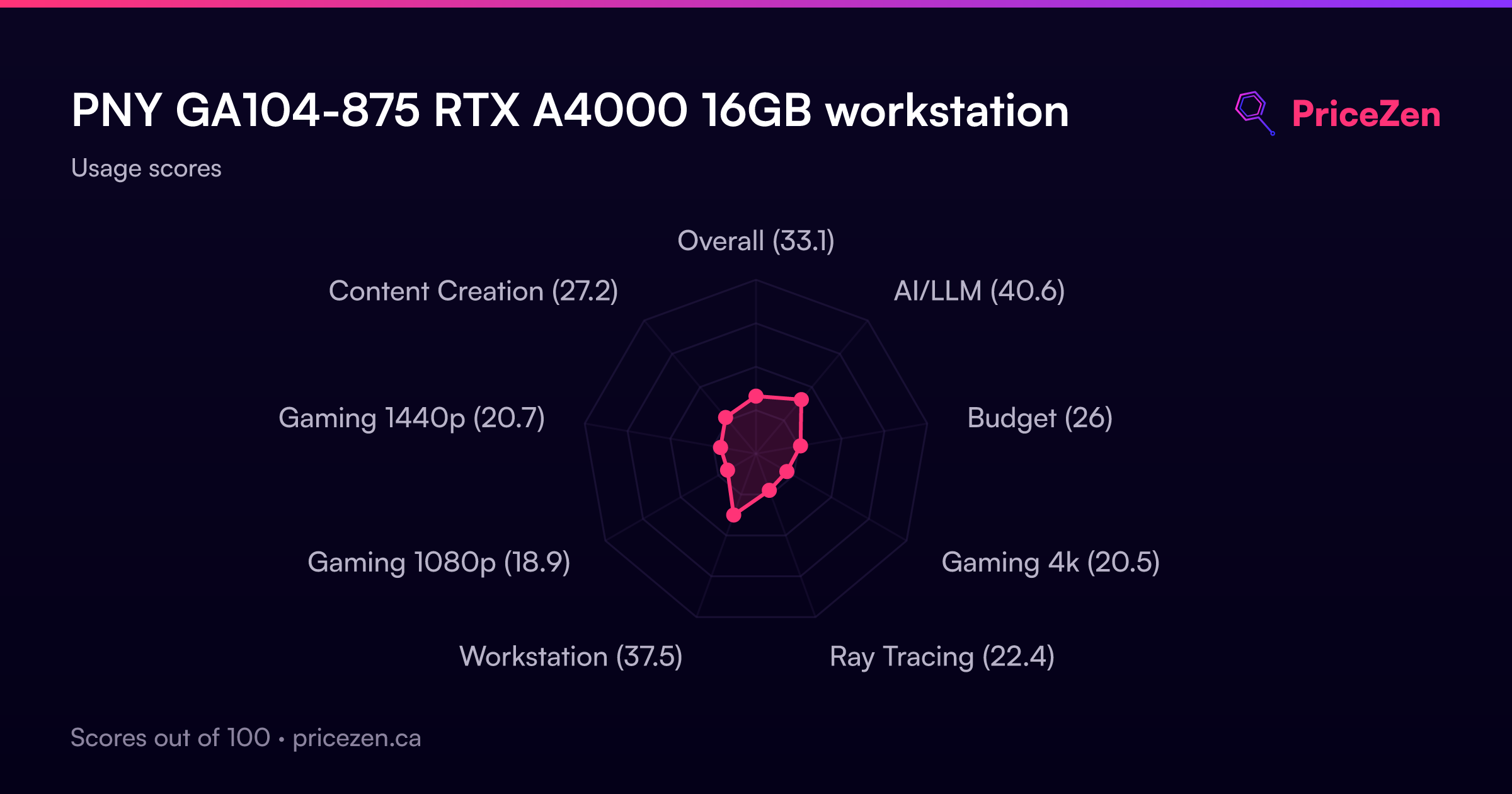
PNY GA104-875 RTX A4000 16GB workstation
The GA104-875 Ampere chip delivers 6144 CUDA cores, 192 third-gen Tensor cores, and 48 second-gen RT cores, pushing 19.2 TFLOPS in a single-slot, full-length form factor that fits most workstation chassis. Its 16GB of memory and 140W TDP balance compute density with power efficiency, making it a practical upgrade for deskside workstations. Best for professionals running AI inference or rendering workloads who need ray tracing and CUDA acceleration without occupying multiple PCIe slots.

No current retailer price











Snapshot
The 30-Second Version
The RTX A4000 scores 34.4 out of 100 overall, with raster and compute both at the 22nd percentile. Its 16GB of VRAM and 153.4 TFLOPS of tensor throughput keep AI work at the 67th percentile, but thermals are a rough 7th percentile. It's a single-slot, 140W specialist card, not a general-purpose performer.
Pros & Cons
Pros
- Single-slot design fits compact workstations and multi-GPU rigs 66th
- 140W TDP is easy on power supplies and thermals for the class
- 16GB of VRAM lands at the 63rd percentile, solid for AI and rendering
- 153.4 TFLOPS of tensor throughput keeps AI workloads at the 67th percentile
- 6144 CUDA cores still deliver 19.2 TFLOPS of FP32 for pro apps
Cons
- Raster performance sits at the 22nd percentile, well behind modern GPUs
- Compute ranking is also 22nd percentile, weak for a workstation card
- Thermal performance is just the 7th percentile, the blower cooler struggles
- Connectivity is near the bottom at the 5th percentile, no display outputs on this variant
- Overall score of 34.4 out of 100 makes it hard to justify at current prices
The proof
Performance
Let's talk numbers. The A4000 pushes 19.2 TFLOPS of FP32 from 6144 CUDA cores, 153.4 TFLOPS of tensor throughput from 192 third-gen Tensor Cores, and 37.4 TFLOPS of ray tracing from 48 second-gen RT Cores. Those are respectable Ampere numbers, but our database ranks raster performance at the 22nd percentile and compute at the 22nd percentile. Translation: this card is well behind the current crop of consumer and pro GPUs when it comes to raw rendering and number crunching. The 16GB of VRAM helps, landing at the 63rd percentile, so memory capacity isn't the bottleneck. The architecture is.
Ray tracing is a weak spot too, sitting at the 32nd percentile. The 48 RT cores are second-gen Ampere units, which means they lack the efficiency improvements from Ada Lovelace and Blackwell. For AI work, the story is better. The 67th percentile AI ranking reflects the 153.4 TFLOPS of tensor performance and the 16GB frame buffer, which is enough for smaller model fine-tuning and inference. But don't expect this to hang with a modern 32GB workstation card. It won't.
Specifications
Full Specifications
Chipset
| GPU Chipset | GA104-875 |
| Brand | NVIDIA |
| Architecture | Ampere |
| Class | workstation |
Memory
| VRAM | 16 GB |
Compute
| CUDA Cores | 6144 |
| Tensor Cores | 192 |
| RT Cores | 48 |
Power & Cooling
| TDP | 140 |
Connectivity
| Interface | PCIe |
Physical
| Slot Width | 1 |
| Form Factor | Full Height |
| Weight | 0.9 kg / 2.0 lbs |
Features
| Ray Tracing | Yes |
vs Competition
Against the current field, the A4000 gets lapped in raw performance. The ASUS TUF RTX 5090 with 32GB absolutely destroys it in raster, compute, and AI, though it costs far more and draws way more power. The Gigabyte AERO RTX 5070 Ti and MSI Ventus RTX 5070 Ti both offer dramatically better gaming and rendering performance at similar or lower prices, with 16GB of VRAM matching the A4000. The ZOTAC APOCALYPSE and Sapphire NITRO+ cards also outclass it in most workloads. The A4000's only real advantage is the single-slot, 140W envelope. If you don't need that specific form factor, every competitor here is a better buy.
| Spec | PNY GA104-875 RTX A4000 | ASUS GeForce RTX 5090 TUF Gaming | Gigabyte GeForce RTX 5070 Ti Eagle Ice | MSI GeForce RTX 5070 Ti Ventus 3X OC | ZOTAC GeForce RTX 5080 APOCALYPSE | Sapphire Radeon RX 9070 XT PULSE |
|---|---|---|---|---|---|---|
| Chipset | GA104-875 | GeForce RTX 5090 | GeForce RTX 5070 Ti | GeForce RTX 5070 Ti | GeForce RTX 5080 | Radeon RX 9070 XT |
| Vram | 16GB | 32GB GDDR7 | 16GB GDDR7 | 16GB GDDR7 | 16GB GDDR7 | 16GB GDDR6 |
| Boost Clock Mhz | - | 2407 | 2542 | 2482 | 2730 | 2970 |
| Tdp W | 140 | 575 | 300 | 300 | 360 | 304 |
| Memory Bus Bits | - | 512 | 256 | 256 | 256 | 256 |
| Ray Tracing | true | true | true | true | true | true |
| GPU Class | workstation | consumer | consumer | consumer | consumer | consumer |
| Compare | Compare | Compare | Compare | Compare |
| Product | AI | Rt | Vram | Raster | Compute | Feature | Thermal | Efficiency | Connectivity | Social Proof | Affordability |
|---|---|---|---|---|---|---|---|---|---|---|---|
| PNY GA104-875 RTX A4000 | 66.4 | 31.5 | 63.1 | 21.4 | 23.3 | 33.8 | 6.5 | 21.9 | 5.3 | 25 | 20.8 |
| ASUS GeForce RTX 5090 TUF Gaming Compare | 97.1 | 90.5 | 97.7 | 98.8 | 97.7 | 95.9 | 72.3 | 24.1 | 99.3 | 98.7 | 2.3 |
| Gigabyte GeForce RTX 5070 Ti Eagle Ice Compare | 79.6 | 88.6 | 86 | 89 | 88.2 | 95.9 | 91.7 | 72.2 | 94.1 | 93.3 | 26.7 |
| MSI GeForce RTX 5070 Ti Ventus 3X OC Compare | 79.6 | 92.5 | 86 | 89 | 88.2 | 95.9 | 91.7 | 72.2 | 94.1 | 83.7 | 23 |
| ZOTAC GeForce RTX 5080 APOCALYPSE Compare | 85.7 | 97.6 | 89 | 94.5 | 93.5 | 95.9 | 91.7 | 57.1 | 94.1 | 98.7 | 20.2 |
| Sapphire Radeon RX 9070 XT PULSE Compare | 89.3 | 84.7 | 73.8 | 75.3 | 90.2 | 95.9 | 72.3 | 45.6 | 88.9 | 93.3 | 43.3 |
Price
Value & Pricing
Value is where this card gets painful. The US listing sits at $1,317, while European prices swing wildly from EUR 1,535 to EUR 3,541 across four listings. That's a EUR 2,006 spread for the same card, which is absurd. If you're in Europe, the EUR 1,535 listing is the only one worth considering, and even that feels steep for a card with a 21st percentile affordability ranking. You're paying for the single-slot form factor and the pro driver certification, not raw performance. For most buyers, that math doesn't work.
Price history
Read more
Overview
The RTX A4000 is a weird card to score in 2025. It's a workstation GPU built for CAD, rendering, and AI prototyping, and on paper the specs still sound serious: 6144 CUDA cores, 16GB of ECC-capable GDDR6, 19.2 TFLOPS of FP32, and a 140W TDP in a single-slot package. But our database puts its overall score at 34.4 out of 100, and the percentile rankings tell a harsher story. AI workloads land at the 67th percentile, which is decent, but raster and compute both sit at the 22nd percentile. That's a big gap between what the marketing says and where this card actually lands against modern competition.
The single-slot form factor and 140W power draw are the real selling points here. You can drop this into a compact workstation or a multi-GPU rig without melting your power supply or blocking every adjacent slot. But you're paying a premium for that form factor, and the thermal ranking is rough, just the 7th percentile. A blower-style cooler on a 140W card in a cramped chassis means noise and heat are part of the deal. If you need CUDA cores in a slim box, this still makes sense. If you just want raw performance per dollar, it's a tough sell.
Common Questions
Q: Is the RTX A4000 good for gaming?
Not really. Gaming at 1080p scores just 20.8 out of 100, which is the card's weakest area. The 48 second-gen RT cores and 6144 CUDA cores are tuned for pro workloads, not high-refresh gaming. You'd be much better off with a consumer card like the RTX 5070 Ti at this price point.
Q: Can the RTX A4000 handle AI and machine learning workloads?
Yes, within limits. The 192 third-gen Tensor Cores deliver 153.4 TFLOPS of tensor throughput, and the 16GB of VRAM is enough for smaller model fine-tuning and inference. Our database ranks its AI performance at the 67th percentile, which is solid but not exceptional. For large model training, you'll want more memory and newer tensor cores.
Q: Does the single-slot design cause thermal problems?
It can. The card's thermal performance ranks at just the 7th percentile in our database. The blower-style cooler has to dissipate 140W through a single slot, which means high fan speeds and noticeable noise under sustained load. In a well-ventilated chassis it's manageable, but in a cramped workstation it will get toasty.
Who Should Skip This
Skip this if you have a standard ATX case and a normal power supply. The 22nd percentile raster and compute scores mean you're getting far less performance per dollar than a modern consumer card. The 7th percentile thermal ranking also makes it a poor choice for quiet builds. And if you need display outputs, look elsewhere, this variant's connectivity sits at the 5th percentile. Unless the single-slot, 140W form factor is a hard requirement, there's no reason to pay $1,317 or EUR 1,535 for this level of performance.
Verdict
The RTX A4000 is a niche card that still makes sense for a narrow set of users. If you need CUDA compute in a single-slot chassis with a 140W power ceiling, this is basically your only option, and the 16GB of VRAM plus 153.4 TFLOPS of tensor throughput will handle AI prototyping and pro rendering tasks. But the 22nd percentile raster and compute scores, the 7th percentile thermals, and the 5th percentile connectivity make it a poor value for anyone with a standard ATX case and a normal power supply. At $1,317 or EUR 1,535, you're paying a huge premium for the form factor.
Usage Scores
- Overall33.1
- AI/LLM40.6
- Budget26
- Gaming 4k20.5
- Ray Tracing22.4
- Workstation37.5
- Gaming 1080p18.9
- Gaming 1440p20.7
- Content Creation27.2