VisionTek Radeon HD 7750 Eye 4 2GB GDDR5
The Radeon HD 7750 chipset drives four independent displays via 4x Mini DisplayPort outputs, with 2GB GDDR5 memory and a 178mm low-profile design that fits SFF workstations. Its 70-watt power draw works with a 350W PSU, and the built-in audio delivers 7.1 surround to each screen without extra cables. Best for digital signage setups in retail or hospitality that need multi-screen output from a single compact card, though its 2.3/5 customer rating suggests reliability concerns.

No current retailer price











Snapshot
The 30-Second Version
The VisionTek Radeon HD 7750 Eye 4 is a low-profile, single-slot graphics card built for driving four displays via mini DisplayPort. It's aimed at digital signage and business multi-monitor setups, not gaming. Performance is weak by modern standards, and the price is high for what you get, but it fills a niche that few other cards do.
Pros & Cons
Pros
- Four mini DisplayPort outputs for multi-display setups 82nd
- Low-profile, single-slot design fits slim SFF desktops
- Runs off a standard 350W power supply
- Independent 7.1 audio per display via miniDP
- 178mm length fits in compact cases
Cons
- Very weak 3D performance, 11th percentile for raster
- Only 2GB VRAM, 8th percentile in our database
- Loud fan and questionable cooling, per customer reviews
- Dated GPU architecture from 2012
- Expensive for the raw performance you get
What owners think
The Word on the Street
How owner sentiment changed over time
ExclusiveBased on when customers actually wrote their reviews - so you can see whether early praise held up.
7 written reviews, Feb 2016 – Apr 2026: 2 happy, 5 unhappy
Across all 4 store ratings: 2.3★. The chart counts the 7 written reviews.
Each dot is one written review, in the month it was written. Happy = 4-5★, mixed = 3★, unhappy = 1-2★.
The proof
Performance
Let's be clear about what this card is and isn't. The Radeon HD 7750 scores 1701 on PassMark G3D. That puts it in the 11th percentile for raster performance among all GPUs in our database. In plain English: this is one of the weakest cards we track for anything resembling modern gaming or 3D work. The 800 MHz core clock and 2GB of GDDR5 won't get you far in anything demanding. You could maybe run older titles or esports games at low settings on a single display, but that's not what this card is for.
Where it does its job is multi-display output. The four mini DisplayPort connections can run in clone, independent, or extended modes, and the card supports discrete digital multi-point audio, so you can send 7.1 surround to each display independently. That's genuinely useful for digital signage where you want different content and audio on each screen without running multiple PCs. The 120W TDP is modest, and VisionTek says it can run off a factory 350W power supply, which is a real plus for business machines that weren't built with GPU upgrades in mind.
Specifications
Full Specifications
Chipset
| GPU Chipset | Radeon HD 7750 |
| Brand | AMD |
| Class | consumer |
Memory
| VRAM | 2 GB |
| Memory Type | GDDR5 |
| Memory Bus | 128 |
Compute
| Base Clock | 800 |
Performance
| PassMark G3D | 1701 |
| GPU Compute | 805 |
Power & Cooling
| TDP | 120 |
| Recommended PSU | 350 |
| Power Connectors | 2 x 8-Pin |
| Cooler | Single Fan |
| Fans | 1 |
Connectivity
| Interface | PCI Express 3.0 x16 |
| DisplayPort | 4 |
| HDMI | 0 |
| Max Displays | 4 |
Physical
| Length | 178 |
| Slot Width | 1 |
| Form Factor | Low Profile |
| Weight | 0.5 kg / 1.1 lbs |
Features
| Ray Tracing | No |
| DirectX | 11 |
vs Competition
Stacked against the competition in our database, this card is in a strange spot. The top competitors we track, like the Gigabyte Eagle RTX 5070 Ti, ASUS TUF Gaming RTX 5070 Ti, and MSI Shadow RTX 5070 Ti, are in a completely different universe. Those cards are built for 4K gaming and heavy workstation loads, with 16GB of VRAM and performance scores that make the HD 7750 look like a calculator. But they're also huge, power-hungry, and cost many times more. They won't fit in a slim SFF case, and they need serious power supplies.
The Sapphire NITRO+ and ZOTAC SOLID SFF OC are closer in spirit to what this VisionTek card tries to do, though they're still far more powerful. The ZOTAC SOLID SFF OC, in particular, targets the small form factor market. If you need a compact card that can actually game or handle content creation, that's a much better route. The VisionTek's only real advantage is the four miniDP ports and the ability to run off a 350W PSU. For pure multi-display signage on a budget, it's a niche pick. For anything else, look elsewhere.
| Spec | VisionTek Radeon HD 7750 Eye 4 | Gigabyte GeForce RTX 5070 Ti Eagle Ice | MSI GeForce RTX 5070 Ti Ventus 3X OC | ASUS GeForce RTX 5070 Ti TUF Gaming OC | Sapphire Radeon RX 7900 XTX NITRO+ | PNY GeForce RTX 5070 Ti OC |
|---|---|---|---|---|---|---|
| Chipset | Radeon HD 7750 | GeForce RTX 5070 Ti | GeForce RTX 5070 Ti | GeForce RTX 5070 Ti | Radeon RX 7900 XTX | GeForce RTX 5070 Ti |
| Vram | 2GB GDDR5 | 16GB GDDR7 | 16GB GDDR7 | 16GB GDDR7 | 24GB GDDR6 | 16GB GDDR7 |
| Boost Clock Mhz | - | 2542 | 2482 | 2610 | 2680 | 2450 |
| Tdp W | 120 | 300 | 300 | 300 | 339 | 300 |
| Memory Bus Bits | 128 | 256 | 256 | 256 | 384 | 256 |
| Ray Tracing | false | true | true | true | true | true |
| GPU Class | consumer | consumer | consumer | consumer | consumer | consumer |
| Compare | Compare | Compare | Compare | Compare |
| Product | AI | Rt | Vram | Raster | Feature | Thermal | Efficiency | Connectivity | Social Proof | Affordability |
|---|---|---|---|---|---|---|---|---|---|---|
| VisionTek Radeon HD 7750 Eye 4 | 7.2 | 10.9 | 8.3 | 11 | 10.6 | 25.1 | 9.9 | 47.2 | 1.2 | 82.1 |
| Gigabyte GeForce RTX 5070 Ti Eagle Ice Compare | 79.1 | 88.7 | 85.9 | 89 | 95.8 | 91.8 | 71.7 | 94.1 | 93.3 | 24.1 |
| MSI GeForce RTX 5070 Ti Ventus 3X OC Compare | 79.1 | 92.4 | 85.9 | 89 | 95.8 | 91.8 | 71.7 | 94.1 | 83.8 | 23.5 |
| ASUS GeForce RTX 5070 Ti TUF Gaming OC Compare | 79.1 | 92.4 | 85.9 | 89 | 95.8 | 91.8 | 71.7 | 99.3 | 93.3 | 22.1 |
| Sapphire Radeon RX 7900 XTX NITRO+ Compare | 95.2 | 96.3 | 92 | 83.4 | 95.8 | 91.8 | 51.5 | 98.8 | 69.1 | 18.8 |
| PNY GeForce RTX 5070 Ti OC Compare | 79.1 | 92.4 | 85.9 | 89 | 65.8 | 91.8 | 71.7 | 81.5 | 93.3 | 26 |
Price
Value & Pricing
Value is tricky here. At CAD 424 or MXN 6,899, you're paying a premium for a very specific feature: four mini DisplayPort outputs in a low-profile card. If that's exactly what you need for a digital signage deployment, the price might be justified because alternatives are scarce. But if you just need a basic GPU for a home office PC or light gaming, this is a terrible deal. You can find far more capable cards for less money. The 82nd percentile affordability score in our database reflects that it's cheaper than many high-end cards, but that's damning with faint praise when the performance is this low.
Price history
Read more
Overview
The VisionTek Radeon HD 7750 Eye 4 is a niche card aimed squarely at digital signage and multi-display business setups. It's not a gaming card, and it's not trying to be. The whole pitch is four mini DisplayPort outputs on a low-profile, single-slot card that sips power. If you're searching for a cheap way to drive four monitors from one PC for retail, hospitality, or office use, this is one of the few cards that does it without needing a beefy power supply. The 2GB of GDDR5 on a 128-bit bus is modest by today's standards, but for static signage or basic productivity across four screens, it's enough.
Pricing is all over the place. We see it listed around CAD 424 in Canada and MXN 6,899 in Mexico. That's a lot of money for a card based on a GPU from 2012, but you're paying for the unusual four miniDP configuration, not raw performance. The low-profile bracket and SFF design mean it fits in slim desktops and workstations where most modern cards simply won't go.
One thing to know up front: this card has a 2.3 out of 5 rating from just four reviews in our database. That's a tiny sample, but it's not a great sign. The card works for its intended purpose, but the cooling solution draws complaints, and the overall feature set is dated.
Common Questions
Q: Is the VisionTek Radeon HD 7750 good for gaming?
No, not really. With a PassMark G3D score of 1701 and 2GB of VRAM, it's in the 11th percentile for raster performance in our database. You might run older or very light esports titles at low settings, but this card is built for multi-display output, not gaming.
Q: Can the VisionTek Radeon HD 7750 run four monitors?
Yes, that's its main selling point. It has four mini DisplayPort outputs and can drive up to four displays in clone, independent, or extended modes, with independent 7.1 audio per display.
Q: Does the VisionTek Radeon HD 7750 need a big power supply?
No. VisionTek says it runs off a standard 350W power supply, which is a big plus for business desktops and slim workstations that weren't built for GPU upgrades.
Q: Is the VisionTek Radeon HD 7750 low profile?
Yes. It comes with a low-profile bracket installed and can be converted to a standard ATX height with the included bracket. The card is 178mm long and single-slot, so it fits in slim SFF cases.
Who Should Skip This
Skip this card if you're building or upgrading a gaming PC, a content creation rig, or anything that needs real 3D performance. The 2GB of VRAM and 11th percentile raster score make it a poor fit for modern games, video editing, or 3D rendering. If you need a low-profile card for light gaming or general use, look at something like the ZOTAC SOLID SFF OC or other compact cards with more VRAM and better cooling. And if you only need one or two displays, there are cheaper, quieter, and more capable options that won't leave you stuck with a loud fan and dated architecture.
Verdict
Should you buy the VisionTek Radeon HD 7750 Eye 4? Only if you have a very specific need: driving four displays from a slim, low-power business PC for digital signage or basic productivity. In that narrow lane, it's a functional, if dated, solution. The four miniDP outputs and independent audio per display are genuinely useful features that most modern cards don't offer in this form factor.
But for everyone else, this is a hard pass. The gaming performance is nearly nonexistent by today's standards, the 2GB of VRAM is a serious limitation, and the cooling solution draws complaints even from the few people who bought it. The price is high for what you get, and the tiny review pool with a 2.3 average rating doesn't inspire confidence. If you need a low-profile card for general use, there are better options. If you need gaming or content creation, this isn't even in the conversation.
Usage Scores
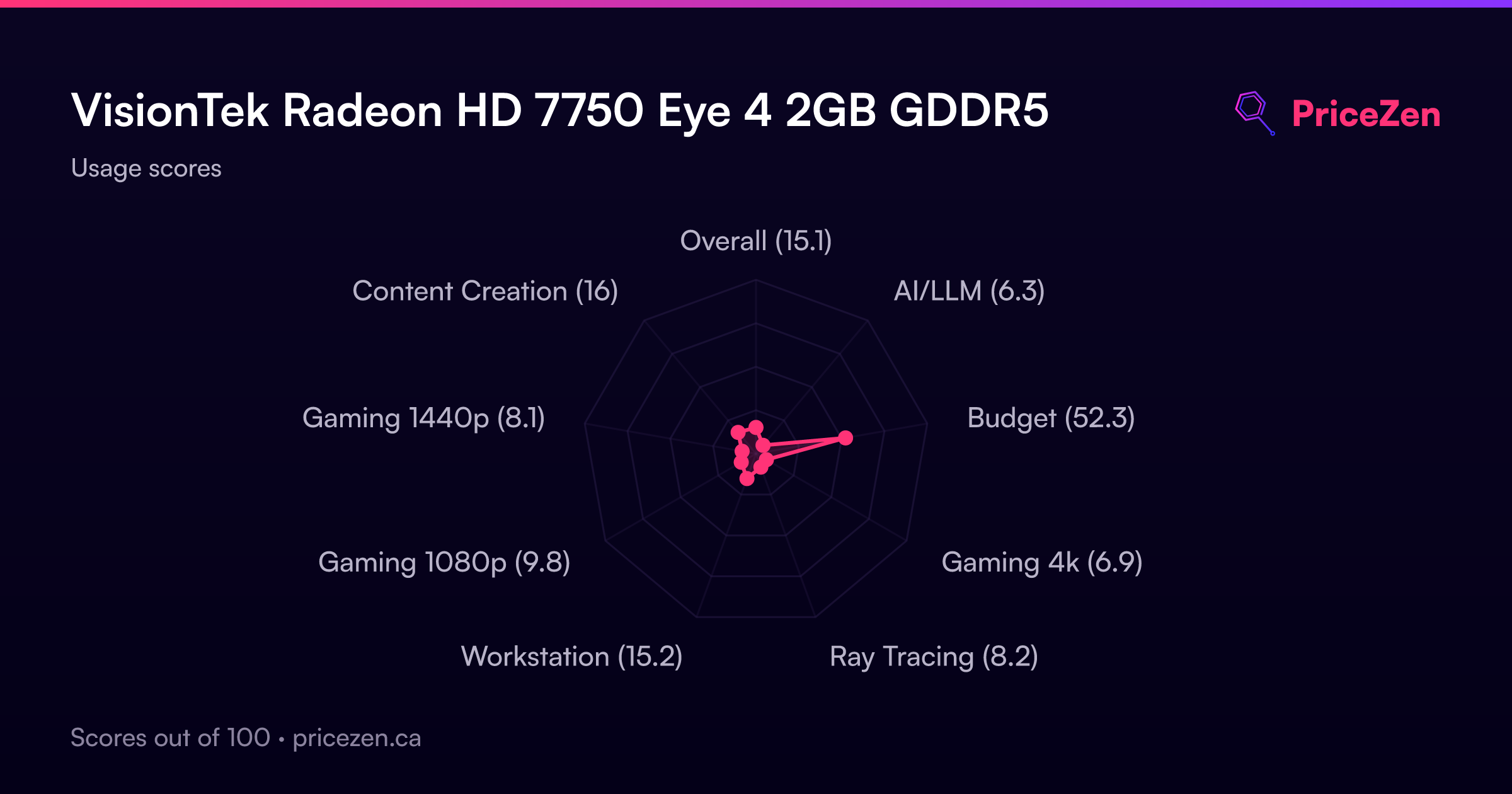
- Overall15.1
- AI/LLM6.3
- Budget52.3
- Gaming 4k6.9
- Ray Tracing8.2
- Workstation15.2
- Gaming 1080p9.8
- Gaming 1440p8.1
- Content Creation16