Sparkle Arc A310 4GB GDDR6
The Sparkle Arc A310 ECO stands out with its exclusive 50W TBP design and compact single-slot, low-profile form factor that fits into the tightest small form factor builds. It uniquely offers modern AV1 encoding and full ray tracing hardware on a 4GB GDDR6 card that requires no external power connector. This card is best for home theater PC builders or office users needing modern media encode/decode in a slim chassis, not for gaming or AI workloads.

No current retailer price











Snapshot
The 30-Second Version
The Sparkle Arc A310 ECO scores 70.7 out of 100 for budget builds and carries a 4.6-star rating from 437 reviews. It's a 50W, single-slot, low-profile transcoding specialist with AV1 encode support that owners consistently praise for media server duty. Just don't expect much from the 5445 PassMark score in games, and be ready to deal with the fan noise.
Pros & Cons
Pros
- 50W TBP means it runs in almost any system, even with a 350W PSU 84th
- AV1 encode support makes it a transcoding workhorse for media servers 84th
- Single-slot, low-profile design at 156mm fits in tiny cases 72nd
- Plug-and-play Linux compatibility, no driver headaches reported
- 4.6 out of 5 stars from 437 reviews, social proof in the 89th percentile
Cons
- PassMark G3D of 5445 puts raster performance in the 16th percentile
- 4GB VRAM on a 64-bit bus is a hard limit for modern games
- Fan noise is a recurring complaint, with surging and droning reported
- No ReBAR support causes roughly 40% performance loss in some workloads
- AI and compute scores are near the bottom, 14th and 4th percentile
What owners think
The Word on the Street
How owner sentiment changed over time
ExclusiveBased on when customers actually wrote their reviews - so you can see whether early praise held up.
11 written reviews, Mar 2024 – Mar 2026: 10 happy, 1 unhappy
Across all 437 store ratings: 4.6★. Most owners rate without writing a review. The chart counts the 11 written reviews.
Each dot is one written review, in the month it was written. Happy = 4-5★, mixed = 3★, unhappy = 1-2★.
The proof
Performance
Let's talk about what this card actually does well. The PassMark G3D score of 5445 puts it in the 16th percentile for raster performance. That's not a typo. It's near the bottom of the barrel for raw graphics grunt. But here's the thing: nobody buying this card cares about that. The 96 Tensor cores and 6 RT cores are there for AV1 encoding and XeSS upscaling, not for Cyberpunk at ultra settings. The 4GB of GDDR6 at 15.5 Gbps on a 64-bit bus is enough for multiple simultaneous transcoding streams, which is exactly what the home server crowd wants. Owners report handling several streams at once without breaking a sweat.
The 50W TBP is the real flex here. That's lower than the reference A310's 75W TDP, and it means this card runs in systems with 350W power supplies without a hiccup. The efficiency score of 27th percentile seems unfair until you remember that the comparison set includes cards that do way more work. For what this card is designed to do, the power draw is excellent. The 1000MHz boost clock isn't going to win any awards, but it's stable and cool enough for a single-fan, single-slot design.
Specifications
Full Specifications
Chipset
| GPU Chipset | Arc A310 |
| Brand | Intel |
| Architecture | Xe HPG |
| Class | consumer |
Memory
| VRAM | 4 GB |
| Memory Type | GDDR6 |
| Memory Bus | 64 |
Compute
| Tensor Cores | 96 |
| RT Cores | 6 |
| Base Clock | 1000 |
| Boost Clock | 1000 |
Performance
| PassMark G3D | 5445 |
| GPU Compute | 2161 |
Power & Cooling
| TDP | 75 |
| Recommended PSU | 350 |
| Power Connectors | None |
| Cooler | Single Fan |
| Fans | 1 |
Connectivity
| Interface | PCIe Gen 4.0 x 8 |
| DisplayPort | 2 |
| HDMI | 1 |
| Max Resolution | 8K |
Physical
| Length | 156 |
| Slot Width | 1 |
| Form Factor | Low Profile |
| Weight | 0.2 kg / 0.4 lbs |
Features
| Ray Tracing | Yes |
| Upscaling | XeSS |
| AV1 Encode | Yes |
| DirectX | 12 Ultimate |
vs Competition
Stacked against the competition, the A310 ECO is playing a completely different game. The PNY OC VCG5070T16TFXPB1-O and ASUS PRIME PRIME-RTX5070-12G are RTX 5070 cards with 12-16GB of VRAM and raster performance that would embarrass this little Sparkle. The XFX Mercury RX-97TRGBBB9 and Gigabyte Gaming GV-R9070XTGAMING-16GD are Radeon 9070 XT cards aimed at 1440p and 4K gaming. The ZOTAC Solid OC ZT-B50700J-10P is another 5070 variant. Every single one of those cards costs significantly more and draws way more power. The A310 ECO isn't competing with them on frames per second. It's competing on size, power draw, and transcoding efficiency. If you need a GPU for a gaming rig, buy literally any of those competitors. If you need a GPU for a Plex server in a Dell Optiplex SFF, this is the one.
| Spec | Sparkle Arc A310 | Gigabyte GeForce RTX 5070 Ti Eagle Ice | ASUS GeForce RTX 5080 PRIME EVO OC | MSI GeForce RTX 5070 Ti Ventus 3X OC | ZOTAC GeForce RTX 5080 APOCALYPSE | Sapphire Radeon RX 7900 XTX NITRO+ |
|---|---|---|---|---|---|---|
| Chipset | Arc A310 | GeForce RTX 5070 Ti | GeForce RTX 5080 | GeForce RTX 5070 Ti | GeForce RTX 5080 | Radeon RX 7900 XTX |
| Vram | 4GB GDDR6 | 16GB GDDR7 | 16GB GDDR7 | 16GB GDDR7 | 16GB GDDR7 | 24GB GDDR6 |
| Boost Clock Mhz | 1000 | 2542 | 2685 | 2482 | 2730 | 2680 |
| Tdp W | 75 | 300 | 360 | 300 | 360 | 339 |
| Memory Bus Bits | 64 | 256 | 256 | 256 | 256 | 384 |
| Ray Tracing | true | true | true | true | true | true |
| GPU Class | consumer | consumer | consumer | consumer | consumer | consumer |
| Compare | Compare | Compare | Compare | Compare |
| Product | AI | Rt | Vram | Raster | Compute | Feature | Thermal | User Sentiment | Efficiency | Connectivity | Social Proof | Affordability |
|---|---|---|---|---|---|---|---|---|---|---|---|---|
| Sparkle Arc A310 | 14.5 | 18.5 | 16.1 | 15.4 | 5 | 71.6 | 25.2 | 45.4 | 25.8 | 33.6 | 83.8 | 83.6 |
| Gigabyte GeForce RTX 5070 Ti Eagle Ice Compare | 79.3 | 88.7 | 86 | 89 | 88 | 95.8 | 91.8 | 85.3 | 71.6 | 94.1 | 93.3 | 23.8 |
| ASUS GeForce RTX 5080 PRIME EVO OC Compare | 85.5 | 97.6 | 89.1 | 94.5 | 93.4 | 88.7 | 91.8 | 71.5 | 56.6 | 94.1 | 93.3 | 18.3 |
| MSI GeForce RTX 5070 Ti Ventus 3X OC Compare | 79.3 | 92.5 | 86 | 89 | 88 | 95.8 | 91.8 | 85.3 | 71.6 | 94.1 | 83.8 | 23.5 |
| ZOTAC GeForce RTX 5080 APOCALYPSE Compare | 85.5 | 97.6 | 89.1 | 94.5 | 93.4 | 95.8 | 91.8 | 99.5 | 56.6 | 94.1 | 98.7 | 20.7 |
| Sapphire Radeon RX 7900 XTX NITRO+ Compare | 95.2 | 96.3 | 92 | 83.4 | 95.6 | 95.8 | 91.8 | 85.3 | 51.5 | 98.8 | 69.1 | 18.8 |
Price
Value & Pricing
The value proposition here is genuinely interesting. At 70.7 out of 100 for budget builds, this card sits in the 83rd percentile for affordability. The price ranges from 255 GBP in the UK to 274-295 EUR across Spain, France, and Italy. That's not cheap for a card with 4GB of VRAM, but you're not paying for VRAM. You're paying for the AV1 encoder, the low-profile form factor, and the 50W power envelope. For a dedicated transcoding card in a home server, that's a fair deal. For anything else, it's a tough sell. The 4.6-star rating suggests most buyers knew exactly what they were getting into.
Price history
Read more
Overview
The Sparkle Arc A310 ECO is a weird little card, and we mean that as a compliment. It scores 70.7 out of 100 for budget builds, which puts it in the top 17% of cards for affordability. That's the story here: a 50W TBP, single-slot, low-profile card that sips power and still manages a PassMark G3D score of 5445. For a card this small, that's genuinely impressive. But the gaming score tells the other half of the story. 30.2 out of 100 for 1080p gaming is rough, and the 4GB of VRAM on a 64-bit bus is a real ceiling. This isn't a gaming card, and pretending otherwise would be silly.
What it is, according to the 437 reviews averaging 4.6 stars, is a transcoding monster. Owners keep calling it the king of small form factor transcoding, and the AV1 encode support plus plug-and-play Linux compatibility backs that up. The social proof sits at the 89th percentile, which means people are buying this thing and talking about it. The catch? User sentiment only lands at the 45th percentile. The fan noise complaints are loud, literally and figuratively. We'll get into that.
Common Questions
Q: Can this card handle 1080p gaming?
It can handle light 1080p gaming on older or less demanding titles, but the gaming score of 30.2 out of 100 and the 4GB VRAM on a 64-bit bus mean modern AAA games will struggle. The PassMark G3D score of 5445 puts it in the 16th percentile for raster performance.
Q: Will this fit in a small form factor case?
Yes. The card is 156mm long, single-slot, and low-profile. It comes with both full-size and low-profile brackets. The 50W TBP means it'll run on a 350W power supply, which is common in SFF and office PCs.
Q: Is this good for a Plex or Jellyfin server?
This is arguably the best use case for this card. The AV1 encode support and low power draw make it ideal for hardware transcoding. Owners report handling multiple simultaneous streams without issue, and Linux compatibility is plug-and-play.
Who Should Skip This
If you're building a gaming PC, skip this. The 30.2 out of 100 gaming score and 4GB of VRAM will frustrate you within a week. The raster performance sits in the 16th percentile, and the AI and compute scores are even worse at 14th and 4th percentile respectively. If you want to run local AI models or do any serious compute work, this card is not for you. The OpenVINO software is reportedly complex and unreliable, and the lack of ReBAR support causes significant performance loss in some workloads. And if you're sensitive to noise, the fan issues might drive you up the wall. This is a purpose-built transcoding card, and buying it for anything else is setting yourself up for disappointment.
Verdict
The Sparkle Arc A310 ECO is a specialist, and it knows it. The 4.6-star rating from 437 reviews isn't an accident. People who buy this card for transcoding love it. The AV1 encode support, 50W TBP, and single-slot low-profile design make it a near-perfect fit for small form factor media servers. The fan noise issue is real though, and it's the main reason user sentiment sits at just the 45th percentile. Multiple owners report needing firmware updates or manual fan curve tweaks to make it tolerable. If you're building a quiet home theater PC, factor that in. For light 1080p gaming, it'll manage older titles, but the 30.2 gaming score should temper expectations. This is a transcoding card first, everything else second.
Usage Scores
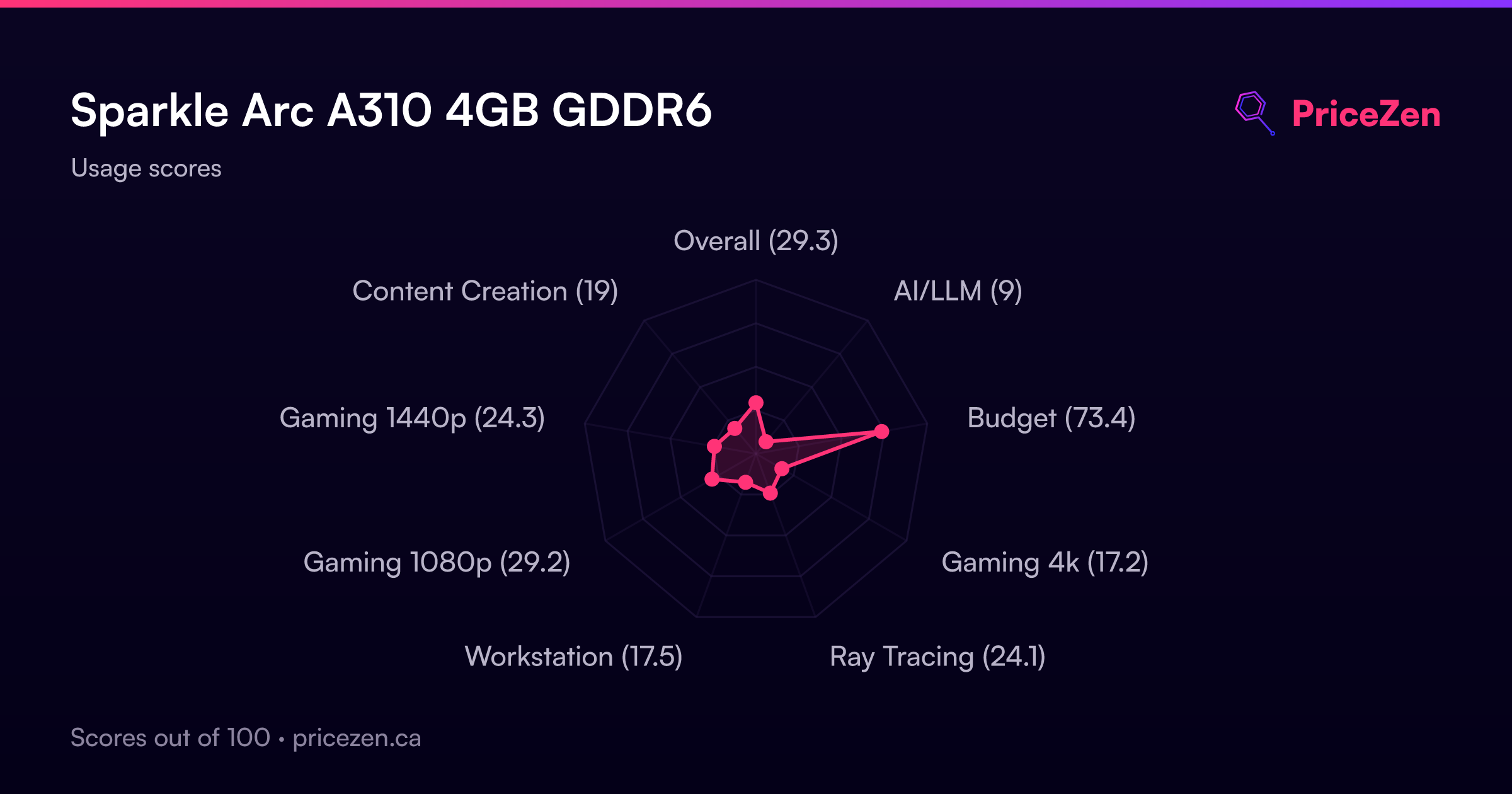
- Overall29.3
- AI/LLM9
- Budget73.4
- Gaming 4k17.2
- Ray Tracing24.1
- Workstation17.5
- Gaming 1080p29.2
- Gaming 1440p24.3
- Content Creation19