MSI GeForce RTX 3060 Ventus 2X OC 12GB GDDR6 Black
The 12GB of GDDR6 VRAM on a 192-bit bus stands out for memory-intensive tasks, providing a capacity advantage over typical 8GB cards in its class. The dual-fan Torx design keeps the factory-overclocked 1710MHz boost chip cool in a compact, dual-slot form factor suitable for smaller builds. This card is best for budget-conscious 3D rendering artists or AI hobbyists who need a large 12GB frame buffer but do not prioritize high-framerate 1080p gaming.












Snapshot
The 30-Second Version
The MSI RTX 3060 Ventus 2X 12G OC is a solid 1080p card with 12GB of VRAM and a huge happy user base. It's not a ray tracing monster, but for budget gaming and productivity it's a great buy. Just make sure you're paying the low end of the price range, ideally from Newegg.
Pros & Cons
Pros
- 12GB of VRAM is generous for a budget card and helps with texture-heavy games 93rd
- Rock-solid 1080p performance for the price 66th
- Easy installation, even in compact builds thanks to the 235mm length
- Massive user base with a 4.7-star average across 6,552 reviews
Cons
- Ray tracing performance is mediocre at best
- Fans get noisy under sustained load
- Not a great choice for 1440p high settings
- MSI's Dragon Center software is a recurring headache for owners
What owners think
The Word on the Street
How owner sentiment changed over time
ExclusiveBased on when customers actually wrote their reviews - so you can see whether early praise held up.
Happy owners: 87% lately, 100% in Oct 2021 – Jun 2024
Too few reviews to call that a change.
Across all 6,552 store ratings: 4.7★. Most owners rate without writing a review. The chart counts the 25 written reviews with stars and their own date.
35 reviews from months with approximate dates (the day we first saw a review) are left out of the trend.
8 written reviews without stars are left out of the trend.
Show the numbers
| Period | Reviews | Happy | Mixed | Unhappy | Happy share |
|---|---|---|---|---|---|
| Oct 2021 – Jun 2024 | 10 | 10 | 0 | 0 | 100% |
| Oct 2024 – Sep 2026 | 15 | 13 | 1 | 1 | 87% |
- Apr – Jun 20264 of 6 happy
Buyers praise the card for solid 1080p gaming performance, easy installation, quiet operation, and good value. One defect report and a software complaint are the main negatives.
- Strong 1080p performance at high/ultra settings; handles modern games and VRAM-intensive titles well.
- Easy installation, quiet fans, and cool temperatures during extended use.
- One verified review reports a faulty unit; a separate complaint about Dragon Center software for 3rd party apps.
- Good value for budget builds; effective upgrade from older cards like GTX 960, 1050 Ti, and 1080 Ti.
- Jan – Mar 202625 of 27 happy · 6 without stars
Buyers report flawless performance, quiet operation, and good value. The GPU delivers expected speed, high fps, and no reliability issues.
- Excellent performance with high fps and smooth gameplay across all games.
- Quieter than expected; noise levels are low and acceptable.
- Reliable with no crashes or problems after 6 months of use.
- Great value for a budget-friendly, popular graphics card.
- Oct – Dec 20253 of 3 happy
Buyers in Q4 2025 praised compute speed and multitasking stability for work; one noted minor compatibility setup for Linux/CUDA.
- CUDA compute performance is fast with 12GB memory, well-suited for AI workloads.
- Multitasking and dual-monitor stability flawless under heavy loads; no crashes.
- Linux/ROCM setup requires workarounds; DaVinci Resolve finicky initially.
- Compact, dual-fan design fits most cases; runs cool and quiet.
- Oct – Dec 20233 of 3 happy · 1 without stars
Gamers report excellent 1080p performance in most titles, with occasional RAM-related lag in heavy games. One reviewer upgraded from a dead 20-series with no issues.
- Excellent 1080p gaming performance; handles demanding games and shaders well.
- Some lag in Fortnite and heavy Minecraft shaders, but attributed to insufficient RAM (16GB).
- Easy upgrade from prior GeForce card; plug-and-play setup, quick delivery.
- Requires a 600W PSU (minimum), one reviewer had to upgrade from 500W.
Each column joins calendar quarters until it holds at least 10 reviews with stars and their own date. Happy = 4-5★, mixed = 3★, unhappy = 1-2★. Period summaries are in English.
The proof
Performance
For 1080p gaming, this card does the job. You'll hit 60+ fps in most titles at high settings, and the 12GB of VRAM gives you headroom that the 8GB cards in this price range just don't have. The PassMark G3D score of 16890 puts it in the middle of the pack for raster performance, around the 38th percentile. Ray tracing is a weak spot at the 47th percentile, so don't expect to crank RT effects in Cyberpunk. DLSS helps, but this is fundamentally a raster-first card. Compute lands at the 35th percentile, which is fine for casual workloads but nothing to write home about. The dual-fan cooler keeps things reasonable under normal load, though owners report it gets audible when pushed hard.
Specifications
Full Specifications
Chipset
| GPU Chipset | GeForce RTX 3060 |
| Brand | NVIDIA |
| Architecture | Ampere |
| Class | consumer |
| Process | 8 |
Memory
| VRAM | 12 GB |
| Memory Type | GDDR6 |
| Memory Bus | 192 |
| Bandwidth | 240 |
| ECC | No |
Compute
| CUDA Cores | 3584 |
| Tensor Cores | 120 |
| RT Cores | 30 |
| Base Clock | 1807 |
| Boost Clock | 1807 |
| FP16 TFLOPS | 12.74 |
| FP32 TFLOPS | 12.74 |
Performance
| PassMark G3D | 16890 |
| GPU Compute | 8110 |
Power & Cooling
| TDP | 170 |
| Recommended PSU | 550 |
| Power Connectors | 1 x 8-pin |
| Cooler | Dual Fan |
| Fans | 2 |
Connectivity
| Interface | PCI Express 4.0 |
| DisplayPort | 3 |
| HDMI | 1 |
| Max Displays | 4 |
| Max Resolution | 7680 x 4320 |
Physical
| Length | 235 |
| Slot Width | 2 |
| Form Factor | Full Height |
| Weight | 1.0 kg / 2.3 lbs |
Features
| Ray Tracing | Yes |
| Upscaling | DLSS |
| AV1 Encode | No |
| VR Ready | Yes |
| DirectX | 12 Ultimate |
| RGB | No |
vs Competition
Against newer cards like the ASUS Prime RTX 5070 or the Gigabyte RX 9070 XT, this 3060 gets smoked in raw performance. Those cards are in a completely different league for 1440p and 4K. But they also cost way more. The real comparison is against other budget options. The Sapphire Pulse and ASRock Steel Legend RX 9070 XT cards are faster, but if you're sticking to 1080p and want CUDA support for productivity work, the 3060 still makes sense. The 12GB VRAM is the differentiator here, it beats a lot of similarly priced 8GB cards for texture-heavy games and video editing.
| Spec | MSI GeForce RTX 3060 Ventus 2X OC | ASUS GeForce RTX 5070 PRIME | Sapphire Radeon RX 9070 XT PULSE | XFX Radeon RX 9070 XT Mercury | PowerColor Radeon RX 9070 XT Hellhound OC | Gigabyte Radeon RX 9070 XT Gaming |
|---|---|---|---|---|---|---|
| Chipset | GeForce RTX 3060 | GeForce RTX 5070 | Radeon RX 9070 XT | Radeon RX 9070 XT | Radeon RX 9070 XT | Radeon RX 9070 XT |
| Vram | 12GB GDDR6 | 12GB GDDR7 | 16GB GDDR6 | 16GB GDDR6 | 16GB GDDR6 | 16GB GDDR6 |
| Boost Clock Mhz | 1807 | 2512 | 2970 | 3100 | 3010 | 2970 |
| Tdp W | 170 | 250 | 304 | 304 | 304 | 304 |
| Memory Bus Bits | 192 | 192 | 256 | 256 | 256 | 256 |
| Ray Tracing | true | true | true | true | true | true |
| GPU Class | consumer | consumer | consumer | consumer | consumer | consumer |
| Compare | Compare | Compare | Compare | Compare |
| Product | AI | Rt | Vram | Raster | Compute | Feature | Thermal | User Sentiment | Efficiency | Connectivity | Social Proof | Affordability |
|---|---|---|---|---|---|---|---|---|---|---|---|---|
| MSI GeForce RTX 3060 Ventus 2X OC | 50.8 | 45.7 | 51 | 36.5 | 34.1 | 65.7 | 54.9 | 45.4 | 58.7 | 55.3 | 93.3 | 58.5 |
| ASUS GeForce RTX 5070 PRIME Compare | 61.2 | 82.9 | 65.2 | 79 | 71 | 95.8 | 91.8 | 71.5 | 78.7 | 94.1 | 93.3 | 44.7 |
| Sapphire Radeon RX 9070 XT PULSE Compare | 89.3 | 84.8 | 73.5 | 74.9 | 90 | 95.8 | 72.1 | 96 | 44.9 | 88.9 | 93.3 | 43.7 |
| XFX Radeon RX 9070 XT Mercury Compare | 89.5 | 84.8 | 75.1 | 74.9 | 91 | 95.8 | 72.1 | 96 | 44.9 | 94.1 | 93.3 | 43.2 |
| PowerColor Radeon RX 9070 XT Hellhound OC Compare | 89.7 | 84.8 | 75.1 | 74.9 | 95.1 | 88.7 | 91.8 | 96 | 44.9 | 94.1 | 47.9 | 41.1 |
| Gigabyte Radeon RX 9070 XT Gaming Compare | 89.5 | 77.9 | 73.5 | 74.9 | 90 | 95.8 | 91.8 | 58.1 | 44.9 | 88.9 | 74.8 | 27.3 |
Price
Value & Pricing
Pricing is all over the place right now. In the US, we're seeing listings from USD 300 to USD 679 across four vendors, which is a wild spread for a card this old. Newegg has the best deal at the low end, so if you're buying, that's where to look. In Canada, the gap is even worse, CAD 300 to CAD 1,123 across five listings. At the low end, this card is a steal. At the high end, you're getting fleeced. Shop around and don't pay more than the low end of that range.
Newegg 1 offer From CA$710
Amazon 1 offer From CA$1,111
Price history
Read more
Overview
The MSI RTX 3060 Ventus 2X 12G OC is the card you buy when you want solid 1080p gaming without selling a kidney. It's got 12GB of GDDR6 on a 192-bit bus, 3584 CUDA cores, and a 1807MHz boost clock. Nothing flashy, just a dependable Ampere card that still holds up in 2025 for budget builds.
Our database puts its social proof in the 95th percentile, which means a ton of people bought this thing and mostly liked it. The 1080p gaming score sits at 60.4 out of 100, which sounds modest until you remember this is a budget card competing against cards that cost twice as much. It's not a chart-topper, but it's a known quantity.
Common Questions
Q: Can this card handle 1440p gaming?
It can, but not at high settings in demanding titles. This card is happiest at 1080p, where the 12GB of VRAM and 3584 CUDA cores deliver smooth frame rates.
Q: Is the 12GB version worth it over the 8GB RTX 3060?
Yes, especially if you play texture-heavy games or do any video editing. The extra VRAM gives you more headroom and better longevity.
Q: What power supply do I need?
MSI recommends a 550W PSU, and the card needs a single 8-pin power connector. It draws 170W under load, so a quality 550W unit is plenty.
Who Should Skip This
Skip this if you're targeting 1440p high refresh rate or 4K gaming. The raster performance just isn't there, and ray tracing is a letdown. If you need serious AI or compute horsepower, the 41.8 out of 100 AI score tells the story, look at something with more tensor cores. And if you're sensitive to fan noise, the dual-fan cooler gets whiny under load.
Verdict
If you're building a budget 1080p rig or upgrading from something like a GTX 1060 or RX 580, this card is a no-brainer at the right price. It's also a solid pick for photo and video editing on a budget, thanks to the 12GB of VRAM and CUDA support. Just don't expect it to be a 1440p powerhouse or a ray tracing champ. Buy it for what it is: a dependable, well-supported 1080p workhorse.
Usage Scores
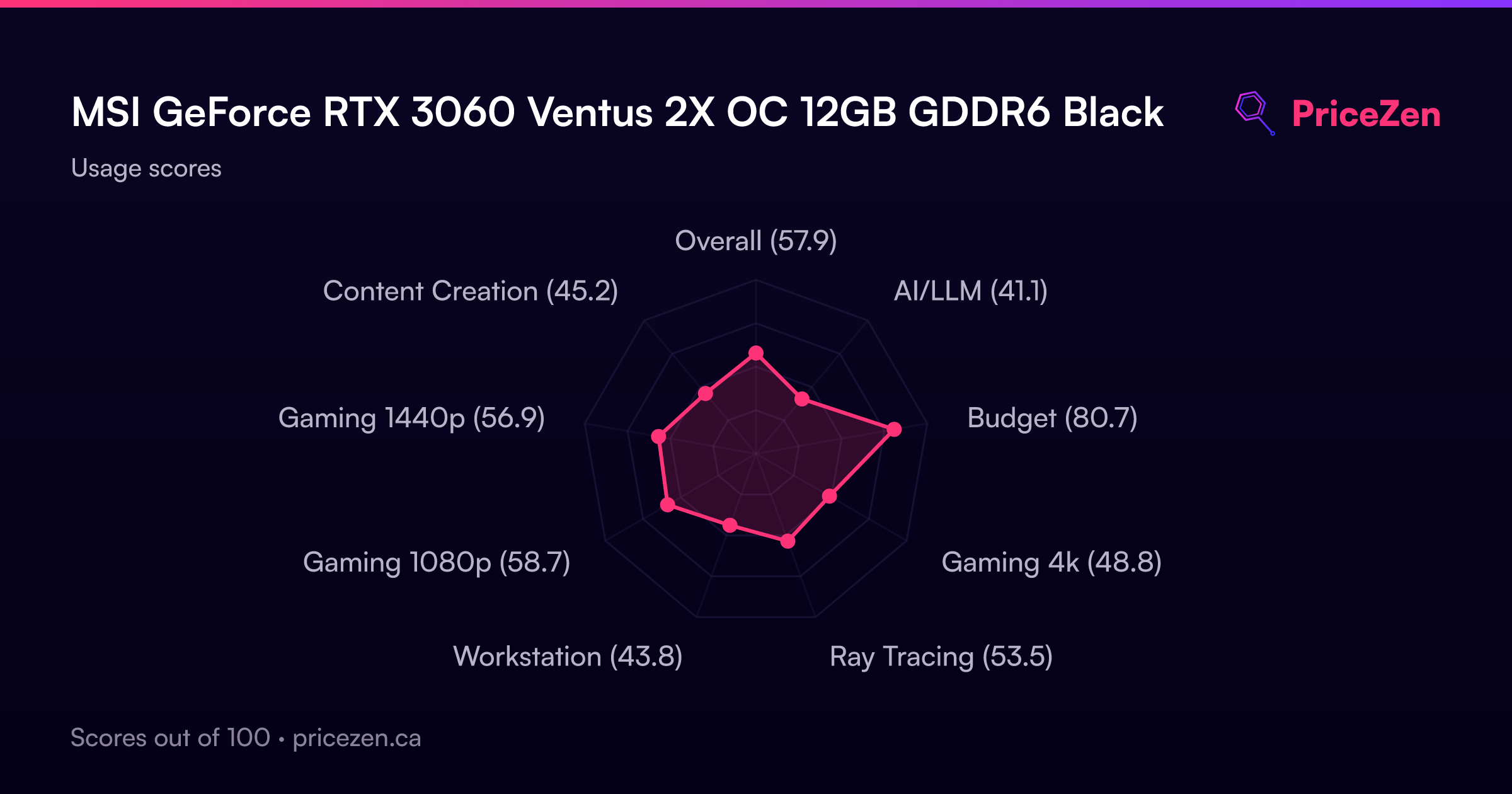
- Overall57.9
- AI/LLM41.1
- Budget80.7
- Gaming 4k48.8
- Ray Tracing53.4
- Workstation43.8
- Gaming 1080p58.7
- Gaming 1440p56.9
- Content Creation45.2