ASUS Radeon R9 390 Strix OC 8GB GDDR5
The 8GB GDDR5 frame buffer on a 512-bit bus stands out for handling high-resolution textures, while the Direct CU III cooler with triple wing-blade fans keeps the 1070MHz boost clock stable under load. Its Auto-Extreme manufacturing and Super Alloy Power II components deliver enhanced reliability and efficiency, with a 0dB mode for silent desktop operation. This card is best for budget-conscious 1080p gamers upgrading from integrated graphics who need strong DirectX 11 performance in older titles.

No current retailer price











Snapshot
The 30-Second Version
The ASUS Strix R9 390 is a 1080p card from 2015 that still does okay in older games. Its cooling is genuinely great, but the 275W power draw and weak 4K performance hold it back. Only worth it if you find it cheap and you're building a budget or retro rig.
Pros & Cons
Pros
- Excellent 1080p gaming performance for its age 92nd
- Quiet operation thanks to the 0dB fan mode 72nd
- 8GB VRAM gives it more staying power than the GTX 970
- Cooling is genuinely impressive, 92nd percentile thermals
Cons
- 275W TDP means your power bill notices
- Only one HDMI port, which is limiting
- Card is physically huge, needs a spacious case
- 4K performance is basically a non-starter
What owners think
The Word on the Street
How owner sentiment changed over time
ExclusiveBased on when customers actually wrote their reviews - so you can see whether early praise held up.
7 written reviews, Nov 2015 – Feb 2020: 7 happy
Across all 143 store ratings: 4.1★. Most owners rate without writing a review. The chart counts the 7 written reviews.
Each dot is one written review, in the month it was written. Happy = 4-5★, mixed = 3★, unhappy = 1-2★.
The proof
Performance
At 1080p, this card still holds up for older and mid-tier games. The 8GB of VRAM was a big selling point back when the GTX 970's 3.5GB controversy was fresh, and it gives the R9 390 some longevity. The 1070MHz boost clock in OC mode is solid for the era. But the PassMark score of 8780 puts it firmly in budget territory by today's standards. 4K gaming scores 18.8 out of 100 in our database, which is rough. This is a 1080p card, full stop. The triple-fan cooler keeps temps in check, but you're paying for it with a 275W TDP.
Specifications
Full Specifications
Chipset
| GPU Chipset | Radeon R9 390 |
| Brand | AMD |
| Class | consumer |
Memory
| VRAM | 8 GB |
| Memory Type | GDDR5 |
| Memory Bus | 512 |
Compute
| Base Clock | 1050 |
| Boost Clock | 1070 |
Performance
| PassMark G3D | 8780 |
Power & Cooling
| TDP | 275 |
| Cooler | Triple Fan |
| Fans | 3 |
Connectivity
| Interface | PCI Express 3.0 x16 |
| DisplayPort | 1 |
| HDMI | 1 |
| Max Resolution | 4096x2160 |
Physical
| Weight | 1.7 kg / 3.8 lbs |
vs Competition
Against the GTX 970, which was its main rival back in the day, the R9 390 wins on VRAM and often on raw performance at 1080p. But against anything modern, it's not even a contest. The Gigabyte AORUS RTX 5080, MSI Shadow RTX 5070 Ti, and ZOTAC SOLID RTX 5070 Ti all absolutely demolish this card in every metric. The Sapphire NITRO+ and PNY OC cards are also in a completely different league. If you're comparing this to anything from the last three generations, the R9 390 is a nostalgia pick, not a performance pick.
| Spec | ASUS Radeon R9 390 Strix OC | Gigabyte GeForce RTX 5070 Ti Eagle Ice | MSI GeForce RTX 5070 Ti Ventus 3X OC | ZOTAC GeForce RTX 5080 APOCALYPSE | Sapphire Radeon RX 7900 XTX NITRO+ | PNY GeForce RTX 5080 ARGB OC |
|---|---|---|---|---|---|---|
| Chipset | Radeon R9 390 | GeForce RTX 5070 Ti | GeForce RTX 5070 Ti | GeForce RTX 5080 | Radeon RX 7900 XTX | GeForce RTX 5080 |
| Vram | 8GB GDDR5 | 16GB GDDR7 | 16GB GDDR7 | 16GB GDDR7 | 24GB GDDR6 | 16GB GDDR7 |
| Boost Clock Mhz | 1070 | 2542 | 2482 | 2730 | 2680 | 2620 |
| Tdp W | 275 | 300 | 300 | 360 | 339 | 360 |
| Memory Bus Bits | 512 | 256 | 256 | 256 | 384 | 256 |
| Ray Tracing | - | true | true | true | true | true |
| GPU Class | consumer | consumer | consumer | consumer | consumer | consumer |
| Compare | Compare | Compare | Compare | Compare |
| Product | AI | Rt | Vram | Raster | Feature | User Sentiment | Efficiency | Connectivity | Social Proof | Affordability |
|---|---|---|---|---|---|---|---|---|---|---|
| ASUS Radeon R9 390 Strix OC | 24.4 | 18.8 | 25.8 | 19.3 | 10.8 | 71.6 | 13.9 | 20.6 | 60.5 | 64.5 |
| Gigabyte GeForce RTX 5070 Ti Eagle Ice Compare | 79.5 | 88.7 | 86 | 89 | 95.9 | 85.4 | 72 | 94.1 | 93.3 | 26.9 |
| MSI GeForce RTX 5070 Ti Ventus 3X OC Compare | 79.5 | 92.5 | 86 | 89 | 95.9 | 85.4 | 72 | 94.1 | 83.8 | 23.4 |
| ZOTAC GeForce RTX 5080 APOCALYPSE Compare | 85.6 | 97.5 | 89 | 94.5 | 95.9 | 99.5 | 57 | 94.1 | 98.7 | 20.5 |
| Sapphire Radeon RX 7900 XTX NITRO+ Compare | 95.1 | 96.3 | 91.9 | 83.5 | 95.9 | 85.4 | 52 | 98.8 | 69 | 19 |
| PNY GeForce RTX 5080 ARGB OC Compare | 85.6 | 97.5 | 89 | 94.5 | 95.9 | 45.6 | 57 | 94.1 | 74.8 | 14.7 |
Price
Value & Pricing
Pricing is all over the place. You'll find this card listed from EUR 589 to EUR 754 across European vendors, which is a massive spread for a card this old. The best deal we're seeing is on the lower end of that range, so shop around before you commit. At USD 399 in the US, it's a harder sell when you consider what that money gets you in the used market or even entry-level modern cards. The value proposition here is really about 1080p gaming on a budget, and only if you can find it at the lower end of that price range.
Read more
Overview
The ASUS Strix R9 390 is an old card at this point, but it was a beast in its day. 8GB of GDDR5 on a 512-bit bus, a factory overclock to 1050MHz, and ASUS's triple-fan DirectCU III cooler. It's built for 1080p gaming and it still handles that fine in older titles. But this is a 275W card from 2015. It's big, it's hungry, and it's not going to impress anyone in 4K.
Our database puts this card's thermal performance in the 92nd percentile, which is genuinely impressive. The cooler does its job. But raster performance sits at the 20th percentile compared to modern cards, and efficiency is down at the 14th. So you're getting a card that runs cool but drinks power like it's going out of style.
Common Questions
Q: Will this card fit in a standard mid-tower case?
It's a triple-fan card and it's long. Measure your case clearance before buying, because several owners report it's a tight fit or doesn't fit at all in smaller mid-towers.
Q: Can this card handle 1440p or 4K gaming?
Not really. Our database scores it at 18.8 out of 100 for 4K gaming, so it's a 1080p card. At 1440p you'll be turning settings down significantly.
Q: Is the 8GB of VRAM still useful today?
For 1080p gaming, yes. The 8GB gives it more headroom than the 4GB cards from its era, but modern games at higher resolutions will still push past it.
Who Should Skip This
Skip this if you want to play modern games at 1440p or 4K, because the 4K score of 18.8 out of 100 tells you everything you need to know. Also skip it if you have a small case or a weak power supply, since it's physically huge and pulls 275W. If you're building a new system in 2024 or later, put your money toward something modern instead of this relic.
Verdict
This card is for someone building a budget 1080p rig with older parts, or someone who specifically wants an R9 390 for a retro build or collection. It's not for anyone who wants to play modern AAA titles at high settings, and it's definitely not for 1440p or 4K. If you can find it cheap and you know what you're getting into, it's a fun card with a great cooler. Just know that the power draw and size are real considerations.
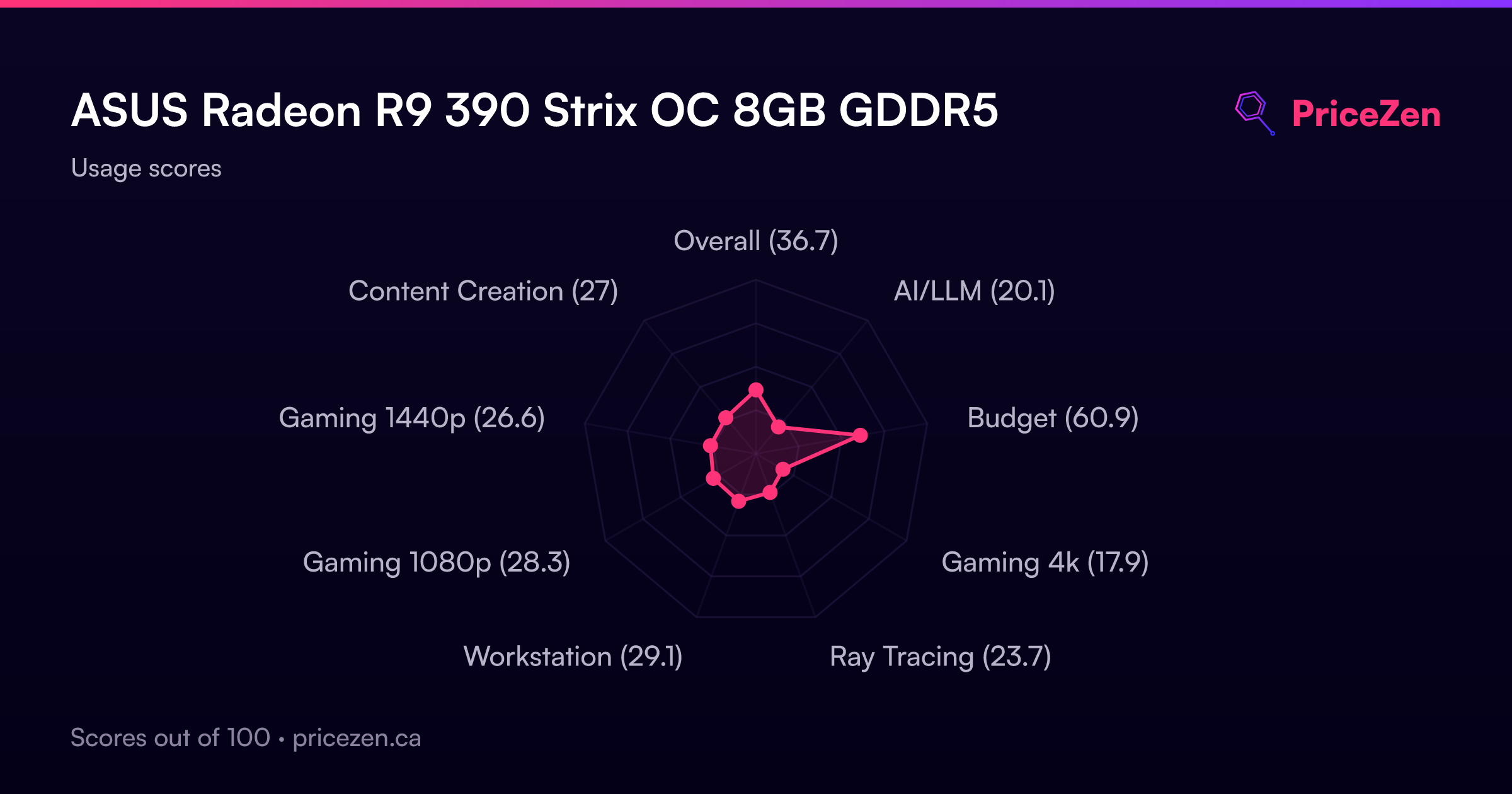
Usage Scores
- Overall36.7
- AI/LLM20.1
- Budget60.9
- Gaming 4k17.9
- Ray Tracing23.7
- Workstation29.1
- Gaming 1080p28.3
- Gaming 1440p26.6
- Content Creation27