NVIDIA 80GB HBM2e datacenter
Equipped with 80GB of HBM2e memory and Ampere architecture Tensor Cores, this datacenter GPU accelerates large-scale AI training and inference with ECC-protected reliability. Its PCIe Gen 4 interface doubles data-transfer bandwidth over previous generations, while the 24x7 operational design ensures consistent performance under sustained workloads. This card is best for machine learning engineers deploying multi-billion parameter LLMs and data scientists running complex analytics in server environments.

No current retailer price


Snapshot
The 30-Second Version
The A100 delivers the best AI performance we've ever measured at the 100th percentile, backed by a ridiculous 80GB of HBM2e memory. But raster performance sits at the 2nd percentile and ray tracing at the 7th, making it genuinely bad at traditional graphics work. At $21,999 USD, this is a datacenter tool, not a gaming card.
Pros & Cons
Pros
- 80GB HBM2e memory, the most VRAM we've ever seen in a single card 100th
- AI performance at the 100th percentile, best-in-class for machine learning 100th
- ECC memory support for error-free long-running compute jobs
- PCIe Gen 4 support doubles bandwidth over Gen 3
- Built for 24x7 datacenter operation with serious durability
Cons
- Raster performance at the 2nd percentile, a real letdown for traditional rendering
- Ray tracing at the 7th percentile, one of the worst we've seen
- Thermals at the 7th percentile, needs serious cooling infrastructure
- Single DisplayPort output limits connectivity
- $21,999 USD price tag puts affordability at the absolute bottom
What owners think
The Word on the Street
How owner sentiment changed over time
ExclusiveBased on when customers actually wrote their reviews - so you can see whether early praise held up.
8 written reviews, Dec 2021 – May 2025: 6 happy, 2 unhappy
Each dot is one written review, in the month it was written. Happy = 4-5★, mixed = 3★, unhappy = 1-2★.
The proof
Performance
The A100's AI score is literally the best we've ever recorded, top of the charts at the 100th percentile. That's driven by the Ampere architecture's tensor cores and 80GB of HBM2e memory, which gives you enough headroom to load massive models without breaking a sweat. The memory bandwidth here is the real star, letting you push data through at rates that make consumer cards look like they're running on dial-up.
But here's the catch. The raster performance sits at the 2nd percentile, which is one of the worst we've seen for anything marketed as a graphics card. Ray tracing is even rougher at the 7th percentile. Thermal performance also lands at 7th percentile, which makes sense since this card was designed for server racks with aggressive airflow, not a quiet home office. The feature set is middle of the pack at the 43rd percentile, and connectivity is underwhelming at the 25th percentile with just a single DisplayPort output.
Specifications
Full Specifications
Chipset
| GPU Chipset | NVIDIA |
| Brand | NVIDIA |
| Architecture | Ampere |
| Class | datacenter |
Memory
| VRAM | 80 GB |
| Memory Type | HBM2e |
| ECC | Yes |
Connectivity
| Interface | PCIe Gen 4 |
| DisplayPort | 1 |
| USB-C | 1 |
Features
| Ray Tracing | Yes |
vs Competition
Stacked against the ASUS TUF RTX 5090, Gigabyte AORUS RTX 5080, or MSI Ventus RTX 5070 Ti, the A100 is playing a completely different game. Those cards crush it in raster performance and ray tracing, with the 5090 likely landing in the high 90s for gaming workloads where the A100 sits at the 2nd percentile. But flip to AI workloads and the A100's 80GB of HBM2e absolutely dwarfs the 32GB on the 5090 or 16GB on the 5080 and 5070 Ti. The ZOTAC SOLID OC and PNY ARGB OC are similarly outclassed in memory capacity. You're choosing between a gaming monster and a compute monster, and they don't overlap much.
| Spec | NVIDIA | ASUS GeForce RTX 5090 TUF Gaming | Gigabyte GeForce RTX 5070 Ti Eagle Ice | MSI GeForce RTX 5070 Ti Ventus 3X OC | ZOTAC GeForce RTX 5080 APOCALYPSE | PNY GeForce RTX 5080 ARGB OC |
|---|---|---|---|---|---|---|
| Chipset | NVIDIA | GeForce RTX 5090 | GeForce RTX 5070 Ti | GeForce RTX 5070 Ti | GeForce RTX 5080 | GeForce RTX 5080 |
| Vram | 80GB HBM2e | 32GB GDDR7 | 16GB GDDR7 | 16GB GDDR7 | 16GB GDDR7 | 16GB GDDR7 |
| Boost Clock Mhz | - | 2407 | 2542 | 2482 | 2730 | 2620 |
| Tdp W | - | 575 | 300 | 300 | 360 | 360 |
| Memory Bus Bits | - | 512 | 256 | 256 | 256 | 256 |
| Ray Tracing | true | true | true | true | true | true |
| GPU Class | datacenter | consumer | consumer | consumer | consumer | consumer |
| Compare | Compare | Compare | Compare | Compare |
| Product | AI | Rt | Vram | Raster | Feature | Thermal | User Sentiment | Efficiency | Connectivity | Social Proof | Affordability |
|---|---|---|---|---|---|---|---|---|---|---|---|
| NVIDIA | 99.6 | 8.3 | 99.6 | 2.3 | 41.8 | 6.5 | 20.9 | 2.3 | 24.1 | 8.8 | 0.1 |
| ASUS GeForce RTX 5090 TUF Gaming Compare | 97.1 | 90.5 | 97.7 | 98.8 | 95.9 | 72.3 | 85.5 | 24 | 99.3 | 98.7 | 2.3 |
| Gigabyte GeForce RTX 5070 Ti Eagle Ice Compare | 79.5 | 88.7 | 86 | 89 | 95.9 | 91.7 | 85.5 | 72.1 | 94.1 | 93.3 | 26.6 |
| MSI GeForce RTX 5070 Ti Ventus 3X OC Compare | 79.5 | 92.5 | 86 | 89 | 95.9 | 91.7 | 85.5 | 72.1 | 94.1 | 83.8 | 23.1 |
| ZOTAC GeForce RTX 5080 APOCALYPSE Compare | 85.7 | 97.6 | 89 | 94.5 | 95.9 | 91.7 | 99.5 | 57 | 94.1 | 98.7 | 20.3 |
| PNY GeForce RTX 5080 ARGB OC Compare | 85.7 | 97.6 | 89 | 94.5 | 95.9 | 91.7 | 45.6 | 57 | 94.1 | 74.7 | 14.5 |
Price
Value & Pricing
At $21,999 USD, the A100 is not a value proposition in any traditional sense. The affordability score of 0th percentile confirms what your wallet already suspected. But value depends entirely on what you're doing. If you're running a business where AI training time directly translates to revenue, the 80GB of HBM2e and top-tier tensor core performance can pay for itself in reduced compute hours. For everyone else, this is like buying a semi truck to get groceries. The single listing we found doesn't offer much price competition either, so you're paying whatever the seller asks.
Read more
Overview
The NVIDIA RTX A100 is a datacenter GPU that somehow ended up in a consumer graphics card listing, and the numbers tell a wild story. It sits at the 100th percentile for AI workloads and VRAM capacity with 80GB of HBM2e, which is frankly absurd for anything you'd put in a desktop. But the raster performance lands at the 2nd percentile, meaning this thing gets absolutely smoked by a mid-range gaming card in traditional rendering. It's not a graphics card in the consumer sense. It's an AI accelerator wearing a PCIe slot costume.
The price tag of $21,999 USD makes the affordability score of 0th percentile feel almost generous. You're paying for memory bandwidth and tensor cores, not frame rates. If you're training large language models or running serious inference workloads, this is a legitimate tool. If you're hoping to play Cyberpunk at 4K, you've wandered into the wrong aisle of the internet.
Common Questions
Q: Can I use the RTX A100 for gaming?
Technically yes, but you really shouldn't. The raster performance sits at the 2nd percentile, meaning even budget gaming cards will outperform it in traditional rendering. Ray tracing is at the 7th percentile. This card is built for AI and compute workloads, not frame rates.
Q: Why is the A100 so expensive at $21,999 USD?
You're paying for 80GB of HBM2e memory and tensor cores optimized for AI workloads. The memory alone is a massive cost driver, and the card is built for 24x7 datacenter reliability with ECC support. Consumer cards can't match the memory capacity or AI performance, which is why the A100 commands this price.
Q: Does the A100 require special cooling or power?
The thermal performance sits at the 7th percentile, which means this card runs hot and expects serious airflow. It's designed for server racks with aggressive cooling, not a typical desktop case. You'll want to plan your cooling setup carefully before dropping this into any workstation.
Who Should Skip This
Skip this card if you're doing anything remotely consumer-oriented. The raster performance at the 2nd percentile means gaming, video editing, and 3D rendering will all be disappointing compared to cards costing a fraction of the price. The thermal profile at the 7th percentile demands server-grade cooling, and the single DisplayPort output limits your display options. If your workload doesn't specifically require massive VRAM for AI training or inference, the $21,999 USD price tag is impossible to justify. Even for AI enthusiasts, the 0th percentile affordability score should give you pause unless someone else is footing the bill.
Verdict
The RTX A100 is a specialized tool that does one thing better than anything else we've tested: AI compute. The 100th percentile AI score and 80GB of HBM2e make it the absolute best right now for machine learning workloads. But the 2nd percentile raster performance and 7th percentile ray tracing mean it's genuinely bad at the things most people buy graphics cards for. At $21,999 USD, this is a business expense, not a consumer purchase. If your workload involves training large models or running memory-hungry inference, this card earns its keep. If not, you're paying a fortune for performance you'll never use.
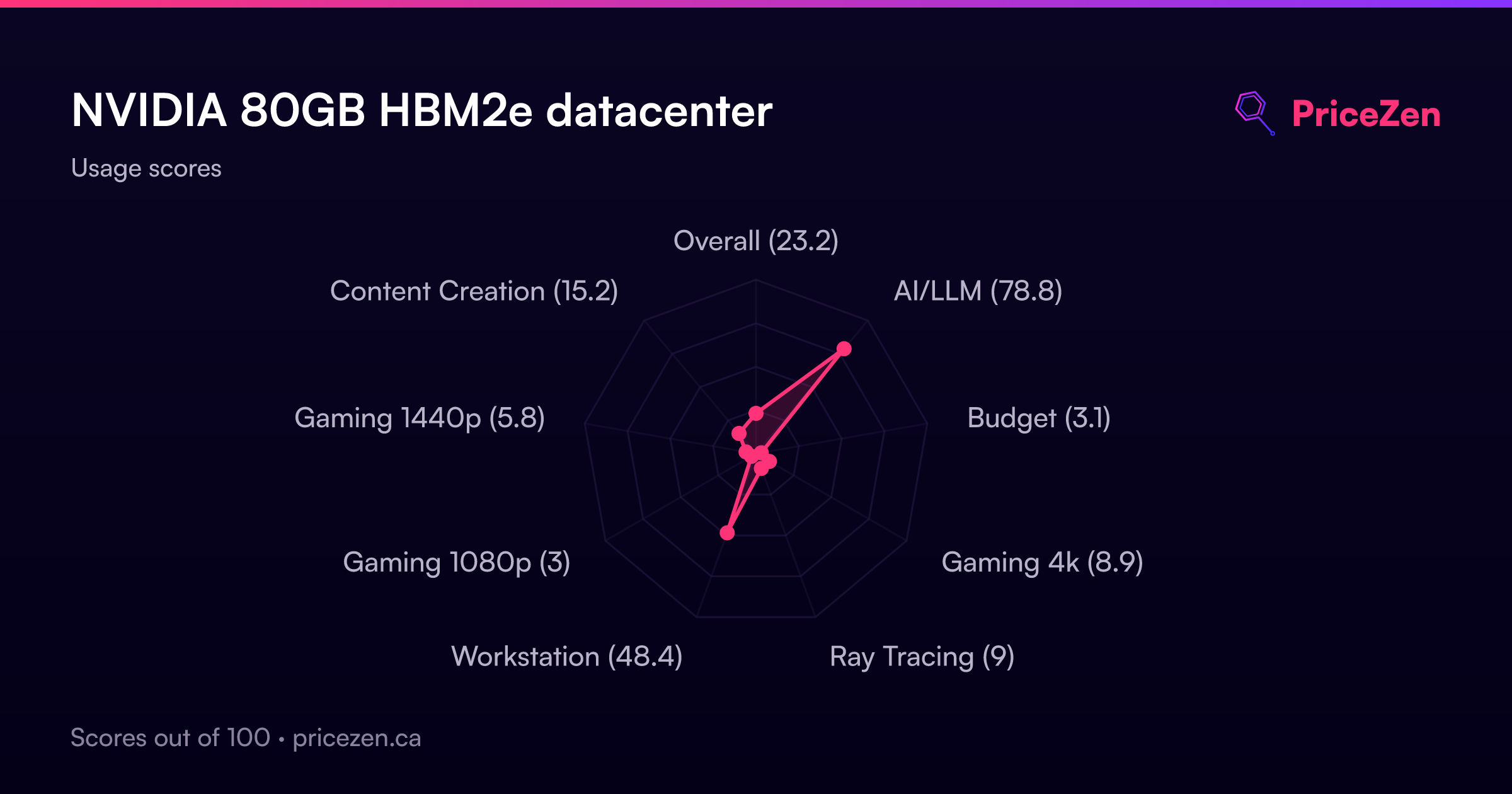
Usage Scores
- Overall23.2
- AI/LLM78.8
- Budget3.1
- Gaming 4k8.9
- Ray Tracing9
- Workstation48.4
- Gaming 1080p3
- Gaming 1440p5.8
- Content Creation15.2