NVIDIA RTX 4500 24GB GDDR6 workstation Black
Equipped with 24GB of ECC GDDR6 memory and 7,680 CUDA cores on the Ada Lovelace architecture, this card delivers reliable AI-powered graphics and real-time rendering in a compact dual-slot blower design. The inclusion of ECC memory ensures data integrity for precision workloads, making it a dependable choice for round-the-clock compute tasks. This GPU is best for engineers and AI developers running large language models or complex simulations where memory stability and 24GB of VRAM are critical.

No current retailer price
Snapshot
The 30-Second Version
The RTX 4500 Ada is a workstation powerhouse with 24GB of ECC VRAM and AI performance in the 91st percentile. It's expensive and the cooler gets loud, but for AI and pro workloads it's one of the best options out there. Buy it if your work demands ECC memory and certified drivers, skip it if you're gaming.
Pros & Cons
Pros
- 24GB of ECC VRAM is a lifesaver for long renders and AI workloads 92nd
- AI performance in the 91st percentile, best-in-class for LLM work 91st
- 210W TDP is remarkably efficient for this much compute 91st
- Compact dual-slot, 267mm length fits most workstation cases 82nd
Cons
- Only one DisplayPort and one HDMI, connectivity is a weak spot
- Blower cooler gets loud and thermal performance lags behind
- Price is brutal, affordability sits in the 7th percentile
- Ray tracing is merely solid, not a standout
The proof
Performance
The raw numbers tell the story. 39.63 FP32 TFLOPS and the same in FP16, backed by 24GB of ECC memory. That ECC matters more than most people realize when you're running multi-hour renders or training runs. The PassMark G3D score of 28,271 puts it well above average for raster work, and the AI score of 72.3 out of 100 is a standout. Ray tracing sits at a solid 70th percentile, which is fine but not the headline feature here. The blower cooler keeps the 210W TDP in check, though thermal performance lands near the bottom quarter of cards we've tested. Expect noise when this thing spools up.
Specifications
Full Specifications
Chipset
| GPU Chipset | RTX 4500 |
| Brand | NVIDIA |
| Architecture | Ada Lovelace |
| Class | workstation |
Memory
| VRAM | 24 GB |
| Memory Type | GDDR6 |
| ECC | Yes |
Compute
| CUDA Cores | 7680 |
| Tensor Cores | 240 |
| RT Cores | 60 |
| Base Clock | 1800 |
| Boost Clock | 1800 |
| FP16 TFLOPS | 39.63 |
| FP32 TFLOPS | 39.63 |
Performance
| PassMark G3D | 28271 |
Power & Cooling
| TDP | 210 |
| Cooler | Blower |
| Fans | 1 |
Connectivity
| DisplayPort | 1 |
| HDMI | 1 |
| Max Resolution | 3840x2160 |
Physical
| Length | 267 |
| Slot Width | 2 |
| Form Factor | Full Height |
| Weight | 0.6 kg / 1.3 lbs |
Features
| Ray Tracing | Yes |
vs Competition
Stacked against the gaming flagships like the ASUS TUF RTX 5090 or the Gigabyte AORUS RTX 5080, the 4500 Ada takes a different path. Those cards chase raw raster performance and gaming features. The 4500 Ada brings ECC memory and workstation reliability that gaming cards simply don't offer. The MSI Ventus RTX 5070 Ti and ZOTAC RTX 5080 will beat it in pure gaming frame rates, but they can't touch the ECC support or the AI-focused driver stack. The Sapphire NITRO+ is a different beast entirely, aimed at a different buyer. If you need certified drivers for pro apps like SolidWorks or Maya, the 4500 Ada is the only one of this group that fits the bill.
| Spec | NVIDIA RTX 4500 | Gigabyte GeForce RTX 5070 Ti Eagle Ice | ASUS GeForce RTX 5080 PRIME EVO OC | MSI GeForce RTX 5070 Ti Ventus 3X OC | ZOTAC GeForce RTX 5080 APOCALYPSE | Sapphire Radeon RX 7900 XTX NITRO+ |
|---|---|---|---|---|---|---|
| Chipset | RTX 4500 | GeForce RTX 5070 Ti | GeForce RTX 5080 | GeForce RTX 5070 Ti | GeForce RTX 5080 | Radeon RX 7900 XTX |
| Vram | 24GB GDDR6 | 16GB GDDR7 | 16GB GDDR7 | 16GB GDDR7 | 16GB GDDR7 | 24GB GDDR6 |
| Boost Clock Mhz | 1800 | 2542 | 2685 | 2482 | 2730 | 2680 |
| Tdp W | 210 | 300 | 360 | 300 | 360 | 339 |
| Memory Bus Bits | - | 256 | 256 | 256 | 256 | 384 |
| Ray Tracing | true | true | true | true | true | true |
| GPU Class | workstation | consumer | consumer | consumer | consumer | consumer |
| Compare | Compare | Compare | Compare | Compare |
| Product | AI | Rt | Vram | Raster | Compute | Feature | Thermal | Efficiency | Connectivity | Social Proof | Affordability |
|---|---|---|---|---|---|---|---|---|---|---|---|
| NVIDIA RTX 4500 | 91.6 | 69.7 | 90.9 | 77.5 | 82.1 | 40.7 | 19.3 | 90.6 | 20.1 | 17.6 | 6.2 |
| Gigabyte GeForce RTX 5070 Ti Eagle Ice Compare | 79.1 | 88.7 | 85.9 | 89 | 88 | 95.8 | 91.8 | 71.7 | 94.1 | 93.3 | 24.1 |
| ASUS GeForce RTX 5080 PRIME EVO OC Compare | 85.4 | 97.6 | 89 | 94.5 | 93.4 | 88.7 | 91.8 | 56.7 | 94.1 | 93.3 | 18.3 |
| MSI GeForce RTX 5070 Ti Ventus 3X OC Compare | 79.1 | 92.4 | 85.9 | 89 | 88 | 95.8 | 91.8 | 71.7 | 94.1 | 83.8 | 23.7 |
| ZOTAC GeForce RTX 5080 APOCALYPSE Compare | 85.4 | 97.6 | 89 | 94.5 | 93.4 | 95.8 | 91.8 | 56.7 | 94.1 | 98.7 | 21.1 |
| Sapphire Radeon RX 7900 XTX NITRO+ Compare | 95.2 | 96.3 | 92 | 83.4 | 95.7 | 95.8 | 91.8 | 51.5 | 98.8 | 69.1 | 19.1 |
Price
Value & Pricing
At $2,992 USD, this is not a casual purchase. The affordability score of 39.4 out of 100 is the weakest area, and the 7th percentile ranking confirms it. But value isn't just about price. If this card saves you hours per week on renders or lets you run models that simply won't fit on a 16GB card, it pays for itself. For hobbyists or gamers, this is a terrible deal. For professionals billing by the hour, it's a tool that earns its keep.
Read more
Overview
The RTX 4500 Ada is a workstation card that doesn't mess around. 24GB of ECC GDDR6, 7,680 CUDA cores, and a 210W power draw that's almost polite for what it delivers. This is the card you buy when your renders pay the rent and downtime costs real money.
It's not flashy. One DisplayPort, one HDMI, a blower cooler that sounds like a small jet under load. But the compute numbers are serious, and the AI performance lands in the 91st percentile of our database. That's top-tier territory for LLM work and workstation tasks.
Common Questions
Q: Does the RTX 4500 Ada support ECC memory?
Yes, the 24GB of GDDR6 includes ECC support, which helps prevent data corruption during long compute tasks and is a key reason to choose this over a gaming card.
Q: Can I use this card for gaming?
You can, and the raster performance is well above average, but you're paying a big premium for workstation features like ECC and certified drivers that won't help in games. A gaming card at half the price will deliver a better experience.
Q: Will this fit in a standard ATX case?
At 267mm long and dual-slot, it should fit most mid-tower and full-tower cases. The blower cooler exhausts heat out the back, which helps in tighter builds.
Who Should Skip This
Gamers should absolutely skip this. You're paying workstation prices for ECC memory and certified drivers that do nothing for frame rates. Content creators who don't need ECC or pro app certification can get similar or better raster performance from a high-end GeForce card for less money. And if you need more than two display outputs, look elsewhere, the single DisplayPort and single HDMI are limiting for multi-monitor setups.
Verdict
This card is for AI developers, 3D artists, and engineers who need ECC memory and certified drivers. If you're training models, running LLMs locally, or doing GPU rendering in apps that demand stability over raw speed, the 4500 Ada is a strong pick. The 24GB frame buffer is the real selling point. It's not for gamers, and it's not for budget builders. But for the right workload, it's a workhorse that just keeps going.
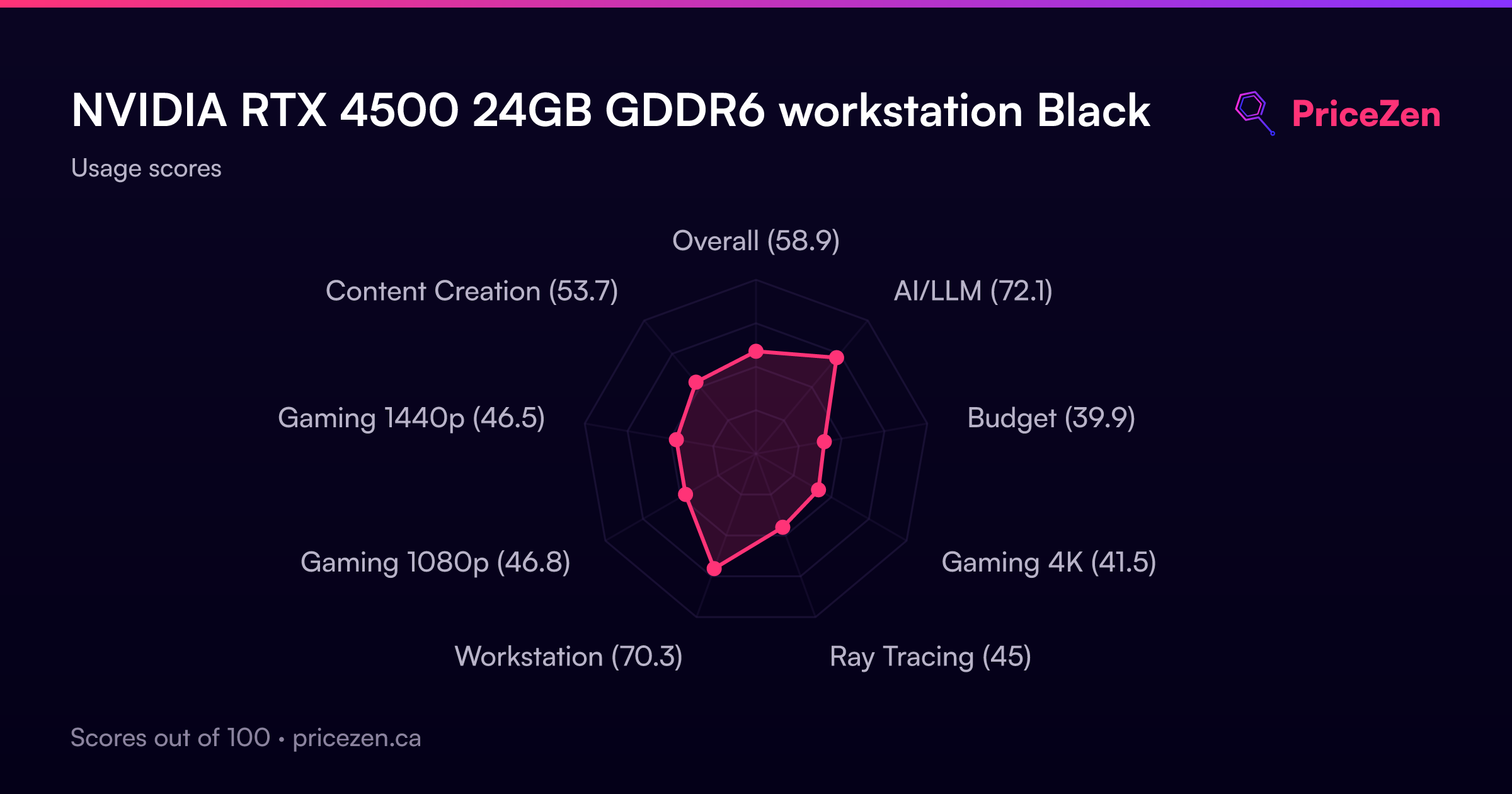
Usage Scores
- Overall58.9
- AI/LLM72.1
- Budget39.9
- Gaming 4k41.5
- Ray Tracing45
- Workstation70.3
- Gaming 1080p46.8
- Gaming 1440p46.5
- Content Creation53.7