NVIDIA GeForce RTX 3070 8GB GDDR6X
The Ampere-based RTX 3070 with 8GB of GDDR6X memory and 5888 CUDA cores delivers strong 1440p rasterization performance at a 220W TDP. Its compact 241mm dual-slot design and solid Founders Edition build quality allow it to fit easily into smaller cases. This card is best for 1440p gamers who prioritize high frame rates in traditional rendering over heavy ray tracing or AI workloads.

No current retailer price
Snapshot
The 30-Second Version
The RTX 3070 Founders Edition is still a capable 1440p card with a PassMark score of 22,099 and 448 GB/s of memory bandwidth. At $645 USD, it's overpriced for what you get, but a used unit under $400 makes sense for budget builders. The 8GB VRAM and bottom-10% thermal ranking are the main concerns. Buy it used, skip it new.
Pros & Cons
Pros
- Strong 1440p gaming performance for the price
- Efficient cooling design according to owner feedback
- PassMark score of 22,099 keeps it competitive in raster workloads
- 448 GB/s memory bandwidth handles high refresh 1440p well
- Compact 241mm length fits in most mid-tower cases
Cons
- 8GB VRAM is limiting for 4K and future titles
- Thermal performance ranks in the bottom 10% of our database
- Requires a 650W PSU, which adds cost if you're upgrading
- Ray tracing performance is just average at the 49th percentile
- AI and compute workloads fall behind newer architectures
What owners think
The Word on the Street
How owner sentiment changed over time
ExclusiveBased on when customers actually wrote their reviews - so you can see whether early praise held up.
The proof
Performance
Let's talk raw numbers. The PassMark G3D score of 22,099 puts this card in the middle of the pack for rasterization, landing at the 57th percentile overall. That's not going to set any records, but it translates to smooth 1440p gaming in most titles without needing to drop settings to potato mode. The FP32 compute figure of 15.97 TFLOPS is solid for the price bracket, though it's worth noting the card sits at the 45th percentile for compute and 37th for AI workloads. If you're doing serious machine learning or rendering work, this isn't your card.
Ray tracing is where things get interesting. The 40 RT cores put it at the 49th percentile for ray tracing performance, which is basically average. You can enable RT in games like Cyberpunk 2077 or Control, but you'll want DLSS running to keep frame rates playable. The 8GB of VRAM is the real constraint here. At the 43rd percentile for VRAM capacity, it's fine for 1080p and most 1440p titles, but newer games at 4K or with heavy texture packs will start to choke. The 448 GB/s bandwidth helps, but it can't fully compensate for the capacity ceiling.
Specifications
Full Specifications
Chipset
| GPU Chipset | GeForce RTX 3070 |
| Brand | NVIDIA |
| Architecture | Ampere |
| Class | consumer |
| Process | 8 |
Memory
| VRAM | 8 GB |
| Memory Type | GDDR6X |
| Memory Bus | 256 |
| Bandwidth | 448 |
Compute
| CUDA Cores | 5888 |
| Tensor Cores | 160 |
| RT Cores | 40 |
| Base Clock | 1500 |
| Boost Clock | 1730 |
| FP16 TFLOPS | 15.97 |
| FP32 TFLOPS | 15.97 |
Performance
| PassMark G3D | 22099 |
| GPU Compute | 11082 |
Power & Cooling
| TDP | 220 |
| Recommended PSU | 650 |
| Power Connectors | 8-Pin |
Connectivity
| Interface | PCI Express 4.0 |
| DisplayPort | 3 |
| HDMI | 1 |
| Max Displays | 4 |
| Max Resolution | 7680 x 4320 |
Physical
| Length | 241 |
| Slot Width | 2.9 |
| Form Factor | ATX |
Features
| Ray Tracing | Yes |
| DirectX | 12 |
vs Competition
The RTX 3070 sits in an awkward spot against its own siblings. The RTX 3080 beats it across the board, and owners in our sentiment data specifically call out that gap. The 3080 has more VRAM, more cores, and better ray tracing performance. If you can stretch your budget or find a good used deal, the 3080 is the better long-term buy.
Against newer cards, the story gets more complicated. The RTX 5070 Ti and RTX 5080 from the current generation absolutely demolish the 3070 in raw performance, but they also cost significantly more. The MSI Ventus RTX 5070 Ti and ASUS PRIME RTX 5080 are in a completely different price bracket. The real competition for the 3070 right now is the used market: RX 6700 XT, RTX 3060 Ti, and even the RTX 4060 Ti. The 4060 Ti has less raw bandwidth but better efficiency and newer features like DLSS 3 frame generation. It's a genuine trade-off between raw raster performance and modern feature support.
| Spec | NVIDIA GeForce RTX 3070 | ASUS GeForce RTX 5090 TUF Gaming | Gigabyte GeForce RTX 5070 Ti Eagle Ice | MSI GeForce RTX 5070 Ti Ventus 3X OC | ZOTAC GeForce RTX 5080 APOCALYPSE | Sapphire Radeon RX 7900 XTX NITRO+ |
|---|---|---|---|---|---|---|
| Chipset | GeForce RTX 3070 | GeForce RTX 5090 | GeForce RTX 5070 Ti | GeForce RTX 5070 Ti | GeForce RTX 5080 | Radeon RX 7900 XTX |
| Vram | 8GB GDDR6X | 32GB GDDR7 | 16GB GDDR7 | 16GB GDDR7 | 16GB GDDR7 | 24GB GDDR6 |
| Boost Clock Mhz | 1730 | 2407 | 2542 | 2482 | 2730 | 2680 |
| Tdp W | 220 | 575 | 300 | 300 | 360 | 339 |
| Memory Bus Bits | 256 | 512 | 256 | 256 | 256 | 384 |
| Ray Tracing | true | true | true | true | true | true |
| GPU Class | consumer | consumer | consumer | consumer | consumer | consumer |
| Compare | Compare | Compare | Compare | Compare |
| Product | AI | Rt | Vram | Raster | Compute | Feature | Thermal | User Sentiment | Efficiency | Connectivity | Affordability |
|---|---|---|---|---|---|---|---|---|---|---|---|
| NVIDIA GeForce RTX 3070 | 36.6 | 48.1 | 42.3 | 55.9 | 44.5 | 33 | 6.3 | 27.5 | 60.9 | 43.9 | 46.2 |
| ASUS GeForce RTX 5090 TUF Gaming Compare | 97.1 | 90.6 | 97.8 | 98.8 | 97.6 | 95.8 | 72.1 | 85.3 | 23.6 | 99.3 | 2.4 |
| Gigabyte GeForce RTX 5070 Ti Eagle Ice Compare | 79.3 | 88.7 | 86 | 89 | 88 | 95.8 | 91.8 | 85.3 | 71.6 | 94.1 | 27.1 |
| MSI GeForce RTX 5070 Ti Ventus 3X OC Compare | 79.3 | 92.5 | 86 | 89 | 88 | 95.8 | 91.8 | 85.3 | 71.6 | 94.1 | 23.5 |
| ZOTAC GeForce RTX 5080 APOCALYPSE Compare | 85.5 | 97.6 | 89.1 | 94.5 | 93.4 | 95.8 | 91.8 | 99.5 | 56.6 | 94.1 | 20.8 |
| Sapphire Radeon RX 7900 XTX NITRO+ Compare | 95.1 | 96.3 | 92 | 83.4 | 95.6 | 95.8 | 91.8 | 85.3 | 51.5 | 98.8 | 19 |
Price
Value & Pricing
Here's where things get tricky. The only listing we're tracking right now is $645 USD, which is a rough price for a card that launched at $499 back in 2020. The GPU market has been weird for years, and the RTX 3070 is no exception. At $645, you're dangerously close to used RTX 3080 territory, and that card beats the 3070 in pretty much every metric that matters.
Our affordability ranking puts this at the 45th percentile, which is about average for the current market. But "average" doesn't mean "good deal." If you can find one of these used for $350-400, it's a genuinely compelling option for 1440p gaming. At $645 new, you're paying a premium for scarcity rather than performance. The value proposition really depends on what you can actually find one for.
Read more
Overview
The RTX 3070 Founders Edition is one of those cards that made a lot of sense when it launched, and still holds up surprisingly well if you know what you're getting into. It's an Ampere card built on Samsung's 8nm node, packing 5888 CUDA cores, 40 RT cores, and 160 Tensor cores. The 8GB of GDDR6X on a 256-bit bus gives it 448 GB/s of memory bandwidth, which was a big deal back in 2020 and still does fine for most 1440p gaming today.
Who's this for? Someone hunting for a used or leftover card that can push high refresh 1440p without completely draining their wallet. Our database puts its 1440p gaming score at 44.2 out of 100, which sounds low until you realize we're comparing it against every GPU we track, including cards that cost three times as much. The 1080p score of 48.6 tells a similar story. It's not a chart-topper anymore, but it's far from obsolete.
The interesting thing here is the mismatch between specs and real-world sentiment. The spec sheet says 220W TDP and a 650W PSU recommendation, which is reasonable. But our thermal percentile ranking sits at a brutal 7th percentile, meaning this card runs hotter than almost everything else in our database. Meanwhile, actual owners seem pretty happy with the cooling. That gap is worth digging into.
Common Questions
Q: What power supply do I need for the RTX 3070?
NVIDIA recommends a 650W PSU for the RTX 3070 Founders Edition. The card itself draws 220W under load, but you'll want headroom for your CPU and other components. A quality 650W unit from a reputable brand will handle it fine, though a 750W gives you more breathing room for overclocking or future upgrades.
Q: Is 8GB of VRAM enough for 1440p gaming?
For most current games at 1440p, yes. The 8GB of GDDR6X with 448 GB/s of bandwidth handles high settings in the vast majority of titles. However, some newer games with heavy texture packs or ray tracing enabled can exceed 8GB, causing stuttering or texture pop-in. If you plan to keep the card for several years, the VRAM ceiling is worth considering.
Q: How does the RTX 3070 compare to the RTX 3080?
The RTX 3080 beats the 3070 in every performance metric, with more CUDA cores, more VRAM, and better ray tracing performance. The 3070 is roughly 20-25% slower in most gaming workloads. If the price difference is small, the 3080 is the better buy, but the 3070 still delivers solid 1440p performance for less money.
Q: Is the RTX 3070 good for 4K gaming?
It can handle 4K in lighter titles or with DLSS enabled, but it's not a native 4K card. The 8GB VRAM and 256-bit memory bus become bottlenecks at 4K with high settings. For a smooth 4K experience, you'd want at least an RTX 3080 or a newer card with more VRAM. The 3070 is happiest at 1440p.
Who Should Skip This
If you're planning to game at 4K or want to keep your GPU for more than a couple of years, skip the 3070. The 8GB VRAM is already a limiting factor in some 2025 titles, and that problem will only get worse. Look at a used RTX 3080, a new RTX 4070 Super, or an RX 7800 XT instead. Those cards give you more VRAM headroom and better ray tracing performance.
Content creators and AI enthusiasts should also look elsewhere. The 37th percentile AI ranking and 45th percentile compute score mean this card struggles with machine learning workloads, video encoding, and 3D rendering compared to newer options. If you're doing serious work in Blender, DaVinci Resolve, or running local LLMs, you'll want something with more VRAM and better compute performance. The RTX 4060 Ti 16GB or a used RTX 3090 would serve you much better.
Verdict
If you're building a 1440p gaming rig on a budget and you can find an RTX 3070 for under $400, it's still a solid choice. The 5888 CUDA cores and 448 GB/s of bandwidth will push high frame rates in esports titles and handle AAA games at high settings without breaking a sweat. Just don't expect to max out ray tracing or run 4K textures without hitting the VRAM wall.
For anyone spending $500 or more, look elsewhere. The 8GB VRAM is already showing its age in 2025, and the thermal performance ranking in the bottom 10% of our database is a red flag for long-term reliability. A used RTX 3080 or a new RTX 4060 Ti will serve you better in the long run. The 3070 was a great card in 2020, but time and the GPU market have moved on.
Usage Scores
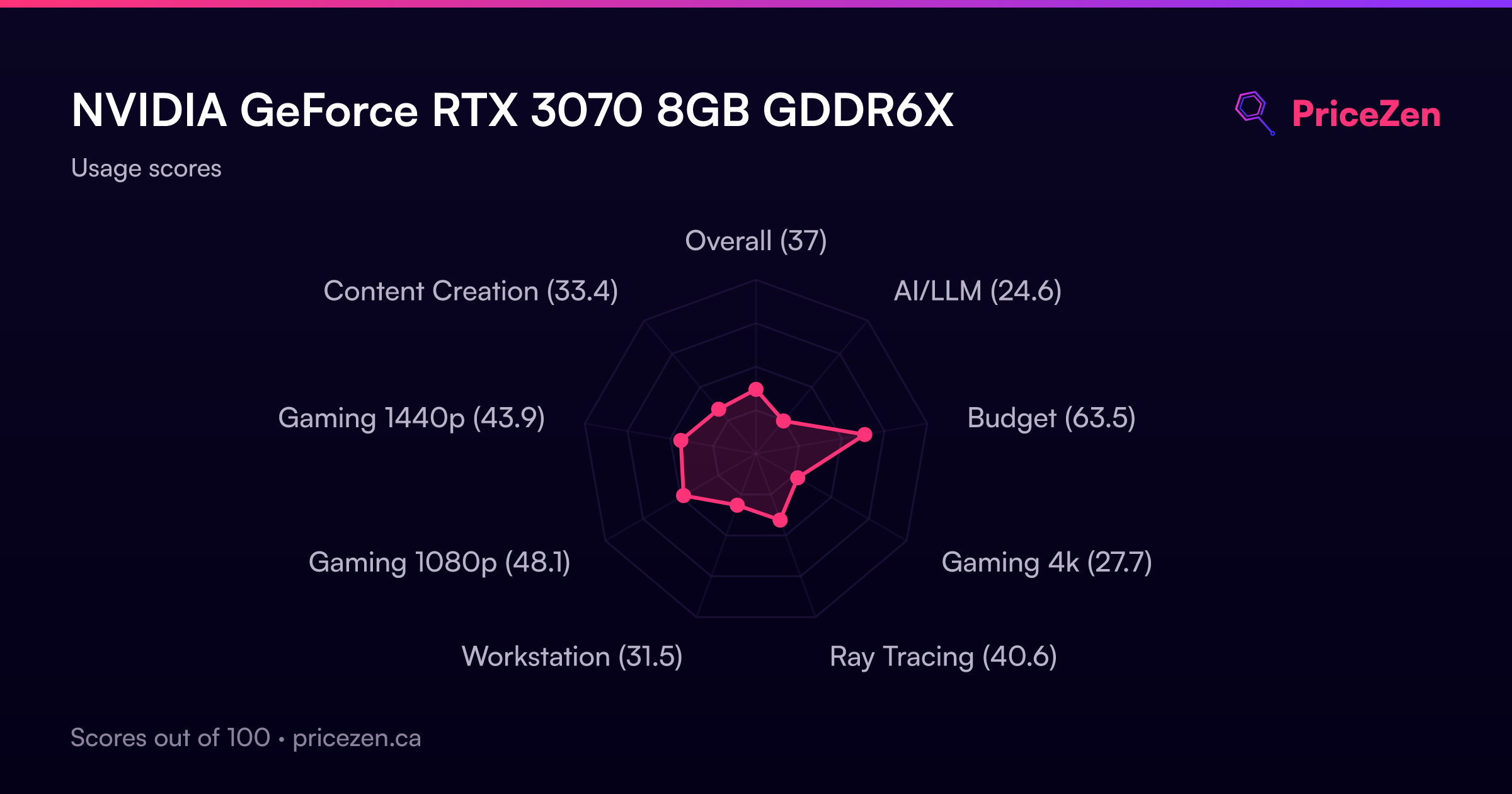
- Overall37
- AI/LLM24.6
- Budget63.5
- Gaming 4k27.7
- Ray Tracing40.6
- Workstation31.5
- Gaming 1080p48.1
- Gaming 1440p43.9
- Content Creation33.4